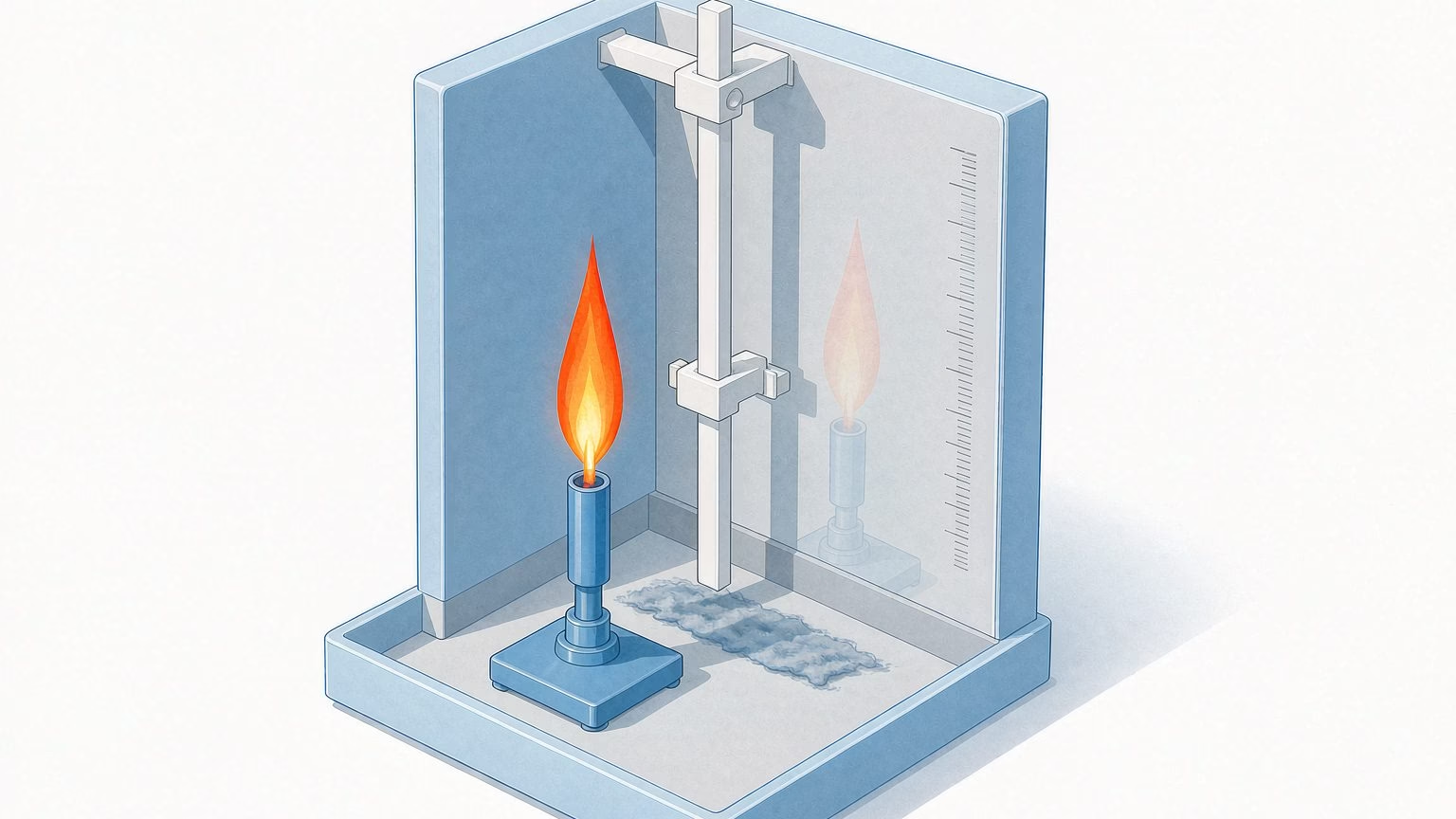
La réponse courte
ASTM E119 is not one measurement but three, taken at the same time on the same specimen: heat transmission, hot-gas transmission and load-carrying ability. The standard’s significance clause sets out exactly that — measurement of the transmission of heat, measurement of the transmission of hot gases through the specimen, and for load-bearing elements measurement of the load-carrying ability during the exposure 1. For individual load-bearing members such as beams and columns, the load-carrying measurement is made with consideration for the end support conditions, that is, restrained or not restrained [1].
That structure explains almost everything else about E119. Because the test produces three different measurements, an E119 rating is a statement about which of them a given assembly held, for how long, under a specified exposure. And because it is made on a specimen of a particular construction, the result belongs to that construction rather than to any product inside it.

What E119 Covers
The scope is written around assemblies rather than products. E119 applies to assemblies of masonry units and to composite assemblies of structural materials for buildings, including loadbearing and other walls and partitions, colonnes, girders, poutres, dalles, and composite slab and beam assemblies for floors and roofs, and to other assemblies and structural units that constitute permanent integral parts of a finished building [1].
| Élément | Covered by E119 | Note |
|---|---|---|
| Load-bearing walls and partitions | Oui [1] | Load-carrying ability is one of the three measurements |
| Non-load-bearing walls and partitions | Oui [1] | Integrity and insulation dominate the result |
| Columns, girders and beams | Oui [1] | End support conditions must be stated [1] |
| Floor and roof slabs, composite slab and beam assemblies | Oui [1] | Fire exposure from below in the usual arrangement |
| Portes | Not the E119 route | Doors have their own assembly standards |
| Windows and glazing | Not the E119 route | Window assemblies are tested under their own standards |
| Applied finishes and reaction to fire | Not this standard | That is a reaction-to-fire question, not a resistance question |
Where the scope is most often stretched
The last three rows are where most misapplication happens. E119 answers “how long does this assembly hold”, pas “how does this product react to fire”, and openings inside a rated wall are handled by their own documents rather than by E119.
Three Measurements, One Test
The measurement list in the significance clause is short and worth reading as a list of criteria rather than of instruments.
| Measurement | What it establishes | Typical instrumentation |
|---|---|---|
| Transmission of heat [1] | Whether the unexposed side stays cool enough to prevent ignition on the far side | Thermocouples on the unexposed face |
| Transmission of hot gases [1] | Whether flame or hot gas finds a path through the assembly | Observation along joints, penetrations and edges |
| Load-carrying ability, for load-bearing elements [1] | Whether the assembly keeps supporting its design load while burning | Load applied through the testing frame |
| Load-carrying ability of beams and columns, with end support conditions [1] | Whether the member survives in a restrained or unrestrained condition | Load plus the specified end restraint |
Heat transmission is the criterion people forget
An assembly can remain visually intact and still fail, because the criterion is not only whether flame appears on the cold side but whether enough heat arrives there. This is why thermocouple placement and the number of measuring points are specified rather than left to the laboratory, and why a report that gives a rating without the temperature data is harder to defend than one that includes it.
Hot-gas transmission is an integrity question
The second measurement is about paths rather than surfaces. Joints, perimeter gaps, penetrations and service openings are where hot gas gets through, and they are the reason the specimen has to be built the way the product will be built rather than the way it is easiest to assemble in a laboratory.
Load-carrying ability only exists if a load is applied
A non-load-bearing partition and a load-bearing wall can be built from similar materials and produce completely different ratings, because only one of them is carrying anything. When a supplier quotes a rating without saying whether the assembly was loaded, the number is ambiguous.
Restrained or Unrestrained: The Distinction That Changes the Rating
For beams and columns, E119 requires the load-carrying measurement to consider the end support conditions, restrained or not restrained [1]. The distinction is not a laboratory detail; it describes how the member is held in the real building, and it changes how the member behaves when it heats and tries to expand.
A restrained member is held against thermal expansion by the surrounding structure, so it develops forces it would not otherwise see. An unrestrained member is free to expand. The same steel member can therefore produce two different ratings depending on which condition is claimed, and a specification that quotes one without the other has left out the part that decides whether it applies.
This is one of the clearest differences between the North American and European traditions, and it is the reason a US submittal asks a question that a European classification does not: not only how long, but held how.
The Standard Fire Is a Specified Exposure, Not a Real Fire
E119 exposes the specimen to a standard fire controlled to achieve specified temperatures throughout a specified time period, and where required the exposure is followed by a specified standard fire hose stream applied in accordance with Practice E2226 [1]2. The standard is explicit that the exposure is not representative of all fire conditions, because conditions vary with the amount, nature and distribution of fire loading, ventilation, compartment size and configuration, and heat sink characteristics of the compartment [1].
Reading the exposure clause
That sentence is the most useful thing in the document for anyone arguing about a real building. A one-hour rating does not mean the assembly survives one hour of any fire; it means the assembly met the criteria for one hour of this exposure. The variables the standard lists are precisely the ones a fire engineer adjusts when assessing a real compartment, which is why an E119 result is an input to that assessment rather than a substitute for it.
Why a Rating Belongs to a Design, Not a Product
E119 states that it does not provide information as to the performance of test specimens constructed with components or lengths other than those tested [1]. It also warns, in the same significance clause, that variation from the test conditions or test specimen construction — size, materials, method of assembly — changes the result [1].
The practical consequence is the concept most European suppliers meet last: in the North American market a fire-resistance rating is attached to a described assembly, usually published as a design with a number, listing every component and its acceptable substitutes. The product is one line in that description. Selling a board, a fixing or an intumescent strip into that market means being inside a listed design rather than holding a test report of your own.
Our walkthrough of fire resistance testing for walls and partitions covers the specimen build in more detail; the point here is narrower — the design is the unit of claim.
The Hose Stream
E119 makes the hose stream conditional: when required, the fire exposure is followed by the application of a specified standard fire hose stream applied in accordance with Practice E2226 [1][2]. It is not part of every rating, and a report should say whether it was applied.
Two things follow. A rating that includes a hose stream is a stronger statement about mechanical robustness after heating than one that does not. And a project that requires the hose stream but receives a report that does not mention it has a gap that no amount of reading the rating will close.
What the Report Will Not Tell You
E119 lists three exclusions in its significance clause, and they are worth memorising because each one maps to a question buyers ask anyway [1].
| Exclusion | The question it leaves open |
|---|---|
| Performance of specimens built with components or lengths other than those tested [1] | Can I use this design at a different height, span or board thickness? |
| Contribution to fire hazard through smoke, toxic gases or other products of combustion [1] | Is the smoke from this assembly acceptable? |
| Degree of control of smoke or products of combustion passing through the assembly [1] | Does this assembly leak smoke? |
There is a fourth statement that belongs with them. E119 says classifications register comparative performance to specific fire-test conditions during the period of exposure, and shall not be construed as having determined suitability under other conditions or for use after fire exposure [1]. A rated assembly is not certified as repairable, and a building that has had a fire needs an engineering assessment rather than a rereading of the rating.
Reading an E119 Report: The Fields That Matter
| Field | Why it decides whether the rating applies to your project |
|---|---|
| Assembly description and design reference | The rating attaches to this, not to a product [1] |
| Element type | Wall, partition, column, faisceau, slab and roof behave differently [1] |
| Loaded or unloaded | Only a loaded assembly has a load-carrying result [1] |
| Restrained or unrestrained | Applies to beams and columns and changes the outcome [1] |
| Exposure duration achieved | The number that gets quoted, and the least informative on its own |
| Hose stream applied or not | A stronger or weaker statement about post-heating robustness [1][2] |
| Whether the exposure held to the specified temperatures | Whether the run is usable at all [1] |
| Components and permissible substitutions | The list that decides whether your product is inside the design [1] |
The three fields that decide usability
If a report cannot answer the third, fourth and eighth rows, it is not yet a document that a specifier can use, however impressive the first number looks.
E119 and the Rest of the World
In North America, UL 263 carries the same test work under UL’s own designation for fire tests of building construction and materials, and NFPA 251 is the NFPA counterpart 34. A laboratory often reports to E119 and lists to UL 263, which is why a single test can produce two document references.
Two designations, one test run
In Europe the equivalent role is played by the EN 1363 series for the exposure and by EN 13501-2 for the classification, and the vocabulary shifts from a rating attached to a design to a classification expressed as letters and minutes. The two systems are not convertible: they differ in specimen preparation, in instrumentation, in how restraint is handled and in what the resulting document claims. A project that needs both markets needs both tests, and our note on fire rating versus fire resistance rating covers the terminology trap that catches people first.
Equipment
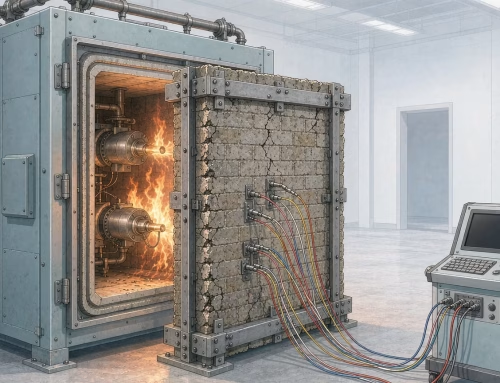
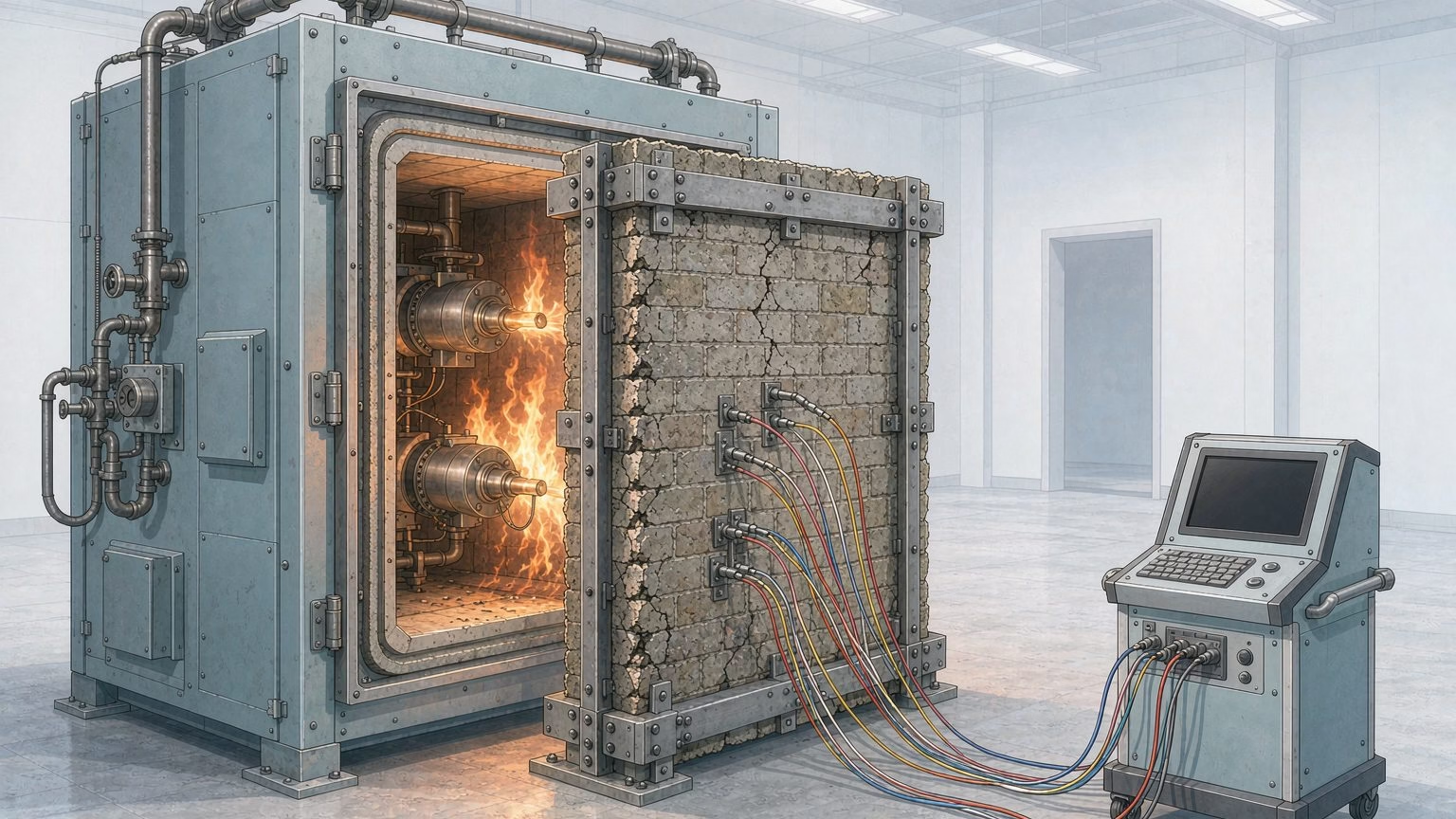
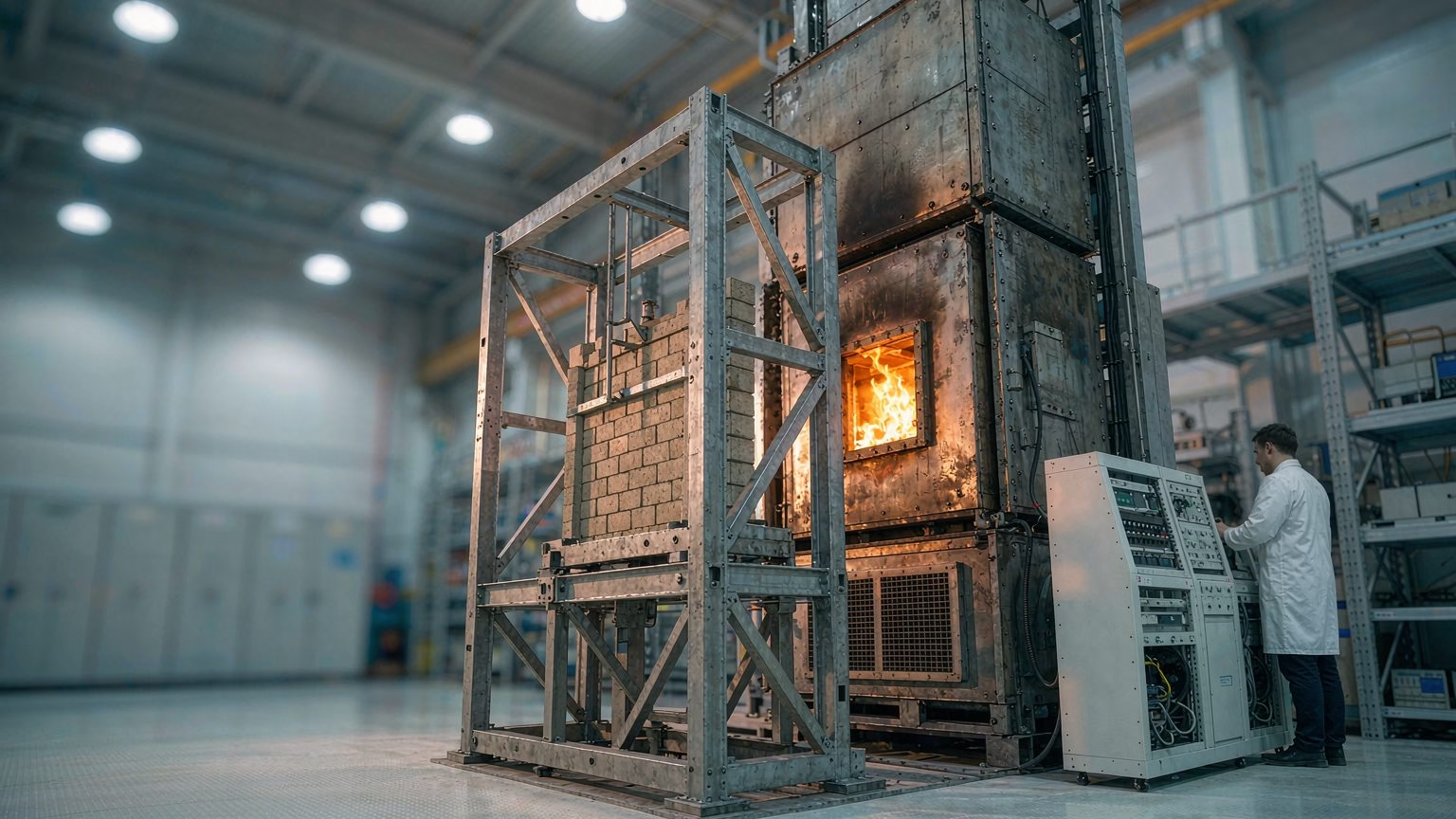
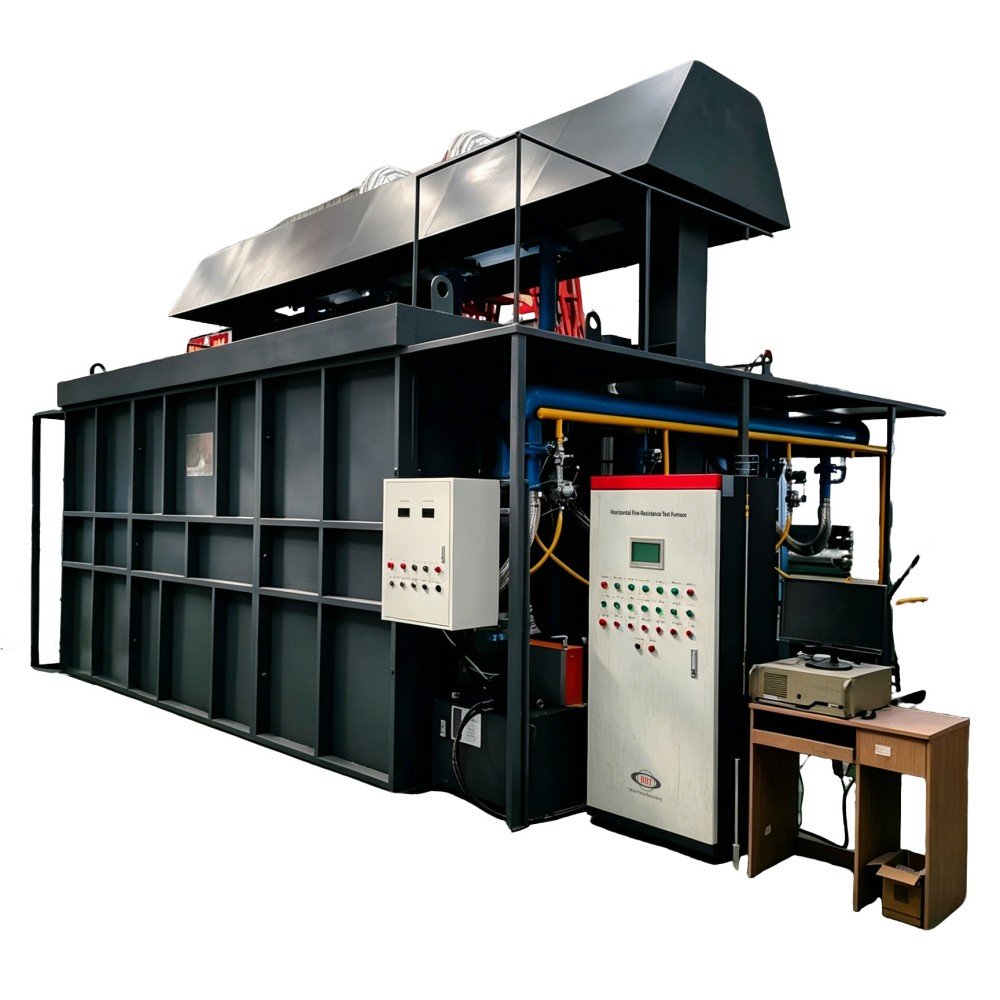
An E119 programme needs a furnace sized for the element, a loading frame if the assembly is load-bearing, and instrumentation that records furnace temperature, unexposed-face temperature and integrity observations on the same time base. BRT’s vertical integrated fire resistance test furnace carries wall and partition specimens, et le horizontal fire resistance test furnace carries floor and roof assemblies.
Foire aux questions
What does ASTM E119 actually measure?
Three things in one exposure: the transmission of heat through the specimen, the transmission of hot gases through it, and for load-bearing elements the load-carrying ability during the test. For beams and columns the load-carrying measurement is made with consideration for the end support conditions, restrained or not restrained.
What is the difference between a restrained and an unrestrained assembly?
It describes how the member is held at its ends in the real building. A restrained member is held against thermal expansion and develops forces it would not otherwise see, while an unrestrained member is free to expand. The same member can produce two different ratings depending on which condition is claimed, which is why E119 requires the condition to be considered.
Does a one-hour E119 rating mean one hour in any fire?
Non. E119 exposes the specimen to a standard fire controlled to achieve specified temperatures, and states that the exposure is not representative of all fire conditions because those vary with fire loading, ventilation, compartment size and configuration, and heat sink characteristics. The rating is a relative measure under that exposure.
Can I use an E119-rated design with a different board thickness or a different stud?
Not without checking the design. E119 states that it does not provide information as to the performance of specimens constructed with components or lengths other than those tested, and warns that variation in size, materials or method of assembly changes the result. The listed design names the components and the permissible substitutions.
Is the hose stream always part of an E119 test?
Non. The standard makes it conditional: when required, the fire exposure is followed by a hose stream applied in accordance with Practice E2226. A report should state whether it was applied, because a rating that includes it is a stronger statement about robustness after heating.
Does the rating cover smoke?
Non. E119 states that it does not evaluate the degree by which the specimen contributes to the fire hazard through smoke, toxic gases or other products of combustion, and does not measure the degree of control of smoke passing through the assembly. Smoke leakage is a separate test.
Est-ce qu'UL 263 the same as ASTM E119?
They cover the same test work under different designations, which is why a single laboratory run often appears in both an ASTM test report and a UL listing document. NFPA 251 is the NFPA counterpart. For a submittal, check which designation the authority having jurisdiction expects to see.
Conclusion: Five Questions Before You Quote a Rating
- Which element type? Wall, partition, column, faisceau, slab or roof — each is treated separately in the scope [1].
- Loaded or unloaded? Only a loaded assembly has a load-carrying result, and only a loaded assembly can support a load-bearing claim [1].
- Restrained or unrestrained? For beams and columns this decides which of two different results applies [1].
- Was the hose stream applied? The report should say so, and the project should know whether it needs it [1][2].
- Which design does the rating belong to? The assembly description and its permissible substitutions decide whether your product is inside the claim [1].
If you are preparing an E119 programme and need to match a furnace and a loading arrangement to the element you are rating, send BRT the assembly details and we will map it to a test configuration.
Written by the BRT fire testing applications team, Shenyang Baoruitong Automation Equipment Co., Ltée. Portée, significance and limitation statements are quoted from ASTM E119 as published; no numerical acceptance criteria are reproduced because they belong to the standard itself.
Sources
- ASTM International — E119 Standard Test Methods for Fire Tests of Building Construction and Materials — https://store.astm.org/e119.html
- ASTM International — E2226 Standard Practice for Application of Hose Stream — https://store.astm.org/e2226.html
- UL Standards & Engagement — UL 263 Fire Tests of Building Construction and Materials, Edition 14 — https://www.shopulstandards.com/ProductDetail.aspx?productId=UL263
- National Fire Protection Association — NFPA 251 Standard Methods of Tests of Fire Resistance of Building Construction and Materials — https://www.nfpa.org/codes-and-standards/nfpa-251-standard-development/251