A resposta curta
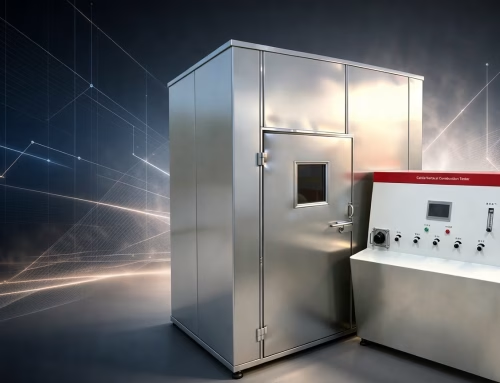
The smoke class on a datasheet says nothing about what is in the smoke. Smoke toxicity testing measures which gases fire effluents contain and in what amounts — not how opaque the smoke is. For building materials the workhorse is the ISO 5659 câmara de fumaça: specimens are exposed at 25 ou 50 kW/m² radiance, and when toxicity is required the effluent is pulled through an Analisador de gás FTIR that quantifies CO, CO₂, HCl, HBr, HCN, HF, SO₂, NOₓ and formaldehyde, among others 1. Those concentrations are then converted into hazard metrics — a fractional effective dose (FED) — under the frameworks of ISO 13344 e ISO 13571 23. Rail, marine and airport specifications drive most building-sector toxicity testing; general construction product classes in Europe do not yet carry a toxicity class, which is precisely the gap this article explains.
Toxicity Is Not Smoke Density — and the Euroclasses Only Cover Density
The most common specification error is treating the smoke class as a toxicity claim. Em EM 13501-1, the European reaction-to-fire classification, the additional smoke classes s1, s2, s3 describe light obscuration (smoke production) measured in the SBI test, e d0, d1, d2 describe flaming droplets 4. Nothing in that system measures what the smoke is made of. A product can hold the best smoke class, s1, and still release dangerous concentrations of hydrogen cyanide or hydrogen chloride when it burns.
The two measurements also use different physics. Smoke density testing — covered in detail in why smoke production matters in fire testing — watches a light beam dim as particles accumulate in a chamber. Toxicity testing analyses the chemical composition of the same kind of fire effluent, because it is the gas molecules, not the particles, that incapacitate and kill. Buyers specifying “low smoke” materials for occupied spaces should confirm whether the requirement is optical (s classes, or a smoke density rating) or chemical (toxicity data) — the test equipment differs.
| Aspect | Smoke density testing | Smoke toxicity testing |
|---|---|---|
| What is measured | Light obscuration by smoke particles | Gas species and concentrations |
| Typical result | Ds values / s1–s3 class | ppm concentrations, yields, FED/FEC or CIT |
| Governing methods | ISO 5659 opacity reading, EM 13823 SBI | ISO 5659 chamber + FTIR gas analysis [1] |
| Classification home | EM 13501-1 s classes [4] | No Euroclass; sector specs (rail EN 45545-2 etc.) 6 |
| Typical question answered | Will occupants see an escape route? | Will the smoke incapacitate occupants? |
The Primary Method: ISO 5659 with FTIR Gas Analysis
How the specimen is burned
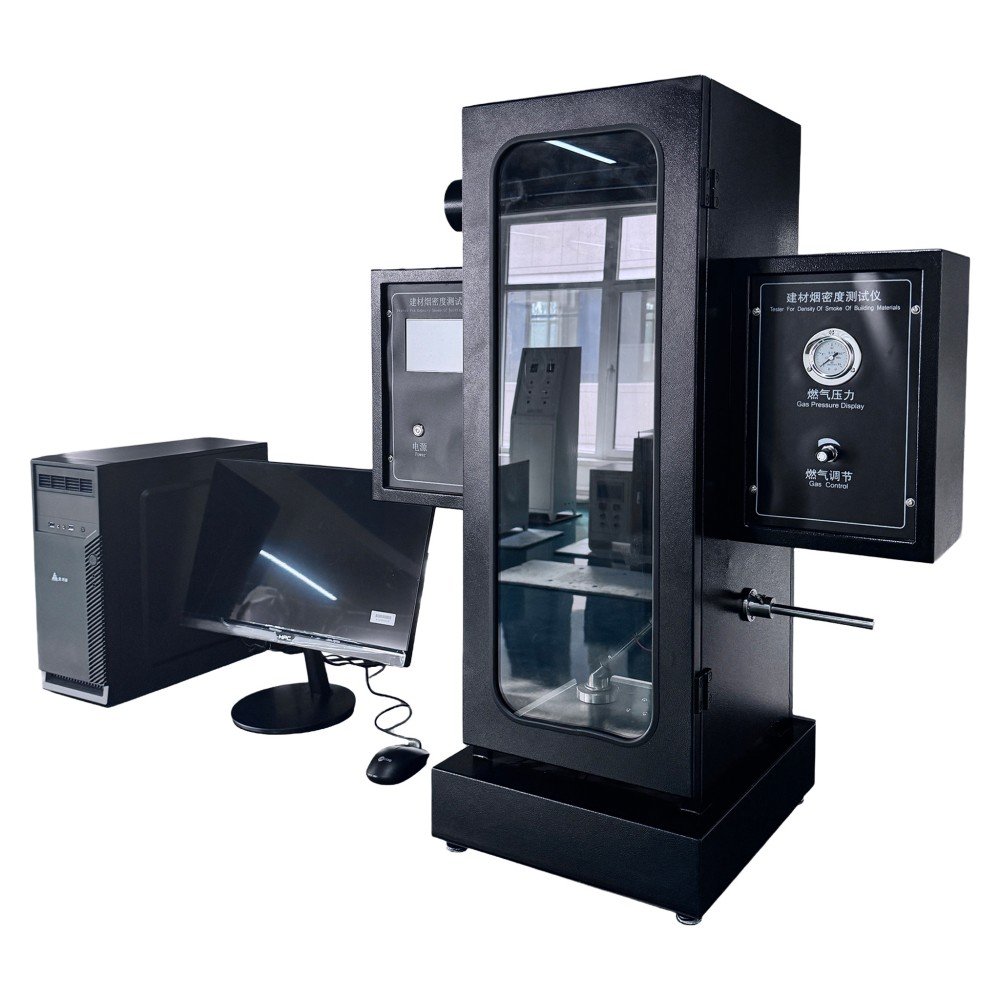
The method formerly published as ISO 5659-2:2017 was withdrawn on 27 Janeiro 2026 and renumbered — the current document is ISO 5659:2026 [1]5. It specifies smoke production from the exposed surface of specimens of materials or composites: flat specimens no more than 25 mm thick are exposed in the chamber at a set radiant heat flux, with the standard exposure levels being 25 kW/m² for all materials and 50 kW/m² when a higher-flux condition is specified. Specimens may be tested with or without pilot flame ignition depending on the specification.
The exposure choice is not decorative — it changes which chemistry the specimen passes through. At the lower flux with pilot ignition, a material smoulders and flames gently, favouring incomplete-combustion products such as carbon monoxide. No 50 kW/m² without a pilot flame, the specimen pyrolyses hard, and halogenated or nitrogen-bearing polymers release their acid and cyanide gases at very different rates. This is why specifications fix the exposure mode precisely, and why a laboratory asked to “run the toxicity test” without a named exposure should refuse to guess: the same material at the two conditions can produce qualitatively different gas profiles.
Which gases are analysed
When a toxicity requirement sits behind the smoke test, the chamber effluent is sampled through an FTIR spectrometer that reads the infrared absorption spectrum continuously and quantifies the toxicologically relevant gas set. Rail specifications built on EN 45545-2 made this arrangement famous: the gas concentrations feed a conventional toxicity index (CIT) that must stay below limits set by hazard level. O 2020 edição de EN 45545-2 was itself withdrawn on 11 outubro 2023, and UNI does not yet list a successor edition — labs working to rail specs should confirm the applicable edition with their assessment body (待确认) [6].
O 2026 renumbering is a live documentation issue
Any current datasheet or test report still citing ISO 5659-2 is citing a withdrawn edition. The scope and method carried over into ISO 5659:2026 with the same 25/50 kW/m² exposure structure [1], but procurement documents, QA procedures and published data should be updated to the new designation — the same housekeeping many laboratories had to do when other part-numbered standards were renumbered.
From Gas Concentrations to Hazard: the FED Framework
Raw gas concentrations do not compare directly with each other; 1,000 ppm of CO and 50 ppm of HCN do not carry the same weight. Two ISO documents supply the conversion:
- ISO 13344:2015 describes the estimation of lethal toxic potency of fire effluents from analytical data — the earlier, potency-based approach built around LC₅₀-style dose modelling [2].
- ISO 13571:2012 provides the guidance on assessing hazards to life from fire effluents, introducing the fractional effective dose (FED) e fractional effective concentration (FEC) approach: each gas contributes a fraction of an incapacitating dose, and the fractions are summed. The FED for the asphyxiant gases (CO, HCN) and the FEC for the irritant gases (HCl, HBr, HF, SO₂, NOₓ, acrolein, formaldehyde) are the two sums that matter [3].
Product specifications use these models differently — some cap individual gas yields per mass of specimen, others require the FED of the exhaust sample to stay under a threshold — but all of them trace back to the same measured gas concentrations, which is why the FTIR chain, not the chamber alone, is the deliverable that matters in toxicity work.
The gases divide into two functional groups, and the two sums treat them differently:
| Group | Principal gases | Behaviour | Role in the models |
|---|---|---|---|
| Asphyxiants | CO, HCN | Reduce the blood’s oxygen delivery; HCN output rises with nitrogen chemistry in the material | Sum into the FED — the incapacitation dose [3] |
| Irritants | HCl, HBr, HF, SO₂, NOₓ, acrolein, formaldehyde | Impair breathing and vision, slowing escape even below incapacitating levels | Sum into the FEC — the escape-impairment concentration [3] |
| Fundo | CO₂ | Drives ventilation rate and deepens breathing | Modifies uptake of the asphyxiants [3] |
Two practical notes follow from the grouping. Primeiro, carbon monoxide dominates most building-material FED sums, but materials with high nitrogen content — certain polyurethanes and polyamides — can shift the balance toward HCN, which is why the material’s chemistry, not just its “plástico” label, predicts its toxicity profile. Segundo, irritant gases matter most in the early minutes of an escape; a material that emits low irritant concentrations buys evacuation time even when its asphyxiant yields are not zero.
Inside the FTIR Measurement Chain
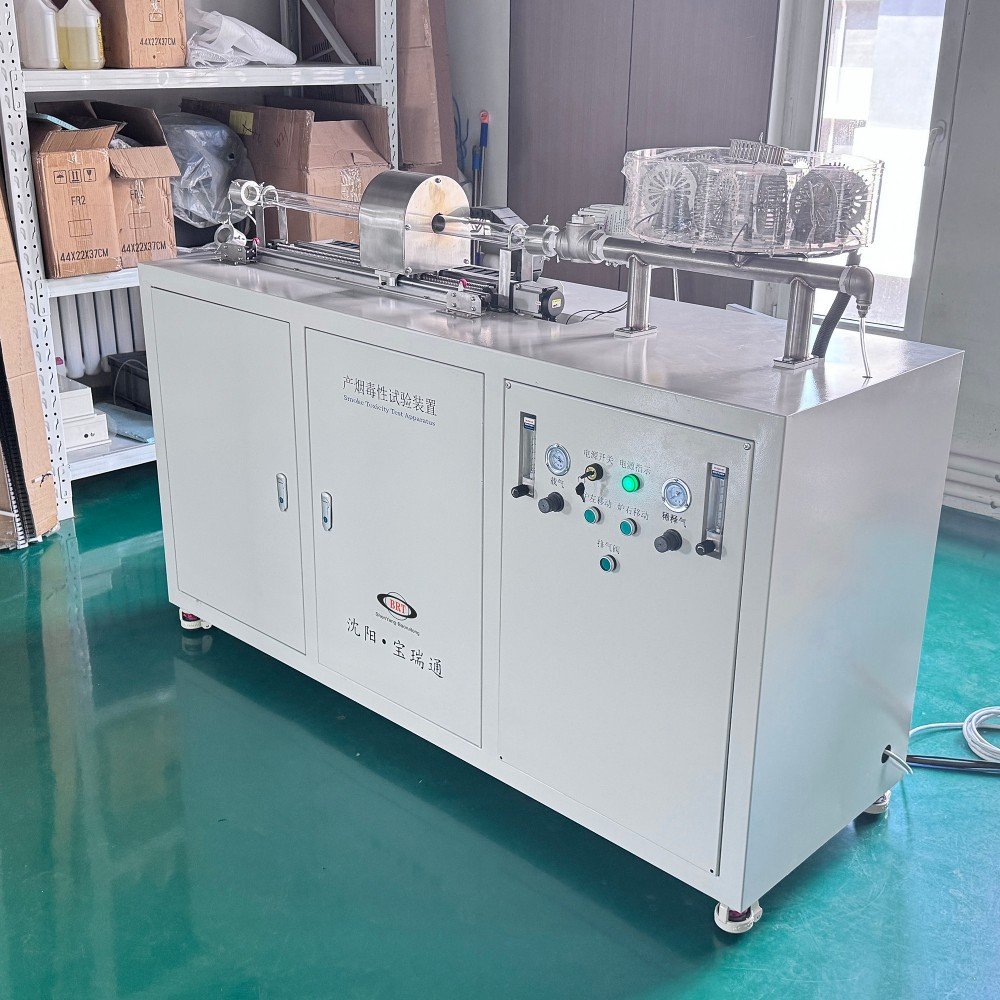
The analyser is the part of a toxicity chain that decides data quality. Chamber effluent is drawn through a heated sampling line into an FTIR cell — heated to prevent condensation of acids and water vapour that would otherwise remove exactly the gases being measured. Inside the cell, the spectrometer records infrared absorption spectra continuously, and a spectral library fits each scan to quantify the regulated species simultaneously. The alternative — discrete electrochemical sensors per gas — cannot keep up with the species list or the dynamic range a burning polymer produces, which is why FTIR became the default for fire effluent analysis.
Calibration closes the chain: the analyser needs valid calibration spectra for every gas it reports, and laboratories verify the sampling path — line temperature, filter condition, cell windows — before a campaign, because a cold spot in the line silently deletes HCl and HF from the results. When comparing laboratories or auditing reports, the analyser specification and calibration status are the first things to check after the standard edition.
Where Building-Sector Toxicity Requirements Actually Appear
Outside rail, toxicity requirements reach building materials unevenly:
- Railway vehicles — EN 45545-2 hazard levels set CIT-type limits for interior materials; this is the largest established demand [6].
- Cables — the construction product standard for cables (EM 50575) adds smoke classes to the Euroclass but toxicity remains outside the CE-marking classes; some project specifications add gas-analysis requirements contractually (待确认 per project).
- Airports, tunnels and marine installations — typically through project or operator specifications referencing ISO 5659 gas analysis directly.
- General building products — no toxicity class exists in EN 13501-1; manufacturers provide voluntary data, often from the same ISO 5659 + FTIR arrangement [1][4].
The pattern to note: where people are trapped (trains, tunnels, ships), toxicity is regulated; where escape is assumed, opacity and heat release dominate. Laboratories serving both markets therefore keep a smoke density chamber and a toxicity-capable gas-analysis chain side by side — see the difference on the building materials smoke density tester e smoke toxicity test equipment product pages.
| Sector | How toxicity enters the specification | Status a buyer should verify |
|---|---|---|
| Railway vehicles | EM 45545-2 hazard levels with gas-analysis limits | 2020 edition withdrawn Oct 2023; successor not yet listed on UNI — confirm applicable edition (待确认) [6] |
| Cables | Smoke classes via EN 50575; toxicity only by contract | No Euroclass toxicity — check project documents |
| Tunnels, airports, marinho | Operator or project specs citing ISO 5659 gas analysis directly | Flux level and hazard model vary by project [1][2][3] |
| General building products | None in EN 13501-1 | Voluntary data only [4] |
Reading a Toxicity Report Without Being Misled
Toxicity reports accumulate a specific set of pitfalls, and most of them are visible on the first page:
- A withdrawn edition cited as the basis. Reports still naming ISO 5659-2 predate the January 2026 renumbering [5]; the data may be usable, but the document reference must be mapped to ISO 5659:2026 before it enters a current approval file [1].
- Concentrations quoted without the exposure. A ppm figure means nothing without the heat flux, ignition mode and specimen thickness that produced it [1].
- ppm and yield mixed up. ppm is a chamber concentration; yield (mg per gram of specimen) normalises to the material. Specifications use one or the other, and mixing them is a classic procurement error.
- The hazard model left unstated. “FED = 0.4” is only interpretable once the model (ISO 13344 potency or ISO 13571 FED/FEC) and its inputs are named [2][3].
- Analyser conditions missing. Sampling-line temperature and calibration status determine whether acid gases were measured at all; a report silent on the FTIR chain is incomplete.
What a Toxicity Test Report Should Contain
A usable report lets the reader trace every number to a condition:
- the standard designation and edition — pre-2026 reports citing ISO 5659-2 should be mapped to the renumbered document [1][5];
- exposure mode: heat flux level (25/50 kW/m²), pilot or non-pilot ignition, specimen orientation and thickness [1];
- gas list with concentrations in ppm and yields in mg/g of specimen;
- the hazard model applied (ISO 13344 potency or ISO 13571 FED/FEC) and its inputs [2][3];
- for rail work, the CIT value and the hazard level it was evaluated against [6].
Perguntas frequentes
What is smoke toxicity testing?
Smoke toxicity testing analyses which toxic gases a material releases as it burns and in what quantities. Typically a specimen is burned in a smoke chamber such as ISO 5659 at a set radiant heat flux, and the effluent is analysed with an FTIR spectrometer for gases including CO, CO₂, HCl, HCN, HF, SO₂ and NOₓ. The concentrations are converted into hazard metrics such as a fractional effective dose to judge whether the smoke could incapacitate occupants.
Is smoke toxicity the same as smoke density?
Não. Smoke density measures how much visible smoke a fire produces — light obscuration in a chamber, classified in Europe as the s1 to s3 classes of EN 13501-1. Smoke toxicity measures the chemical composition of the smoke — gas species and concentrations analysed by FTIR. A material can be low-smoke and still release hazardous gas concentrations, so the two requirements must be specified and tested separately.
Which standard is used for smoke toxicity testing?
The smoke generation step uses ISO 5659:2026, which replaced the withdrawn ISO 5659-2:2017 on 27 Janeiro 2026, exposing flat specimens at 25 ou 50 kW/m². Gas analysis is added through FTIR sampling of the chamber effluent, and hazard assessment follows ISO 13344 for toxic potency or ISO 13571 for the FED/FEC framework. Rail applications additionally apply the EN 45545-2 toxicity index requirements.
What is FED in fire toxicity?
FED stands for fractional effective dose. It is a hazard model in which each asphyxiant gas contributes a fraction of the dose that would incapacitate an average person, and the fractions are summed during the exposure. If the FED reaches one, incapacitation is predicted. ISO 13571 provides the guidance, with a parallel fractional effective concentration (FEC) sum covering irritant gases that impair escape rather than cause unconsciousness.
Why did ISO 5659-2 become ISO 5659?
ISO renumbered the document when the 2026 edition was published on 27 Janeiro 2026: the withdrawn ISO 5659-2:2017 was replaced by ISO 5659:2026 as a renumbered edition with the same scope of measuring smoke production from exposed surfaces of materials and composites. The practical consequence is documentary: test reports, datasheets and QA files citing ISO 5659-2 should be updated to cite ISO 5659:2026.
Do building codes require smoke toxicity testing?
Generally not for ordinary construction products in Europe: EM 13501-1 has smoke production and droplet classes but no toxicity class. Requirements concentrate where occupants cannot escape quickly — railway interiors under EN 45545-2, tunnels, marine and airport projects — through operator or project specifications. Some buyers add contractual toxicity limits for cables and interiors even where no product standard mandates them.
What equipment does a toxicity-capable laboratory need?
A smoke chamber meeting ISO 5659 with a calibrated radiant heater and specimen holders, an FTIR gas analyser with the heated sampling line and gas library for the regulated species, and software implementing the ISO 13344 ou ISO 13571 hazard calculations. Laboratories serving density-based specifications also keep a dedicated smoke density chamber, because the two tests answer different questions.
Conclusão: A Decision Order
Specifying or buying toxicity testing reduces to four questions:
- Is the requirement optical or chemical — density classes or gas data? [4]
- Which edition applies — cite ISO 5659:2026, not the withdrawn 5659-2 [1][5].
- Qual hazard model does the spec use — potency or FED/FEC [2][3]?
- Qual sector rules sit on top — rail CIT limits, project-specific caps [6]?
One habit makes every downstream step cheaper: treat the report as a traceability document, not a certificate. Edition, exposure mode, gas list, model and analyser calibration are the five things a reviewer will ask for first; a laboratory that records them as standard practice turns each new approval into a formality, while a report missing any one of them becomes a re-test. Fire effluent toxicity is a fast-moving corner of fire science — the renumbering of ISO 5659 em 2026 is the latest evidence — and documentation discipline is what keeps old data usable when designations change.
BRT Testing supplies the full chain: o smoke toxicity test equipment page covers the gas-analysis route, o building materials smoke density tester page the opacity route, e o SBI test apparatus page the EN 13501-1 s/d classification source. Contact us to match the configuration to your specification.
About the Author
Teste de BRT (Shenyang Baoruitong Automation Equipment) manufactures smoke density and smoke toxicity test equipment, SBI apparatus and fire test instrumentation for construction-product and rail-interior laboratories. The content team writes from the instrument side: chamber control, FTIR sampling and the hazard-model calculations that turn gas concentrations into specification numbers. The standard-status facts above were verified against UNI catalogue entries in November 2026.
Fontes
- SONO - GRANDE 5659:2026 (Status CURRENT, 27 Jan 2026) - https://webstore.uni.com/en/iso-5659-2026
- SONO - GRANDE 13344:2015 (Status CURRENT, 01 Dec 2015) - https://webstore.uni.com/en/iso-13344-2015
- SONO - GRANDE 13571:2012 (Status CURRENT, 12 Sep 2012) - https://webstore.uni.com/en/iso-13571-2012
- UNI—EN 13501-1:2018 (Status CURRENT, 19 Dec 2018) - https://webstore.uni.com/en/en-13501-1-2018
- SONO - GRANDE 5659-2:2017 (Status WITHDRAWN AND REPLACED, 27 Jan 2026) - https://webstore.uni.com/en/iso-5659-2-2017
- UNI—EN 45545-2:2020 (Status WITHDRAWN, 11 Oct 2023) - https://webstore.uni.com/en/en-45545-2-2020