Buy fire testing equipment in the order your classification route demands, not the order the catalogue presents it. Fire testing equipment for construction materials falls into three tiers — bench instruments, facility rigs and full furnaces — and almost nobody should buy them in that order on day one. Two things set the list: the market whose rules you have to satisfy, and the euroclass or rating you have to reach. Most board, insulation and flooring makers can run the ignitability and heat-of-combustion layers in-house from the first day; the single burning item rig is the real dividing line; and full fire-resistance furnaces almost always stay with a third-party laboratory unless your product is itself an assembly. Getting that sequence wrong is expensive in both directions — manufacturers routinely buy a bench they cannot yet use, or commission a furnace for a test their product will never need.
What You Are Actually Buying
A Classification Capability, Not a Machine
An furnace does not produce a euroclass. A chain of tests does, and the machine buys you one link in that chain. Under the European system, the class you declare is assembled from several test results — non-combustibility, calorific value, single burning item behaviour, and small-flame ignitability — each drawn from a different standard 1234. The practical consequence is that the value of any single instrument depends entirely on whether the other links in the chain are available to you, whether in-house or at a partner laboratory.
This is why specification should start from the classification rather than from the equipment. Write the class you need on one side of the page and the test route that produces it on the other, and only then look at which instruments you could own. Everything else — extraction, floor loading, operator training, verification intervals — follows from that list.
Two Questions Set the List Before Anything Else
O market decides which vocabulary applies: EM 13501-1 and its euroclasses for products placed on the European market, ASTM E84 with its flame spread and smoke developed indices for the United States, and the GB regime for China. Several markets require more than one. O target class then decides which tests sit behind it, and each of those tests has its own apparatus. A product targeting A1 needs different equipment from one targeting D, even though both are sold into the same market.
Answering those two questions before you speak to any vendor shortens every subsequent conversation. It also prevents the most common procurement error in this field, which is buying the instrument associated with the highest class you aspire to rather than the one associated with the class you actually need to declare. A manufacturer of insulation boards does not need the non-combustibility furnace that a stone wool producer needs, even though both sell into construction, because the two products reach their declared classes by different routes.
Your Product Family Decides the Test Route
The same European framework routes different construction products through entirely different test programmes, and the differences show up in your equipment list.
| Product family | Typical European target | Tests behind the class | Equipment implied |
|---|---|---|---|
| Inorganic boards, stone wool, plasterboard | A1 or A2 | Non-combustibility [1] plus gross calorific value [2], with SBI added for A2 [3] | Non-combustibility furnace; calorímetro de bomba; SBI rig later |
| Insulation boards and sandwich panels | B, C or D | Single burning item [3] plus small-flame ignitability 5 | Aparelho SBI; single-flame source bench |
| Flooring products | Bfl–Ffl | Radiant panel ignitability plus small flame, with fl subscripts | Radiant flux/panel tester; small-flame bench |
| Timber and treated timber products | B–D | SBI plus small flame; some routes use heat release 6 | SBI rig; cone calorimeter for development |
| Coatings applied to substrates | Varies with the substrate rule | Usually tested as part of the assembly rather than alone | Small-flame bench plus the assembly test method |
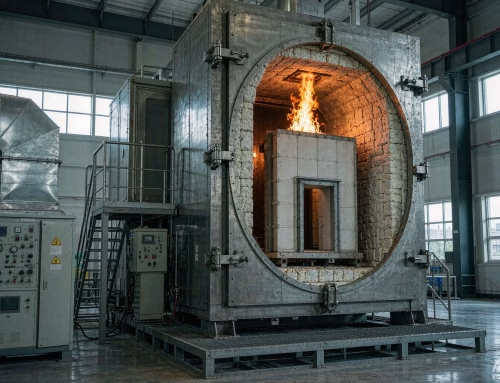
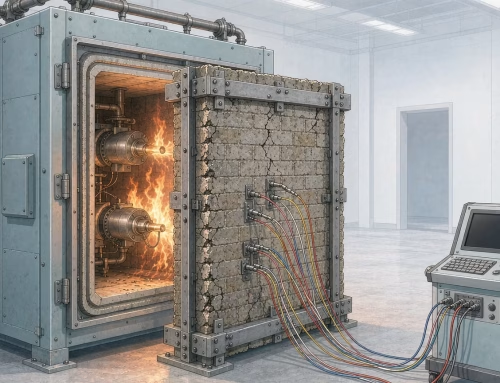
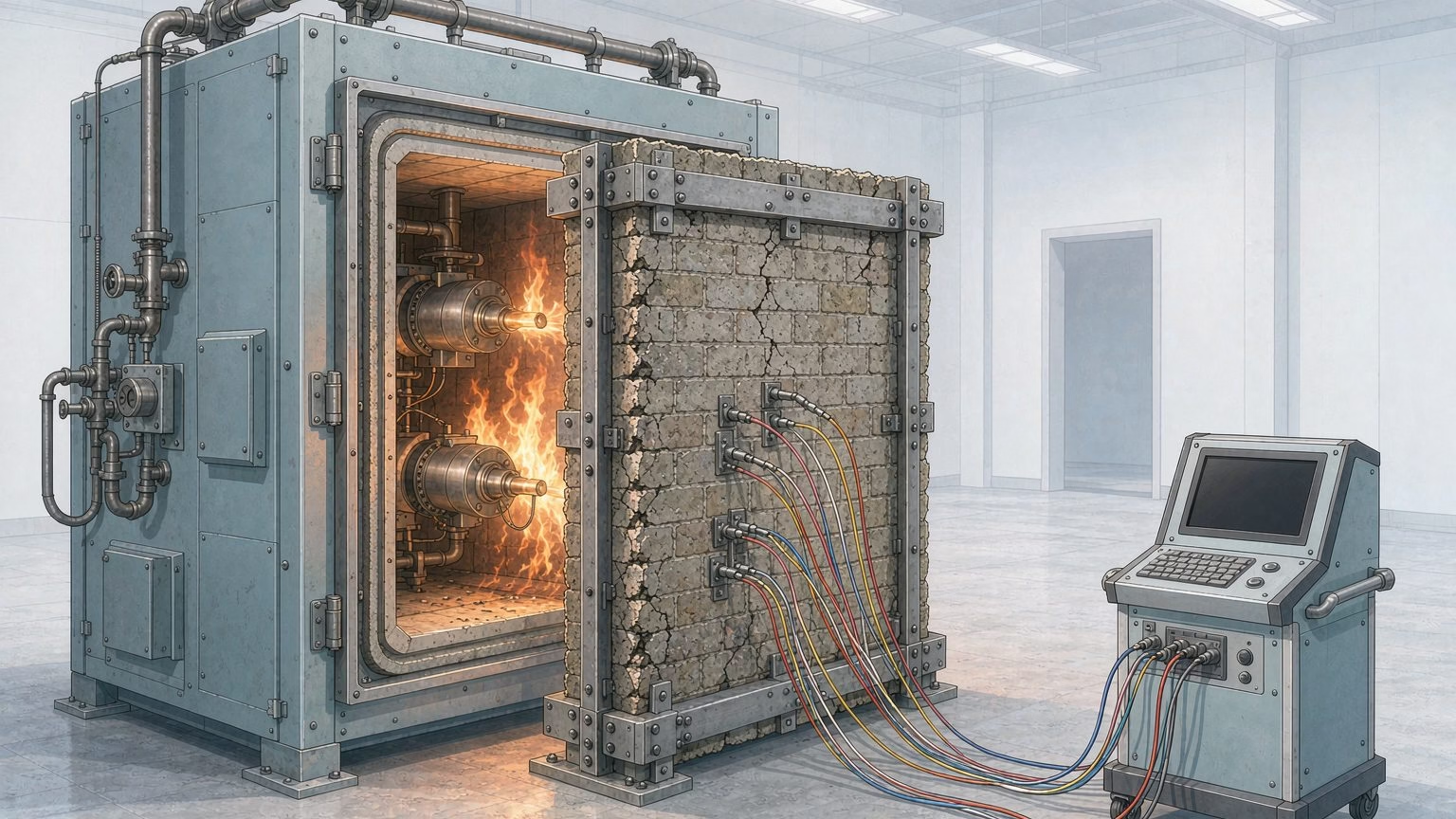
| Wall and floor assemblies, doors | Fire resistance ratings rather than reaction to fire | Furnace exposure to a standard time-temperature curve 7 | Large fire resistance furnace — usually outsourced |
Read the table from left to right, and the purchase list writes itself. Note also what the bottom two rows say: once your product é an assembly rather than a material, you have left reaction-to-fire testing entirely and entered fire resistance testing, which is a different family of equipment and a different family of standard 8.
The Entry Layer: Fire Testing Equipment for Construction Materials Everyone Can Own
Whatever else you eventually buy, two benches are within reach of most manufacturers and deliver most of the early value. O single-flame source test applies a small, match-sized flame directly to a vertically oriented specimen and observes ignition and flame spread [5]. Its apparatus is a bench-sized unit with a defined burner, a specimen clamp and an indicator layer beneath — a building material combustibility test apparatus is built for exactly this role. O non-combustibility furnace exposes small cylindrical specimens to a stabilised furnace temperature and measures temperature rise, mass loss and flaming duration [1]; the corresponding ISO 1182 non-combustibility apparatus is a vertical tube furnace with its own thermocouple set and specimen insertion mechanism.
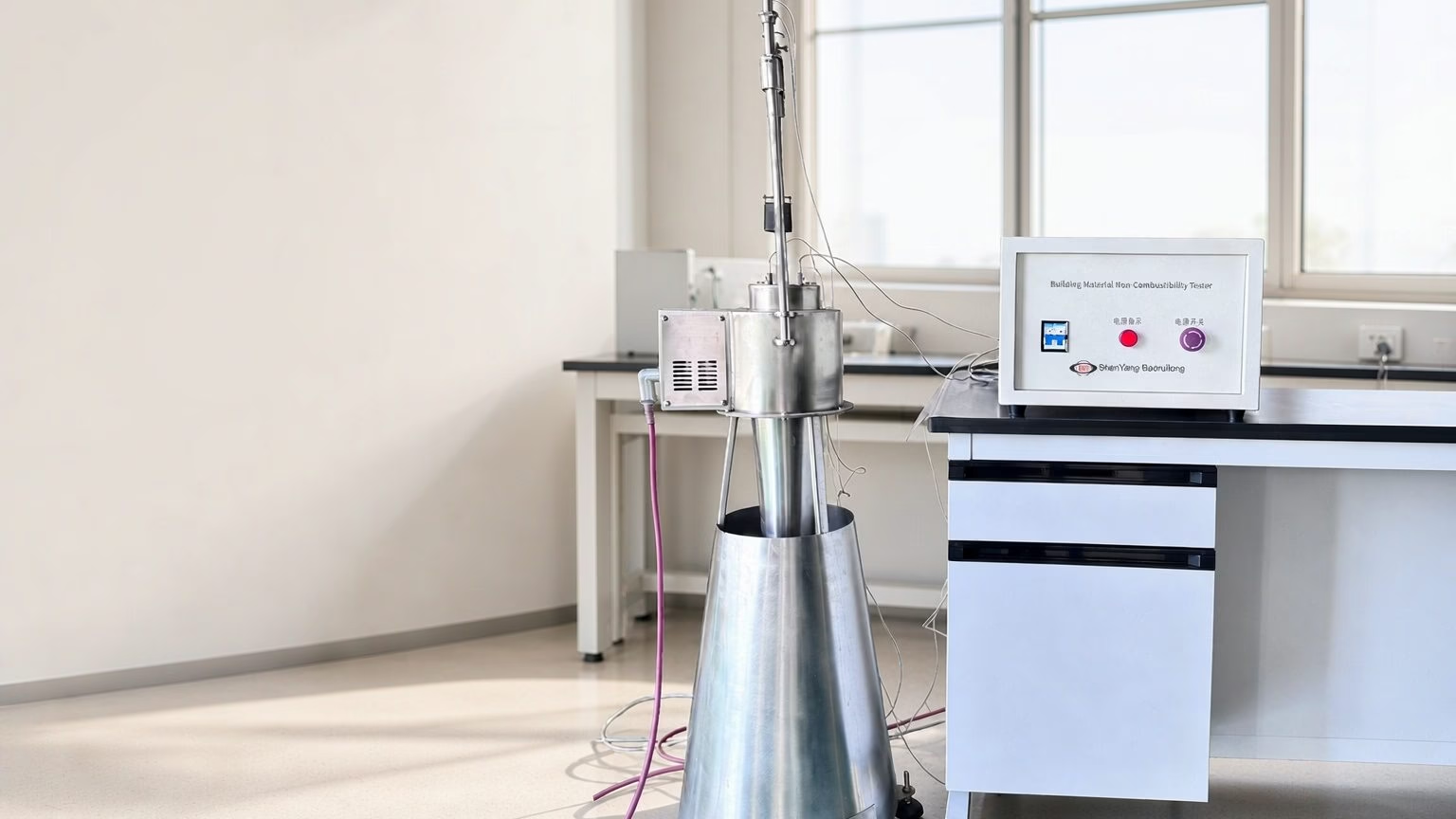
Both are cheap to run relative to their value, both are used during formulation work long before a formal classification is needed, and neither requires the building modifications that larger rigs demand. Our dedicated walkthrough of non-combustibility testing to ISO 1182 covers the method in far more detail.
Gross Calorific Value: The Small Instrument With a Large Job
Heat of combustion decides whether a material qualifies at the very top of the European scale, and it is measured in a bomb calorimeter rather than in a furnace. It also has a second life well beyond compliance: because it is fast and uses a small specimen, it is the most useful screening tool a formulation laboratory can own. UM gross heat of combustion tester for building materials sits on the bench between the balance and the small-flame apparatus, which is exactly where it earns its keep.
The Single Burning Item Rig Is the Real Dividing Line
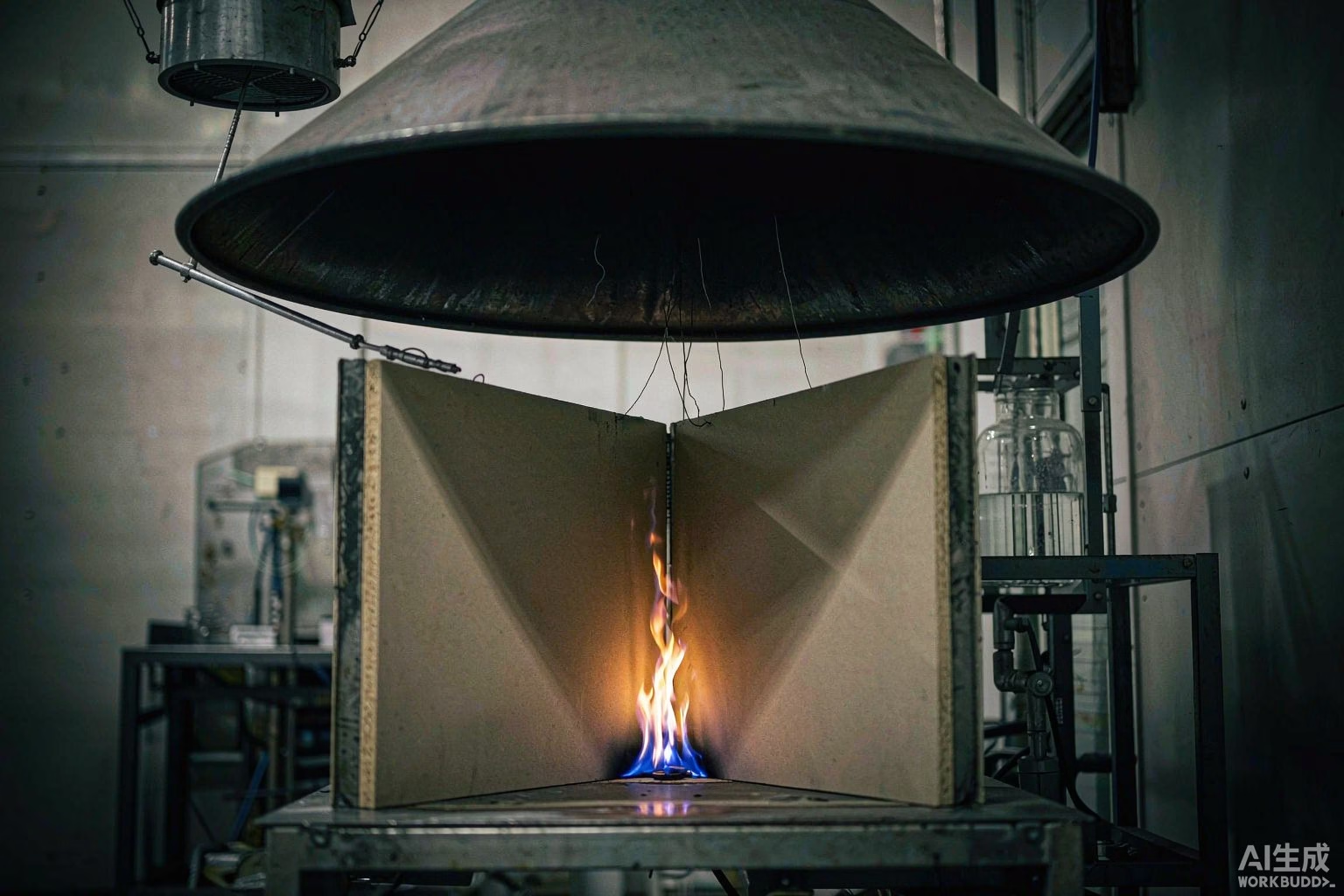
Everything above is bench or cabinetry scale. The SBI test is not. It builds a corner assembly from two specimen wings, burns it with a defined gas burner under a collection hood, and derives heat release and flame spread from the exhaust gas analysis train [3]. That means an extraction path capable of capturing the whole plume, a gas supply sized for the burner, a hood and duct run, and enough floor area for the trolley and specimen build-up area.
This is where most manufacturers should pause and do arithmetic. If your volume of SBI work cannot keep the rig busy, sending those specimens to a partner laboratory usually costs less than owning the rig and keeping it calibrated, staffed and exercised. If your development cycle genuinely needs iterative SBI feedback, ownership pays for itself. Nosso guia para reaction to fire testing sets out where SBI sits among the four tests, and the deeper walkthrough of the EM 13501-1 euroclass route covers the thresholds behind each class.

Smoke and Toxicity: Two Second-Tier Benches Worth Knowing
Some product families and some export markets require more than the four core European tests. UM building materials smoke density tester quantifies smoke generation in a closed chamber, e smoke toxicity test equipment addresses the effluent rather than the flame. Neither is needed for a standard euroclass declaration, and both are frequently required by transport, marine or rail specifications. Buy them when a specific customer specification names them, not before.
The Third Cost Nobody Budgets For: People and Records
The capital cost of fire testing equipment is the visible half. The recurring half is the operator who has to run it correctly and the record system that has to demonstrate it. Two or three people need method-specific training, not general laboratory training, because the results depend on specimen preparation and conditioning as much as on the instrument. Calibration of thermocouples, gas flows, balances and gas analysers has to run to a documented cycle with traceable certificates. And each result has to be recorded with the standard edition it was run to, because a classification report that cites a withdrawn edition is rework rather than evidence. Budgeting for these three things is what separates a laboratory that produces defensible data from one that produces numbers.
| Capability | What it requires | Often overlooked |
|---|---|---|
| Method-trained operators | Formal training on the specific standard, not general induction | Specimen conditioning and preparation errors look like instrument faults |
| Traceable calibration | Documented cycle plus certificates for sensors and analysers | Gas analyser drift changes heat release results silently |
| Records tied to editions | Reports citing the standard and edition actually used | A withdrawn edition invalidates otherwise good data |
| Reference materials and spares | Consumables, thermocouples, filters, certified reference boards | A rig idle for six weeks waiting on a thermocouple costs more than the part |
In-House or Outsourced: Honest Boundary Conditions
| Test | Realistic ownership | Why |
|---|---|---|
| Single-flame source ignitability | Almost always in-house | Bench scale, low utilities, used weekly during development |
| Non-combustibility | Almost always in-house | Simple furnace, standardised specimen, frequent screening use |
| Gross calorific value | Almost always in-house | Bomb calorimeter, high specimen throughput, formulation feedback |
| Cone calorimetry | Frequently in-house for R&D | Bench scale with exhaust; the leading development tool for heat release [6]9 |
| SBI | Depends on throughput | Needs hood, canalização, gas supply and trained operators [3] |
| Steiner tunnel / surface burning | Rarely in-house | Long tunnel and specific infrastructure; typically outsourced 10 |
| NFPA 285 exterior wall assembly | Almost never in-house | Full multi-storey assembly rig 11 |
| Fire resistance furnaces | Only for manufacturers of elements | Forno, loading frame, extração; belongs with door and wall makers [7][8] |
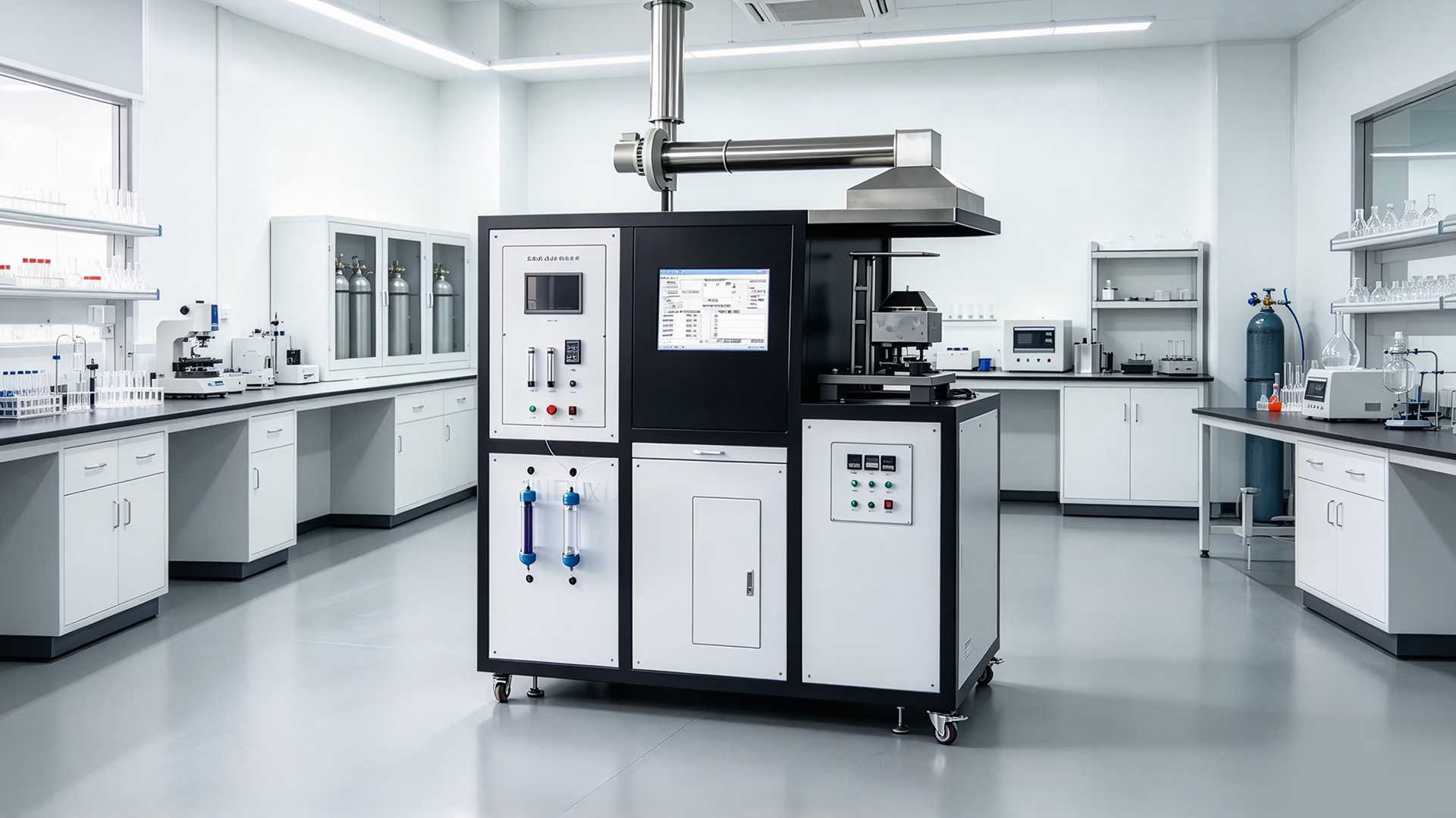
UM calorímetro de cone deserves a specific note. It is not part of the standard European construction product route, but it is by far the most informative development instrument in the fire laboratory, because it returns heat release rate directly and uses a small specimen [6][9]. Manufacturers who buy it usually discover they use it several times a week for formulation screening and rarely for certification — which is precisely the argument for owning it. Our dedicated article on ISO 5660 cone calorimeter heat release rate testing explains what it returns.
Sequencing the Purchase
Buy in this order and you will rarely regret a purchase:
- Establish the target class and its full route with your notified or certification body before ordering anything.
- Bench layer first — single flame, non-combustibility, calorific value. These cover most daily development questions and most low-class declarations.
- Cone calorimetry next if you formulate. It is the tool that keeps paying for itself during product development [6].
- SBI only when throughput justifies it, and only after the utility services for the hood and burners are confirmed.
- Smoke density and toxicity when a named specification requires them.
- Fire resistance furnaces only if your product is an element or assembly. Otherwise use a partner laboratory [7][8].
- Re-verify the whole chain annually, including editions. EM ISO 11925-2, for example, moved from the 2020 edition to a 2026 edição [5]12, and equipment specified against the older edition may need review rather than replacement.
Note the last point: standard editions move, and the competent laboratories cite the edition they tested to. Our regional overview of padrões de teste de fogo de materiais de construção tracks the major regimes, and our comparison of fire resistance and flame retardancy clarifies which family your product actually belongs to.
Finally, once the technical list is settled, the vendor decision has its own criteria — edition currency, calibration traceability, commissioning support, spares and references. Those are set out in our guide to choosing a fire testing laboratory equipment supplier, which is the natural next read once you have a specification in hand. The complete product range is listed under equipamento de teste de fogo e chama.
Perguntas frequentes
What fire testing equipment does a construction material manufacturer actually need?
It depends on your product family and target class. Almost every manufacturer benefits from three bench instruments: a single-flame source apparatus, a non-combustibility furnace and a gross calorific value tester. The single burning item rig comes only when throughput justifies it, and fire resistance furnaces only when your product is an element rather than a material.
Can I reach a euroclass declaration using only in-house equipment?
For the lower classes, often yes. For project purposes, in-house evidence usually suffices for development decisions. For the higher classes you need evidence from methods such as non-combustibility, calorific value and single burning item testing, and some of those are commonly outsourced. Equipment that has been calibrated and operated to the current editions still has to be cited correctly in the declaration.
What is the difference between reaction-to-fire and fire-resistance equipment?
Reaction-to-fire equipment tests materials and products: how easily they ignite and how much heat they release. Fire-resistance equipment tests whole elements and assemblies against a standard fire curve under load. They are different standards, different apparatus, and rarely belong in the same laboratory unless your product range spans both.
Should I buy a cone calorimeter if it is not needed for my classification?
Often yes, if you formulate. It returns heat release rate from a small specimen and is the most informative screening tool in fire testing, even though it is not part of the standard European construction product route.
Why is the single burning item rig considered the dividing line?
It is the first instrument that requires building infrastructure rather than bench space: a hood and ducted extraction sized to capture the plume, a gas supply for the burner, space to build the corner assembly, and trained operators to keep the gas analysis train calibrated.
Does equipment specified to an older standard edition have to be replaced?
Usually not. Editions move — EN ISO 11925-2 went from a 2020 to a 2026 edition — and existing equipment frequently continues to work. What is required is a review of whether the tolerances and measurement points changed, followed by documented verification, rather than automatic replacement.
Where should I start if I have no fire test laboratory at all?
Start with the target class and route, then buy the bench layer — single flame, non-combustibility, calorific value. That trio covers most daily development questions, costs a fraction of a full facility, and tells you from real usage whether the larger rigs are justified before you commit capital.
Build the Capability in the Right Order
Work through five steps. Primeiro, fix the market and the target class with your certification body. Segundo, write down every test behind that class. Third, decide honestly for each test whether its throughput justifies ownership or whether a partner laboratory is cheaper — this decision, not the purchase price, drives your total cost. Fourth, buy the bench layer before the facility layer. Fifth, re-check the editions annually and re-verify the instruments on the same cycle.
BRT Testing manufactures fire test equipment across the full spread described above, from single-flame benches and non-combustibility furnaces through cone calorimeters, SBI apparatus and fire resistance furnaces. Send us your product family, target class and intended throughput, and we will return a staged equipment proposal with the utility requirements and acceptance checks for each stage — including which items we would recommend you do not buy yet.
Prepared by the applications engineering team at Shenyang Baoruitong Automation Equipment Co., Ltda. (Teste de BRT), a manufacturer and exporter of fire testing equipment and laboratory instruments. Company information is available on our about page, and technical enquiries can be directed through our página de contato.
Sources
- UNI Ente Italiano di Normazione — ISO 1182:2020
- UNI Ente Italiano di Normazione — ISO 1716:2018
- UNI Ente Italiano di Normazione — EN 13823:2020
- iTeh Standards — EN 13501-1:2018
- NSAI Standards Store (Ireland) — I.S. EM ISO 11925-2:2020
- UNI Ente Italiano di Normazione — ISO 5660-1:2015
- UNI Ente Italiano di Normazione — ISO 834-1:2025
- UNI Ente Italiano di Normazione — EN 1363-1:2020
- ASTM International — E1354-23 Standard Test Method for Heat and Visible Smoke Release Rates for Materials and Products Using an Oxygen Consumption Calorimeter
- ASTM International — E84-23a Standard Test Method for Surface Burning Characteristics of Building Materials
- NFPA — NFPA 285
- glstd.com — EN ISO 11925-2:2026
- ASTM International — E119-24 Standard Test Methods for Fire Tests of Building Construction and Materials