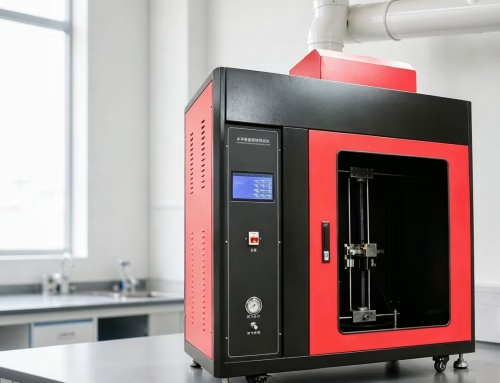
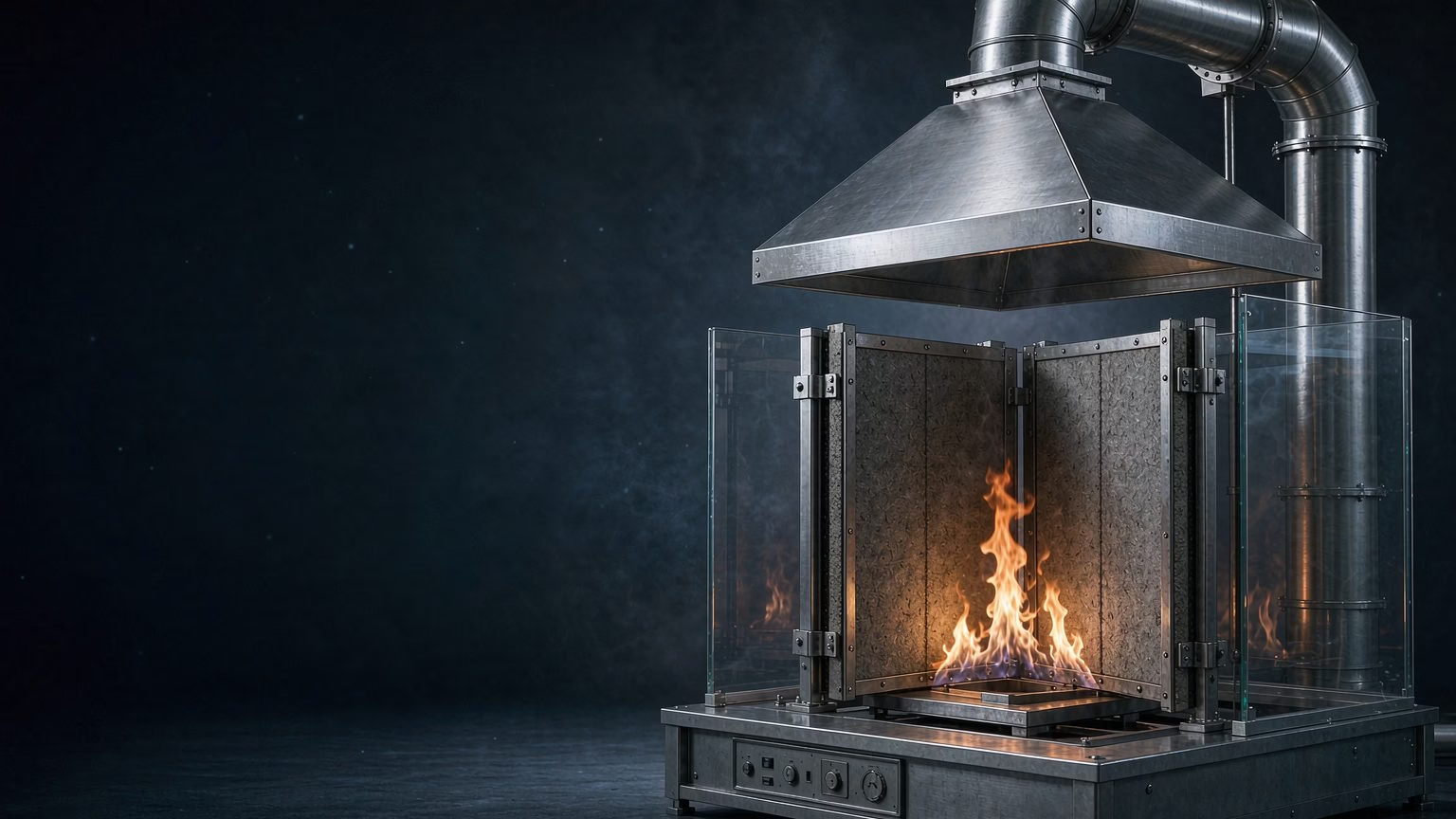
IEC 60695 is not a single test — it is a family of about a dozen fire hazard test methods, and the product standard that governs your device, not IEC 60695 itself, decides which of them you must run and at what severity. If you remember one thing from this guide, remember that order: read IEC 60335, IEC 60598, IEC 60884 or IEC 62368-1 first, take the glow-wire temperature and the flammability class from there, then use IEC 60695 only to learn how that requirement is measured. Teams that start with IEC 60695 tend to buy the wrong apparatus, or test the wrong specimen, or produce a beautiful material datasheet that no certification body accepts as evidence for a finished product.
What IEC 60695 Flammability Testing Covers
Two Kinds of Part: Guidance and Test Method
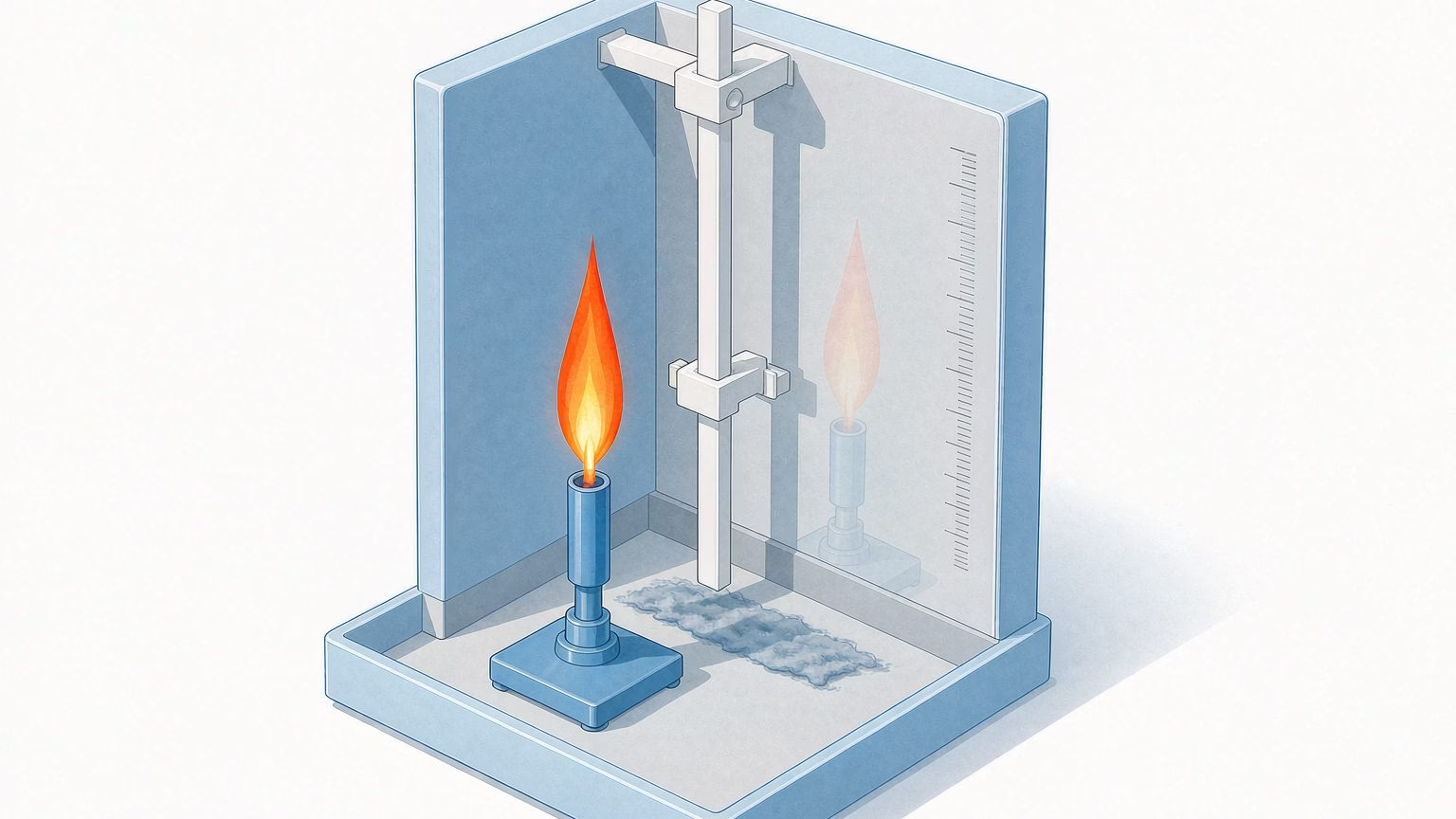
The series splits cleanly in two. Part 1 (IEC 60695-1-10, -1-11, -1-12, -1-14 and their siblings) contains guidance: how to structure a fire hazard assessment, how mechanisms of ignition are modelled, and how Preselection activity (IEC 60695-1-30) narrows candidate materials before any testing starts 1. Part 2, Part 10 and Part 11 contain the actual methods — the glow-wire family in Part 2, the ball-pressure test in Part 10-2, and the flame-based methods in Part 11.
Nothing in Part 1 tells you a pass temperature; nothing in Part 11 tells you which class your product needs. Confusing the two is why engineers sometimes ask a laboratory for “an IEC 60695 test” without being able to state a severity.
Where the Severity Comes From
Every method in the series defines how to measure; only the product standard defines how severe the measurement has to be. IEC 60695-2-11 states this plainly — it is a basic safety publication intended for use by technical committees preparing safety publications in accordance with IEC Guide 104 and ISO/IEC Guide 51 2. In practice that means the essential question for any component is: what do household-appliance, luminaire, switchgear or IT-equipment committees require of this part? Common severities cluster at 550 °C, 650 °C, 750 °C, 850 °C and 960 °C, and the aplicable value is mandated at the product-committee level. Ask your certification body which temperature governs before you buy anything.
How IEC 60695 Flammability Testing Is Organised by Ignition Source
The quickest way to navigate IEC 60695 flammability testing is by the hazard each method simulates.
| Simulated hazard | Part | Method name | Çıkış |
|---|---|---|---|
| Overheated metal part, ignition of finished assembly | 2-11 | GWEPT (end-product glow-wire flammability) | Pass/fail at a stated temperature |
| Same source, ranking a material by extinguishing behaviour | 2-12 | GWFI (glow-wire flammability index) | Temperature in °C |
| Same source, ranking a material by ignition behaviour | 2-13 | GWIT (glow-wire ignition temperature) | Temperature in °C |
| Small flame from an internal fault | 11-5 | Needle-flame test | Pass/fail with defined flame times |
| Small 50 W flame on material bars | 11-10 | Method A horizontal, Method B vertical | HB rating or V-0/V-1/V-2 |
| Larger 500 W flame on bars and plaques | 11-20 | 500 W vertical flame methods | 5VA / 5VB |
| Heat softening a live part in position | 10-2 | Ball-pressure test | Indentation diameter, pass/fail |
IEC 60695-2-10 is used with all three glow-wire tests: it specifies the glow wire itself, the apparatus and a common procedure shared by Parts 2-11, 2-12 Ve 2-13 3.
The Glow-Wire Family in IEC 60695 Yanıcılık Testi
The Apparatus and the Clock Come From IEC 60695-2-10
Because Part 2-10 sets the common procedure, the apparently mechanical details matter more than they look 4. Current Edition 3.0 was issued in October 2021, and it made four changes worth knowing before you specify equipment: new terms and definitions covering times and durations were added to Clause 3; the old Annex A listing equipment manufacturers and suppliers was deleted; the guidance on ignition and flaming observations — previously informative Annex B, now renumbered Annex A — became normatif; and a new Annex C visualises the times and durations and gives worked examples of how to evaluate specimen behaviour [3].
The third change is the one with teeth. Observation criteria that a laboratory once treated as guidance are now requirements, and an argument about whether a particular specimen “ignited” now has a definitional answer in the standard rather than in the laboratory’s internal procedure.
GWEPT, GWFI and GWIT Answer Three Different Questions
The three glow-wire outcomes are routinely quoted as though they were interchangeable. They are not.
| IEC 60695-2-11 (GWEPT) | IEC 60695-2-12 (GWFI) | IEC 60695-2-13 (GWIT) | |
|---|---|---|---|
| Specimen | Complete end product, or representative part [2] | Standard test specimens of the material | Standard test specimens of the material |
| Question asked | Will this assembly ignite, or spread flame, at a given wire temperature? | Highest wire temperature at which this material copes acceptably? | Lowest wire temperature at which this material ignites? |
| Pass idea | Does not ignite, or flames go out before the observation window and the underlay does not ignite | Does not ignite, or extinguishes within 30 s of glow-wire removal, is not totally consumed, and drips do not ignite the wrapping tissue 5 | Does not ignite, or no sustained flaming longer than 5 s for any single flame event, and is not totally consumed 6 |
| Reported as | Pass/fail at one temperature | A temperature, typically reported with a 25 K step | A temperature 25 k (veya 30 k) above the maximum test temperature at which the material did not ignite [6] |
| Evidence class | End-product evidence | Material property | Material property |
GWFI is an index — a useful ranking number for comparing grades during material selection. GWIT answers an ignition-sensitivity question, ve 25 K or 30 K offset exists precisely to keep the reported figure away from the discontinuities of the stepwise procedure described by the standard.
Neler Değişti? 2021 Editions
All three glow-wire parts moved together. Parçalar 2-10, 2-11 Ve 2-12 were issued as Edition 3.0 in October 2021 and Part 2-13 as Edition 3.0 in August 2021 [3][5][6]7. For Part 2-11 the third edition replaced the second edition published in 2014, and its single significant technical change was the addition of numerous terms and definitions to Clause 3 — a change driven by disagreement about what “ignition”, “flame event” Ve “duration” meant [2]. For Parts 2-12 Ve 2-13, the new times-and-durations terms in Clause 3 are stated to have an effect on how the test method is applied [5][6].
If your existing test reports quote IEC 60695-2-11:2014, they are not wrong, but they were produced under a less explicit vocabulary. Re-testing is usually not required; re-reading them against the 2021 definitions sometimes is.
Needle Flame in IEC 60695 Yanıcılık Testi
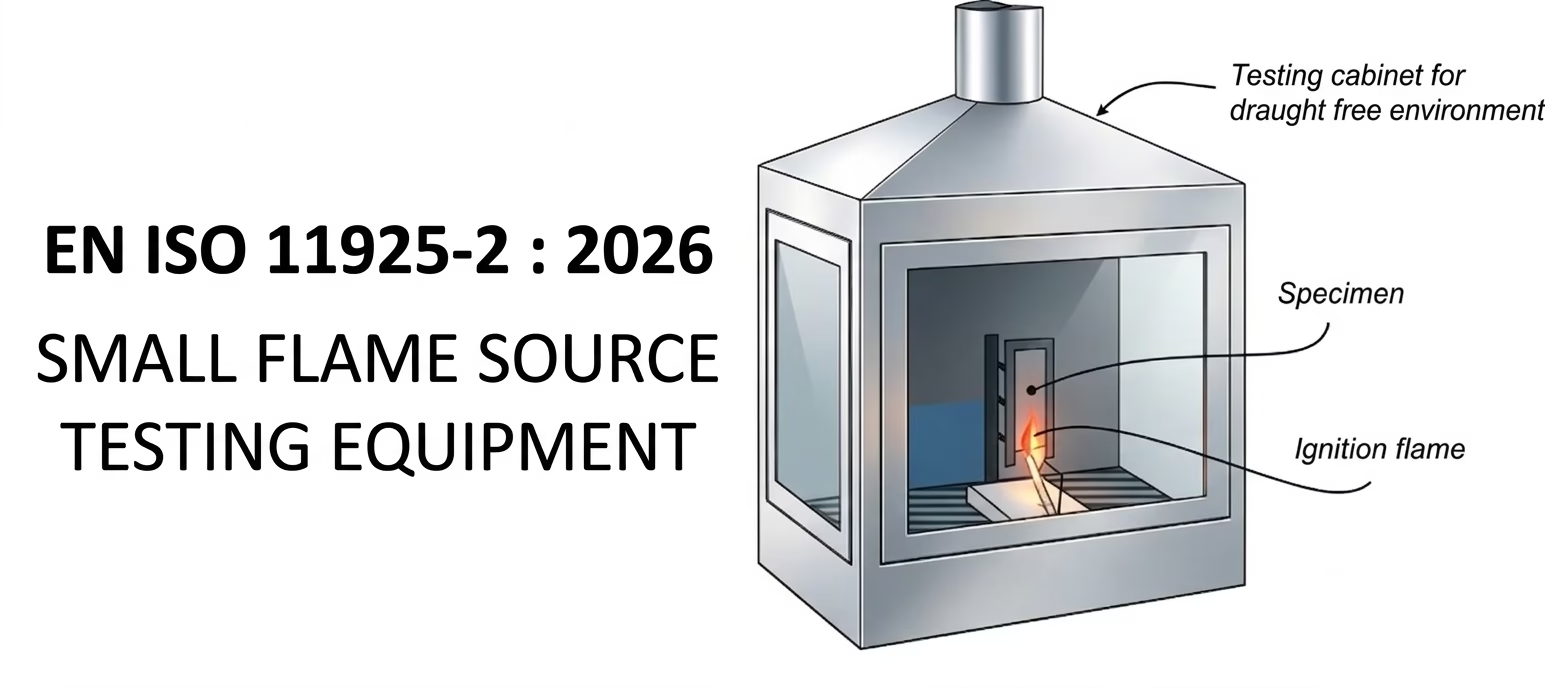
The needle-flame method in IEC 60695-11-5 simulates a small flame arising from a fault condition, and it is applied to electrotechnical equipment, sub-assemblies, components and solid insulating materials 8. Sürüm 2.0 was published in December 2016 and cancelled the 2004 first edition. Four technical changes matter for anyone specifying or interpreting a test:
- The scope broadened. The first edition addressed faults inside the equipment; Sürüm 2.0 also allows the method to simulate the effects of small flames from outside it [8].
- Fuel is defined. Propane and butane are the specified fuel sources, with a minimum purity of 95 % — a change that removed a recurring source of inter-laboratory variation [8].
- The burner may be moved. A new provision allows the burner to be moved during the test so that dripping material does not fall onto the burner tube tip [8]. This single clause changes how long a test rig has to survive in production.
- Material callouts changed. The reference for the copper block material changed, because ISO 1337 was withdrawn without replacement [8].
For anyone comparing quotations: a rig that cannot move the burner, or that lacks downdraught control, was designed against the withdrawn era.
The 50 W and 500 W Flame Tests
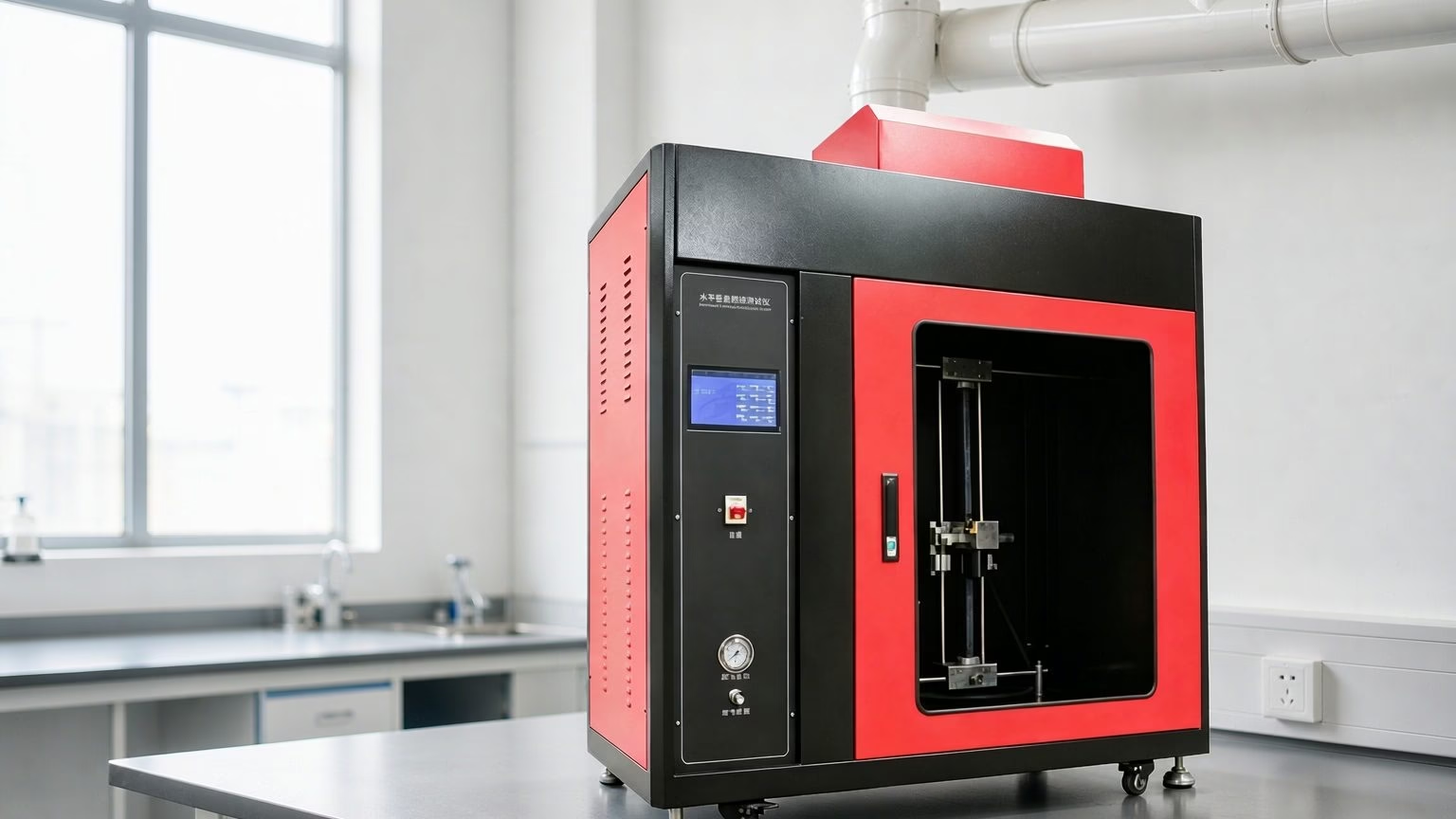
These two are the ones engineers recognise from material datasheets, because they generate the classifications that look like UL 94.
| Characteristic | IEC 60695-11-10 | IEC 60695-11-20 |
|---|---|---|
| Nominal flame power | 50 K | 500 K |
| Specimen geometry | Test bar, Method A horizontal / Method B vertical | Bars and flat plaques |
| Ne ölçülür | Method A: linear burning rate; Method B: whether specimens self-extinguish 9 | Burn-through behaviour and after-flame after repeated applications |
| Typical classes obtained | HB; V-0, V-1, V-2 | 5VA, 5VB |
| Edition in service | Sürüm 2.0, May 2013 (includes the September 2014 corrigendum) [9]10 | Refers back to IEC 60695-11-4 for the calibrated flame |
Two practical limits sit inside IEC 60695-11-10 and are frequently missed by both buyers and test houses. Birinci, the methods apply to solid and cellular materials with an apparent density greater than 250 kg/m³, determined in accordance with ISO 845 — a low-density foam is outside the stated scope [9]. Saniye, Part 11-10 is to be read in conjunction with IEC 60695-11-4:2011, which defines the 50 W test flame itself; the classification part alone is not self-contained [9]11.
The full definitions of the individual V-classes, including the after-flame time budgets and the cotton-indicator rule, are set out in our separate guide to UL 94 flammability classifications; the horizontal versus vertical distinction is treated in detail in our comparison of horizontal and vertical flammability testing for plastics. Consult both before you read a datasheet class as evidence.
Material Data and End-Product Evidence Are Not Interchangeable
This is where projects most often lose months. GWFI, GWIT and the 50 W or 500 W burning classes are material properties, measured on standard bars or plaques. GWEPT and the needle-flame test are applied to the actual product or part, with its real wall thickness, ventilation slots, seams and neighbours [2][8].
The failure mode is predictable: a procurement team shortlists a polymer graded V-0 with a GWFI of 850 °C, treats that datasheet as compliance evidence, and discovers during certification that the end product still needs GWEPT at the temperature the product committee mandates. A material can be moulded thin, perforated for cooling, or mounted next to a heatsink — and a material property simply does not describe any of those situations. Use material data to choose; use end-product tests to prove.
Building an IEC 60695 Flammability Testing Sequence
Run IEC 60695 flammability testing in this order and you will rarely have to repeat anything:
- Establish the governing product standard and the applicable edition. Everything downstream depends on it.
- List every non-metallic part, its function, and whether it encloses, supports or is adjacent to live connections. That trio determines which Parts apply.
- Pull the severities from the product standard — glow-wire temperature per part, flammability class per part, ball-pressure temperature where it is required.
- Screen materials using GWFI and GWIT, ideally through the preselection route described in IEC 60695-1-30, before committing tooling.
- Run the classification tests on the chosen grade to the applicable Part of Part 11.
- Run GWEPT and needle flame on the finished assembly or representative part.
- Write the report so the second and third columns above are explicit, including the specimen configuration used. Part 2-11 requires specified layers beneath the specimen and expects results within defined conditioning windows; a report that omits either invites rework [2].
The Apparatus Behind Each IEC 60695 Yöntem
Once the methods are known, the equipment follows directly.
| Yöntem | Apparatus required | Control points that decide results |
|---|---|---|
| GWEPT / GWFI / GWIT (Part 2-10 family) | Glow-wire test station with the Part 2-10 wire geometry, calibrated temperature measuring system, carriage with defined contact force, dark test chamber of adequate volume | Wire temperature stability, contact force, penetration limit, timing of the application and the 30 s observation window, underlay specification |
| Needle flame (Part 11-5) | Needle burner with specified fuel, confirmatory copper-block arrangement, timing device, fume extraction | Fuel identity and purity, flame height verification, the new burner-movement capability [8] |
| 50 W horizontal/vertical (Part 11-10) | Flame chamber with the 50 W burner, gas train, specimen clamps, cotton indicator, timing | Burner calibration to the flame of Part 11-4, specimen thickness control, conditioning per Clause 9 [9] |
| 500 K (Part 11-20) | Higher-energy burner and chamber rated for plaque testing | Flame calibration at the higher power, plaque and bar handling |
| Ball pressure (Part 10-2) | Ball-pressure apparatus and a temperature-controlled bath | Test temperature set by the product standard, indentation measurement resolution |
If your production mix spans both IEC work and building-product work, note that reaction-to-fire apparatus for construction materials is a different family altogether; our fire testing laboratory equipment supplier guide covers the split between the two buying decisions.
For the flame methods themselves, A horizontal and vertical combustion tester covers the bar and plaque geometry used by Part 11-10 and Part 11-20, while a foam-specific vertical and horizontal burning tester handles the cellular materials that Part 11-10 excludes. Where the product under test is a cable or a harness rather than a moulded part, the product-level cases are covered by bundled cable vertical flame test equipment. For the material screening that precedes glow-wire work, an automatic limiting oxygen index tester gives a fast, complementary ranking of candidate grades before you commission anything else. The full range is listed under yangın ve alev test cihazları.
Sıkça Sorulan Sorular
What is IEC 60695 flammability testing used for?
It provides laboratory methods for assessing the fire hazard of electrotechnical products and their materials. Each part simulates a realistic ignition source — a glowing or overheated wire, a small flame from a fault, or a heat-softened supporting part — so that ignition and flame spread can be measured under repeatable controlled conditions.
What is the difference between GWEPT, GWFI and GWIT?
GWEPT (IEC 60695-2-11) is an end-product test: does this assembly resist ignition or limit flame spread at a stated wire temperature? GWFI (Part 2-12) is a material index: the highest temperature at which flames extinguish within 30 s of wire removal. GWIT (Part 2-13) is a material ignition temperature, taken as 25 K or 30 K above the highest non-igniting test temperature.
Which standard should I read first, IEC 60695 or my product standard?
Your product standard. IEC 60695-2-11 describes itself as a basic safety publication intended for technical committees preparing IEC 62368-1-class safety publications, which means the requirements live in the product committees and only the measurement lives here.
Does a V-0 material datasheet exempt my product from glow-wire testing?
HAYIR. V-0 and HB classes are material properties from the Part 11 family; GWEPT applies to the finished assembly with its real geometry. A V-0 grade can still fail an end-product test once it is moulded thin or vented, so treat datasheet classes as material selection input, not as compliance evidence.
Which temperature should I use for glow-wire testing?
The one your product standard mandates for that part. Common severities are 550 °C, 650 °C, 750 °C, 850 °C and 960 °C, but IEC 60695 does not assign them — that decision belongs to the product committee, informed by where the part sits and what it carries.
What changed in the 2021 editions of the glow-wire standards?
Parçalar 2-10, 2-11 Ve 2-12 moved to Edition 3.0 in October 2021, and Part 2-13 in August 2021. The most substantive change is in Part 2-10: the ignition and flaming observations annex became normative, new times-and-durations terms were added across the family, and a new Annex C visualises the timings.
Can one machine run every glow-wire test?
Yes for the family, because they share the apparatus and common procedure in IEC 60695-2-10. Confirm the station supports the defined contact force, penetration limit, timing resolution and the observation criteria that became normative in Edition 3.0. Flame-based Part 11 methods need separate chambers and burners.
Running IEC 60695 Flammability Testing in Sequence
Decide in this order. Birinci, identify the governing product standard and edition. Saniye, map every non-metallic part to its severities — glow-wire temperature, flammability class, ball-pressure temperature. Üçüncü, screen candidate materials with GWFI and GWIT before tooling is committed. Fourth, confirm the classification on the chosen grade with the applicable Part 11 method. Fifth, prove the assembly itself with GWEPT and, where a small internal flame is credible, needle flame. Sixth, specify test equipment against the current editions, not the ones your existing reports cite.
BRT Testing builds flame test chambers, needle-flame apparatus and the broader family of fire test equipment used across these methods. If you would like the temperature, timing and observation criteria for your product standard mapped onto an equipment specification, send us the standard reference and the parts list, and we will return a configuration and an acceptance checklist you can take to any supplier.
Prepared by the applications engineering team at Shenyang Baoruitong Automation Equipment Co., Ltd.. (Metrobüs Testi), a manufacturer and exporter of fire test equipment and laboratory instruments. Company details are on our about page, and technical enquiries can be sent through the contact page.
Kaynaklar
- iTeh Standards — prEN IEC 60695-1-14:2025
- VDE Verlag — IEC 60695-2-11:2021
- VDE Verlag — IEC 60695-2-10:2021
- EN Standard (standards catalogue) — IEC 60695-2-10:2021
- VDE Verlag — IEC 60695-2-12:2021
- VDE Verlag — IEC 60695-2-13:2021
- EN Standard (standards catalogue) — IEC 60695-2-13:2021
- VDE Verlag — IEC 60695-11-5:2016
- VDE Verlag — IEC 60695-11-10:2013
- IEC Webstore — IEC 60695-11-10:2013
- NSAI Standartları Mağazası (İrlanda) — IS. İÇİNDE 60695-11-10:2013