- La respuesta corta
- Which Parts of the Car Count for Fire Testing of Automotive Interior Materials
- The Test Itself: Burn Rate and the Escape Clause
- The International and Chinese Routes
- What the Burn Rate Does Not Tell You
- Building a Test Programme for Interior Materials
- Preguntas frecuentes
- Which parts of a vehicle count as interior materials for flammability testing?
- What is the burn rate limit for automotive interior materials?
- What is the escape clause and when does it apply?
- How are composite interior materials sampled?
- Is a GB 8410-2006 report the same as an FMVSS 302 report?
- Does the burn rate test cover smoke and toxicity?
- What determines the thickness of the specimen?
- Conclusión: Una orden de decisión
- Sobre el autor
- Fuentes
La respuesta corta
Fire testing of automotive interior materials is a horizontal burning-rate test on components from the occupant compartment, and in the United States the rule is FMVSS 302 (49 CFR 571.302) 1. The regulation applies to passenger cars, multipurpose passenger vehicles, trucks and buses, and it names the components it covers: seat cushions, seat backs, seat belts, headlining, convertible tops, arm rests, all trim panels including door, front, rear and side panels, compartment shelves, head restraints, floor coverings, sun visors, curtains, shades, wheel housing covers, engine compartment covers, mattress covers, and any other interior materials including padding and crash-deployed elements designed to absorb energy on contact by occupants in a crash [1]. The pass criterion is a burn rate of no more than 102 mm per minute, with a separate escape clause for materials that stop burning early [1]. The international counterpart is ISO 3795 for road vehicles 2, and the Chinese national standard is ES 8410-2006, which is non-equivalent to FMVSS 571.302 and carries its own class structure 3.
Which Parts of the Car Count for Fire Testing of Automotive Interior Materials
The Scope Is Defined by Distance from the Air Space
The scope rule in FMVSS 302 is deceptively simple: any portion of a single or composite material within 13 mm of the occupant compartment air space must meet the requirement [1]. For the engineer planning fire testing of automotive interior materials, that clause does more work than the burn rate itself — it decides the sampling plan, the specimen build-up and how many parts a vehicle programme has to send. That single number decides the sampling plan, because it decides which face of a door panel, which ply of a headliner and which foam layer of a seat actually has to be tested.
| Component group named in S4.1 | Typical material | Why it is regulated |
|---|---|---|
| Seat cushions, seat backs, head restraints | Polyurethane foam, textil, composite | Occupant contact and padding absorbs crash energy |
| Seat belts | Webbing, elastomer | Restrains the occupant |
| Headlining, convertible tops | Non-woven, textil, CLORURO DE POLIVINILO | Large overhead surface close to the air space |
| All trim panels: puerta, front, rear, side | CLORURO DE POLIVINILO, ABS, textile-covered board | Thin mouldings directly exposed |
| Compartment shelves, sun visors, curtains, shades | Cardboard, textil, film | Concealed or overhead surfaces |
| Revestimientos de suelos, wheel housing covers, engine compartment covers | Carpet, felt, moulded plastic | Adjacent to the air space |
| Mattress covers | Textile, coated fabric | Bedding in passenger-carrying vehicles |
Adhering and Non-Adhering Materials
A second scope rule governs how a specimen is built. Material that does not adhere to other material at every point of contact is tested separately; material that adheres at every point of contact is tested as a composite with the other material [1]. The regulation even works through an example: if part of material B lies within 13 mm of the occupant compartment air space and B adheres to C at every point of contact, then B and C are tested as a composite, and the cut that makes the specimen 13 mm thick is made in material C [1].
That rule is where most first-time submissions go wrong. A trim assembly with a foam pad glued to a plastic backing is one specimen, not two; testing the foam alone removes the backing that keeps the burning material attached, and the result no longer describes the part as fitted.
The Test Itself: Burn Rate and the Escape Clause
El 102 mm/min Criterion
The requirement is that the material, when tested, shall not burn, nor transmit a flame front across its surface, at a rate of more than 102 mm per minute [1]. The requirement about flame-front transmission does not apply to a surface created by cutting a specimen for testing [1] — a practical allowance, since cutting a composite exposes an edge that the finished part does not have.
The Escape Clause
The second paragraph of S4.3 is the one that decides borderline cases: if a material stops burning before it has burned for 60 artículos de segunda clase from the start of timing, y has not burned more than 51 milímetros from the point where timing started, it is considered to meet the burn-rate requirement [1]. En la práctica, a material that self-extinguishes quickly is compliant even if a naive “distance divided by time” calculation would suggest a high rate. This is why escape behaviour must be observed and recorded, not inferred.
The Method: Muestra, Cabinet, Burner, Momento
The method is specified in detail, which is helpful because it removes laboratory-specific interpretation.
| Parámetro | Requirement in FMVSS 302 [1] |
|---|---|
| Test cabinet | Metal cabinet 381 mm long, 203 mm deep, 356 mm high, with glass observation window |
| Ambient conditions | 21 °C, 50 % relative humidity |
| Acondicionamiento | 24 horas en 21 °C and 50 % relative humidity before testing; tested under those conditions |
| Specimen frame | Two matching U-shaped frames of metal stock 25 mm wide and 10 mm high; interior dimensions 51 mm wide by 330 mm long |
| Burner | Bunsen burner with 10 mm inside-diameter tube; flame 38 mm high with the tube vertical; air inlet closed |
| Specimen size | 102 mm wide by 356 mm long, wherever possible |
| Thickness rule | Material thickness as used in the vehicle; if it exceeds 13 milímetros, cut down to 13 mm measured from the surface closest to the occupant compartment air space |
| Cutting direction | Cut so as to provide the most adverse test result; the surface closest to the air space faces downward on the frame |
| Flame application | Burner tip centred 19 mm below the bottom edge of the open end of the specimen; 15 seconds of flame exposure |
| Timing start | When the flame from the burning specimen reaches a point 38 mm from the open end |
| Timing end | When the flame reaches a point 38 mm from the clamped end |
| Burn rate formula | B = 60 × (D/T), where D is the flame travel in millimetres and T the time in seconds |
El 102 mm/min figure itself comes from that formula: over the roughly 280 mm timing span of a 356 mm specimen, the permitted rate defines how far the flame may travel in a given time. A laboratory quoting “burn rate 102 mm/min” without the specimen dimensions and the timing span has given half the information.
Orientation and Adverse Cutting
Two preparation rules deserve a second reading because they are easy to overlook. The specimen is oriented so the surface closest to the occupant compartment air space faces downward on the frame [1], and it is cut in the direction that provides the most adverse test results [1]. For napped or tufted surfaces the regulation even prescribes combing the nap twice with a comb of seven to eight smooth rounded teeth per 25 milímetros [1] — a small detail that removes an obvious source of scatter in textile results.
The International and Chinese Routes
ISO 3795 for Road Vehicles
ISO 3795:1989 covers road vehicles, and tractors and machinery for agriculture and forestry, and specifies a method for determining the horizontal burning behaviour of interior materials [2]. It is the international method that national regulations are usually built on, and it shares the horizontal-burn-rate logic with FMVSS 302 while differing in apparatus detail and reporting. When a supplier serves several markets, the practical move is to test to the method the regulation actually names rather than to the method the laboratory finds convenient.
ES 8410-2006 in China
China’s mandatory national standard for the flammability of automotive interior materials is ES 8410-2006, Flammability of automotive interior materials [3]. It replaced GB 8410-1994, was published on 18 Enero 2006 and took effect on 1 Julio 2006, and the national standards portal records it as a mandatory standard that is not an equivalent adoption of FMVSS 571.302 [3]. That last point matters commercially: a Chinese test report is not automatically a US report and vice versa, even though the two standards address the same product family.
The portal entry also lists the neighbouring Chinese standards a supplier will meet in the same project — ES 38262-2019 for the flammability of passenger-bus interior materials, y GB/T 32086-2015 for vertical burning characteristics of interior materials for specific vehicle types [3]. Where a project combines passenger cars and buses, the two regimes have to be planned separately rather than assumed equivalent.
The Regulatory Map
| Mercado | Governing standard | Nature | Key note |
|---|---|---|---|
| United States | FMVSS 302, 49 CFR 571.302 [1] | Mandatory federal regulation | 102 mm/min limit plus escape clause [1] |
| International | ISO 3795:1989 [2] | Standard method | Horizontal burning behaviour of interior materials [2] |
| Porcelana | ES 8410-2006 [3] | Mandatory national standard | Non-equivalent to FMVSS 571.302; own class structure [3] |
| Porcelana, buses | ES 38262-2019 [3] | Mandatory national standard | Passenger-bus interior materials [3] |
For a reader who wants the measurement side rather than the regulatory side, the companion article on how to measure burning rate in flammability testing sets out the instrument settings that change the answer across five methods, y horizontal vs vertical flammability testing for plastics explains why the orientation decision changes the question being asked.
What the Burn Rate Does Not Tell You
A passing burn rate is one property among several that an interior material has to satisfy, and it is the one most often treated as the whole story.
| Property a buyer may ask for | familia de prueba | Why the burn rate is not a substitute |
|---|---|---|
| Flame spread along a surface | Horizontal burn rate (FMVSS 302, ISO 3795) [1][2] | Does not address vertical flame spread or melt dripping |
| Smoke and toxic gas emission | Chamber and FTIR methods | A fast-burning but low-smoke material can still pass the rate test |
| Ignition source behaviour | Calorímetro de cono, ignition tests | Burn rate ignores how readily the material ignites |
| Structural behaviour of the part | Component or assembly tests | Rate is measured on a coupon, not on the fitted part |
| Durability over vehicle life | Ageing and conditioning protocols | An initial pass does not cover a 10-year service environment |
The commercial consequence is straightforward: an interior material supplier that offers only the burn-rate test is offering one line of evidence. Most automotive programmes need at least the burn rate plus a smoke/heat-release view, and the equipment plan has to cover both — which is why fire testing of automotive interior materials is planned as a programme rather than a single test order.
Building a Test Programme for Interior Materials
Sampling Is the Programme
Because the scope is defined by distance from the air space and by the adhering relationship between layers, the sampling plan does more work than the test itself. A structured programme looks like this:
- List every interior component in the vehicle, including the trim variants and the hidden parts behind covers.
- Classify each component as within or beyond 13 mm of the air space, and record the basis for the classification [1].
- Group by construction — anything adhering at every point of contact becomes one composite specimen [1].
- Cut to the adverse orientation, with the air-space-facing surface downward [1].
- Condition and test en 21 °C and 50 % relative humidity after 24 horas [1].
- Record escape behaviour alongside the rate, since the 60-second and 51 mm escape clause may be the deciding criterion [1].
Equipment the Programme Needs
| Requisito | What it serves |
|---|---|
| Horizontal test cabinet with draught protection and a viewing window | The specified cabinet geometry and observation of the specimen [1] |
| Specimen frames and specimen holder | Holding the 102 milímetros × 356 mm specimen with the correct orientation |
| Burner with adjustable flame height and closed air inlet | El 38 mm flame with a 10 mm tube [1] |
| Timing and distance measurement to the 38 mm marks | The D and T values behind B = 60 × (D/T) [1] |
| Environmental control at 21 °C / 50 % RH | The conditioning requirement [1] |
| A separate vertical mode | Other interior programmes require vertical burning capability |
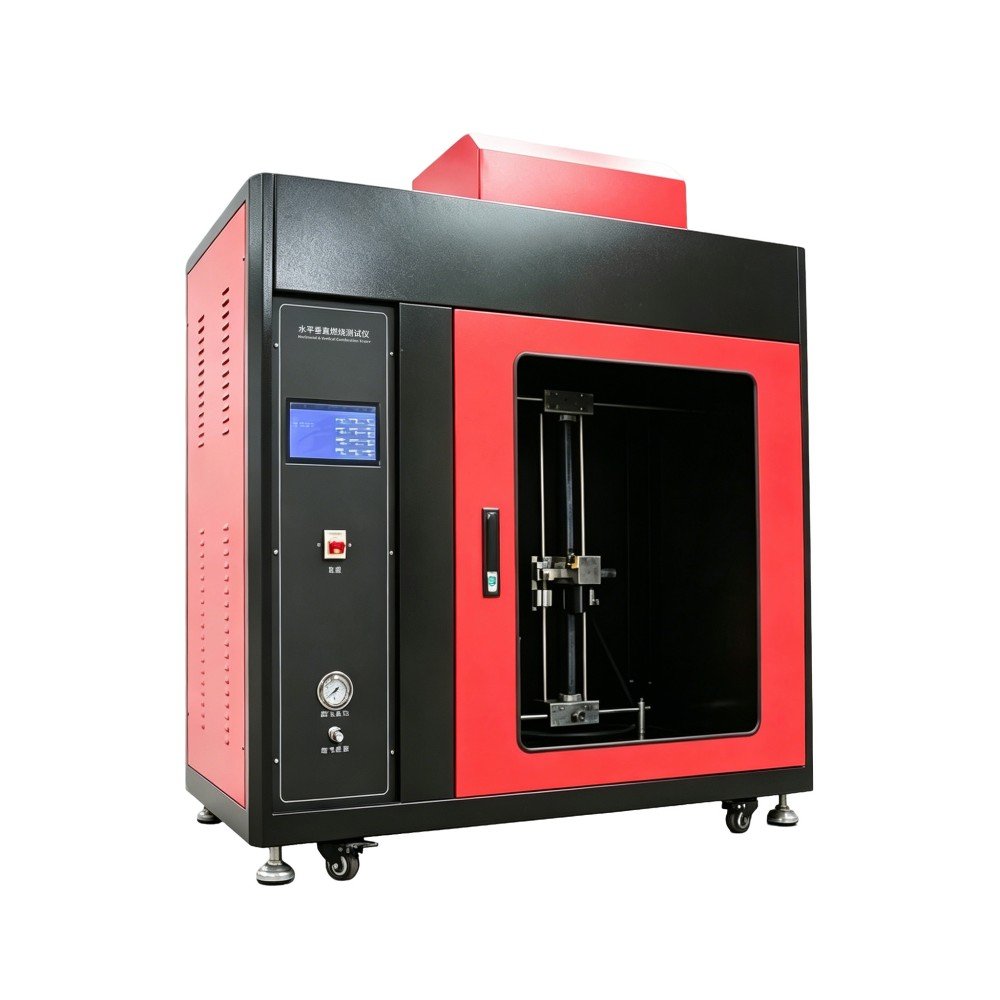
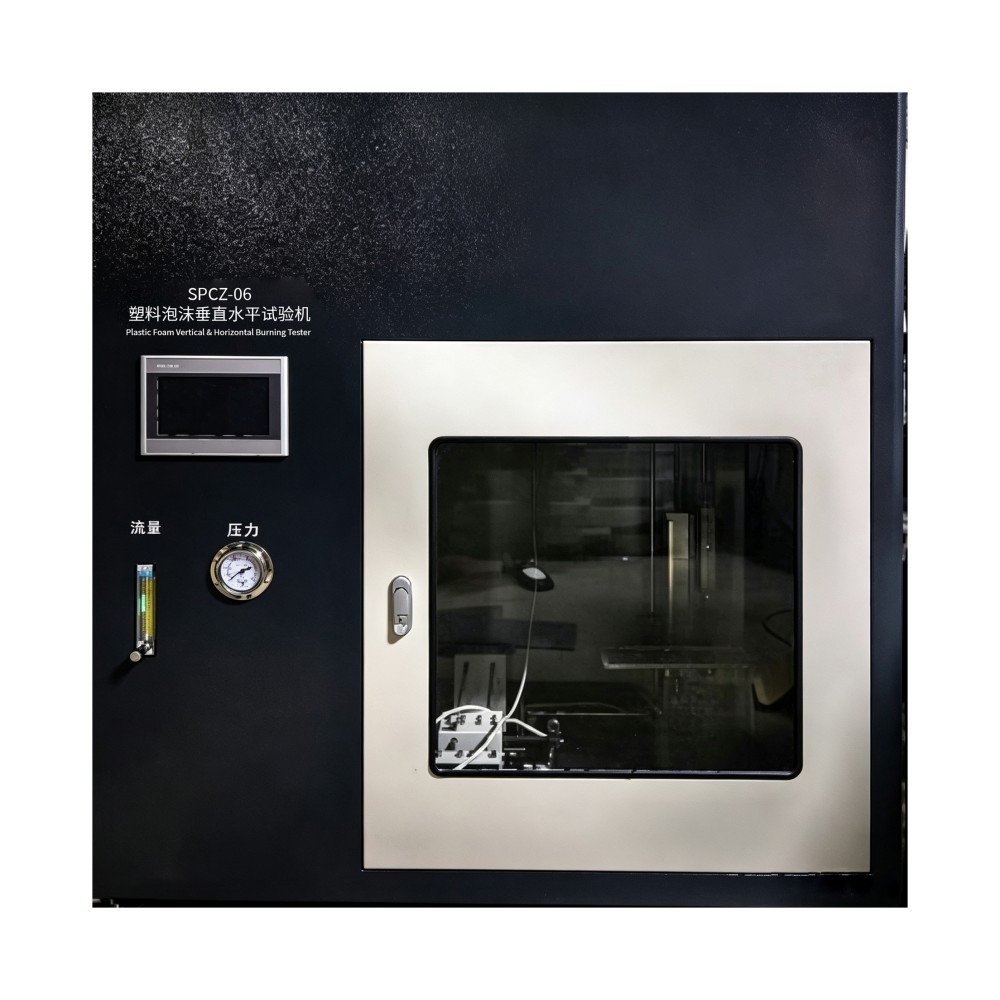
That last row is why a combined horizontal-vertical combustion tester is the usual purchase for an automotive laboratory: the horizontal mode runs the FMVSS 302 y ISO 3795 procedimiento, while the vertical mode serves the other interior flammability routes in the same programme. El horizontal vertical combustion tester page covers the configuration, y el plastic foam vertical horizontal burning tester covers the foam and padding builds where seat and trim components need their own sample holders.
Preguntas frecuentes
Which parts of a vehicle count as interior materials for flammability testing?
FMVSS 302 lists them directly: seat cushions, seat backs, seat belts, headlining, convertible tops, arm rests, all trim panels including door, front, rear and side panels, compartment shelves, head restraints, floor coverings, sun visors, curtains, shades, wheel housing covers, engine compartment covers, mattress covers, and any other interior materials including padding and crash-deployed elements designed to absorb occupant energy in a crash.
What is the burn rate limit for automotive interior materials?
The limit in FMVSS 302 es 102 millimetres per minute: the material shall not burn, nor transmit a flame front across its surface, at a rate of more than that value. The rate is calculated as B = 60 × (D/T), where D is the distance the flame travels in millimetres and T the time in seconds, measured between the 38 mm mark from the open end and the 38 mm mark from the clamped end.
What is the escape clause and when does it apply?
If the material stops burning before it has burned for 60 seconds from the start of timing, and has not burned more than 51 millimetres from the point where timing started, it is considered to meet the burn rate requirement even though the calculated rate would be high. It is a separate compliance route, so escape behaviour has to be observed during the test and written into the report.
How are composite interior materials sampled?
By adhesion. Material that does not adhere to other material at every point of contact is tested separately; material that adheres at every point of contact is tested as a composite with that material. Any portion of a single or composite material within 13 mm of the occupant compartment air space falls under the requirement.
Is a GB 8410-2006 report the same as an FMVSS 302 report?
No. The Chinese national standards portal records GB 8410-2006 as a non-equivalent adoption of FMVSS 571.302, so the two documents are related but not identical. Each market’s regulation has to be satisfied on its own terms, and a report issued under one standard does not automatically discharge the requirement of the other.
Does the burn rate test cover smoke and toxicity?
No. The horizontal burn rate measures how fast a flame front travels across the specimen surface. Smoke production, toxic gas emission, ignition behaviour and heat release are separate properties measured with different apparatus, and a programme that only runs the burn rate leaves those questions open.
What determines the thickness of the specimen?
The material thickness as used in the vehicle, except that where it exceeds 13 mm the specimen is cut down to 13 milímetros, measured from the surface closest to the occupant compartment air space. Where a flat specimen is not possible because of surface curvature, the specimen is cut to not more than 13 mm thick at any point.
Conclusión: Una orden de decisión
- Fix the market and the standard first: FMVSS 302 for the US, ISO 3795 as the international method, ES 8410-2006 for China and GB 38262-2019 for Chinese passenger-bus interiors [1][2][3].
- Build the component list, then classify each item by distance from the occupant compartment air space and by adhesion [1].
- Sample to the composite rule, cut to the adverse orientation, and condition at 21 °C and 50 % RH for 24 horas [1].
- Run the burn rate between the two 38 mm marks, and record escape behaviour against the 60-second and 51 mm clause [1].
- Plan the parallel lines the programme will also need — smoke and heat release — before the equipment list is written.
Run this order once per vehicle programme and fire testing of automotive interior materials stops being a form-filling exercise and becomes an evidence trail: each component, its rule, its specimen, its numbers and the clause it passed on. The related reading on this site is how to measure burning rate in flammability testing for the instrument side and horizontal vs vertical flammability testing for plastics for why orientation decides the question. For equipment, el horizontal vertical combustion tester y plastic foam vertical horizontal burning tester pages describe the configurations; send BRT your component list and target market and we will map the sample holders and test modes.
Sobre el autor
Pruebas BRT (Shenyang Baoruitong Automation Equipment) manufactures combustion and flammability test equipment — horizontal-vertical combustion testers, foam burning testers, oxygen index equipment and smoke and toxicity instrumentation for automotive, plastics and construction materials. The content team writes for automotive suppliers and testing laboratories, with the regulatory details above taken from the published text of 49 CFR 571.302 and the national standards portal, and the standard editions checked against the UNI catalogue in November 2026.
Fuentes
- U.S. National Archives and Records Administration / Legal Information Institute — 49 CFR 571.302, Federal Motor Vehicle Safety Standard No. 302, Flammability of Interior Materials (scope, 102 mm/min limit, escape clause, and test method in S4 and S5). https://www.law.cornell.edu/cfr/text/49/571.302
- DORMIR - GRANDE 3795:1989, Road vehicles, and tractors and machinery for agriculture and forestry — Determination of burning behaviour of interior materials (in force 19 Octubre 1989). https://webstore.uni.com/en/iso-3795-1989
- 国家标准全文公开系统 / 全国标准信息公共服务平台 — GB 8410-2006 汽车内饰材料的燃烧特性(强制性国家标准,2006-01-18 发布、2006-07-01 实施,全部代替 GB 8410-1994,非等效采用 FMVSS 571.302)。 https://std.samr.gov.cn/gb/search/gbDetailed?id=71F772D762BED3A7E05397BE0A0AB82A