La réponse courte
Deux spectromètres FTIR avec des plages de longueurs d'onde identiques peuvent être très différents en termes de prix, because the cost is driven by configuration, not by the wavelength spec. Eight levers move the number: bench optics quality, the detector (DTGS vs cooled MCT), spectral resolution and range, the sampling ladder (ATR → transmission → IR microscope), software and regulatory compliance (21 Partie CFR 11 electronic records), data libraries, service coverage, and consumables that keep the bench running 1 4. This article walks each lever qualitatively — BRT Testing sells under B2B quotation, so no figures are given here; the goal is that you can read any FTIR spectrometer price quotation and know which line is doing the work.
A useful way to read the quotation is to treat it as three layers, not one number. Le base instrument is the bench that acquires spectra: interferometer, source, détecteur, electronics and the data system. Le configuration is the sampling ladder and the compliance software that turn that bench into a usable instrument for your samples and your regulator. Le ownership layer is service, consumables, verification standards and training over five years. Prices in the first layer differ modestly between suppliers; prices in the second and third differ enormously, and it is the second layer that usually decides whether two quotations are comparable at all. Ask any supplier to quote those three layers separately — a single lump sum hides exactly the differences you need to see.
The Eight Cost Drivers at a Glance
| Lever | Where the cost sits | How to tell if you need it |
|---|---|---|
| Bench optics | Interferometer quality, sealed vs open designs | Scellé, drift-stable optics cut lifetime servicing |
| Détecteur | DTGS (room temperature) vs MCT (cooled) | MCT pays only where sensitivity or speed demands it |
| Résolution / gamme | 4 cm⁻¹ routine vs sub-cm⁻¹ work; near/mid/far-IR extension | Match to the chemistry, not the catalogue |
| Sampling | Fixed ATR → multi-bounce ATR → transmission → IR microscope | Each step adds hardware and a learning curve 2 |
| Logiciel & conformité | 21 Partie CFR 11 workflows, audit trails, user roles [4] | Only regulated labs need the full stack |
| Libraries | Spectral search databases | Scope and update rights vary widely |
| Service | Coverage length, response time, loaner terms | Uptime math, not sticker math |
| Consumables | Crystals, sources, desiccants, lasers, reference standards | Annualised, often the forgotten line |
Four Configurations and What Each One Buys
Reading a quotation is easier when you know which of a handful of typical configurations it describes. The table below names four common bench architectures by the work they are built for; the relative cost bands are qualitative on purpose, since no figures are given in this article.
| Configuration | Sampling | Détecteur | Conformité | Typical buyer | Relative cost band |
|---|---|---|---|---|---|
| Teaching bench | Single-bounce ATR | DTGS | Aucun | University teaching lab | Entry |
| QC / identification bench | Multi-bounce ATR, transmission cell | DTGS | Basic data system, no Part 11 | Industrial QC, incoming inspection | Mid |
| Research bench | ATR + transmission, optional kinetics | TCM | Optional Part 11 | Materials R&D, polymer analysis | Mid-high |
| Micro-analysis bench | IR microscope + ATR | TCM, cooled | Partie 11 where regulated | Contaminant, failure analysis, pharma | Haut |
Two things in this table are counter-intuitive enough to be worth stating. D'abord, the highest band is not the most sensitive bench but the most complete optical train: a microscope dominates the cost because it is a second instrument sharing the same light source, not because its detector is better. Deuxième, the mid band is where most laboratories should aim, and it is where quoting discipline pays off most — it is the band with the widest spread in delivered configuration, because suppliers often bundle a transmission cell “for completeness” or omit the multi-bounce crystal that the workload actually needs. The bands move only when the workload moves; upgrading afterwards costs more than configuring correctly at order time.
The Bench: Optics, Détecteur, Résolution
The interferometer is where instrument makers differentiate, and it shows in long-term stability rather than day-one performance. Sealed or purge-protected optics resist the humidity drift that quietly degrades mid-IR data — a real cost driver in laboratories that run water-bearing samples daily. Performance documentation matters here: ASTM E1421 is the standard practice for describing and measuring FT-MIR spectrometer performance, and a supplier willing to quote against E1421’s descriptors (résolution, wavenumber accuracy, photometric precision) is easier to compare than one quoting slogans [1].
Detector choice is the clearest price step. A room-temperature DTGS detector handles routine identification work; a cooled TCM detector buys sensitivity and speed for weak-emission, fast-kinetics or microscope work — at the cost of a cooling system and its upkeep. Laboratories that buy MCT “for flexibility” without a microscope or kinetics use case pay for sensitivity they never exercise. Resolution follows the same discipline: 4 cm⁻¹ covers most polymer and QC identification; demanding work (gas-phase lines, certain crystalline studies) is where sub-cm⁻¹ resolution justifies its price.
The bench layer also determines what the instrument will still be doing in year five, which is where much of the real FTIR spectrometer price hides. A sealed, purge-protected optical train that resists humidity drift keeps its daily verification cycle short; an open optical bench in a humid room needs frequent alignment, frequent re-verification and a service visit each time. Specifications quote day-one performance because day-one performance is what is measurable in a demo; ownership cost is decided by stability, and stability is an engineering choice made at the bench level. That is also why “identical wavelength range” is such a weak comparison basis: two instruments covering 4000–400 cm⁻¹ can differ in optical design, thermal management and drift behaviour by enough that their five-year costs are not close.
The Sampling Ladder Is the Biggest Single Lever
For most buyers, sampling moves the quotation more than the spectrometer itself. UN fixed diamond ATR covers the majority of solid and liquid identification work; multi-bounce ATR extends sensitivity for dilute solutions; transmission cells add gases and thin films; et un IR microscope — a full optical bench bolted to the spectrometer — opens micro-sample and contaminant analysis at a completely different order of cost. The selection logic (and the crystal trade-offs between diamond, ZnSe and germanium) is covered in the Guide de sélection FTIR et le Comparaison des cristaux ATR; from the price side, the rule is simple: buy the sampling rung your actual samples sit on, and confirm the accessory can be added later without replacing the bench [2].
Two cost mechanics of sampling are worth stating plainly, because they are what makes the gap between two quotations so wide. The first is duplication: a transmission stage, a multi-bounce ATR and a microscope are three accessories that cannot occupy the sample compartment at the same time, so a laboratory that needs all three either swaps them manually or owns more than one bench. The second is the knock-on chain — a microscope needs a cooled detector to be useful, a cooled detector needs the thermal and electronic headroom the bench must provide, and a bench with that headroom costs more before any accessory is ordered. Budgeting for “échantillonnage” as a single line item is how laboratories end up with an instrument that cannot take the accessory they actually need, or with two instruments they did not need. Ask the supplier to confirm the configuration as a working set, not as a list of options.
Software and Compliance: Pay for the Audit Trail You Need
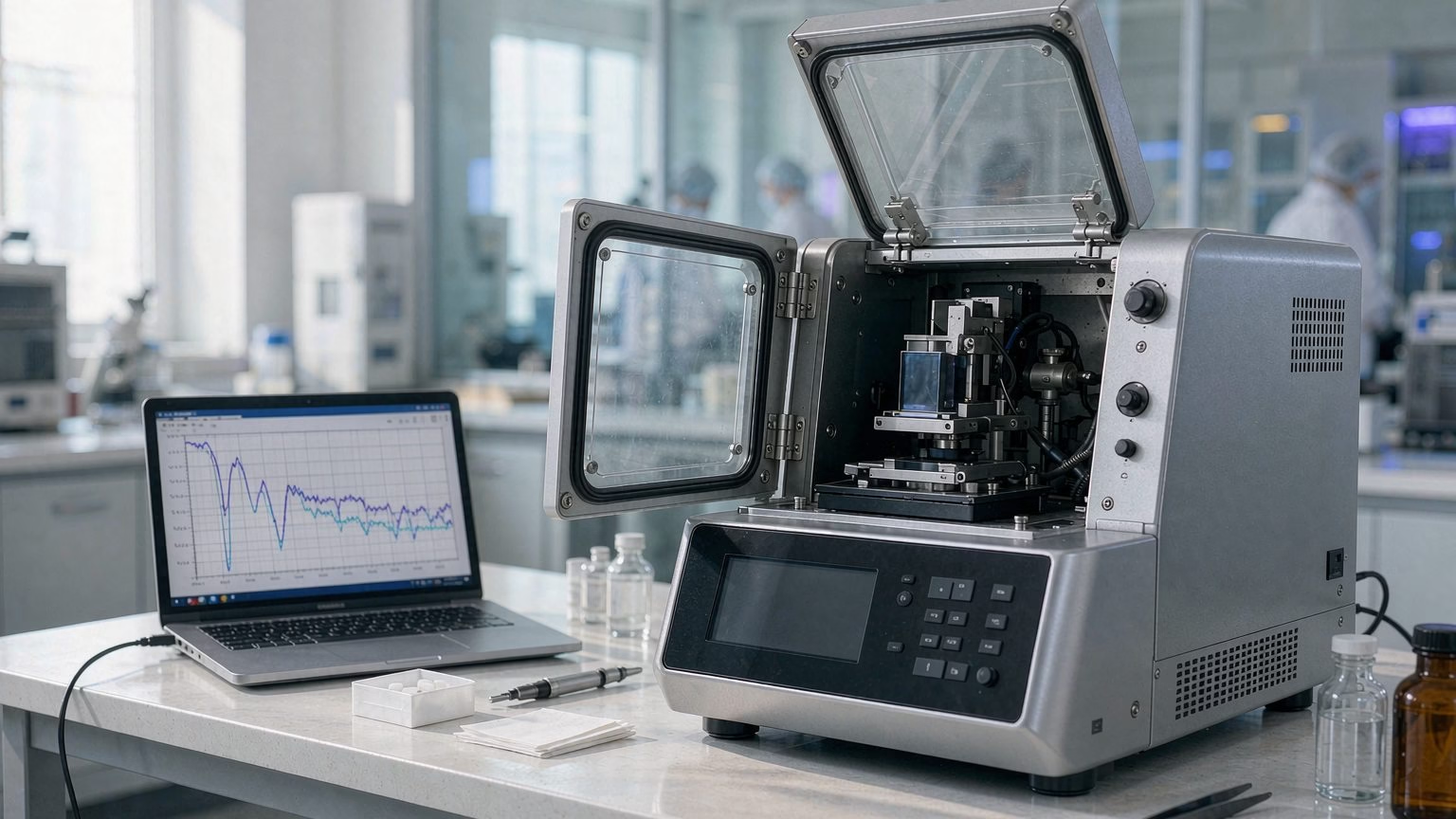
Regulated laboratories — pharmaceutical QC above all — need electronic-records compliance: user roles, audit trails, secure data, validated workflows aligned with 21 Partie CFR 11 [4]. That software stack is engineered and licensed, and it prices accordingly. A teaching or materials-development laboratory does not need it and should not buy it. The same logic applies to spectral libraries: search databases are licensed works whose scope (polymères, forensics, pharmaceuticals) and update rights differ; buy the library that matches your sample universe, not the biggest catalogue.
The cost is rarely the licence line alone. Compliance capability reaches into the hardware and the workflow: a data system that cannot distinguish an operator from an administrator cannot enforce role separation, and validation work — installing the package, proving the audit trail captures what the regulation expects, documenting the SOP, training staff — is paid in consultant days even where the licence itself is modest. This is the single most under-estimated line in many FTIR spectrometer price comparisons, because a quotation that lists “logiciel de conformité” as one item hides an implementation project behind it. The practical question to put to a supplier is not whether compliance is available but what the validated configuration looks like out of the box, and how much of the validation evidence they have already generated for it.
Running Costs: The Line Items Buyers Forget
| Running cost | Why it recurs | Mitigation |
|---|---|---|
| ATR crystals | Wear, damage from hard samples | Diamond for hard/abrasive work; keep ZnSe/Ge for dedicated roles [2] |
| IR source | Finite lifetime, degrades in humid air | Sealed optics; source-included service terms |
| Déshydratant / purge | Humidity protection for optics | Automated indicators, not manual schedules |
| Laser (HeNe or solid-state) | Wavelength reference, ages | Check replacement terms in service contract |
| Reference standards | Periodic verification (par exemple. NIST SRM 1921b for wavenumber) 3 | Budget the standard + re-certification cadence |
| Service visits | Alignement, détecteur, software updates | Coverage length and response time, par écrit |
Reference materials deserve a line of their own: wavenumber verification needs a traceable standard — NIST SRM1921b (polystyrene film, 13 certified bands from 540 à 3125 cm⁻¹) is the canonical choice, and its certificate’s non-uniform uncertainties across bands are exactly the detail a verification procedure should respect [3]. Laboratories that skip verification save pennies and lose defensibility.
The annualisation question is the one buyers skip: multiply each consumable’s replacement interval by its cost and divide by the interval to get a yearly figure, then compare that figure against what a service visit would have cost. A lab running a hard-sample ATR workload with diamond crystals will replace them far sooner than the schedule in the manual suggests, because abrasive samples scratch the crystal face before the rated lifetime is reached — and a scratched crystal is not just a consumable cost, it is a data-quality problem you may not notice until the spectra stop matching. Budget the interval the workload implies, not the interval the manufacturer rated, and put the replacement terms in writing at purchase, because the default “pay per replacement” arrangement transfers the whole risk to the laboratory.
Questions to Put to Every FTIR Supplier
| Question | What it exposes |
|---|---|
| Which performance descriptors do you quote against E1421? [1] | Spec-sheet vagueness |
| Is the interferometer sealed, and what humidity protection ships standard? | Lifetime drift and service cost |
| What exactly does the Part 11 package add, and what is excluded? [4] | Compliance sticker without substance |
| Can the microscope/accessories be retrofitted to this bench? | Dead-end architecture |
| What are the terms for source, laser and crystal replacement? | The running-cost reality |
| Which libraries are included, and are updates licensed? | Library lock-in |
Total Cost of Ownership Over Five Years
The purchase price is the part everyone compares; it is also the smallest part of the real number for a bench that runs daily. Build the ownership view as a table with four columns — what it is, when it recurs, whether it is fixed or workload-driven, and who carries the risk — and the quotation stops being the only thing on the table.
| Cost element | Recurrence | Driver | Typical risk holder if left unstated |
|---|---|---|---|
| Étalonnage / verification | Scheduled | Lab’s own labour + reference standards | Laboratory |
| Consumables (crystals, source, desiccant) | Workload-driven | Sample abrasiveness, humidity, hours of use | Laboratory |
| Service visits | Annual or on failure | Contract coverage vs pay-per-visit | Laboratory |
| Compliance validation | One-off + on change | Règlement, staff turnover | Laboratory |
| Training | On hire, on upgrade | Staff turnover | Laboratory |
| Downtime during failure | Unplanned | Spare-part availability, loaner terms | Supplier, unless negotiated |
Two readings matter here. D'abord, every row marked “laboratoire” is a row where the purchase price is not the deciding figure — the supplier who includes a service package and a spare-unit commitment has effectively priced risk transfer into the deal, and that package can justify a higher purchase price without making the instrument a worse value. Deuxième, the workload-driven rows are the ones a fixed-price comparison hides completely: two laboratories can own identical benches and face running costs that differ by a factor, purely because one tests abrasive industrial samples and the other tests finished consumer products. This is why a quotation written against a stated workload is worth more than a lower number written against a catalogue.
Matching the Configuration to the Workload
BRT Testing’s FTIR line spans the ladder: le BRT-890 FTIR spectrometer for QC and research workloads, le BRT-8 Plus FTIR spectrometer as the higher-end bench, et le BRT-800 FTIR spectrometer for routine identification. An identification laboratory that states its sample types, throughput and regulatory exposure can be quoted accurately in one pass — which is the real price lever: quotations written against workload, not against catalogue maxima.
The same logic applies to the ask. Tell the supplier what you will do, not what you might do: sample types (solid, liquide, film, gaz), expected daily specimen count, whether any work needs microscopy or kinetics, whether a regulator will ever look at the electronic records, and the ambient conditions of the room the bench will sit in. Those five answers determine almost every line of the quotation, and a supplier who quotes against them is giving you a configuration-accurate number rather than a catalogue entry. The FTIR spectrometer price you should plan around is the one written against your own workload — and the fastest way to find out whether a quotation does that is to check whether it names the sampling accessory, the detector type and the service terms, or simply lists a product code.
Foire aux questions
What is the biggest factor affecting FTIR spectrometer price?
Sampling configuration, then detector. A fixed-ATR benchtop instrument and the same instrument fitted with an IR microscope are different purchases entirely, because the microscope is a complete optical system. Detector choice follows: a room-temperature DTGS covers routine identification, while a cooled MCT detector — needed for microscope work, weak signals or fast kinetics — adds the detector and its cooling upkeep. Spectral range and resolution move the price less than these two.
Do I need an MCT detector?
Only if your work needs the extra sensitivity or speed: microscope-based microanalysis, weak-emission measurements, fast kinetic studies, or samples that give very weak spectra. For routine polymer and QC identification, a room-temperature DTGS detector delivers the performance the task requires. Buying MCT without one of those use cases means paying for sensitivity the workload never exercises, plus its cooling maintenance.
Why does compliance software cost extra?
Regulated laboratories must keep electronic records with user roles, audit trails and secure data handling aligned with 21 Partie CFR 11. That capability is engineered into the spectrometer’s data system and licensed separately, so it appears as a distinct line in quotations. If your laboratory is not regulated, the compliance package is unnecessary — but if it is, the software is not optional and quoting without it only defers the cost.
What running costs should I budget for an FTIR spectrometer?
The recurring items are ATR crystals (wear and damage), the infrared source (finite lifetime, worse in humid environments), desiccant or purge consumables, the wavelength-reference laser, traceable reference standards for verification — such as NIST SRM 1921b for wavenumber accuracy — and service coverage. Annualised, these can rival the depreciation on the bench itself in busy laboratories, which is why replacement terms belong in the purchase negotiation, not after it.
Are FTIR spectral libraries included with the instrument?
Sometimes a starter library is bundled, but professional libraries are licensed works with scope and update terms that vary by publisher and field — polymers, forensics, pharmaceuticals and so on. The cost driver is matching the library to your sample universe: a small, well-matched library outperforms a large generic one for identification confidence. Confirm what is included, what is licensed and how updates are delivered before comparing quotations.
How does resolution affect the cost?
Resolution capabilities step the optics price: 4 cm⁻¹ covers most identification work, while sub-cm⁻¹ resolution demands higher-grade interferometer engineering and shows in the quotation. The practical check is your chemistry — gas-phase work and certain crystalline or line-shape studies need the finer resolution; routine solids and liquids do not. Specifying more resolution than the workload uses is one of the most common over-specifications in FTIR purchasing.
Can accessories be added to an FTIR spectrometer later?
With most open-architecture benches, yes — ATR upgrades, transmission stages and libraries can be retrofitted — but microscope retrofit depends on the instrument’s optical design and space, and it should be confirmed in writing before purchase. The cost question to ask a supplier is not only “can it be added” but “at what price and with what downtime”, because retrofit terms vary widely and a dead-end architecture effectively fixes your sampling ladder at day one.
Conclusion: Une ordonnance de décision
- Define the workload: sample types, throughput, regulatory exposure.
- Choose the sampling rung first — it moves the quotation most [2].
- Pick the detector for the physics you actually run [1].
- Buy compliance software only if Part 11 s'applique [4].
- Negotiate running-cost terms — crystals, source, laser, verification standard — into the purchase [3].
The FTIR spectrometer price is decided by configuration, not by the wavelength line on the datasheet. The bench is the foundation, the sampling ladder is the price, the compliance layer is the qualification, and the ownership terms are the five-year truth. Get those four answers in writing from every supplier, compare the quotations on the same basis, and the cheapest-looking number usually stops looking cheapest.
BRT Testing quotes against workload: start at the BRT-890, BRT-8 Plus ou BRT-800 fiches produits, or see what an FTIR spectrometer is used for to match the bench to the task. Contact us with your sample list for a configuration-accurate quotation.
À propos de l'auteur
Tests BRT (Équipement d'automatisation de Shenyang Baoruitong) manufactures the BRT-800 series FTIR spectrometers for QC, research and education laboratories. The content team writes for buyers comparing quotations, with the performance-description and reference-standard facts above drawn from the ASTM and NIST documents cited. BRT Testing sells under B2B quotation; no prices are stated in this article.
Sources
- ASTM International — E1421, Standard Practice for Describing and Measuring Performance of Fourier Transform Mid-Infrared (FT-MIR) Spectrometers; the reference for the performance descriptors used in this article. https://store.astm.org/e1421.html
- ASTM International — E573, Standard Practices for Internal Reflection Spectroscopy; the reference for ATR sampling practice and crystal behaviour. https://store.astm.org/e573.html
- NIST — Certificate of Analysis for SRM 1921b, polystyrene film for FTIR wavelength calibration (13 certified bands from 540 à 3125 cm⁻¹). https://tsapps.nist.gov/srmext/certificates/1921b.pdf
- US Code of Federal Regulations (via Legal Information Institute, Cornell) — 21 Partie CFR 11, Electronic Records; Electronic Signatures. https://www.law.cornell.edu/cfr/text/21/part-11