The Short Answer
Cable insulation fire testing runs at two levels, and buying a compound on the strength of a finished-cable result is the most common mistake in the category. At material level the compound is screened on oxygen index to ISO 4589-2 2, on halogen acid gas release to IEC 60754-1 4 and, where a low-halogen claim is made, on the ion-chromatography route in IEC 60754-3 5. At cable level the finished construction is judged on flame propagation of a single insulated wire to IEC 60332-1-2 3, on a bunched ladder to IEC 60332-3, and in Europe on heat release, smoke and acidity under the EN 13501-6 class system 1. A result at one level does not transfer to the other: a compound with a high oxygen index can still fail a bunched-cable test if the cable design feeds the fire, and a cable that passes a single-wire test says nothing about its smoke or acid gas output. The tests are also conditioned differently, which is why EN 13238 6 has to be read alongside them.
Why the Insulation Compound Gets Tested Before the Cable Exists
A cable is a composite. The insulation is the part that touches the conductor, carries the dielectric duty, and in a fire becomes the first fuel the flame meets. Compound suppliers therefore test at pellet or plaque stage, long before a cable design is frozen, because that is the only point where a formulation change is still cheap.
What the compound actually contributes to a fire
Three contributions matter, and they are measured by three different tests. The first is ignitability, expressed as the limiting oxygen index: the minimum oxygen concentration in which a downward-propagating flame will keep burning. The second is fuel value, which is why halogen-free formulations are not automatically better — a polyolefin carries a higher calorific load than a plasticised PVC even though it releases no hydrogen chloride. The third is the chemistry of what leaves the material, meaning hydrogen halides, acidity and smoke optical density.
That third contribution is where export projects most often come unstuck. A compound can be genuinely halogen-free and still produce enough smoke to miss an s1 sub-class, and a flame-retardant PVC can hold a high oxygen index while releasing acid gas that corrodes switchgear in the compartment next door.
The three failure routes that start in the compound
In practice, compound-driven failures fall into three patterns, and each has a different remedy.
| Failure route | What it looks like in the report | Where the fix sits |
|---|---|---|
| Flame outruns the specimen | Char reaches the upper clamp in IEC 60332-1-2, or the ladder keeps burning after the burner is removed | Flame-retardant loading, filler type, or a change of base polymer |
| Heat release too high for the target class | FIGRA above the class limit in the EN 50399 route | Formulation, but also cable geometry — insulation thickness and core count both count |
| Smoke or acidity sub-class missed | Transmittance too low, or conductivity and pH outside the a1 / a2 window | Filler system, and the choice between halogenated and halogen-free chemistry |
Cable Insulation Fire Testing at Material Level: Three Measurements
Material-level testing is cheap, fast and directional. It is not a substitute for a cable test, and the standards do not treat it as one.
Limiting oxygen index to ISO 4589-2
The oxygen index test burns a small vertical specimen in a controlled oxygen/nitrogen atmosphere and finds the lowest oxygen fraction that sustains combustion [2]. Results are reported as a percentage, and comparisons are only valid between specimens of the same geometry and conditioning. A polyethylene or XLPE compound typically sits in the high teens to low twenties; a flame-retardant filled compound runs appreciably higher, and heavily filled halogen-free grades sit higher again.
The number is useful for ranking formulations and for incoming-goods checks. It is a poor predictor of a bunched-cable result, because the test has no ladder, no mutual heating between cables and no vertical chimney effect. North American work uses ASTM D2863 for the same measurement 7, which is why a supplier quoting “LOI 32” without a method reference has told you almost nothing.
Halogen acid gas to IEC 60754-1 and IEC 60754-3
IEC 60754-1 burns a weighed sample in a tube furnace, absorbs the combustion gases in solution and titrates the halide present, reporting the result as milligrams of halogen acid per gram of material [4]. Two practical points sit inside that method and are routinely missed in data sheets.
The first is the reporting floor: the method is not recommended for reporting values below 5 mg/g, so a claim of “less than 5 mg/g” is a statement about the method’s precision, not a measured zero. The second is scope — the method is written for individual components of a cable construction, and the standard itself warns against declaring cable performance from a test on a material combination.
IEC 60754-3 takes a different analytical route, using ion chromatography to measure chlorine, bromine, fluorine and iodine at low levels [5]. It exists because titration runs out of resolution where halogen-free compounds live. A compound supplier claiming a halogen-free grade should be able to say which of the two methods produced the figure.
Smoke, measured on the compound and on the cable
Smoke is measured in two places, and the numbers are not interchangeable. On the material side, small-scale smoke density work tells you how much light a specimen obscures under a defined irradiance. On the cable side, the EN 13501-6 route uses the smoke production measured during the EN 50399 test, plus transmittance from the 3 m cube test, to assign an s1, s2 or s3 sub-class [1].
That split is the reason a compound data sheet can look excellent and the cable still miss s1. The cube test measures a different fire size, a different geometry and a different moment in the burn.
Cable Insulation Fire Testing at Cable Level: The Class Route in Europe
Once the cable exists, the question changes from “what is this material” to “what does this construction do in a defined fire”. In Europe that question is answered by EN 13501-6, and the current edition is EN 13501-6:2018+A1:2022, in force since 21 December 2022 [1]. The 2014 edition it replaced was withdrawn on 19 December 2018 8, which is why data sheets still quoting “EN 13501-6:2014” are citing a superseded text.
The seven classes and what each one actually requires
| Class | Test route | What it establishes |
|---|---|---|
| Aca | EN ISO 1182 and EN ISO 1716 | The cable materials are effectively non-combustible; almost no cable reaches it |
| B1ca | EN 50399 at the higher burner output, plus EN 60332-1-2 | Very limited heat release and flame spread on a bunched ladder |
| B2ca | EN 50399, plus EN 60332-1-2 | Limited contribution, with a wider heat release budget than B1ca |
| Cca | EN 50399, plus EN 60332-1-2 | Moderate contribution; the common target for public buildings |
| Dca | EN 50399 at the lower burner output, plus EN 60332-1-2 | Higher contribution, still bounded |
| Eca | EN 60332-1-2 only | Flame propagation on a single wire; no heat release data |
| Fca | No performance determined | The default when nothing has been tested |
The IEC 60332 family behind those routes — single wire, small cable and bunched ladder, plus the 2018 revision — is set out in our IEC 60332 cable flame testing guide.
The class letter is only half the designation. Smoke and acidity are carried as sub-classes, and a complete designation looks like Cca-s1b,d1,a1 — class, smoke, burning droplets and acidity in that order.
The sub-classes that decide whether a project accepts the cable
Smoke sub-classes s1, s2 and s3 are assigned from smoke production during EN 50399 together with transmittance in the cube test. Acidity sub-classes come from IEC 60754-2 and are the ones compound suppliers should watch most closely, because they are read directly off the material’s combustion chemistry:
| Acidity sub-class | Conductivity | pH |
|---|---|---|
| a1 | ≤ 2.5 µS/mm | ≥ 4.3 |
| a2 | ≤ 10 µS/mm | ≥ 4.3 |
| a3 | Neither a1 nor a2 | — |
A halogen-free compound will normally clear a1 with margin. A flame-retardant PVC will not clear a1 at all, and no amount of formulation work will get it there — the chlorine is in the polymer backbone. That is a specification decision, not a testing problem, and it is better made before the cable design is released than after the first classification report.
The Material Ladder: PVC, PE, XLPE, EPR and LSZH
Compound families are not interchangeable, and the table below is a starting point for a conversation with a supplier rather than a specification. Oxygen index values in particular depend on filler loading and on the test method used.
| Compound family | Halogen content | Typical oxygen index band | Realistic EN 13501-6 ceiling | Where it usually stops |
|---|---|---|---|---|
| Plasticised PVC | High | Mid twenties to low thirties | Cca with careful design | Acidity: cannot reach a1 |
| PE / XLPE | None | High teens to low twenties | Eca on its own | Burns readily; needs fillers or a mica tape |
| Filled halogen-free (LSZH) | None | Low thirties and above | B2ca, sometimes B1ca | Smoke and heat release at high filler loading |
| EPR / EPDM | None | Low twenties | Eca to Dca | Flame propagation on the ladder |
| Silicone rubber | None | High twenties and above | Dca to Cca | Mechanical properties, not fire performance |
Why the oxygen index column misleads buyers
A high oxygen index means the material needs more oxygen to keep burning in a small-scale test. It does not mean the cable will pass a ladder test, because a bunched cable generates its own preheated draught and radiant field. Two compounds with the same oxygen index can differ by a whole class once they are made into cables of different core counts.
The practical consequence is that compound selection should be driven by the target class, then confirmed by a cable test, not the other way round. Buying a higher-index compound to fix a B2ca shortfall is an expensive way to discover that the problem was insulation thickness. The wider family of small-flame and oxygen-index methods for polymers is compared in our guide to testing the flammability of plastic materials.
Cable Insulation Fire Testing: Sample Preparation, Conditioning and the Details That Move Results
Most “the lab got a different number” disputes are preparation disputes. EN 13238 sets the conditioning atmosphere and the substrate rules that the reaction-to-fire test methods assume [6], and deviations from it are the first thing to check when two laboratories disagree.
For cable work specifically, four details decide whether a result is comparable:
- Non-metallic volume per metre. The bunched-cable categories are defined by litres of non-metallic material per metre of ladder, not by cable count. Two “Category C” ladders can carry very different fuel loads.
- Conditioning time and atmosphere. Damp insulation burns differently from dry insulation, and the difference is large enough to cross a class boundary.
- Ageing before test. Where a specification calls for aged specimens, the ageing regime belongs in the test request, not in a footnote.
- Specimen mounting tension. A slack specimen sags into the flame; an over-tensioned one pulls away from it.
North America and China: The Parallel Routes
Projects rarely stay inside one regulatory system, and a compound that satisfies a European class may still need a second data set.
| System | Insulation-relevant tests | What it produces |
|---|---|---|
| Europe (CPR) | EN 50399, EN 60332-1-2, EN 61034-2, IEC 60754-2 | An EN 13501-6 class with sub-classes |
| North America | UL 1581 VW-1, UL 44 / UL 83, ASTM D2863 for oxygen index | A pass mark or a material rating, not a class |
| China | GB/T 19666, GB/T 18380 series, GB/T 17650 series, GB/T 17651 series | A product-standard compliance statement |
The mismatch that catches exporters is the middle row. A VW-1 pass is a single-wire indicator test, and it is not a class. Presenting it as an equivalent of Cca invites a rejection at submittal, because the European reviewer is looking for heat release, smoke and acidity data that VW-1 does not produce.
What a Supplier Should Declare After Cable Insulation Fire Testing
A short, checkable declaration beats a long one. The items below are the minimum that lets a cable maker or a specifier use the data without asking follow-up questions.
| Item | Why it has to be stated |
|---|---|
| Test method and edition | “IEC 60754-1” without the edition cannot be verified against a current text |
| Specimen form | Pellet, plaque or granulate change the result |
| Conditioning before test | EN 13238 atmosphere or an equivalent, stated explicitly |
| Result with units and uncertainty | “32” is not an oxygen index; “32 % at 23 °C / 50 % RH” is |
| Whether the value is a measured figure or a method floor | Distinguishes a real 4 mg/g from “below 5 mg/g” |
| Cable-level data, if claimed | A compound result cannot be presented as a cable class |
Equipment for Cable Insulation Fire Testing
The test programme above needs four capabilities, and they are usually bought at different times rather than as one package.
Circuit integrity — whether the cable keeps working while it burns — is a separate programme, covered in our IEC 60331 cable fire resistance guide.
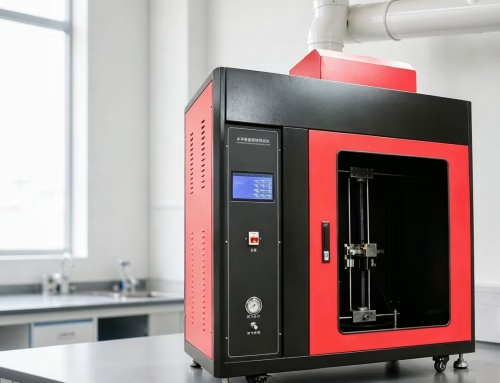
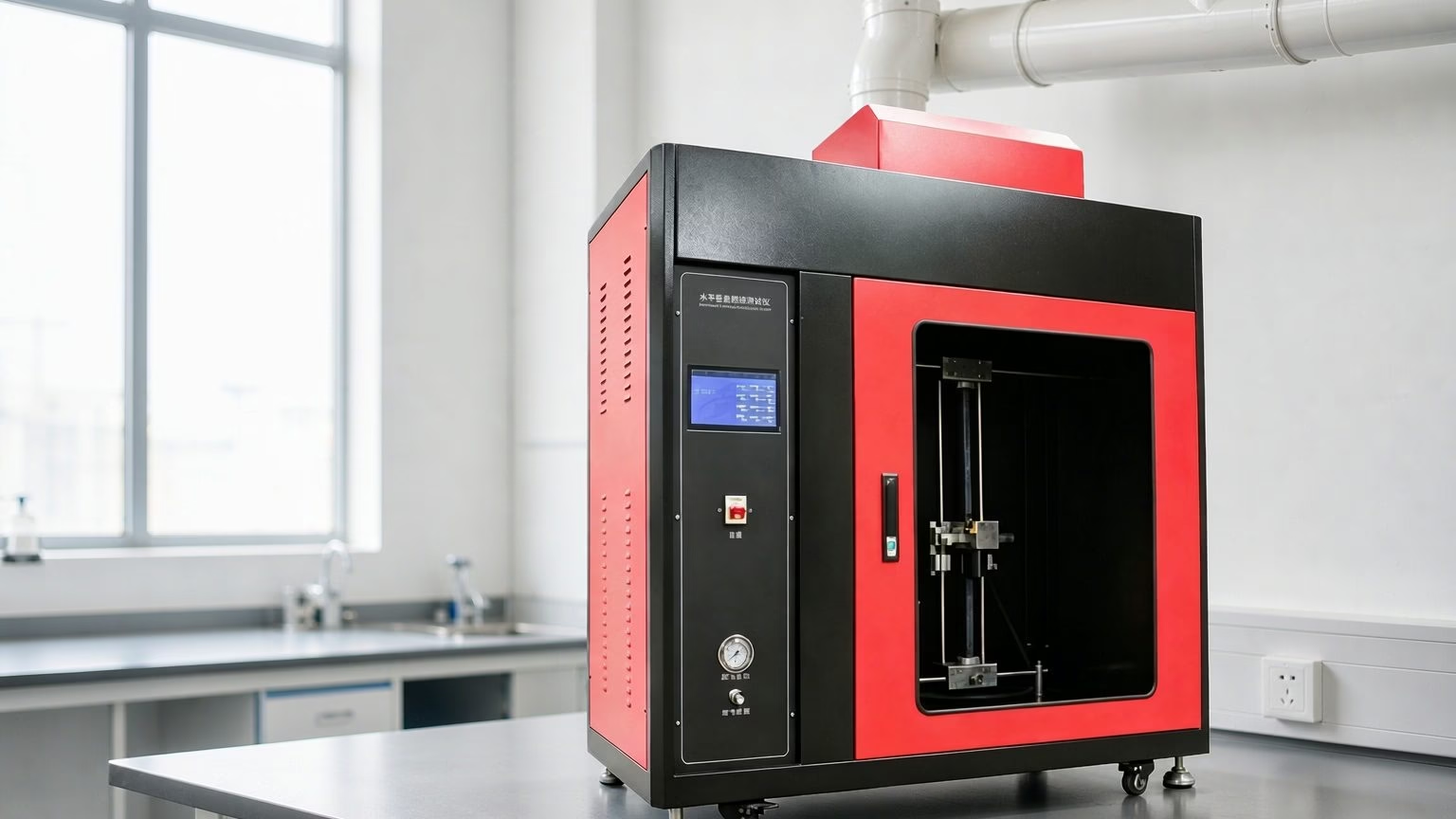
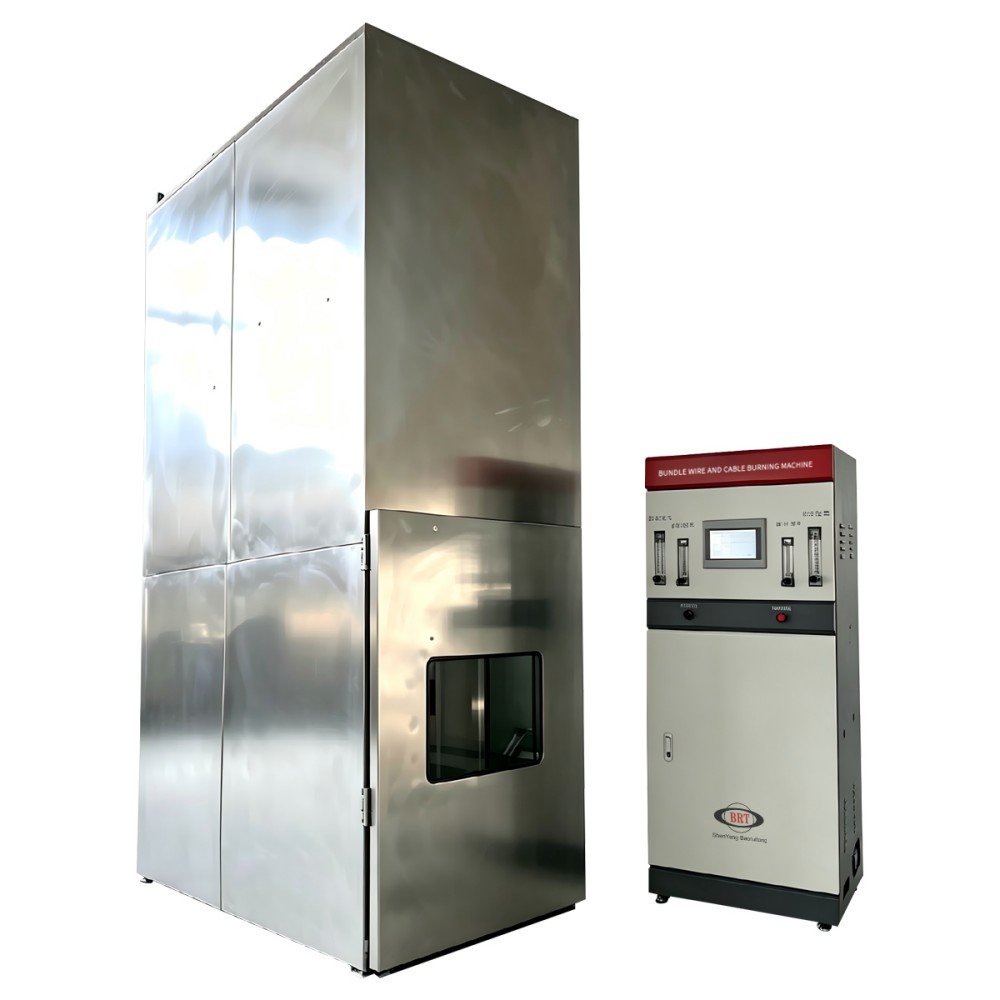
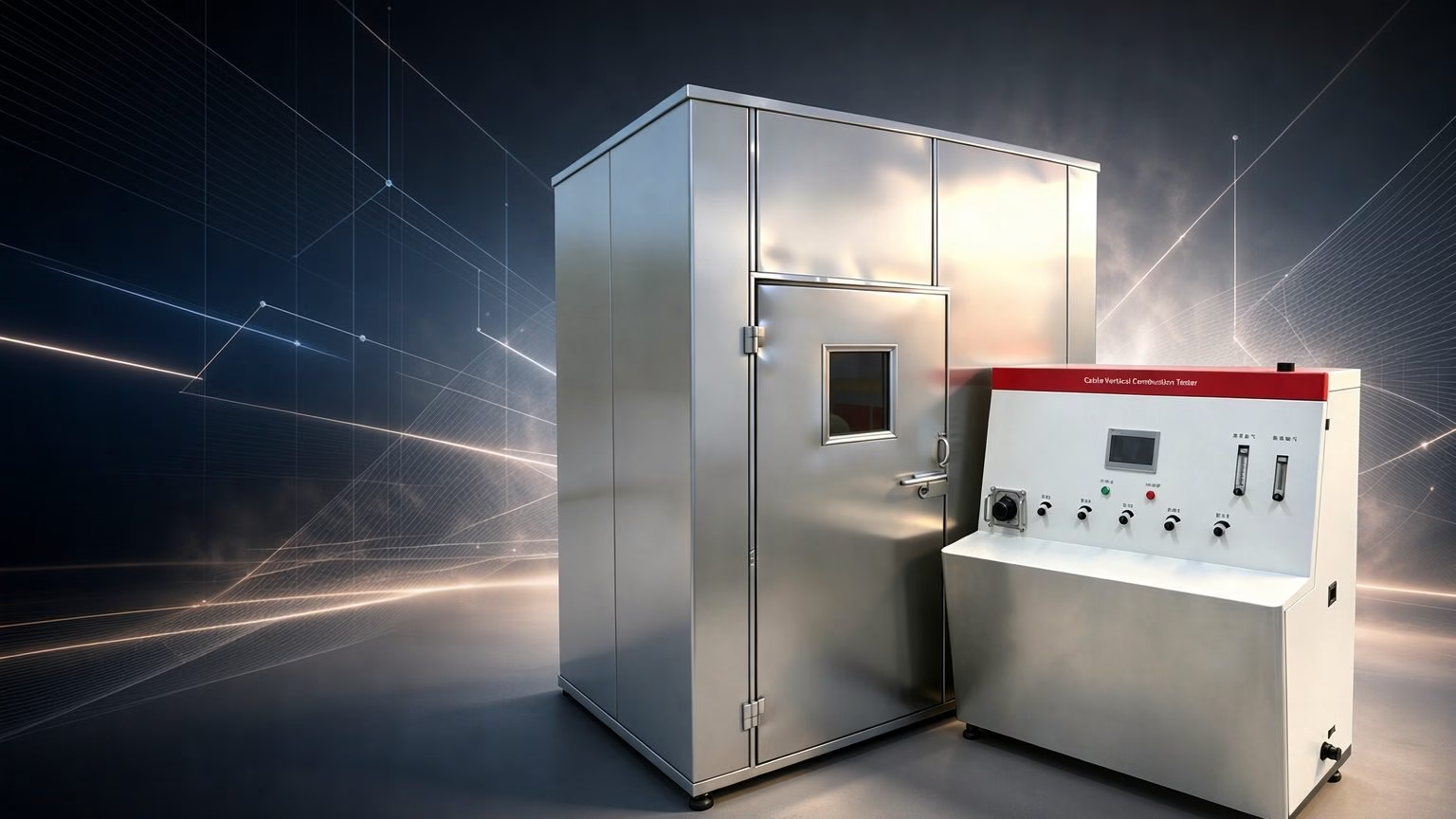
A material-level bench needs an oxygen index tester and a tube-furnace acid gas train. A cable-level bench needs either a single-wire rig or a bunched ladder, and if European classes are the target, a heat release calorimeter for the EN 50399 route plus a smoke cube. BRT Testing supplies the oxygen index testers, the bundled cable vertical flame test equipment and the cable fire resistance tester used for circuit integrity work, and the fire and flame testing equipment category page lists the full range.
Frequently Asked Questions
Is cable insulation fire testing the same as testing the finished cable?
No. Insulation testing works on the compound — pellets, plaques or granulate — and measures oxygen index, acid gas and smoke potential. Finished-cable testing mounts the actual construction on a wire rig or a ladder and measures flame propagation, heat release and smoke production. A compound result ranks formulations; a cable result is what a class is built from.
What oxygen index does a cable compound need?
There is no universal number, because the index depends on filler loading and specimen geometry and because the cable test, not the index, decides the class. A compound in the low thirties is common for filled halogen-free grades aimed at Cca or B2ca. Treat any single index figure quoted without a method and a specimen form as indicative only.
Why does my halogen-free compound still fail the acidity sub-class?
Usually because the claim and the measurement are about different things. Halogen-free describes the polymer system; the a1 sub-class is set by conductivity and pH under IEC 60754-2, and fillers, additives, colourants and processing aids all contribute. Ask for a test report on the actual production formulation rather than on a development sample.
Can a single-wire IEC 60332-1-2 pass be used for a bunched installation?
No. IEC 60332-1-2 places one insulated wire in a flame and checks how far the char travels. A bunched ladder has mutual heating, a chimney effect and a much larger fuel load, which is why the EN 13501-6 classes above Eca need heat release data from EN 50399. A single-wire pass is a floor, not a ceiling.
Which edition of EN 13501-6 is current?
EN 13501-6:2018+A1:2022, in force since 21 December 2022. The 2018 edition was withdrawn on the same date, and the 2014 edition was withdrawn on 19 December 2018. Data sheets in circulation still quote the 2014 text, so check the edition before using a class in a specification.
Does the 5 mg/g figure in IEC 60754-1 mean zero halogen?
No. It is a reporting floor: the method is not recommended for reporting values below 5 mg/g of sample, because the precision does not support it. A “less than 5 mg/g” statement is honest; presenting it as a measured zero is not, and IEC 60754-3 exists precisely to resolve the low-level range.
What does the “d” in a cable class designation mean?
It is the burning-droplet sub-class, written d0, d1 or d2, and it records whether burning material fell from the specimen during the EN 50399 test. It is separate from the smoke and acidity letters, which is why a full designation such as Cca-s1b,d1,a1 carries four independent judgements rather than one.
Conclusion: A Decision Order
The order below keeps a compound programme from spending money on the wrong test.
- Fix the target class from the project specification, including sub-classes, before talking to compound suppliers.
- Screen candidate compounds on oxygen index and acid gas, and record method and edition for each figure.
- Ask for the smoke and acidity numbers in the form the class system uses, not in a supplier’s own scale.
- Make cables at the intended construction and run the cable-level test — single wire first, ladder if the class needs it.
- Re-test after any formulation, filler or thickness change, because a class belongs to a construction, not to a material.
Talk to BRT Testing about the bundled cable vertical flame test equipment or the oxygen index tester behind these tests, or get in touch with the class you are targeting and the cable construction you are working with.
About the Author
Written by the BRT Testing application engineering team in Shenyang, China. BRT Testing builds fire and flame test equipment for cable, construction and polymer laboratories, and works with compound suppliers and cable makers on test programmes built around IEC, EN and GB methods. Standard editions quoted in this article were checked against the IEC webstore and the UNI store on 2 November 2026.
Sources
- UNI — EN 13501-6:2018+A1:2022, Fire classification of construction products and building elements, Part 6 — https://webstore.uni.com/en/en-13501-6-2018-a1-2022
- UNI — ISO 4589-2:2017, Determination of burning behaviour by oxygen index, ambient-temperature test — https://webstore.uni.com/en/iso-4589-2-2017
- IEC — IEC 60332-1-2:2025, Test for vertical flame propagation for a single insulated wire or cable — https://webstore.iec.ch/en/publication/80873
- 国家数字标准馆 — IEC 60754-1:2011+AMD1:2019, Determination of the halogen acid gas content — https://ndls.org.cn/standard/detail/ff6bdca2bd7f3177800510d5b546f490
- 国家数字标准馆 — BS EN IEC 60754-3:2019, Measurement of low level of halogen content by ion chromatography — https://ndls.org.cn/standard/detail/eb8dd18894ba69a38a10bff7566d7448
- UNI — EN 13238:2010, Conditioning procedures and general rules for selection of substrates — https://webstore.uni.com/en/en-13238-2010
- ASTM — D2863, Measuring the minimum oxygen concentration to support candle-like combustion of plastics — https://store.astm.org/d2863-23.html
- UNI — EN 13501-6:2014, superseded edition, withdrawn 19 December 2018 — https://webstore.uni.com/en/en-13501-6-2014