A resposta curta
A plastic part in electrical equipment is not asked to pass one fire test. It is asked to survive four physically different ignition scenarios, and each has its own method. A small flame from outside is covered by the 50 W horizontal and vertical flame test in IEC 60695-11-10, which produces the HB and V-0, V-1, V-2 classifications 1. A larger flame is covered by the 500 W method in IEC 60695-11-20, which adds a plaque burn-through check 2. A small flame from a fault condition inside the equipment is covered by the needle-flame test in IEC 60695-11-5 3. An overheated or glowing internal part is covered by the glow-wire family, which splits into an end-product test and two material properties 4567. A contaminated surface breaking down under voltage is covered separately by IEC 60112 8. The requirement is never “make it flame retardant”; it is a named method, a severity and a specimen thickness, and it comes from the end-product standard, not from the material datasheet.
The Four Failure Modes a Part Has to Survive
| Failure mode | Fonte de ignição | Method family | What the result looks like |
|---|---|---|---|
| Ignition by a small external flame | A flame from outside the equipment | CEI 60695-11-10, 50 C [1] | HB, V-2, V-1, V-0 |
| Ignition by a larger flame | A more severe external flame | CEI 60695-11-20, 500 C [2] | 5VB, 5VA |
| Ignition by a small internal flame | A flame from a fault inside the equipment | CEI 60695-11-5, needle flame [3] | Pass or fail against the product standard |
| Ignition by an overheated part | A glowing or glowing-hot element | CEI 60695-2-10 para -2-13 [4][5][6][7] | GWEPT result; GWFI or GWIT value |
| Breakdown across a wet, dirty surface | Tracking under voltage | CEI 60112 [8] | PTI or CTI value |
Small Flame from Outside
O 50 W pre-mixed flame of IEC 60695-11-10 is the workhorse, and it is the method behind the familiar HB and V-classifications [1]. Both a horizontal and a vertical procedure are available, and the vertical procedure is the one that produces V-0, V-1 and V-2 based on afterflame times and whether flaming particles drip. Because the burner is only 50 C, the method deliberately models a modest external ignition source rather than a developed fire.
A Hot or Glowing Internal Part
The glow-wire family models something quite different: a component that is already hot because current is flowing through it, or a connection that has overheated. CEI 60695-2-10 covers the apparatus and the general method [4], and the family then splits by what is being tested, which is the single most important distinction in this article [5][6][7].
Tracking Across a Contaminated Surface
The fourth scenario is not a flame at all. An insulating surface contaminated with moisture and dust can form a conducting path under voltage, and the resulting tracking leads to erosion and eventually to ignition. That behaviour is measured by IEC 60112, whose current edition is edition 6.0 published on 23 June 2025 [8], and which produces a proof tracking index or a comparative tracking index.
The Small Flame Methods
| Method | Flame power | Classifications produced | Current edition |
|---|---|---|---|
| CEI 60695-11-10 | 50 C | HB, V-2, V-1, V-0 | 2013 [1] |
| CEI 60695-11-20 | 500 C | 5VB, 5VA | 1999 with Amendment 1:2003 consolidated [2] |
Thickness Is Part of the Classification
This is the point that costs the most rework. A vertical flame classification is only valid at the thickness tested, and a material rated V-0 no 3.0 mm carries no claim at 0.8 milímetros. Thin-wall parts — connector bodies, cable tie mounts, film insulators, the walls of small enclosures — routinely fail at thicknesses where the same compound passes comfortably at 3 milímetros, because there is less material to absorb and carry away the heat of the flame. The practical consequence is that a component specification must state the wall thickness alongside the classification, and that a material selection made from a datasheet table without checking which row the thickness falls in is not a selection at all.
Where the 500 W Method Adds Something
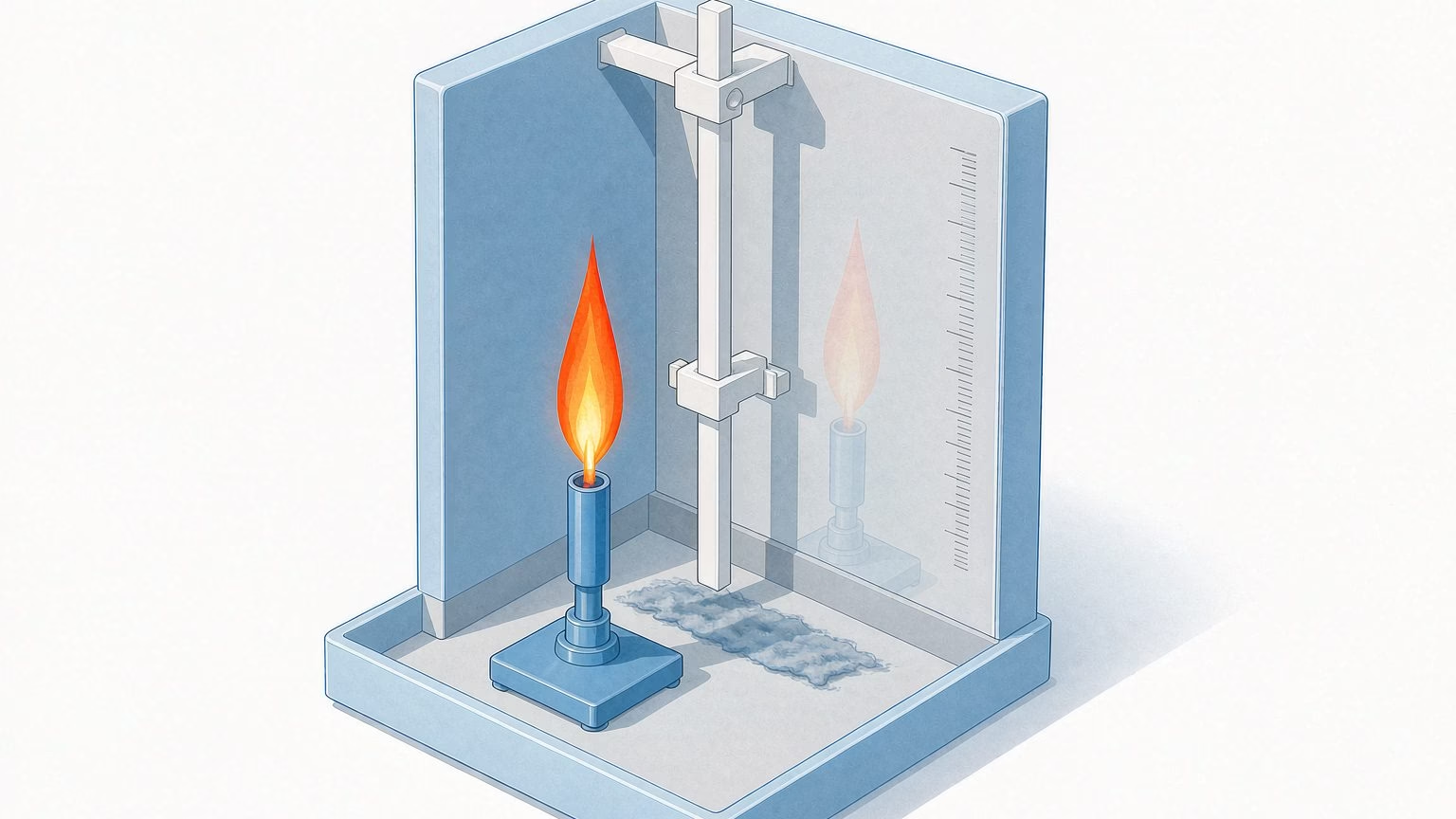
O 500 W method is not simply a harsher version of the same test. CEI 60695-11-20 adds a burn-through check on a plaque, which is why its classifications are 5VB and 5VA rather than another step in the V series [2]. A material that holds V-0 in the 50 W test can still be penetrated by the 500 W flame, and the distinction matters for parts that separate a live conductor from the outside of the equipment. The underlying UL designation for this severity is UL 94 5V; our UL 94 5V testing article treats it separately, e o HB, V-0, V-1 and V-2 explained article covers the 50 W classifications in detail.
The Glow-Wire Family
| Papel | What it is | Output | Current edition |
|---|---|---|---|
| CEI 60695-2-10 | Glow-wire apparatus and test method, general | Method and apparatus | 2013 [4] |
| CEI 60695-2-11 | Glow-wire end-product test | GWEPT: pass or fail at a specified temperature | 2014 [5] |
| CEI 60695-2-12 | Glow-wire flammability index for materials | GWFI: a temperature | 2021 [6] |
| CEI 60695-2-13 | Glow-wire ignition temperature for materials | GWIT: a temperature | 2021 [7] |
The End-Product Test and the Material Properties Are Not Interchangeable
The split is worth stating plainly, because it is the most common specification error in this family. CEI 60695-2-11 is a test on a finished part: the glow wire is applied to the component as it will be used, at a temperature the product standard names, and the result is pass or fail [5]. CEI 60695-2-12 e -2-13 are material properties measured on standard plaques: GWFI is the highest temperature at which the material either does not ignite or extinguishes within the specified time without burning droplets, and GWIT is set above the highest temperature at which no ignition occurred in three consecutive tests [6][7]. A GWIT value is a material datum used to select a compound; it is not a substitute for the end-product test on the finished geometry, where wall thickness, ribs, proximity to other parts and ventilation all change the outcome.
The Severities Product Standards Actually Use
Product standards name a glow-wire test temperature, and in practice the severities cluster on a small set of values, commonly 550 °C, 650 °C, 750 °C, 850 °C e 960 °C, with the temperature chosen according to whether the part carries current, whether it is a connector, and whether a failure would expose a live part. The rule of thumb that follows from the family’s structure is simple: the hotter the specified severity, the more the requirement starts to look like a material selection problem, and the more likely a compound has to be chosen on GWFI or GWIT data before a prototype exists.
Needle Flame: CEI 60695-11-5
The needle-flame test, current in its 2016 edição, models a small flame originating inside the equipment from a fault condition [3]. It is applied to the finished part or to a sub-assembly, and it answers a question the other small-flame methods do not: whether a flame that starts at a component — rather than arriving from outside — propagates to the surrounding material. It is widely referenced in product standards for exactly that reason, because it is the cheapest way to screen for “does a fault here become a fire there”. Our practical guide to IEC 60695 flammability testing maps where needle flame sits relative to the rest of the family.
Tracking: CEI 60112
| Index | What it is | How it is used |
|---|---|---|
| Proof tracking index (PTI) | Acceptance criterion at a specified voltage | Acceptance testing and quality control of materials and fabricated parts [8] |
| Comparative tracking index (CTI) | The voltage at which a material reaches the tracking limit | Basic characterisation and comparison of material properties [8] |
What CTI Does Not License You to Do
CEI 60112 is explicit on this point, and it is the sentence most often skipped. Test results are not directly suitable for the evaluation of safe creepage distances when designing electrical apparatus [8]. The standard also notes that this test discriminates between materials with relatively poor resistance to tracking and those with moderate or good resistance, for equipment used under moist conditions, and that results have to be used together with overvoltage levels, creepage distances and the pollution degree expected in service, in compliance with IEC 60664-1. A CTI figure is therefore a material comparison tool and an input to insulation coordination, not a clearance calculation. The current edition also states that the described test method is designed for a test voltage up to 600 V AC, because higher test voltages and DC voltage give a reduced test severity [8].
Reading a Material Datasheet
| Datasheet claim | What to check | Trap |
|---|---|---|
| “V-0” | At which thickness, and to which method | V-0 no 3.0 mm says nothing about 0.8 milímetros [1] |
| “5VA” | Whether the 500 W method was used | Not a step in the V series [2] |
| “GWIT 775 °C” | Whether it is GWIT or GWFI | Different definitions, different numbers [6][7] |
| “Glow wire 960 °C passed” | Whether it was the end-product test | Material data does not cover finished geometry [5] |
| “CTI 600” | Whether it is CTI or PTI, and the edition | PTI is an acceptance value, CTI is a comparison value [8] |
| “Flame retardant” | Nothing measurable | Not a requirement |
The general pattern is that a datasheet claim is only a requirement when it carries a method, an edition, a severity and a thickness. Everything else in the table is marketing, however technically respectable the underlying test was.
What a Component Programme Looks Like in Order
Plastic component fire testing is easiest to get right when it is sequenced, because each step narrows what the next one has to cover. The sequence that avoids the usual rework runs roughly as follows.
Start with the product standard, not with the material. Read the clause and write down four things: o método, the edition, the severity and the specimen. If any of the four is missing from your note, the clause has not been read yet.
Próximo, map each clause onto one of the five scenarios. A component often collects three or four obligations in the same document — a 50 W classification for the housing material, a glow-wire end-product test at a named temperature for the terminal block, a needle-flame test for an internal barrier, and a tracking index for the insulation. Sorting them this way turns a confusing list into five short work packages.
Then pre-screen the material before a prototype exists. LOI, GWFI and GWIT data cost far less than a failed end-product test, and they eliminate compounds that will not survive the severity the standard names. This is where a material selection actually happens; everything after it is verification.
Then test the part, at the thickness it will be moulded, with the geometry it will have.
Finally, keep the specimens and the report together. When a tool change alters wall thickness by a few tenths of a millimetre, the classification may no longer apply, and the fastest way to know is to have the original specimen available for comparison.
Where Plastic Component Fire Testing Goes Wrong
| Failure | Cause | Fix |
|---|---|---|
| Part passes at 3 milímetros, fails in production | Classification quoted without thickness | Specify thickness with the classification [1] |
| Material selected on GWIT, part fails GWEPT | Material property used as an end-product result | Run the end-product test on the finished part [5][6][7] |
| V-0 specified where 5VA was needed | Severity chosen from habit, not from the product standard | Read the product standard’s named method [2] |
| Needle flame omitted | Only external ignition considered | Add IEC 60695-11-5 for internal fault ignition [3] |
| CTI used as a clearance calculation | Standard explicitly excludes it | Use it as a material comparison input only [8] |
| Enclosure-level test ordered for a component | Wrong level of assembly | Component methods first, enclosure methods second |
Equipment for Plastic Component Fire Testing
| Equipment | Which scenario it covers | Product page |
|---|---|---|
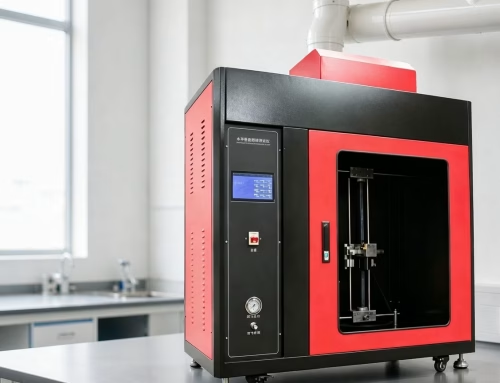
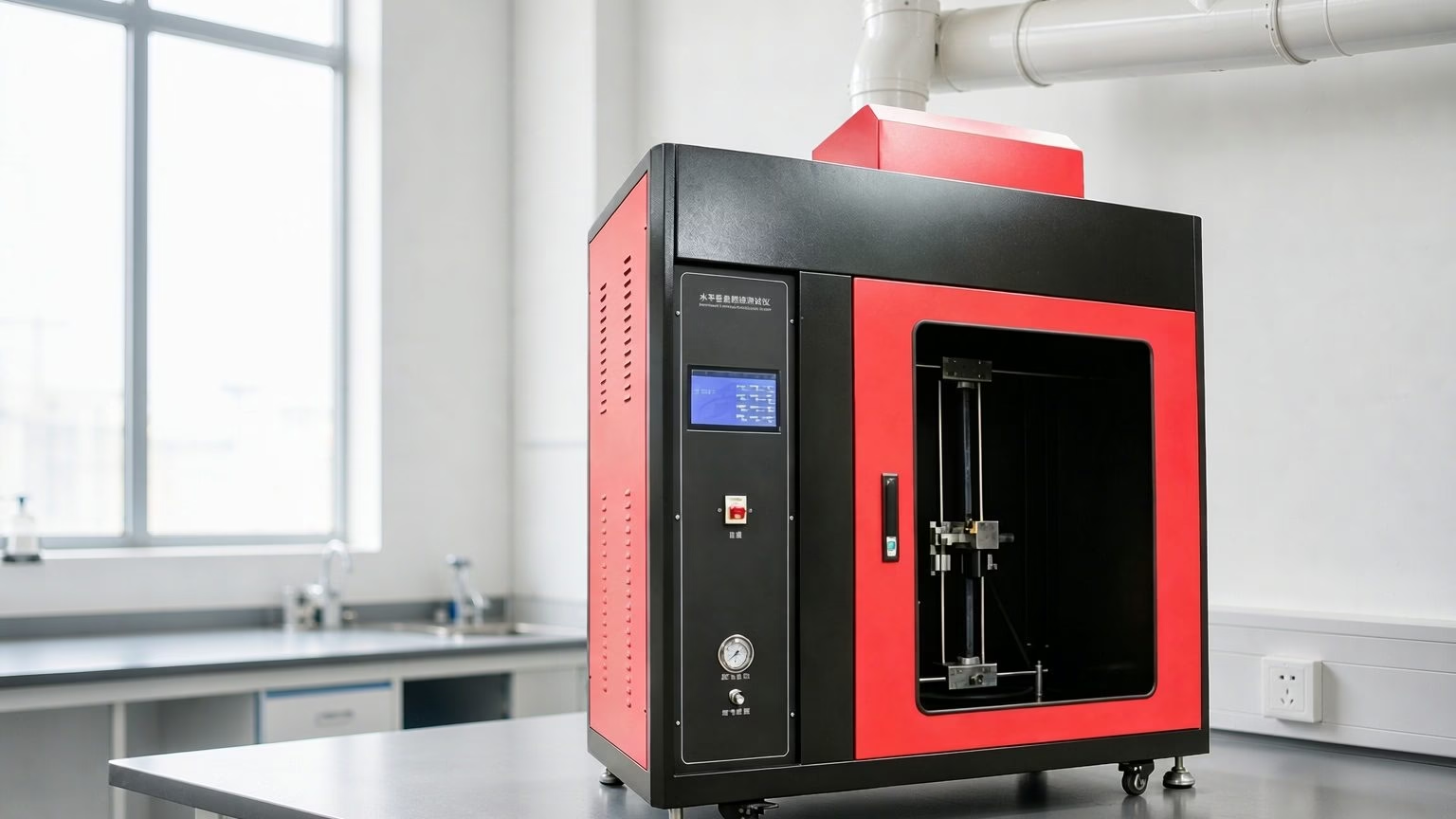
| Horizontal and vertical combustion tester | 50 W and 500 W small-flame methods, HB through 5VA | Horizontal and vertical combustion tester |
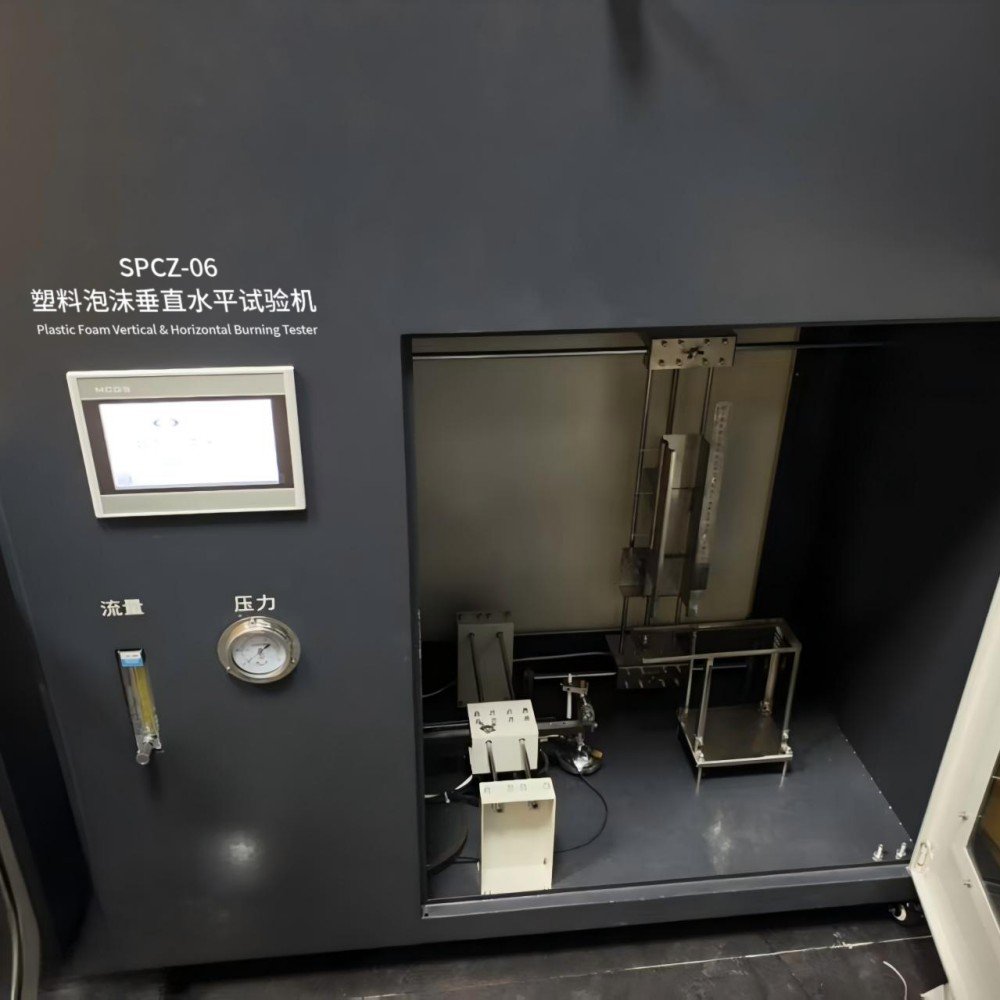
| Plastic foam vertical and horizontal burning tester | Vertical and horizontal procedures on cellular plastics and thin parts | Plastic foam vertical and horizontal burning tester |
| Plastic limiting oxygen index tester | LOI screening during compound development before flame testing | Plastic LOI limiting oxygen index tester |
| Intelligent automatic touch screen oxygen index tester | Higher-throughput LOI work with automatic control | Intelligent automatic touch screen oxygen index tester |
A component laboratory is usually built around the small-flame chamber first, because it generates the classifications that appear in most component specifications, and then adds a glow-wire apparatus when end-product work starts. Where the team also has to test the enclosure rather than the part, the methods change level entirely — see fire testing methods for electrical enclosures — and where the question is about the plastic material rather than the component, how to test the flammability of plastic materials is the closer reference.
Perguntas frequentes
Is V-0 enough for a plastic electrical component?
Not by itself. V-0 comes from the 50 W method of IEC 60695-11-10 and only at the thickness tested. A component may also need the 500 W method, a glow-wire end-product test at a temperature the product standard names, a needle-flame test, or a tracking index, depending on what the product standard requires.
What is the difference between GWFI and GWIT?
Both are material properties measured on standard plaques. GWFI is the highest temperature at which the material does not ignite, or ignites and extinguishes within the specified time without burning droplets. GWIT is set above the highest temperature at which no ignition occurred over three consecutive tests.
Can a GWIT value replace the glow-wire end-product test?
Não. CEI 60695-2-11 is a test on the finished part at a temperature the product standard names, and the result is pass or fail. GWIT and GWFI are material data used to select a compound; they do not account for wall thickness, ribs, ventilation or proximity to other parts in the finished geometry.
Why does thickness matter so much for small-flame classifications?
Because the vertical classifications are only valid at the thickness tested. Thinner walls absorb and carry away less heat from the flame, so a compound that is V-0 no 3.0 mm can fail at 0.8 milímetros. Component specifications should always state the wall thickness alongside the classification.
What does the needle-flame test cover that other small-flame tests do not?
It models a small flame starting inside the equipment from a fault condition, rather than a flame arriving from outside. It asks whether ignition at a component propagates into surrounding material, which is why product standards reference it widely for internal fault screening.
What is the difference between PTI and CTI in IEC 60112?
The proof tracking index is an acceptance criterion at a specified voltage and is used for acceptance and quality control of materials and fabricated parts. The comparative tracking index is the voltage at which a material reaches its tracking limit and is mainly used to characterise and compare materials.
Can I use a CTI value to calculate creepage distances?
Não. CEI 60112 states directly that test results are not directly suitable for the evaluation of safe creepage distances when designing electrical apparatus. The value is a material comparison input that must be used together with overvoltage levels, creepage distances and the pollution degree expected in service.
Conclusão: A Decision Order
- Start from the end-product standard. It names the method, the severity and the specimen — the material datasheet only supplies evidence [1][2][5].
- Work through the four scenarios. Small external flame, larger flame, internal fault flame, overheated part, and tracking if the surface can be contaminated [1][2][3][5][8].
- Always state thickness with a flame classification. V-0 no 3.0 mm is not V-0 no 0.8 milímetros [1].
- Keep material properties and end-product tests separate. GWFI and GWIT select a compound; CEI 60695-2-11 judges the finished part [5][6][7].
- Use tracking data as comparison, not as clearance. CEI 60112 excludes creepage calculations [8].
- Build the laboratory in the same order. Small-flame chamber first, then glow wire, then the enclosure-level methods if the programme needs them.
The test of a good specification is that someone who has never seen the part could order the right work from it. Plastic component fire testing rewards that discipline more than most areas of fire engineering, because the methods are cheap and the wrong method is expensive in exactly the way that is hard to see.
If you are specifying a plastic part for electrical equipment, send us the product standard and the wall thickness, and we will tell you which of these methods you actually need.
Talk to BRT Testing about a horizontal and vertical combustion tester configured for the 50 W and 500 W methods, ou get in touch with your component geometry and target specification.
Written by the BRT Testing application engineering team. BRT Testing manufactures fire and flame testing equipment for plastics, cables and construction products. Editions in this article were verified against the IEC Webstore on 28 outubro 2026.
Sources
- International Electrotechnical Commission (CEI), TC 89 — IEC 60695-11-10:2013, Fire hazard testing — Part 11-10: Test flames — 50 W horizontal and vertical flame test methods — https://webstore.iec.ch/en/publication/2938
- International Electrotechnical Commission (CEI), TC 89 — IEC 60695-11-20:1999+AMD1:2003 CSV, Fire hazard testing — Part 11-20: Test flames — 500 W flame test methods — https://webstore.iec.ch/en/publication/2944
- International Electrotechnical Commission (CEI), TC 89 — IEC 60695-11-5:2016, Fire hazard testing — Part 11-5: Test flames — Needle-flame test method — Apparatus, confirmatory test arrangement and guidance — https://webstore.iec.ch/en/publication/27371
- International Electrotechnical Commission (CEI), TC 89 — IEC 60695-2-10:2013, Fire hazard testing — Part 2-10: Glowing/hot-wire based test methods — Glow-wire apparatus and common test procedure — https://webstore.iec.ch/en/publication/2951
- International Electrotechnical Commission (CEI), TC 89 — IEC 60695-2-11:2014, Fire hazard testing — Part 2-11: Glowing/hot-wire based test methods — Glow-wire flammability test method for end-products (GWEPT) — https://webstore.iec.ch/en/publication/2952
- International Electrotechnical Commission (CEI), TC 89 — IEC 60695-2-12:2021, … Part 2-12: … — Glow-wire flammability index (GWFI) test method for materials — https://webstore.iec.ch/en/publication/62845
- International Electrotechnical Commission (CEI), TC 89 — IEC 60695-2-13:2021, … Part 2-13: … — Glow-wire ignition temperature (GWIT) test method for materials — https://webstore.iec.ch/en/publication/62846
- International Electrotechnical Commission (CEI), TC 112 — IEC 60112:2025 (Edition 6.0, publicado 23 June 2025), Method for the determination of the proof and the comparative tracking indices of solid insulating materials — https://webstore.iec.ch/en/publication/108139