- The Short Answer
- Where the UL 94 5V Series Sits in the System
- What Actually Changes in a UL 94 5V Test
- Specimens and Conditioning for UL 94 5V
- Reading the UL 94 5VA and 5VB Criteria
- Equipment and Setup
- How UL 94 5V Lines Up with IEC and ASTM
- Mistakes That Cost a UL 94 5V Submission
- Building a UL 94 5V Capability in Your Own Laboratory
- Frequently Asked Questions
- Is 5VA better than V-0?
- Do I have to test plaques if I only want 5VB?
- What is the 60-second limit measured from?
- Can a material hold 5VA at one thickness and 5VB at another?
- Is UL 94 5V the same as IEC 60695-11-20?
- Why does the 5V test use five short applications instead of two long ones?
- What gas does a 5V burner use?
- The Decision Sequence
- About the Author
The Short Answer
UL 94 5V is not a stricter V-test — it is a different test. The familiar V-0, V-1 and V-2 ratings are decided on a 125 mm × 13 mm bar exposed to a 20 mm flame of roughly 50 W applied twice for ten seconds. The 5V series replaces that flame with a 125 mm flame of roughly 500 W whose inner blue cone alone is 40 mm tall, applies it five times for five seconds each, and adds a second specimen: a 150 mm × 150 mm plaque judged on whether the flame burns through it 12. A material that passes the bars is classified 5VB; a material whose plaques are also not perforated is classified 5VA, the highest rating UL 94 offers [1]. Two further points decide most real submissions. A 5V rating cannot be claimed alone — the material must first satisfy V-0 or V-1 at the same thickness [1]. And the same 500 W method exists outside the UL system: IEC publishes it as IEC 60695-11-20 3 and ASTM as ASTM D5048 4.
Where the UL 94 5V Series Sits in the System
UL 94 is a family of five small-flame procedures rather than a single test, and the rating a product can carry is decided as much by its geometry as by its chemistry. Thin films cannot be tested as bars, foams behave differently again, and the 5V series exists for the cases where a self-extinguishing bar is not enough evidence.
| Test family | Specimen | Flame and application | Ratings issued |
|---|---|---|---|
| Horizontal burning (HB) | Bar 125 mm × 13 mm at the thickness of use | 20 mm flame applied to one end for 30 s; rate measured between the 25 mm and 100 mm marks | HB |
| Vertical burning, 50 W | Bar 125 mm × 13 mm | 20 mm flame, two 10 s applications | V-0, V-1, V-2 |
| Vertical burning, 500 W | Bar 125 mm × 13 mm and plaque 150 mm × 150 mm | 125 mm flame with a 40 mm inner cone, five 5 s applications | 5VA, 5VB |
| Thin material vertical burning | Sheet or film 200 mm × 50 mm wrapped on a 12.7 mm mandrel | 20 mm flame, two 3 s applications | VTM-0, VTM-1, VTM-2 |
| Foam horizontal burning | Foam specimen 150 mm × 50 mm | 20 mm flame applied to the lower edge for 60 s | HBF, HF-1, HF-2 |
The pattern worth noticing is that severity rises along two axes at once — thermal power and specimen count. HB, V and VTM all use the same 20 mm flame. Only the 5V series changes the flame, and only the 5V series asks for a second specimen geometry. If one datasheet quotes “UL 94 V-0” and another quotes “UL 94 5VA”, the two are not adjacent points on a single scale; the second material has been through a test the first one has never seen. We cover the 50 W family in our guide to UL 94 HB, V-0, V-1 and V-2 and the wider picture in how to test the flammability of plastic materials.
What Actually Changes in a UL 94 5V Test
A 500 W flame instead of a 50 W flame
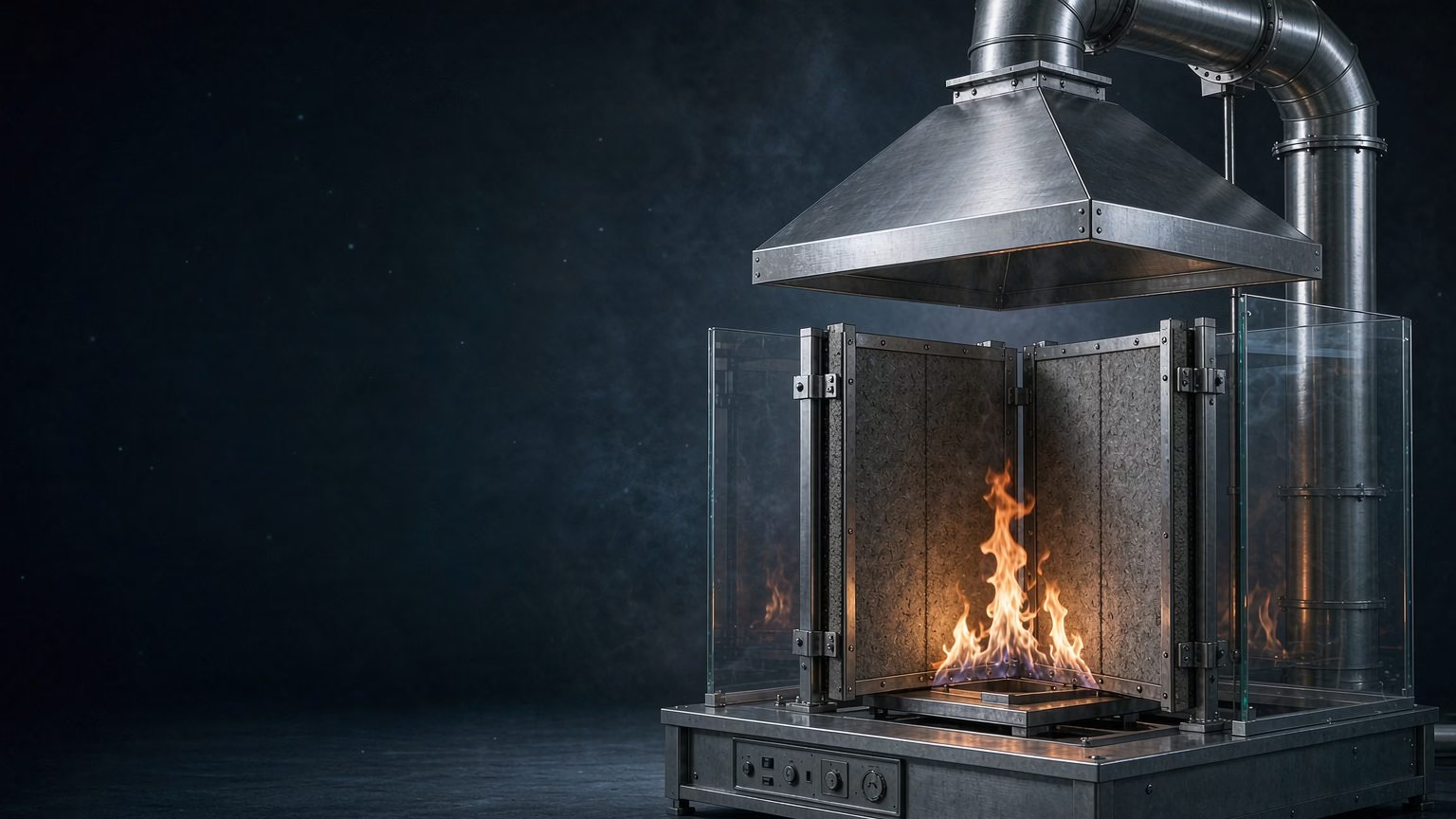
The V-series burner produces a 20 mm blue flame with a nominal thermal power of 50 W. The 5V burner produces a 125 mm flame with a 40 mm blue inner cone and a nominal thermal power of about 500 W — roughly ten times the power, and a flame whose inner cone alone is twice the height of the entire V-test flame [1][2]. IEC publishes both flames under separate parts of the same series: IEC 60695-11-3 specifies the 50 W flame and its confirming test 6, and IEC 60695-11-4 specifies the 500 W flame and its confirming test 5. The 5V burner is also tilted 20° from the vertical and positioned so that the tip of the inner cone touches the specimen [1], which is not how the 50 W burner is set.
That change in geometry is the practical reason 5V results cannot be extrapolated from V-test results. The failure mode changes. A material that self-extinguishes after a short 50 W exposure is being asked something different when a 500 W flame is pressed against the same surface — whether it survives long enough to keep acting as a barrier.
Five applications instead of two
The V-test applies the flame for ten seconds, withdraws it, and reapplies it for a further ten seconds once flaming has ceased; the reported figures are afterflame times t1 and t2 plus afterglow t3 across two sets of five specimens [2]. The 5V test applies the flame for five seconds, withdraws it for five seconds, and repeats until the specimen has received five applications [1]. The number that decides the rating is the afterflame plus afterglow time after the fifth application, and the limit is 60 s for both 5VA and 5VB [1][2]. The load is therefore cumulative: the specimen is deliberately re-ignited five times in quick succession and must stop burning within a minute of the last one.
Plaques in addition to bars
This is the structural difference, and the one most often missed when a datasheet is read. V-ratings are decided entirely on bars. A 5V submission adds 150 mm × 150 mm plaques, mounted horizontally with the flame applied to the centre of the underside for the same five 5-second applications [1]. Once the specimen has stopped burning it is inspected for a perforation; burn-through on any plaque is the single variable that separates 5VA from 5VB [1]8. A plaque that survives is 5VA. A plaque that is perforated still passes the bars and is classified 5VB.
Read that the other way round and it explains why 5VA is specified for some products: a bar cannot tell you whether a wall of material holds as a barrier, and a hole in an enclosure wall is exactly the failure an un-ignited interior is relying on not to happen.
Specimens and Conditioning for UL 94 5V
Bars
Bars are 125 mm long by 13 mm wide, moulded or cut at the thickness at which the rating will be claimed, and two sets of five are tested — one set conditioned at 23 °C and 50 % relative humidity for 48 hours, and a second set aged for 168 hours at 70 °C and cooled in a desiccator before testing [1][2]. Ratings are always reported against thickness, because a grade that reaches V-0 at 3.0 mm may not reach it at 0.8 mm.
Plaques
Plaques are 150 mm × 150 mm at the same thickness as the bars. If a 5VA claim is being made, plaques are required; if only 5VB is being claimed, they are not [1]. That asymmetry matters commercially, because plaques are more expensive to mould, consume more material and take longer to condition than bars.
Conditioning
Two conditions are always run, and the lower of the two results governs. The 48-hour ambient set establishes the as-received behaviour. The 168-hour oven-aged set at 70 °C exists because flame-retardant packages migrate and volatilise, and a material that has lost part of its additive load will behave differently in a fire years after it was moulded [2]. A submission that only reports the ambient set is incomplete.
| Step | Parameter | Why it is specified |
|---|---|---|
| Ambient conditioning | 48 h at 23 °C, 50 % RH | Establishes as-received behaviour; absorbed moisture otherwise causes sputtering and premature dripping |
| Thermal ageing | 168 h at 70 °C, then cooled in a desiccator | Checks that the flame-retardant package survives long-term heat |
| Gas purity | Technical grade methane, ≥ 98 % | Flame temperature and shape depend on gas quality; impurity shifts the inner cone |
| Cotton indicator | ≤ 0.08 g, spread to about 50 mm × 50 mm, not more than 6 mm thick, 300 mm below the specimen | Provides a consistent ignition target for flaming drips |
Reading the UL 94 5VA and 5VB Criteria
Both ratings share the bar criteria; the plaque criterion is what divides them.
| Criterion | 5VA | 5VB |
|---|---|---|
| Afterflame plus afterglow after the fifth application, each bar | ≤ 60 s | ≤ 60 s |
| Flaming drips igniting the cotton indicator | Not permitted | Not permitted |
| Burn-through of any plaque specimen | Not permitted | Permitted |
| Plaque specimens required | Yes | No |
| Prerequisite at the same thickness | Must also meet V-0 or V-1 | Must also meet V-0 or V-1 |
Why burn-through is the deciding variable
A bar test measures whether a material stops burning. A plaque test measures whether it stays intact while burning. Those are different properties, and a formulation can be optimised for one at the expense of the other — a char-forming system may extinguish a bar quickly and still leave a brittle char that cracks open under a 500 W flame on a flat panel. This is why 5VA is normally reserved for large equipment housings and for parts in high-voltage positions where an internal arc could otherwise find a path out.
The V-0 or V-1 prerequisite
A 5V submission is not a replacement for the V-series; it is built on top of it. The material must satisfy V-0 or V-1 at the thickness being claimed before a 5V rating can be assigned [1]. In practice that means a laboratory needs both capabilities, because the two use different burners and different flame heights, and the sequence has to be run in that order.
Equipment and Setup
A 500 W capability is not a V-series chamber with a bigger burner fitted. The items below are what separate a compliant setup from one that produces numbers a certifier will not accept.
| Item | What to check |
|---|---|
| Burner and flame | 125 mm overall flame height with a 40 mm blue inner cone, mounted at 20° from vertical [1][5] |
| Gas train | Technical grade methane at ≥ 98 % purity, with a calibrated flow meter and a stable supply pressure [2] |
| Specimen holders | A vertical clamp for 125 mm × 13 mm bars and a separate horizontal holder that supports a 150 mm × 150 mm plaque without shielding its underside [1] |
| Cotton indicator station | Fixed at 300 mm below the specimen, with a pad of ≤ 0.08 g spread to about 50 mm × 50 mm [2] |
| Timing | Resolution and operator reaction time fine enough to resolve a 5 s application and a 60 s criterion reproducibly |
| Chamber and extraction | Sufficient volume that combustion products do not accumulate around the specimen, with extraction that does not disturb the flame |
| Conditioning hardware | A cabinet at 23 °C / 50 % RH and an oven at 70 °C, plus a desiccator for the aged set [2] |
| Confirming tests | The flame itself is a calibrated artefact; the 500 W confirming procedure is specified in IEC 60695-11-4 [5] |
How UL 94 5V Lines Up with IEC and ASTM
The 500 W vertical method is not unique to UL. IEC publishes it as IEC 60695-11-20, whose current consolidated text is the 1999 edition with amendment 1 of 2003, and which is to be read alongside the 500 W flame specification in IEC 60695-11-4 [3][5]. ASTM publishes a comparable procedure using a 125 mm flame as ASTM D5048, which measures comparative burning characteristics and resistance to burn-through of solid plastics [4]. The 50 W counterpart is ASTM D3801 for vertical burning of solid plastics 7.
The practical consequence is that a laboratory configured to IEC 60695-11-20 and a laboratory configured to UL 94 5V are running recognisably the same experiment, and results are frequently reported against both. What is not interchangeable is the rating label: “5VA” is a UL 94 classification, and reporting it as an IEC result is a category error. If your customers cite the IEC 60695 family instead, our practical guide to IEC 60695 flammability testing sets out which part applies to which question.
Mistakes That Cost a UL 94 5V Submission
| Mistake | What goes wrong | How to avoid it |
|---|---|---|
| Submitting bars only and expecting 5VA | 5VA requires plaque data; a bar-only submission can only yield 5VB | Decide the target rating before moulding, because plaques cost more and take longer to condition |
| Claiming 5V without a V-0 or V-1 result at the same thickness | The prerequisite is not optional | Run the 50 W series first, in the same conditioning batches |
| Reusing V-series conditioning for the 5V set | The aged set is a separate 168 h / 70 °C condition | Condition both specimen geometries in the same batch |
| Testing at a thickness that is not the production thickness | Ratings are thickness-specific | Test at the thinnest wall the part will be moulded at |
| Treating the flame as a fixed setting | The 500 W flame is a calibrated artefact with its own confirming procedure | Run the confirming test in IEC 60695-11-4 and keep the record [5] |
| Reading a 5VB result as equivalent to 5VA | The two differ precisely on the property the enclosure needs | Specify 5VA explicitly where burn-through matters |
Building a UL 94 5V Capability in Your Own Laboratory
Running the 5V series in-house means covering two flame powers and two specimen geometries, which is more apparatus than a V-series-only setup. The three building blocks below are what a laboratory typically needs, and they are the same instruments used for the rest of the small-flame family.
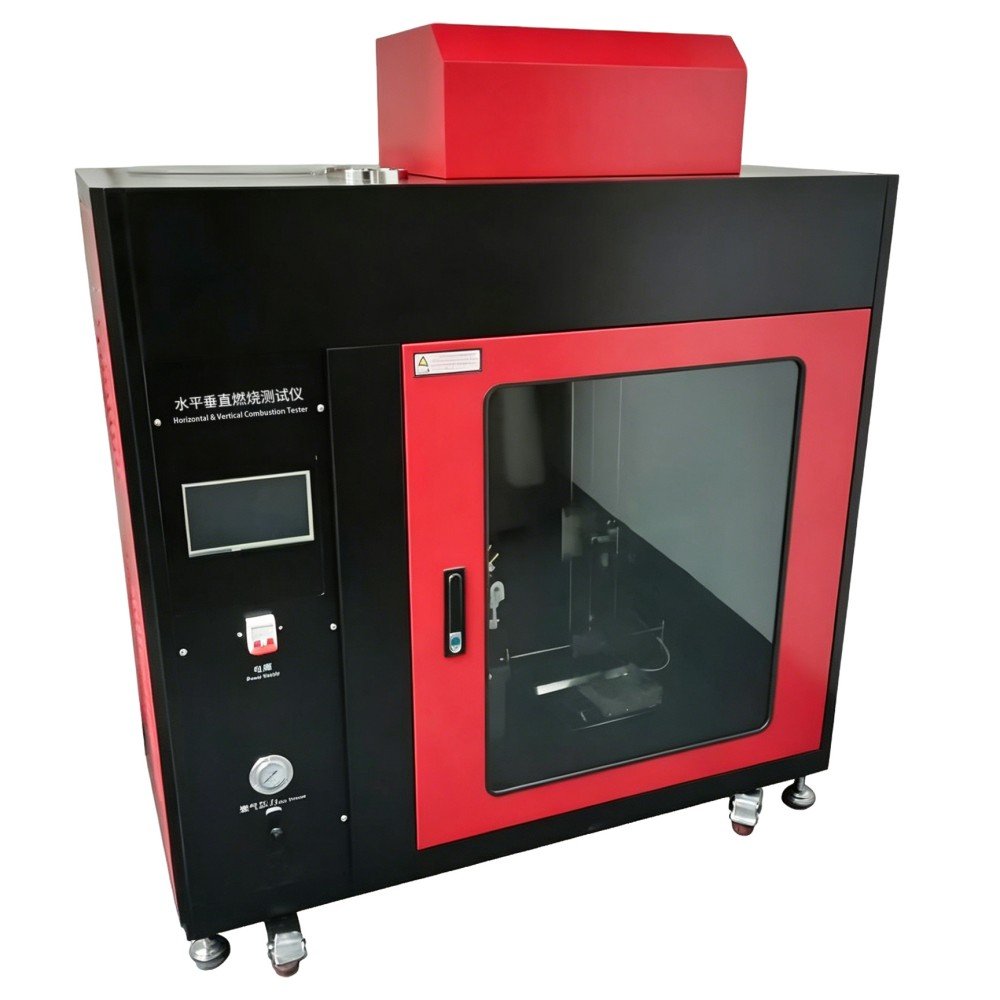
A horizontal and vertical combustion tester is the core instrument, and it needs both a 50 W and a 500 W burner position, bar clamps and a plaque holder. Our SPCZ-05 horizontal and vertical combustion tester is configured for the full small-flame family including the foam procedures. For cellular materials, the plastic foam vertical and horizontal burning tester covers the 150 mm × 50 mm foam geometry that the bar and plaque procedures cannot handle.
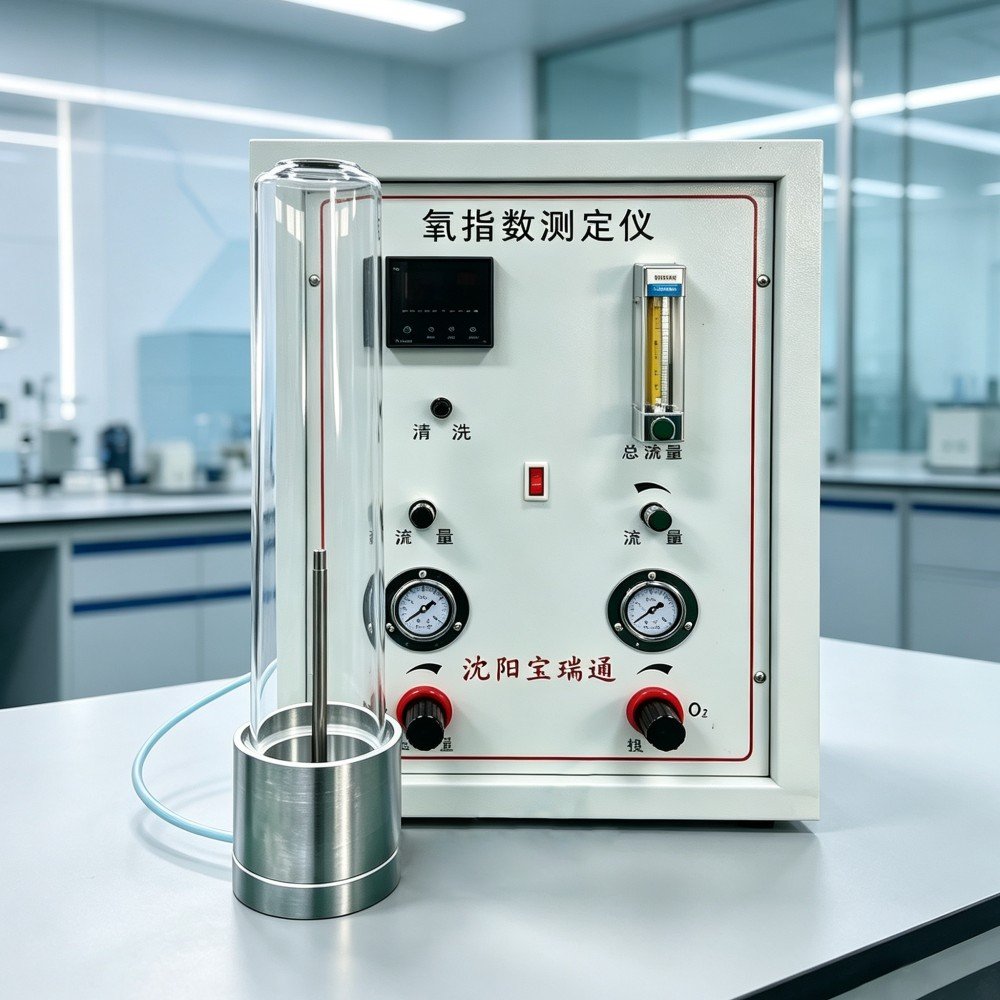
An oxygen index tester is the natural companion. Where a flame test returns a pass or fail, ISO 4589-2 returns a number — the minimum oxygen concentration that supports candle-like combustion — which makes it a far more sensitive tool for ranking candidate formulations before committing to a conditioned UL 94 submission. Both the automatic touch-screen oxygen index tester and the LOI tester for plastics are built to that method.
Where the question stops being about a small flame and becomes about how much heat a material actually releases, a cone calorimeter answers it; we set out what that instrument measures in our article on ISO 5660 heat release rate.
Frequently Asked Questions
Is 5VA better than V-0?
It is a different claim rather than a strictly better one. Both can be held at the same time, and in fact a 5VA classification requires the material to satisfy V-0 or V-1 first. V-0 says the material self-extinguishes quickly after two 10-second exposures to a 50 W flame. 5VA says the same material also survives five 5-second exposures to a 500 W flame without its plaques being perforated.
Do I have to test plaques if I only want 5VB?
No. Plaque specimens are required for a 5VA claim and are not required for 5VB. If burn-through is not a concern for the part, a bar-only submission yields 5VB and costs less in moulding and conditioning. Confirm which rating the end-product standard actually calls up before commissioning the plaques.
What is the 60-second limit measured from?
It is the afterflame plus afterglow time measured after the fifth flame application has been withdrawn, and the limit applies to each individual bar specimen. The flame is applied for 5 seconds, withdrawn for 5 seconds, and repeated until five applications have been made; the clock starts when the flame comes off for the fifth time.
Can a material hold 5VA at one thickness and 5VB at another?
Yes, and this is normal. Flammability ratings are thickness-specific and are always reported with the thickness, for example 5VA at 3.0 mm. A thinner section has less thermal mass and less char to form, so the plaque is more likely to perforate. Test at the thinnest wall the production part will use.
Is UL 94 5V the same as IEC 60695-11-20?
They are recognisably the same experiment — a 500 W flame applied five times to bars and plaques — but they are published by different bodies and the rating labels are not interchangeable. IEC 60695-11-20 is the IEC publication; 5VA and 5VB are UL 94 classifications. ASTM D5048 is a third publication covering the 125 mm flame procedure.
Why does the 5V test use five short applications instead of two long ones?
Because the question changes. Two 10-second applications ask whether the material self-extinguishes. Five 5-second applications with 5-second gaps keep re-igniting a surface that is already hot and already charred, which is closer to what happens when an enclosure is exposed to a sustained ignition source. The result reported is the afterflame plus afterglow after the last application.
What gas does a 5V burner use?
Technical grade methane of at least 98 % purity, with a calibrated flow meter and a stable supply pressure. Flame height, inner cone geometry and thermal power all depend on gas quality, so an impurity or a drifting flow rate will silently change the severity of the test. The 500 W flame has its own confirming procedure, published as IEC 60695-11-4.
The Decision Sequence
- Find out which rating the end-product standard calls up. UL 94 is referenced by other standards rather than applied directly; the rating is a means, not an end.
- Establish the production thickness. Every rating is thickness-specific, and the thinnest wall is the one that governs.
- Decide between 5VB and 5VA before moulding. Plaques are required only for 5VA, and they change the cost and lead time of the submission.
- Run the 50 W series first. V-0 or V-1 at the same thickness is a prerequisite for any 5V rating.
- Confirm the flame, not just the instrument. The 500 W flame is a calibrated artefact with a published confirming procedure.
- Report the rating with its thickness and its conditioning. A rating without those two qualifiers is not a complete result.
If you are building or upgrading a small-flame laboratory and want the two flame powers, both specimen geometries and the confirming hardware specified together, talk to the BRT application team about the configuration. Our guide to choosing a fire testing laboratory equipment supplier sets out the questions worth asking of any vendor.
About the Author
This article was prepared by the BRT combustion testing application team at Shenyang Baoruitong Automation Equipment Co., Ltd., which builds horizontal and vertical combustion testers, oxygen index testers and cone calorimeters for plastics and building product laboratories. All standard references are to the publishers’ own catalogue entries, and the procedure details are taken from published UL 94 method summaries, IEC 60695 parts and ASTM test methods.
Sources
- RTP Company — UL94 5VA and 5VB flammability standard
- Guangce Instrument — UL 94 flammability ratings explained (HB, V-0, V-1, V-2, 5VA, 5VB)
- IEC Webstore — IEC 60695-11-20:1999+AMD1:2003, 500 W flame test methods
- ASTM International — D5048-20, 125 mm flame burning characteristics and burn-through resistance
- IEC Webstore — IEC 60695-11-4:2011, 500 W test flame apparatus and confirming test
- IEC Webstore — IEC 60695-11-3:2012, 50 W test flame apparatus and confirming test
- ASTM International — D3801-20a, comparative burning characteristics of solid plastics in a vertical position
- UL Solutions Korea — UL plastics flammability test methods