- What a Supplier Actually Provides
- The Six Criteria That Predict Whether It Works
- Site Readiness: The Part Buyers Underestimate
- How to Read a Quotation
- Technical Due Diligence: What to Ask an Engineer
- Total Cost of Ownership, Without Guessing
- Red Flags
- A Five-Step Selection Process
- Frequently Asked Questions
- What should I look for in a fire testing laboratory equipment supplier?
- How do I verify that fire testing equipment meets a standard?
- Does the supplier need ISO/IEC 17025 accreditation?
- Why is calibration traceability so important in fire testing?
- How important are references from other laboratories?
- What is a realistic lead time for fire testing equipment?
- Should I buy a combined test station or separate benches?
- Next Steps
Choose a fire testing laboratory equipment supplier on evidence, not on a catalogue: the machine must reproduce a named standard and edition, the calibration must be traceable, and the supplier must still support the installation after the warranty ends. Every fire testing laboratory equipment supplier will describe its machines as reliable; far fewer can document it. Fire testing equipment is unusual in that a small mechanical or control error does not merely annoy the operator — it invalidates results that a laboratory has staked its accreditation on. That makes the evaluation closer to buying a measurement system than to buying a machine. This guide sets out the six criteria that predict whether an installation will work, how to read a quotation, and the questions that reveal a supplier’s real depth.
What a Supplier Actually Provides
The equipment is only one of four things being purchased, and the other three are where most projects go wrong.
Instruments, Integration and the Standards They Satisfy
A fire test station is a system: furnace or rig, burner and gas train, extraction, instrumentation, data acquisition and the software that turns thermocouple voltages into a reported result. Each element is governed by the method — the heating curve and pressure profile in a fire resistance furnace, the burner output and hood flow in an SBI rig, the irradiance calibration in a cone calorimeter. A supplier who sells the chamber but leaves integration to the buyer has sold a component, not a test capability.
Why the Edition Matters More Than the Brand
Standards are revised, and revisions change tolerances. ISO 834-1 was reissued in 2025 with an aligned curve and revised load-bearing criteria, and EN 1363-1 was reissued in 2020 45. Older equipment can often be upgraded, but only if the control system was built with that in mind. Ask which edition the machine is designed against, and ask what changes when the next revision lands.
The Six Criteria That Predict Whether It Works
Score every candidate against these, and ask for documentary evidence rather than verbal assurance.
1. Standard Coverage and Edition Currency
The supplier should be able to name, for each product, the standard and edition it is built to satisfy, and to explain where national adoptions differ. Breadth matters less than honesty: a supplier who says “this rig covers EN 13823 and the national variants, but not the 2024 amendment” is more useful than one who claims everything 6. A fire testing laboratory equipment supplier that publishes an edition matrix — model against standard against revision — is telling you how it manages change. Our overview of global building material fire testing standards is a useful checklist for mapping the standard landscape before you talk to anyone.
2. Calibration and Traceability
Every measurement that appears in a report has to be traceable. That means calibration certificates for thermocouples, load cells, flow meters, gas analysers, heat flux meters and the timing system, referenced to a national metrology institute. Ask which items ship with certificates, which are calibrated on site, and what the recalibration interval is. A supplier who treats calibration as an afterthought will hand you an instrument that fails its first audit.
3. Mechanical Build Versus Control Software
Two machines can meet the same curve tolerance and behave very differently in year three. Look at the parts that wear: burner nozzles, thermocouple sheaths, door seals, specimen frames, extraction dampers. Then look at the software: can it export raw data, keep an audit trail, and reproduce a run from stored settings? A locked data format is a long-term liability, because accreditation bodies increasingly want the underlying records, not a summary sheet.
4. Installation, Commissioning and Training
Commissioning is where a standard becomes a capability, and it is the stage most often compressed when a project runs late. A credible supplier commits to a factory acceptance test, a site acceptance test against the method’s tolerances, and operator training that covers calibration checks and the failure modes. Ask how many days of commissioning are included, who pays for the engineer’s travel, and what happens if the site acceptance test fails on the first attempt — the answer separates a supplier who expects to pass from one who expects to negotiate. Ask for the commissioning protocol in writing before the order, and check that it names the tolerances it will demonstrate — not just the items it will switch on.
5. Spares, Consumables and Service Response
Fire test equipment consumes parts: thermocouples, igniters, filters, seals, gas components. Ask for a recommended spares list with lead times, and ask who holds stock in your region — a fire testing laboratory equipment supplier without regional stock is really offering a shipping service. A machine that is unavailable for six weeks because a burner component has to ship from another continent costs more than the price difference between two suppliers, and it is not covered by a warranty clause about defects.
6. References in Your Test Scope
Ask for installations running the same test you intend to run, and ask permission to speak to one of them. A reference in a different test scope proves the supplier can build something; a reference in your scope proves they can build this. When you call, ask two questions that a brochure cannot answer: how long the machine took to pass its acceptance test, and how quickly the supplier responded the first time a component failed. Where a supplier cannot provide one, that is information, not necessarily disqualification — but it should change how much verification you do yourself.
| Criterion | Evidence to request | Weak answer looks like |
|---|---|---|
| Standard coverage | Written standard and edition per model | “Meets all international standards” |
| Calibration | Certificates list with issuing bodies | “Calibration included” without scope |
| Build and software | Spares list, data export sample, audit trail demo | Screenshots only, no data format |
| Commissioning | Protocol naming tolerances | “Installation and training included” |
| Service | Regional stock list, response commitment | No named service partner |
| References | Two contacts in your test scope | “Many customers worldwide” |
Site Readiness: The Part Buyers Underestimate
Most delays attributed to a fire testing laboratory equipment supplier are actually site delays wearing the supplier’s name. Before the order, confirm what the building can deliver.
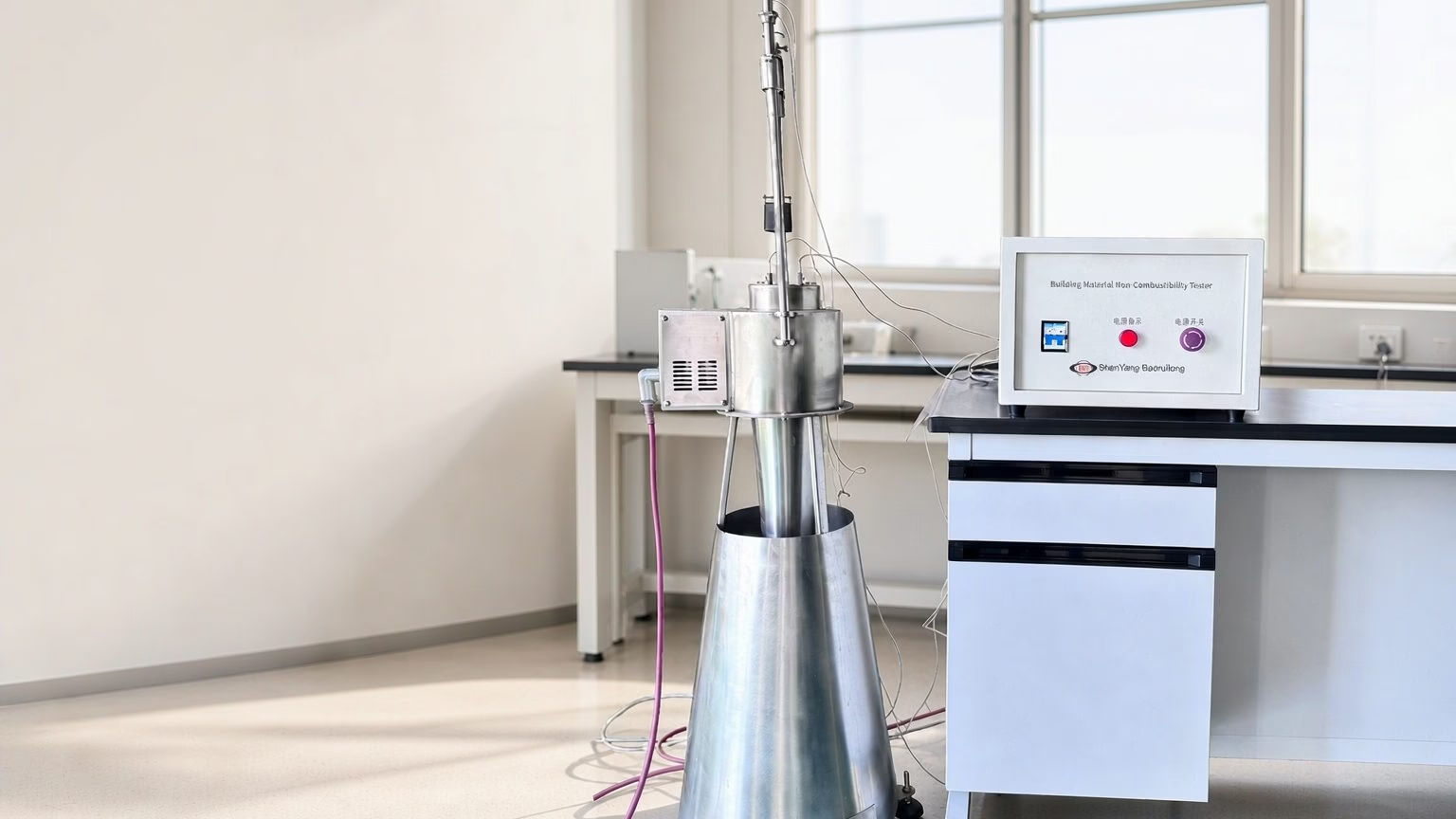
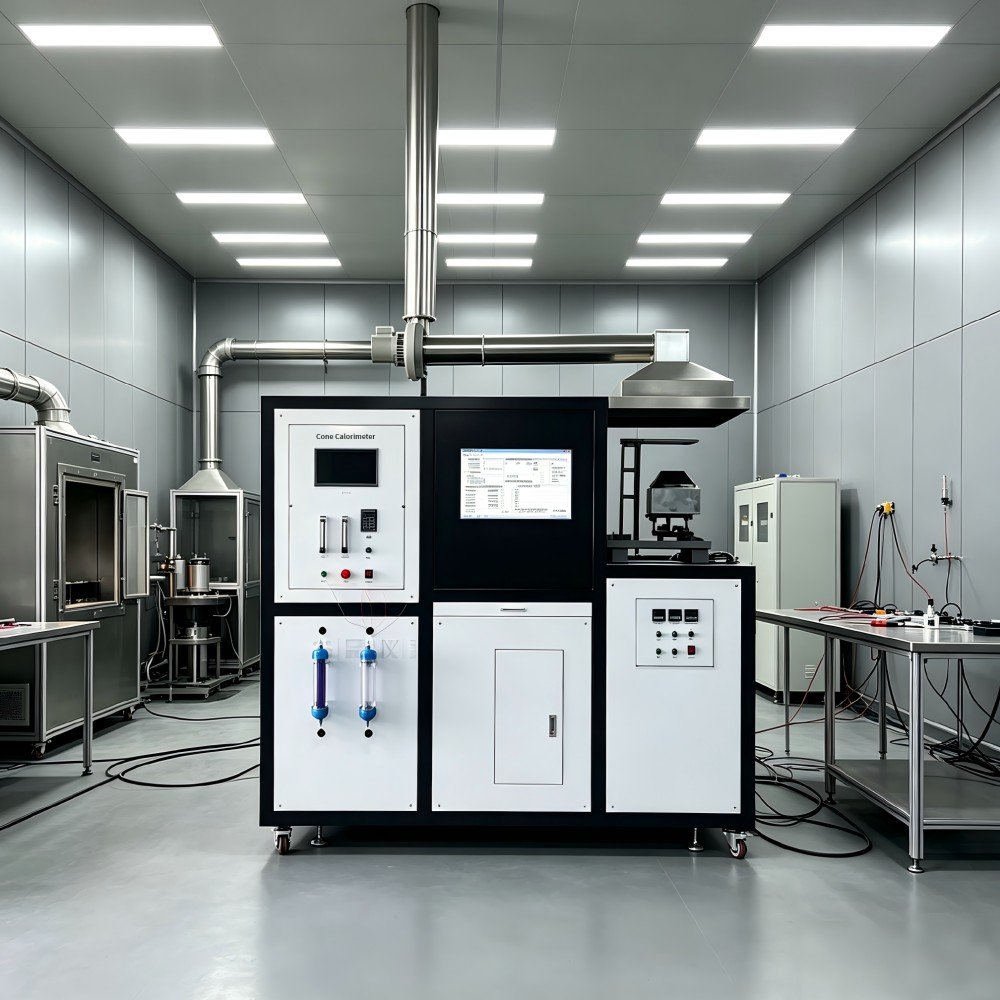
A loaded-section furnace needs a gas supply sized for the burner and a flue that can carry the products of combustion without affecting the pressure regime inside the chamber. An SBI rig needs an extraction hood with a controlled flow, because the measurement depends on capturing the whole plume. A cone calorimeter needs a stable exhaust and a clean gas supply for the analysers. None of these are optional accessories; they are part of the measurement chain.
| Utility | Typical question to resolve | Consequence if missed |
|---|---|---|
| Electrical supply | Is the capacity available at the proposed location, or does a sub-panel need installing? | Commissioning slips while cabling is upgraded |
| Fuel gas | Is the supply pressure and calorific value within the burner’s specification? | Flame calibration cannot be demonstrated |
| Extraction | Can the flue or hood hold the required flow without disturbing the test? | Results become unstable and non-repeatable |
| Floor and structure | Can the slab carry the furnace and specimen loading? | Relocation after installation, at your cost |
| Space and access | Will the largest component pass through the doors and into position? | Partial disassembly on site |
Walk the route with the supplier’s engineer before signing. A photograph of the doorway and a dimensioned drawing of the room cost nothing; moving a furnace afterwards does.
How to Read a Quotation
A quotation is a specification in disguise. The gaps tell you what will become a change order.
| Item | Why it matters | What to insist on |
|---|---|---|
| Scope of supply | Defines the boundary of responsibility | Itemised list including extraction, gas train and software |
| Standard and edition | Determines whether the result is usable | Named standard, edition and any national variant |
| Performance tolerances | The numbers you will be audited against | Curve tolerance, uniformity, burner output, timing accuracy |
| Utilities required | Often the largest hidden cost | Power, gas, water, extraction, floor loading, ceiling height |
| Documentation | Needed for accreditation | Manuals, calibration certificates, drawings, software licence terms |
| Acceptance testing | Proves the capability before payment | FAT and SAT protocol with pass criteria |
| Warranty and service | Determines life-cycle cost | Duration, response time, spares availability, training refresh |
| Lead time and shipping terms | Sets the project schedule | Delivery date, Incoterms, responsibility for import clearance |
Two items deserve particular attention. Utilities are frequently discovered late: a furnace that needs a larger gas supply or a taller extraction stack can delay a project by months. Software licensing decides whether you can add a second workstation or archive data after ten years, and it is rarely discussed at the quotation stage.
Technical Due Diligence: What to Ask an Engineer
A sales conversation tests the brochure. An engineering conversation tests the product. Put these questions to the technical contact, in writing, and compare the answers across suppliers.
- Which clause of the standard defines the tolerance this parameter is checked against, and how is that check performed on site?
- How is the heating curve controlled — what is the control variable, and what happens when the specimen load changes mid-run?
- Which components are calibrated, by whom, and at what interval?
- What is the data sampling rate, and can raw data be exported in an open format?
- How is the burner output verified, and what reference method is used?
- What is the mean time between failures for the parts you expect to replace, based on your service records?
- Which parts are consumables, and what do they cost per hundred tests?
- What changes in the design if the standard is revised, and is that a software or a hardware change?
A supplier who answers these precisely is describing a product they understand. A supplier who redirects every question to a datasheet is describing a product they distribute.
Total Cost of Ownership, Without Guessing
Do not ask for a five-year cost model from a supplier; ask for the inputs and build it yourself. The elements are consistent across suppliers: purchase price, installation and utilities, calibration and verification, consumables and spares, operator training and refresher training, service contracts, software maintenance, and the cost of downtime measured in delayed tests. Add the cost of a repeat test — the labour and specimen preparation that has to be redone when a run is invalidated — because that is where poor equipment quietly spends money.
Where a supplier cannot give you a spares price list, treat the whole quotation as incomplete rather than assume the parts are cheap.
Red Flags
No named standard or edition. “Complies with international fire testing standards” is not a specification and cannot be audited.
Calibration described as a document rather than a process. Traceability requires an issuing body, a reference and an interval.
No commissioning protocol. If acceptance criteria are not written down before the order, they will be negotiated after delivery, when your leverage is lowest.
Unwillingness to name references. Confidentiality is a legitimate reason to route a reference through the supplier, but a flat refusal across the board is a signal.
Consumables with no price list. This usually means the parts are sourced ad hoc, which becomes your lead-time problem.
A single point of contact for sales, service and spares. Depth of organisation shows in how many people can answer a technical question.
A Five-Step Selection Process
- Define the test scope first. List the standards, editions and specimen types you must support in the next three years, not just the first purchase.
- Screen on standard coverage and references. Eliminate suppliers who cannot name the edition or show an installation in your scope.
- Run technical due diligence. Use the eight questions above; score the written answers.
- Compare quotations on scope, not on total. Normalise for extraction, gas train, software, calibration and training before comparing numbers.
- Agree acceptance criteria before signing. FAT and SAT protocols, with tolerances, become the payment milestones.
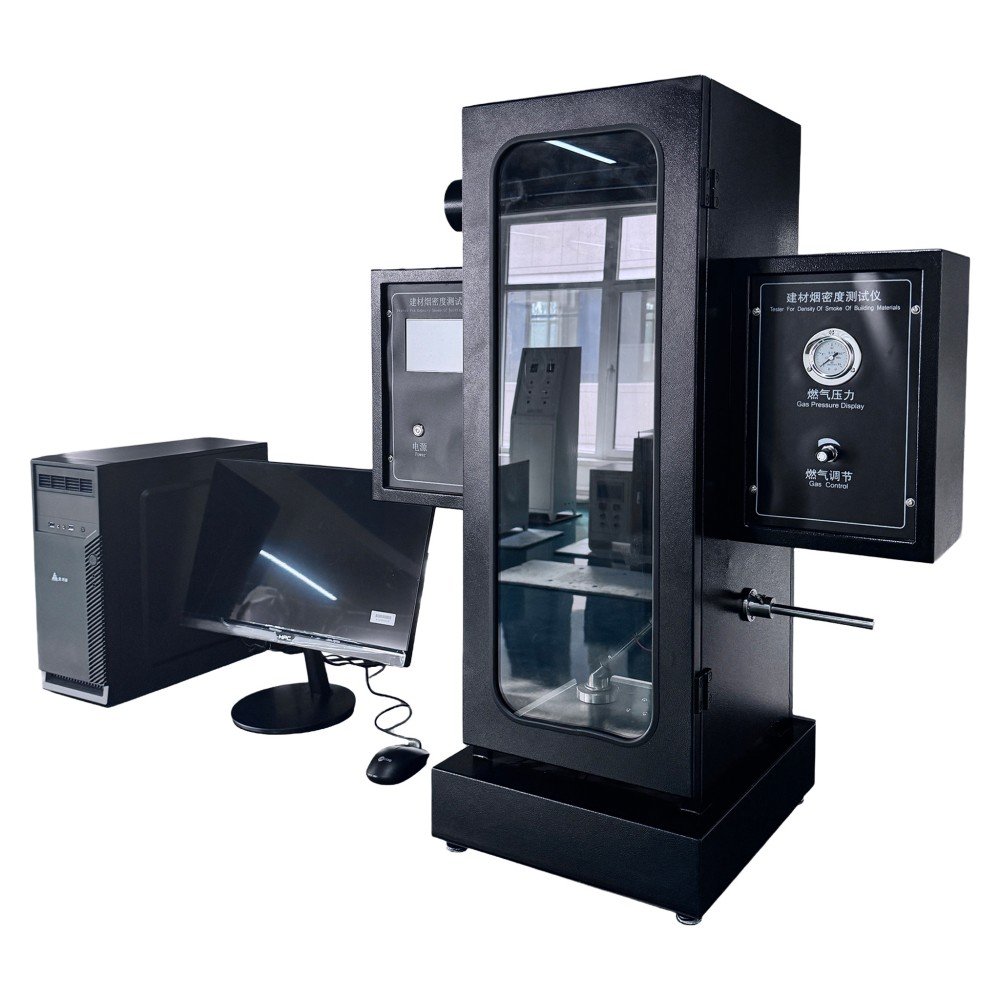
BRT Testing supplies fire and flame testing equipment across fire resistance, reaction to fire, smoke and non-combustibility work, including the non-combustibility apparatus, the SBI test apparatus, the cone calorimeter, the smoke density tester and smoke toxicity equipment. If you want the technical basis behind a specific method before you specify, our guides to ISO 1182 and SBI calibration are written for exactly that conversation.
Frequently Asked Questions
What should I look for in a fire testing laboratory equipment supplier?
Look for four things: a named standard and edition for every product, calibration certificates with traceable issuing bodies, a written commissioning protocol with tolerances, and references in your own test scope. Price and lead time matter, but they cannot rescue equipment that will not pass an accreditation audit.
How do I verify that fire testing equipment meets a standard?
Ask for the factory acceptance test protocol and the site acceptance test protocol, and check that each names the clause and tolerance it demonstrates. Then witness the acceptance test rather than accepting a report. Where a third-party calibration or verification is possible, commission it independently of the supplier.
Does the supplier need ISO/IEC 17025 accreditation?
The laboratory needs ISO/IEC 17025 accreditation for the tests it reports, not the equipment supplier. What the supplier must provide is equipment and documentation that let your laboratory meet that requirement, including traceable calibration and reproducible methods. Accreditation bodies such as ILAC members and national bodies publish the scope rules.
Why is calibration traceability so important in fire testing?
Because nearly every reported result is a temperature, a time, a flow or a heat flux. If those measurements are not traceable, the test report cannot be defended, and a single uncalibrated thermocouple can shift an insulation result. Traceability is what turns a number into evidence.
How important are references from other laboratories?
They are the strongest single predictor of a successful installation, provided the reference runs the same test as you. A supplier with installations in your exact scope has already met the practical problems — utilities, extraction, local gas supply — that a first-of-its-kind installation will discover at your expense.
What is a realistic lead time for fire testing equipment?
It depends entirely on the class of equipment: bench instruments such as an oxygen index tester are measured in weeks, while a loaded-section furnace with custom extraction is a project measured in months. Treat any supplier who quotes a single lead time across the whole range as unfamiliar with their own manufacturing.
Should I buy a combined test station or separate benches?
Combine when the same burner, gas train and extraction can serve several methods without compromise, as with a horizontal and vertical combustion tester. Separate when specimen handling or extraction requirements conflict, as between gas analysis and dusty solid-fuel work. Ask the supplier to justify the combination technically, not commercially.
Next Steps
If you are preparing a purchase, send suppliers a short brief rather than an open request: the standards and editions you must support, the specimen types and sizes, the utilities available, the accreditation you intend to hold, and the date you need to be operational. The replies will separate quickly.
If you would like that brief turned into a technical proposal with a matching acceptance protocol, send it to our application team and we will respond with the configuration, the tolerances it will demonstrate and the documentation that ships with it. Get in touch to start, or review the fire and flame testing equipment range first.
About the author. This article was prepared by the BRT Testing application engineering team at Shenyang Baoruitong Automation Equipment Co., Ltd., a manufacturer of fire testing, spectrophotometric and plastic pipe testing equipment. It reflects commissioning practice across fire resistance, reaction-to-fire and non-combustibility installations; where a product capability is mentioned, the product page is the controlling document.