The short answer: to select a flammability tester for plastics, start from the certificate you have to satisfy, not from the machine. If your customer needs a UL yellow card, you need the 50 W horizontal and vertical arrangement that produces HB, V-0, V-1 and V-2, and the 500 W arrangement if the part is larger than a small component. If you sell into Europe or need CB scheme reports, you need the IEC 60695 equivalents plus glow wire for appliance parts. If you are developing a formulation rather than certifying a part, you need a limiting oxygen index tester and a cone calorimeter, because those measure material properties that a pass/fail rating does not. Buying a vertical tester when the requirement is an oxygen index number, or an oxygen index tester when the customer wants a V-0, is the most common and most expensive mistake in this category.
Start With the Certificate, Not the Catalogue
A flammability tester for plastics is only meaningful in relation to a test method, and a test method is only meaningful in relation to a certification route. Work backwards and the shortlist writes itself.
Three routes cover most of the market. The UL route, built on UL 94 and its ASTM equivalents, produces the yellow card that North American OEMs ask for. The IEC route, built on IEC 60695-11-10 and its siblings, produces the CB scheme reports used in Europe and much of Asia. The material-property route — oxygen index, ignition temperature, heat release — produces numbers used in formulation and in specifications that are not tied to a single end product.
| Your obligation | Governing method | Apparatus you need first |
|---|---|---|
| UL yellow card for a moulded part | UL 94, ASTM D635 and D3801 | 50 W horizontal and vertical cabinet |
| UL 94 5VA or 5VB for a larger part | UL 94 500 W, ASTM D5048 | 500 W (125 mm flame) arrangement |
| IEC CB report for a part | IEC 60695-11-10, IEC 60695-11-20 | 50 W and 500 W arrangements to IEC |
| Appliance part near a live connection | IEC 60695-2-12 and 2-13 | Glow wire apparatus |
| Small parts and thin sections | IEC 60695-11-5 | Needle flame apparatus |
| Formulation development | ISO 4589-2, ASTM D2863, ISO 871, ASTM D1929 | Oxygen index and ignition temperature testers |
| Heat release and smoke data | ASTM E1354, ISO 5660-1 | Cone calorimeter |
The Four Arrangements That Cover Most Plastic Parts
The 50 W horizontal and vertical cabinet
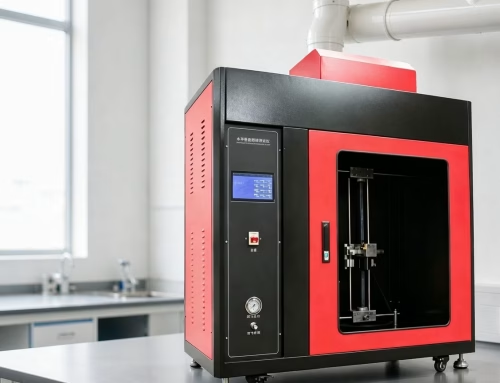
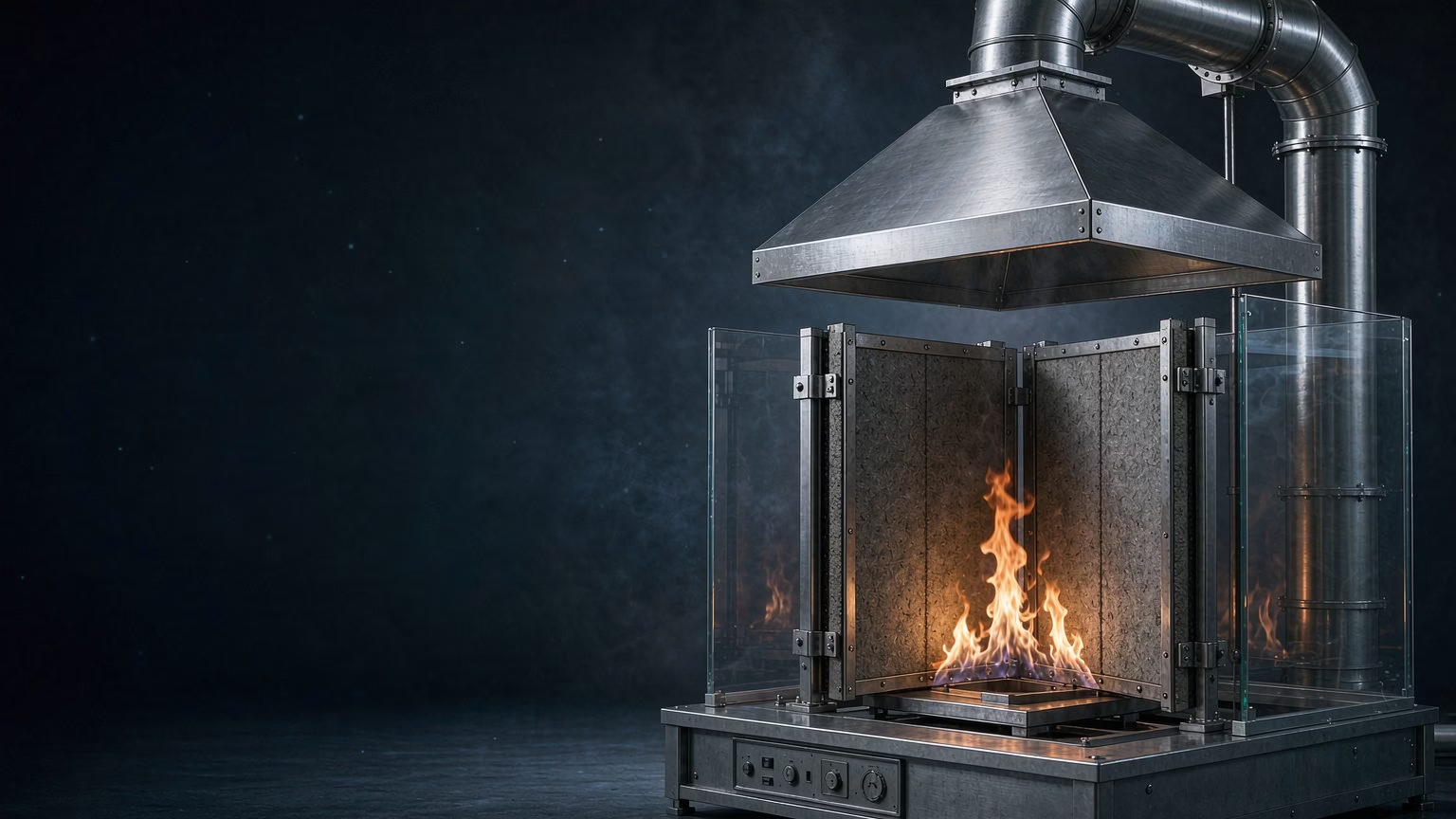
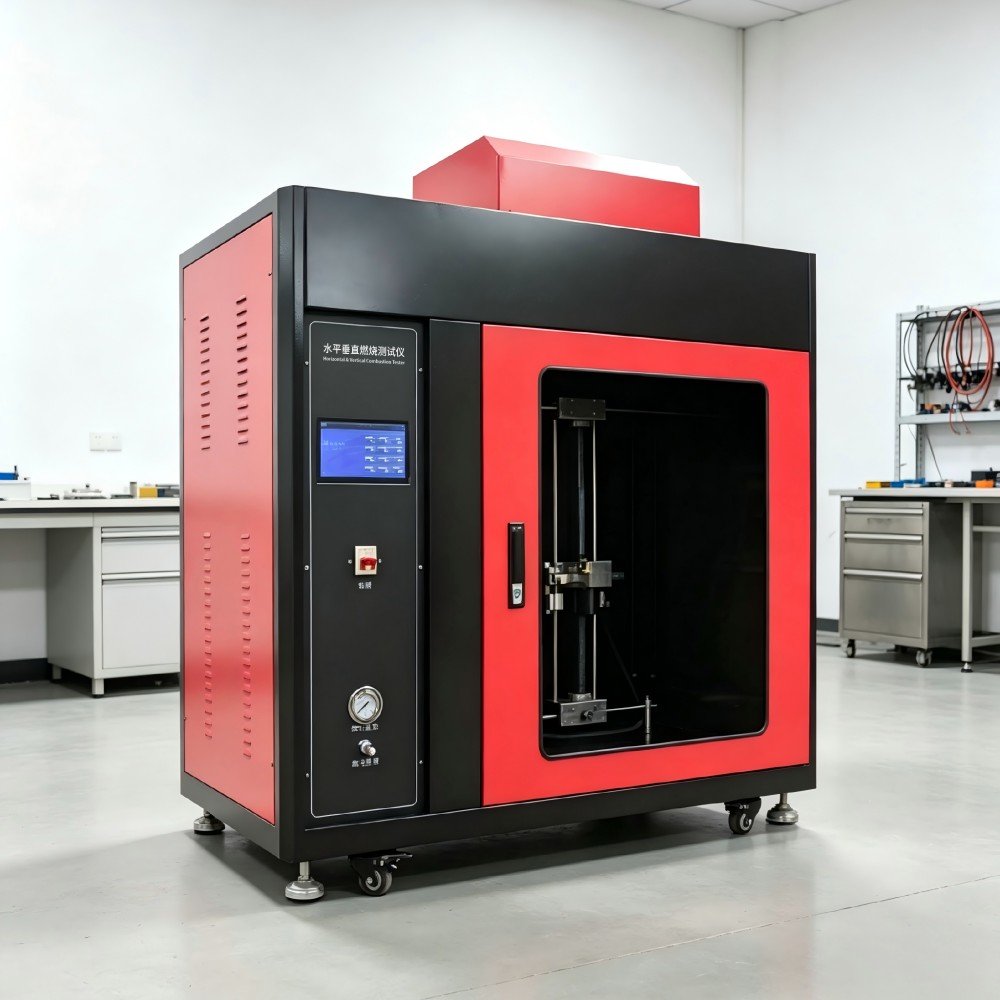
This is the arrangement most people mean when they say “UL 94 tester”. It holds a bar specimen, applies a 50 W premixed flame from a specified burner, and supports two methods. Method A, horizontal, measures the rate of burning along a bar. Method B, vertical, applies the flame twice for ten seconds each and records afterflame time, whether flaming material drips, and whether the cotton pad below ignites. That combination of observations produces HB, V-0, V-1 or V-2.
The international equivalent is IEC 60695-11-10, which describes the same 50 W flame and the same horizontal and vertical methods in IEC language 1. ASTM D635 covers the horizontal rate of burning 2 and ASTM D3801 covers the vertical comparative burning characteristics 3. In practice a modern cabinet is sold with all three sets of specimen holders, because the geometry is shared and only the fixtures and the recording sheet differ.
The 500 W arrangement for 5VA and 5VB
When a part is too large, too thick or too structural for the 50 W test to be meaningful, the 500 W flame takes over. The flame is roughly 125 mm long and the exposure is far more severe: for 5VA the specimen must not burn through, and for 5VB it may burn through but within limits on the hole and on afterflame. IEC 60695-11-20 is the IEC text 4 and ASTM D5048 is the ASTM route to comparable data 5.
This is the arrangement buyers most often omit and then need within a year. If your product range includes appliance housings or thick sections, price the 500 W capability at the outset rather than as a retrofit.
Glow wire for appliance and switchgear parts
Glow wire testing does not use a flame at all. A heated wire loop is pressed against the specimen, and the question is whether the material ignites and whether anything burning falls onto the tissue paper beneath. IEC 60695-2-12 determines the glow wire flammability index, the highest temperature at which the specimen either does not ignite or extinguishes within 30 seconds of the wire being removed 6. IEC 60695-2-13 determines the glow wire ignition temperature, the highest temperature at which the specimen does not ignite, or ignites with an afterflame shorter than the specified limit 7.
Glow wire matters because appliance safety standards commonly require it for parts retaining current-carrying connections, and a 50 W flame result does not substitute for it. Buyers who skip it usually come back to it after a first certification failure.
Needle flame for small parts
IEC 60695-11-5 applies a small premixed flame from a needle burner to a small specimen or a complete subassembly 8. It is the arrangement used where the part is too small to make a bar, or where the assessment has to be made on the finished component rather than on a test piece.
Choosing a Flammability Tester for Plastics: Match the Apparatus to the Specimen
Specimen geometry decides more of the purchase than the standard number does. A material supplied as 3 mm bar stock, a 0.2 mm film and a 40 kg/m³ foam cannot share one fixture set, and two of the three may not be testable in the same cabinet at all.
| Specimen form | Governing method | Fixture or machine | Note |
|---|---|---|---|
| Solid bar, 1.5–13 mm | UL 94 / IEC 60695-11-10 | 50 W cabinet, bar clamps | Thickness must be declared; each thickness is a separate rating |
| Solid bar, thick or large part | UL 94 500 W / IEC 60695-11-20 | 500 W burner and plate holder | Burn-through is the discriminator |
| Thin flexible film under 0.25 mm | ISO 9773 10 | Vertical holder with paper support | The paper support is part of the method, not an accessory |
| Foam, density-dependent | ISO 9772 9 | Horizontal foam holder | Foam ratings do not transfer to solid sections |
| Any solid, property test | ISO 4589-2 / ASTM D2863 | Oxygen index tester | Gives a number, not a class |
| Any solid, ignition behaviour | ISO 871 / ASTM D1929 | Ignition temperature tester | Flash and self-ignition temperatures |
| Any solid, heat release | ISO 5660-1 / ASTM E1354 | Cone calorimeter | Research and comparative data |
The film and foam rows are where quotations most often go wrong. A supplier who quotes a standard 50 W cabinet for a 0.15 mm film has quoted the wrong machine: the film needs the ISO 9773 arrangement with its paper support, and the foam needs the ISO 9772 horizontal holder. Ask for the specimen form before you ask for the price.
Oxygen Index Is Not a Rating, and That Matters When Buying
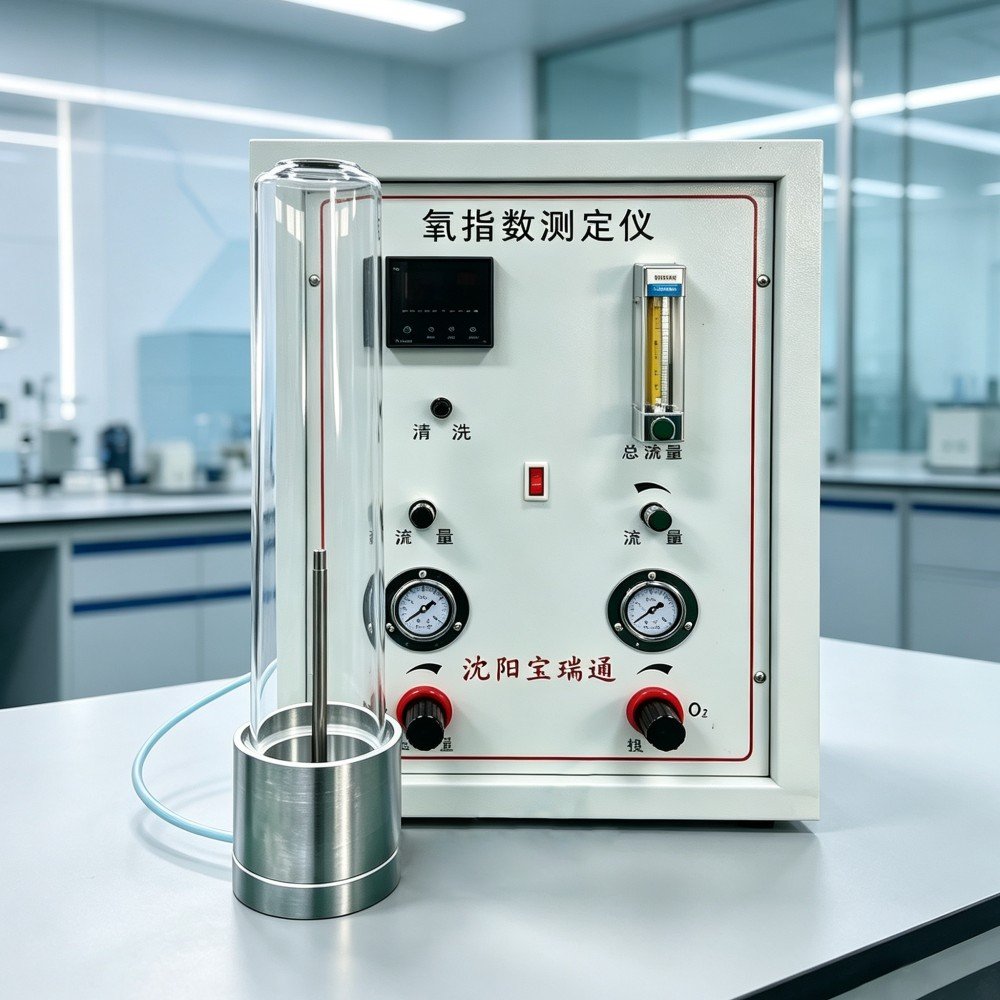
A limiting oxygen index tester measures the minimum oxygen concentration in a nitrogen-oxygen mixture that will sustain candle-like burning of the specimen. ISO 4589-2 defines the method internationally 11 and ASTM D2863 is the North American equivalent 12. The result is a percentage, and it is one of the most useful numbers in formulation work because it responds clearly to flame retardant loading.
It is not a classification. A material with an oxygen index of 32 % has not been shown to meet V-0, and a material that meets V-0 may have an oxygen index anywhere in a broad band. The two tests answer different questions: the oxygen index asks how easily the material sustains combustion in an oxygen-enriched atmosphere, while the vertical test asks how a specific bar behaves under a specific flame for a specific time.
That distinction is why a formulation laboratory usually needs both machines, and why a certification laboratory often needs only the second. If your customer’s drawing says “V-0 at 1.6 mm”, the oxygen index tester will not produce that evidence no matter how good the correlation looks on your internal data.
The Numbers to Settle Before You Request a Quotation
Most quotation errors come from leaving these six items open. They change the price and the lead time far more than the brand of the controller.
| Item | Why the supplier needs it | Typical options |
|---|---|---|
| Governing standard and edition | Determines burner, fixtures and acceptance criteria | UL 94, IEC 60695-11-10, ASTM D3801, ISO 9773 |
| Specimen thickness range | Each thickness is a separate rating; holders differ | 0.8 / 1.6 / 3.0 / 6.0 mm and beyond |
| Flame power | 50 W, 500 W and needle are different burners | 50 W, 500 W, needle, glow wire |
| Gas supply | Flow rates and purity are specified by the method | Propane or methane, regulated and metered |
| Data recording | Afterflame and afterglow are timed observations | Manual timer, or automatic logging with export |
| Extraction and bench space | Combustion products must be removed | Local exhaust, cabinet height, bench footprint |
Two items that are negotiated too late
Two further items are usually raised at contract stage and should be raised at enquiry stage. The first is calibration hardware: the methods require the flame to be verified, and a calibration burner or reference flow set is part of the system, not an optional extra. The second is the specimen preparation kit — a notching or cutting jig sounds trivial until the first interlaboratory comparison shows that specimen width was the variable.
Where Buyers Lose Money
The first loss is buying a vertical tester for a programme that needs an oxygen index, which happens when someone confuses “flammability” with “UL 94”. The second is buying a 50 W cabinet and discovering the product range needs 5VA, which means a second burner, a second holder and often a second cabinet because the 500 W flame needs more space and more extraction. The third is assuming a single thickness covers the range: a V-0 at 1.6 mm is not a V-0 at 0.8 mm, and the certification will be limited to what was tested. The fourth is treating specimen preparation as a workshop task rather than a controlled step, which shows up as irreproducible results that get blamed on the machine. The fifth is forgetting that these tests consume specimens, cotton pads, gas and technician time in quantities that make throughput a real specification item.
A practical way to avoid all five is to buy against a specimen matrix rather than a standard list: write down every product family, its thickness range, its specimen form and the certificate each one must satisfy. That matrix converts directly into a fixture list, and the fixture list converts into a quotation you can compare across suppliers.
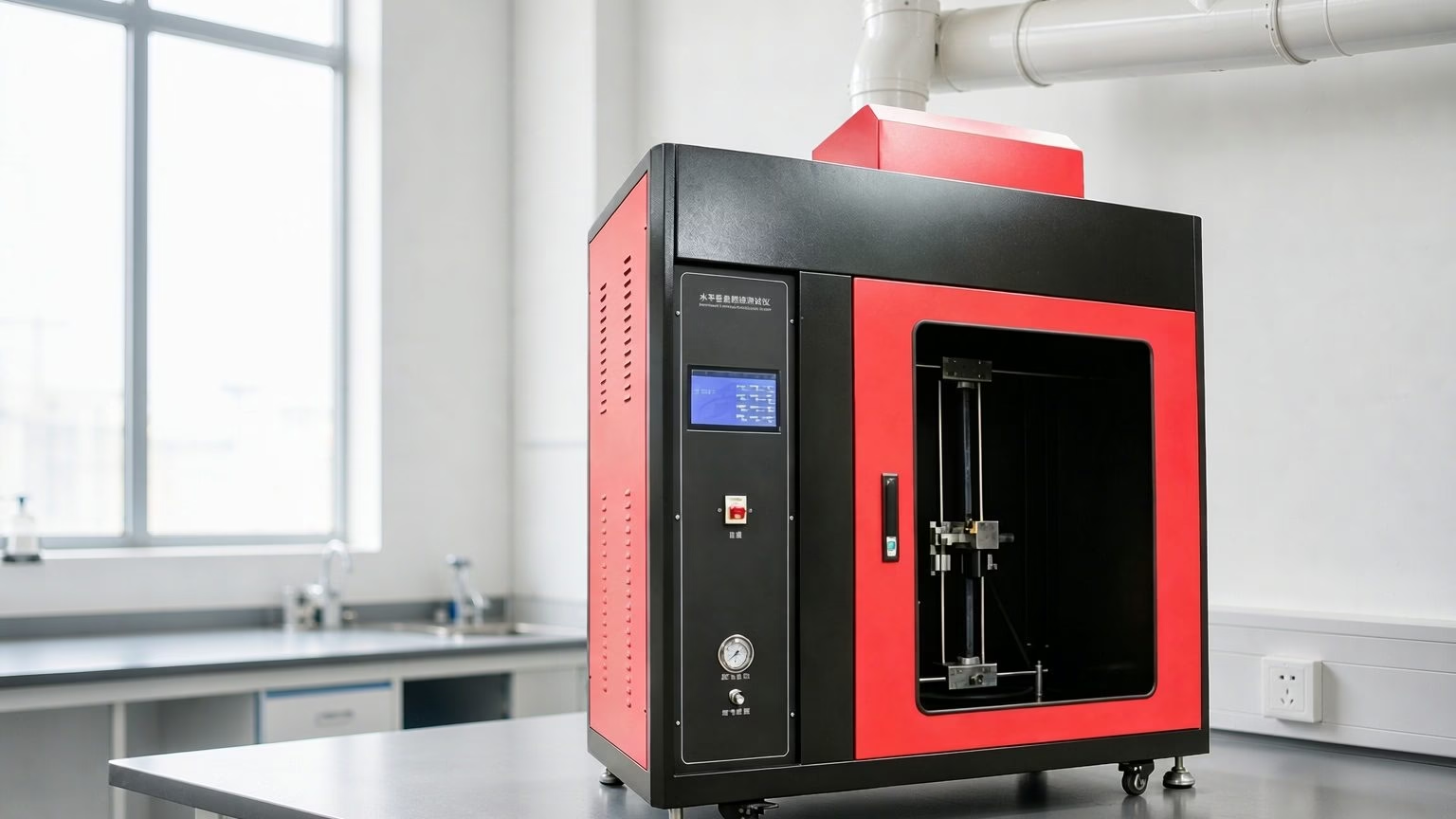
If the shortlist includes a combined cabinet, the horizontal and vertical combustion tester covers the 50 W horizontal and vertical methods in one bench unit, and the plastic foam vertical and horizontal burning tester covers the foam geometries that a bar cabinet cannot hold. For the property side, the plastic LOI limiting oxygen index tester and the touch-screen oxygen index tester cover ISO 4589-2 and ASTM D2863 work, while the cone calorimeter provides heat release data for development. All of them sit under the fire and flame testing equipment category.
An Acceptance Checklist for a New Machine
Commissioning a flammability tester is a short exercise if you prepare for it. The items below are the ones that cause arguments a month after delivery.
| Check | Method | Pass criterion |
|---|---|---|
| Burner geometry and flame height | Measure against the method’s figures | Within the tolerance stated in the standard |
| Flame application timing | Time a test cycle with a stopwatch | Matches the specified exposure and interval |
| Specimen holder alignment | Insert a reference bar, check distance to burner | Within the dimensional tolerance |
| Gas flow control | Set and read back at three flow rates | Stable, within the method’s allowance |
| Timing resolution | Run a dummy vertical test | Afterflame readable to the required precision |
| Cotton pad placement | Inspect the holder | Pad within the specified distance and area |
| Extraction performance | Observe smoke clearance during a burn | No accumulation in the working zone |
| Data export | Produce a report from a dummy run | Complete record with specimen ID and thickness |
Two documents belong with the machine: the calibration record for the flame verification equipment, and a written specimen preparation procedure. Neither comes from the supplier by default, and both are the first things an auditor asks for.
The wider question of which test answers which question is covered in how to test the flammability of plastic materials. For the horizontal and vertical distinction in detail, see horizontal versus vertical flammability testing for plastics, and for the rating letters themselves, UL 94 explained: HB, V-0, V-1 and V-2 plus what makes UL 94 5V testing different. The IEC equivalents are set out in the IEC 60695 practical guide.
Frequently Asked Questions
Do I need a UL 94 tester or an IEC 60695 tester?
Often the same cabinet covers both. IEC 60695-11-10 describes the same 50 W flame and the same horizontal and vertical methods as UL 94, so a modern 50 W cabinet is normally supplied with fixtures and recording sheets for both. What differs is the report format and the acceptance criteria your certification body applies, so confirm with that body which edition it expects before ordering.
Can one machine test both horizontal and vertical?
Yes, if it is sold as a combined unit. The specimen holders differ but the chamber, burner and gas train are shared. Confirm that the vertical fixture includes the cotton pad holder at the correct distance, and that the burner angle and distance can be set to the vertical method, because those are the parts omitted on cheap conversions.
What is the difference between the 50 W and 500 W tests?
The 50 W arrangement uses a small premixed flame and produces HB, V-0, V-1 and V-2 for small parts. The 500 W arrangement uses a much larger flame and produces 5VA and 5VB for larger or thicker parts, with burn-through as the key discriminator. A 50 W result does not establish 5VA, and the 500 W test needs more space and more extraction.
When do I need a glow wire tester instead of a flame tester?
When the applicable product safety standard requires glow wire assessment, which is common for parts retaining current-carrying connections in appliances and switchgear. IEC 60695-2-12 gives the glow wire flammability index and IEC 60695-2-13 gives the glow wire ignition temperature. Neither can be inferred from a UL 94 result, so the requirement has to be read off the end-product standard.
Is an oxygen index tester a substitute for a UL 94 test?
No. The oxygen index is a material property expressed as a percentage of oxygen, used mainly in formulation and specification work. UL 94 is a pass/fail rating of a specific specimen geometry at a specific thickness. A high oxygen index correlates loosely with better vertical performance but does not establish a class, and no certification body accepts one for the other.
How many specimens should I plan for per shift?
Enough that throughput does not become the constraint. A vertical test consumes five specimens, a horizontal test at least three, and retests are routine, so a modest programme of a few materials and thicknesses can consume dozens of bars per day. Plan specimen preparation capacity alongside machine capacity, because the preparation step is usually the real bottleneck.
Does specimen thickness change the rating?
Yes, and each thickness is a separate rating. A material rated V-0 at 1.6 mm is not automatically V-0 at 0.8 mm, and a certificate will state the thicknesses tested. That is why the thickness range belongs in the purchase specification: it determines how many fixture sets and how much specimen preparation capacity you need.
Conclusion: Buy the Matrix, Not the Machine
The reliable sequence is short. List every product family and the certificate each must satisfy. Note the specimen form and thickness range for each. Map those to the governing method. Only then choose apparatus, and check that each machine covers the extremes of your matrix rather than its middle.
If you are assembling a plastics flammability capability, the BRT application team can work from your specimen matrix to a configuration list covering the 50 W and 500 W arrangements, foam and film fixtures, oxygen index and cone calorimeter work. Start from the fire and flame testing equipment category or send us your product families and target certificates.
Written by the BRT Testing polymer flammability team, Shenyang Baoruitong Automation Equipment Co., Ltd. — manufacturers of flammability, glow wire and fire-resistance test equipment for plastics and construction materials.
Sources
- IEC — IEC 60695-11-10:2013, Fire hazard testing — Test flames — 50 W horizontal and vertical flame test methods — https://webstore.iec.ch/en/publication/2938
- ASTM International — D635 Standard Test Method for Rate of Burning and/or Extent and Time of Burning of Plastics in a Horizontal Position — https://store.astm.org/d0635-22.html
- ASTM International — D3801 Standard Test Method for Measuring the Comparative Burning Characteristics of Solid Plastics in a Vertical Position — https://store.astm.org/d3801-20a.html
- IEC — IEC 60695-11-20:1999+AMD1:2003, 500 W nominal test flames — https://webstore.iec.ch/en/publication/2944
- ASTM International — D5048 Standard Test Method for Measuring the Comparative Burning Characteristics and Resistance to Burn-Through of Solid Plastics Using a 125-mm Flame — https://store.astm.org/d5048.html
- IEC — IEC 60695-2-12:2021, Glow-wire flammability index method — https://webstore.iec.ch/en/publication/62845
- IEC — IEC 60695-2-13:2021, Glow-wire ignition temperature method — https://webstore.iec.ch/en/publication/62846
- IEC — IEC 60695-11-5:2016, Needle-flame test method — https://webstore.iec.ch/en/publication/27371
- UNI — ISO 9772:2020, Burning characteristics of horizontally oriented cellular plastic specimens — https://webstore.uni.com/en/iso-9772-2020
- UNI — ISO 9773:2024, Burning behaviour of thin flexible vertical specimens — https://webstore.uni.com/en/iso-9773-2024
- UNI — ISO 4589-2:2017, Determination of burning behaviour by oxygen index — https://webstore.uni.com/en/iso-4589-2-2017
- ASTM International — D2863 Standard Test Method for Measuring the Minimum Oxygen Concentration to Support Candle-Like Combustion of Plastics — https://store.astm.org/d2863-23.html