The Short Answer
Single burning item testing gives a cladding product its Euroclass, and it does not prove that a facade system is compliant. The distinction is the whole subject. EN 13823 puts a corner specimen in front of a propane burner and produces four measured quantities that map onto an EN 13501-1 class of A2, B, C or D 13. What it cannot do is represent a built wall: the specimen carries no joint, no cavity, no cavity barrier, no window reveal and no fixing schedule. For an exterior wall assembly, regulators therefore ask for a full-scale facade test on the system as built — ISO 13785-2 in the international family, NFPA 285 in the United States, and the BS 8414 route in the United Kingdom 678. The practical reading rule is simple: single burning item testing tells you what the panel contributes; the full-scale test tells you what the wall does. Buy the SBI apparatus for product development and CE-marking evidence; commission a full-scale rig, or a laboratory that has one, when the deliverable is an assembly. If you need the classification scheme itself rather than the facade angle, start with our EN 13501-1 Euroclass and SBI testing guide.
What Single Burning Item Testing Measures
The corner geometry and why it is severe
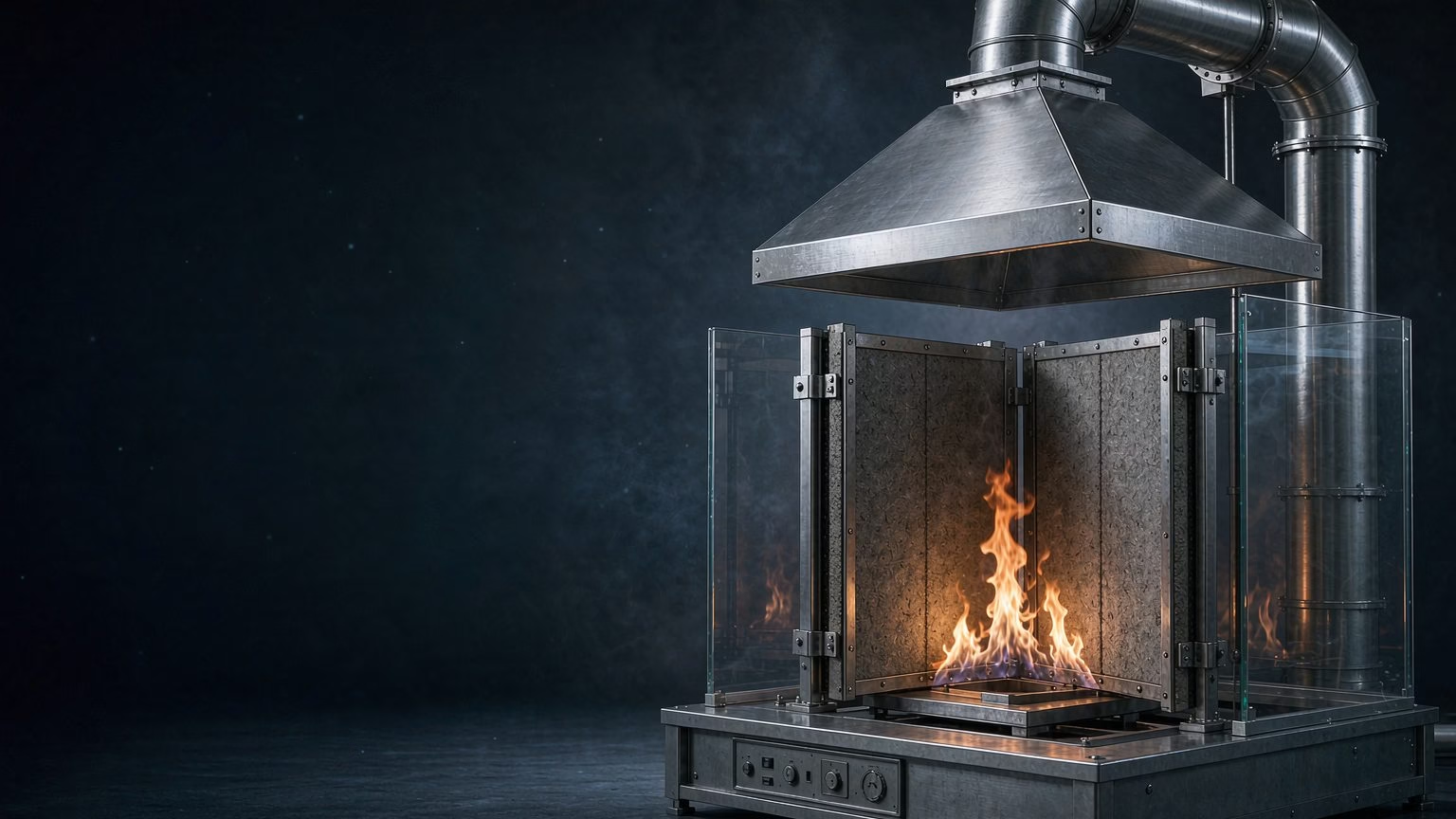
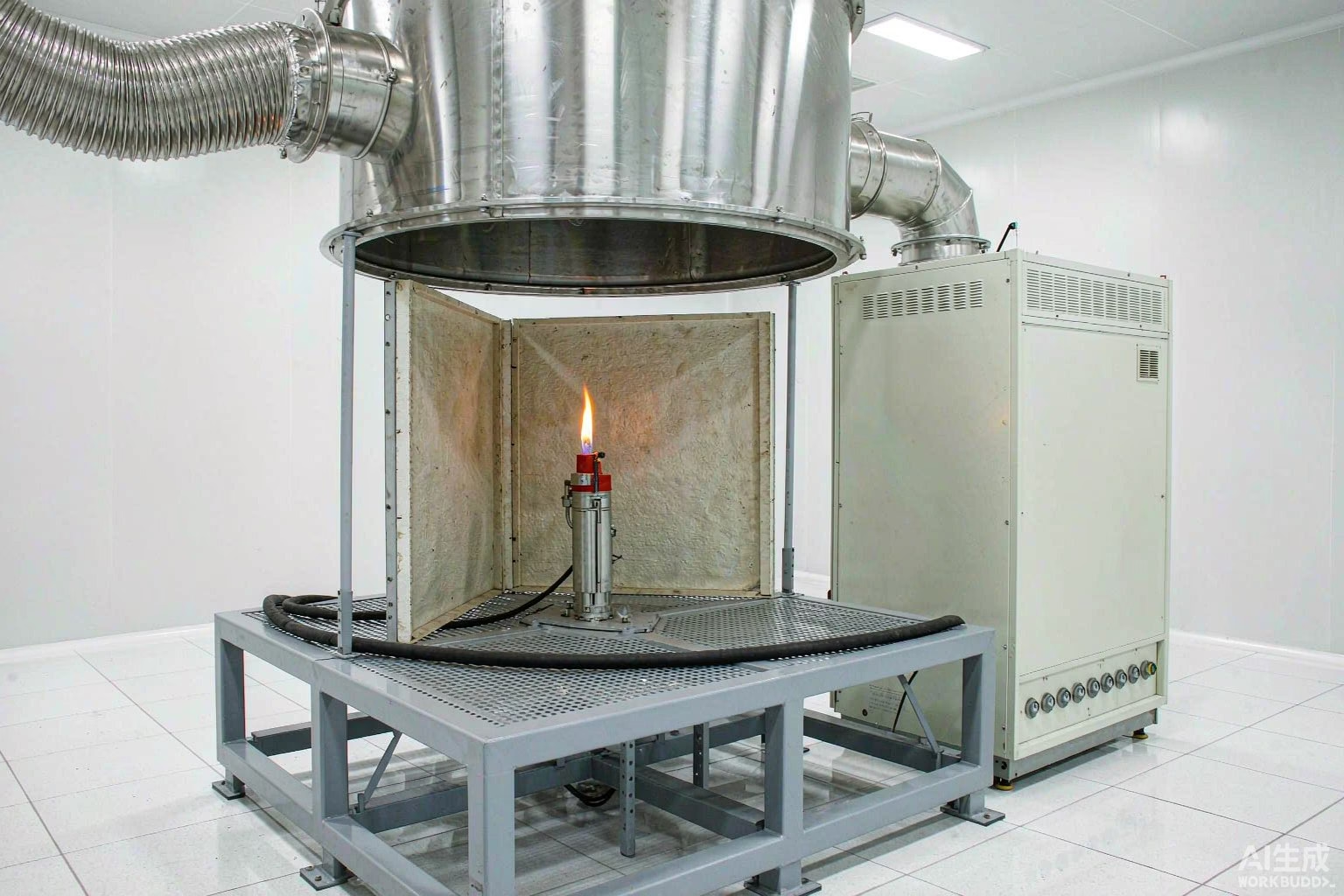
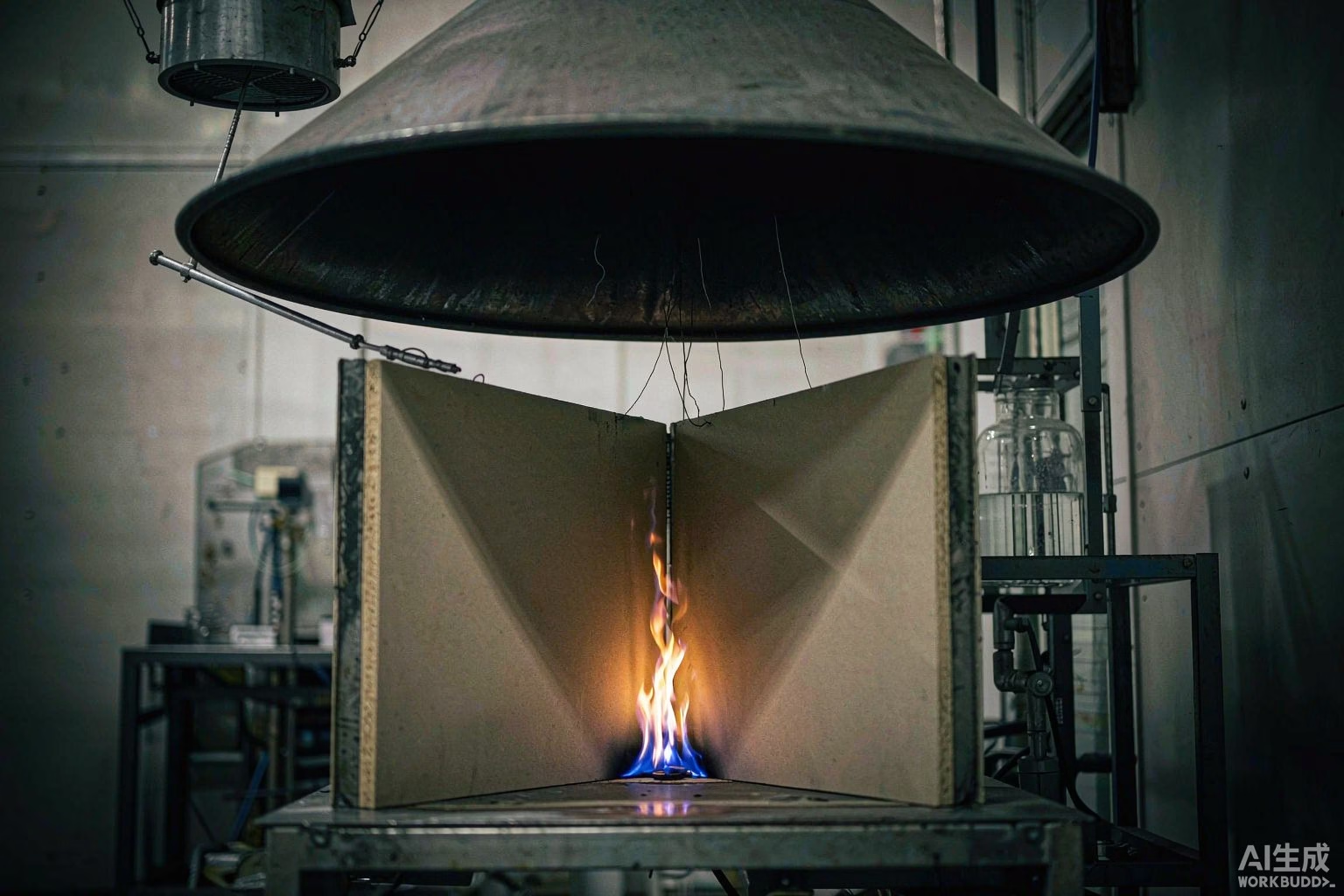
The EN 13823 specimen is a corner, not a flat panel. Two wings meet at 90°: a short wing of (495 ± 5) mm × (1500 ± 5) mm and a long wing of (1000 ± 5) mm × (1500 ± 5) mm, with a maximum specimen thickness of 200 mm. A corner traps radiant heat between two burning faces, so flame growth is faster there than on a flat surface — which is why the configuration was chosen, and why a flat-panel result is never a substitute.
The burner and the four numbers
| Measured quantity | Unit | What it captures |
|---|---|---|
| FIGRA (fire growth rate index) | W/s | How fast heat release accelerates in the early fire |
| THR600s (total heat release, first 600 s) | MJ | How much energy the specimen releases early on |
| LFS (lateral flame spread) | observation | Whether flame reaches the edge of the long wing |
| SMOGRA / TSP600s | m²/s² and m² | Smoke growth rate and total smoke production, which set the s1–s3 suffix |
| Flaming droplets and particles | observation | Which set the d0–d2 suffix |
The full method — rig layout, calibration burns, the step-by-step procedure and how the numbers are reduced — is set out in our single burning item guide to EN 13823 and EN 13501-1; here we keep only what changes when the product is a facade cladding.
Reading FIGRA and THR600s together
The two heat numbers are often read as one, and they are not. FIGRA is a rate — it describes how fast the fire grows, which is what decides whether a room reaches flashover and how quickly. THR600s is an energy total over the first ten minutes — it describes how much fuel the specimen puts into the fire, which is what decides how large the fire becomes. A product can pass the rate limit and fail the energy limit, or the reverse, and the two failure modes call for different reformulation work: a high FIGRA usually points at the surface and at the early burning behaviour, while a high THR600s usually points at the total combustible mass in the panel. That is why a development programme reads both numbers on every run rather than watching the class letter alone.
The burner sits at the base of the corner and delivers roughly 30 kW of propane, and the run lasts about 20 minutes. Those four numbers are then read against the EN 13501-1 classification limits — FIGRA not above 120 W/s and THR600s not above 7.5 MJ for class B, 250 W/s and 15 MJ for class C, 750 W/s for class D, with no lateral flame spread to the edge for B and C [3]. Smoke and droplet suffixes come off the same run: s1 requires SMOGRA ≤ 30 m²/s² and TSP600s ≤ 50 m², while s2 allows up to 180 m²/s² and 200 m²; d0 means no flaming droplets or particles within 600 s.
Why a Facade Is the Hardest Case for Single Burning Item Testing
A component is not a system
Every classification scheme built on EN 13823 classifies a product in a defined end use, not a wall. The moment a cladding panel becomes an exterior wall, four things enter the fire problem that no bench-scale corner specimen can carry: the cavity behind the panel, which can turn a small ignition into a vertical chimney; the joints between panels, which are where flame usually enters; the fixings, which fail on their own schedule; and the cavity barriers, whose presence or absence decides whether a fire stops at one storey. None of those four appear in a 1.5 m corner specimen.
Where the cavity changes the answer
The cavity is the item that turns a component result into an unreliable predictor. A ventilated facade has an air gap behind the panel, and once flame enters that gap the fire has a vertical path with its own draught — a geometry with no counterpart in a 1.5 m corner specimen. Cavity barriers exist precisely to interrupt that path, and their spacing, fixing and fire behaviour are assessed at assembly level, not at product level. Two consequences follow for anyone planning single burning item testing on a ventilated system. The Euroclass of the panel remains a necessary input, because the barrier cannot rescue a panel that contributes too much heat too quickly. But it is not a sufficient one, and the spacing and specification of the barriers have to be justified by an assembly-level argument or an assembly-level test.
This is not a criticism of the method, and it is not a gap that EN 13823 was ever meant to close. It is a scope limit, and the cost of ignoring it is measured in re-testing rather than in a marginal classification.
What the large-scale facade tests actually simulate
| Test | Fire scenario it reproduces | Scope limit stated in the standard |
|---|---|---|
| ИСО 13785-1 | A simulated external fire with flames impinging directly on the facade | Screening method; only for facades added to an existing external wall, not free-standing; vertical elements only; not for structural strength [6] |
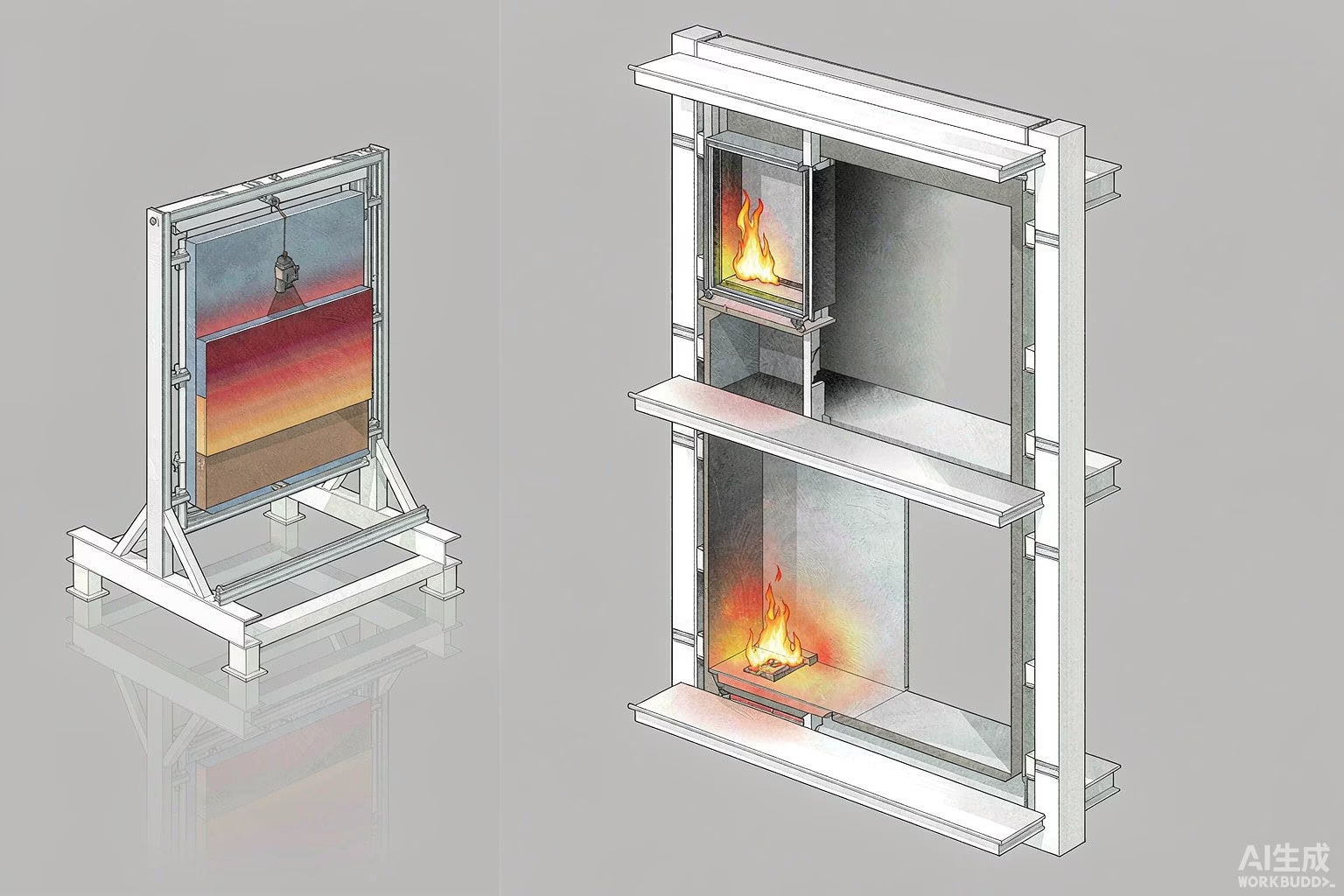
| ИСО 13785-2 | A simulated interior compartment fire with flames emerging through a window opening onto the facade | Non-loadbearing claddings only; balconies, windows, shutters and curtains are not considered; not intended to determine the fire behaviour of a given building facade [7] |
| NFPA 285 | Fire propagation characteristics of exterior wall assemblies (United States) | Assembly-level test used by US codes for combustible cladding and insulation [8] |
| ASTM E84 | Surface burning characteristics of a building material (United States) | Material-level tunnel test; not an assembly test 9 |
The difference between the first two rows is worth internalising, because it decides which rig you commission. ИСО 13785-1 asks what happens when the fire is outside and attacks the cladding; ИСО 13785-2 asks what happens when the fire is inside a room and comes out of a window onto the cladding. ИСО 13785-2 also builds the geometry into the specimen: the standard notes that an internal corner produces a more intense exposure than a flat facade, and states that the test specimen therefore contains an internal corner with a re-entrant angle of 90° [7].
Mounting a Cladding Product in the SBI Rig
| Decision | Why it changes the result |
|---|---|
| Substrate and backing board | Many claddings are classified on a specified substrate; changing it can change the FIGRA, because the substrate can shield, insulate or contribute |
| Joints and panel edges | A real facade has joints; the SBI specimen does not — so joint behaviour must come from a separate test, not from the Euroclass |
| Fixing method and density | Mechanical fixings conduct heat and can open gaps; adhesive-only mounting can delaminate under the burner |
| Thickness and orientation | Classifications are thickness- and orientation-dependent; a result obtained at one thickness does not cover another |
| Conditioning | Specimens are conditioned before testing; EN 13238 was republished in 2026 and is current at that edition [10] |
The single most common failure in this category is not a bad test but a mis-scoped classification: a manufacturer tests a panel on a substrate it does not sell, at a thickness it does not stock, mounted in a way that no installer will reproduce. The certificate is valid and the claim is still unsupportable.
Facade Product Families and What Drives Their Result
| Product family | What usually drives the EN 13823 result | What to watch |
|---|---|---|
| Metal composite panel | The core material, not the metal faces | Core thickness and the exposed cut edge |
| Insulation board in an ETICS | Density, facing and the render system it is tested with | Tested as a system or as a board — the two are different claims |
| Timber and modified timber cladding | Surface treatment and species density | Treatment durability is a separate question from the class |
| Fibre-cement and mineral board | Usually low contribution; the substrate and fixings matter more | Joint detailing and fixing schedule |
| Rainscreen laminate and HPL | Resin content and surface finish | Delamination behaviour under the burner |
Read that table as a map of where to look, not as a prediction. Single burning item testing is comparative inside a defined end use, so the number a laboratory reports belongs to the exact construction it was given — substrate, thickness, orientation, fixing method and edge condition included. Change any of those and you have commissioned a new test, not a reinterpretation of the old one. This is the point at which most budgets are lost: a programme that treats the Euroclass as a property of the material re-tests three times, while a programme that treats it as a property of the tested construction tests once and then manages change control.
Reading a Facade Euroclass
A designation such as B-s1,d0 is three statements, not one. The letter says how much the product feeds a growing fire under the EN 13823 exposure. The s suffix says how much smoke it produces. The d suffix says whether it sheds burning droplets. What the string does not say is anything about the cavity, the barriers, the fixings or the assembly — and those are exactly the items a facade specification turns on.
For the mapping from corner-rig numbers to a class designation, see how EN 13823 SBI testing shapes Euroclass fire classifications, and for the scheme from first principles see our beginner’s guide to building material fire classification. Two further limits follow. Class E is a weak claim: it comes from the single flame source test alone, where a match-sized flame must simply not spread 150 mm in 20 seconds. And class A2 still needs the SBI: the A1 and A2 lines are drawn by EN ISO 1182 and EN ISO 1716, with the SBI run alongside for A2, which is why a laboratory chasing A2 evidence needs the corner rig anyway. Note the edition drift in that sentence — EN ISO 11925-2 was republished and the 2020 edition was withdrawn on 28 January 2026 45, so a procedure written to the 2020 text is now out of date.
Which Standards Editions Are Current
| Standard | Current edition | Status note |
|---|---|---|
| EN 13823 (SBI) | 2020+A1:2022 | In force since 20 July 2022 [1] |
| EN 13823:2020 | withdrawn | Withdrawn 20 July 2022 2 |
| EN 13501-1 | 2018 | In force since 19 December 2018 [3] |
| EN ISO 11925-2 | 2026 | In force since 28 January 2026 [4] |
| ИСО 13785-1 | 2002 | Current; edition 2 is at the FDIS stage, so expect a change [6] |
| ИСО 13785-2 | 2002 | Current, confirmed at review [7] |
Two items from that table deserve a line in your test plan. The first is EN 13823 itself: the plain 2020 edition was withdrawn almost immediately when the amendment landed, so any quotation or report citing “EN 13823:2020” without “+A1:2022” is citing a withdrawn document [1][2]. The second is ISO 13785-1, where the second edition has reached the final draft ballot stage; if your facade programme runs for more than a year, build in a review point rather than locking the screening method to the 2002 text [6].
Procurement Checklist for Single Burning Item Testing Equipment
| Question | Why it matters |
|---|---|
| Is the rig supplied against EN 13823:2020+A1:2022? | The 2020 edition was withdrawn on 20 July 2022 [1][2] |
| Does the burner and flow train hit the specified propane output and stability? | The thermal input drives FIGRA, which drives the class |
| Is the exhaust duct, oxygen analyser and flow measurement specified as a calibrated chain? | Heat release is computed from oxygen consumption and duct flow |
| Does the smoke measurement chain cover SMOGRA and TSP600s? | The s1–s3 suffix comes from the same run, not from a second instrument |
| Are the specimen holders and backing board fixtures supplied for both wing sizes? | 495 mm and 1000 mm wings, 1500 mm high [1] |
| What is the documented calibration procedure? | See our dedicated EN 13823 SBI calibration guide |
| Do you also need a cone calorimeter? | Different question, different apparatus — see SBI apparatus versus cone calorimeter |
How to Sequence a Facade Test Programme
Four steps, in order, and skipping one of them is what produces expensive surprises. Screen first. Run single burning item testing early in formulation, on the intended substrate, and read FIGRA and THR600s together rather than the class letter. Then fix the construction. Lock substrate, thickness, orientation and fixing method into a written end-use definition before any certification run, because that document is what the classification is scoped to. Then decide whether the assembly needs its own test. If the product goes into a ventilated facade, or into a wall where the code asks about the assembly, commission the full-scale work on the system as built — ISO 13785-2 or NFPA 285 depending on the market [7][8]. Then manage change. Any change to core material, thickness, coating or substrate is a classification question, not a production note, and should go back through the first step.
The reason to sequence it this way is that the two tests fail differently. A screening failure is cheap: reformulate and re-run a corner specimen. An assembly failure discovered late is not cheap, because it usually means the cavity strategy or the barrier specification has to change, and everything downstream of it has to be re-argued.
Часто задаваемые вопросы
Does single burning item testing prove my facade system is compliant?
Нет. Single burning item testing classifies a product, not an assembly. The EN 13823 corner specimen has no cavity, no joints, no cavity barriers and no fixings, all of which govern how a real facade behaves. Where a code asks about the wall as built, it asks for a full-scale facade test such as ISO 13785-2, NFPA 285 or the BS 8414 route.
Which Euroclass can a cladding panel realistically reach?
Classes A2, B, C and D come out of EN 13823. Class B needs FIGRA at or below 120 W/s and THR600s at or below 7.5 MJ with no lateral flame spread to the specimen edge; class C allows 250 W/s and 15 MJ; class D allows 750 W/s. A1 comes from EN ISO 1182 and EN ISO 1716 alone, and E from the small-flame test alone.
What do the s and d suffixes mean on a cladding Euroclass?
The s suffix ranks smoke production and the d suffix ranks flaming droplets. Class s1 requires SMOGRA at or below 30 m²/s² and TSP600s at or below 50 m²; s2 allows up to 180 m²/s² and 200 m². The d0 suffix means no flaming droplets or particles were produced within 600 seconds.
Why does the SBI use a corner specimen instead of a flat panel?
Because a corner traps radiant heat between two burning faces and accelerates flame growth, making it a more severe and more realistic geometry than a flat panel. Most compartment fires begin in or near a corner. The same reasoning appears in ISO 13785-2, whose facade specimen is built with a 90° internal corner for exactly that reason.
What is the difference between ISO 13785-1 and ISO 13785-2?
ИСО 13785-1 is an intermediate-scale screening method that exposes the facade to a simulated external fire with flames impinging directly on it, and is limited to non-free-standing cladding added to an existing wall. ИСО 13785-2 is a large-scale test that reproduces an interior compartment fire emerging through a window opening onto the facade, using a specimen with a 90° internal corner.
Which edition of EN 13823 should I cite?
EN 13823:2020+A1:2022, which has been in force since 20 July 2022. The plain 2020 edition was withdrawn on the same day it was replaced, so a report or quotation that cites EN 13823:2020 without the amendment is pointing at a withdrawn document.
Do I need a cone calorimeter as well as an SBI apparatus?
They answer different questions and are not interchangeable. The SBI produces a classification under EN 13501-1 from a corner specimen at a defined burner output; the cone calorimeter produces heat release rate and smoke production rate under a controlled radiant flux for research, formulation and hazard modelling. Many laboratories end up with both.
Заключение
Work in this order. Первый, decide what the deliverable is — a product classification or an assembly verdict — because that single decision sends you to the SBI rig or to a full-scale facade rig. Second, if it is a classification, define the end use precisely: substrate, thickness, orientation and fixing method, all stated on the test request. Third, name the editions you are working to, and check the table above for the two that changed recently. Fourth, read the classification as three statements — fire contribution, smoke, droplets — and do not let a letter carry a claim it does not make. Fifth, if the project is an exterior wall with a cavity, treat the Euroclass as an input to the assembly argument rather than as the answer.
BRT supplies the single burning item (SBI) test apparatus built to EN 13823, together with the exhaust, gas analysis and smoke measurement chain the classification depends on. Send us the target market, the product family and the class you need to reach, and we will return a configuration with the instrument list and the verification procedure.
BRT 燃烧测试应用团队 — Shenyang Baoruitong Automation Equipment. Fire testing application engineering; sources are the CEN, ИСО, ASTM and NFPA standard pages cited below.
Sources
- UNI Ente Italiano di Normazione — EN 13823:2020+A1:2022
- UNI Ente Italiano di Normazione — EN 13823:2020
- UNI Ente Italiano di Normazione — EN 13501-1:2018
- UNI Ente Italiano di Normazione — EN ISO 11925-2:2026
- UNI Ente Italiano di Normazione — EN ISO 11925-2:2020
- UNI Ente Italiano di Normazione — ISO 13785-1:2002
- UNI Ente Italiano di Normazione — ISO 13785-2:2002
- NFPA — NFPA 285
- ASTM International — E84 Standard Test Method for Surface Burning Characteristics of Building Materials