- Kısa Cevap
- What Makes Composite Building Materials Different to Test
- The Three Questions Composite Building Materials Have to Answer
- Reaction to Fire: How a Composite Panel Is Classified
- Heat Release: ISO 5660-1 on a Composite Specimen
- Smoke: ISO 5659 Names Composites Explicitly
- Yangına Dayanıklılık: the Assembly Is the Specimen
- Large-Scale Tests: Where Composites Really Fail
- North America: ASTM E84 and What It Does Not Cover
- A Test Matrix for Composite Building Materials
- Five Failure Modes That Only Appear in Composite Building Materials Testing
- Specifying Tests for a Composite: A Checklist
- Equipment for Composite Testing
- Sıkça Sorulan Sorular
- What fire tests does a composite building panel need?
- Why is a composite tested by its components?
- Can a Euroclass B panel be used as a fire-rated wall?
- Does passing ASTM E84 make a composite safe?
- What is the difference between NFPA 285 and a Euroclass test?
- Which smoke test applies to composite panels?
- Does the cut edge need to be tested?
- Çözüm: A Decision Order
- About the Author
- Kaynaklar
Kısa Cevap
Fire testing requirements for composite building materials fall into three separate blocks, and no single certificate covers all three: its components are tested for non-combustibility and calorific value, the product is tested for reaction to fire as a non-homogeneous item, and the assembly it forms is tested for fire resistance or façade propagation. İÇİNDE 13501-1 sets out the reaction-to-fire classification procedure for construction products and treats the three product families separately 1; ISO 1182, the furnace route behind the top classes, applies to homogeneous products and to the substantial components of non-homogeneous ones 2; and a sandwich wall that has to hold a fire is assessed as a wall under EN 1364-1 veya TR 1365-1, not as a panel 67. Read the specification in that order and the test programme writes itself.
What Makes Composite Building Materials Different to Test
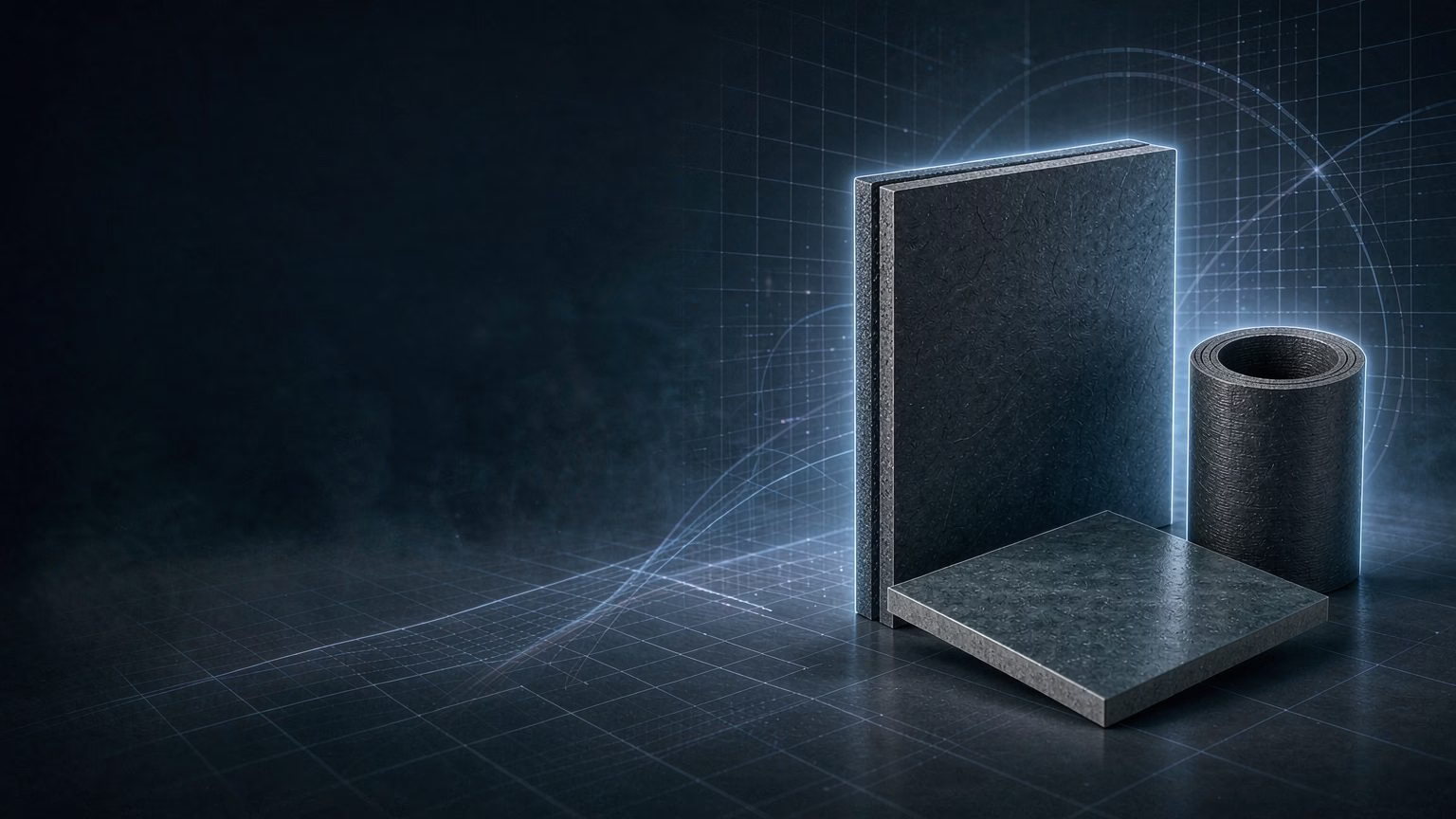
A homogeneous board is one material, so one set of results describes it. A composite is a stack of materials with different chemistries, different thicknesses and a bond line between them, and the fire does not treat the stack as one substance. The facing may be mineral and inert while the core is a hydrocarbon foam; the adhesive may be the first thing to pyrolyse.
The component question
This is the reason the standards are written the way they are. Non-combustibility is assessed on the homogeneous material, and where the product is not homogeneous, on its substantial components [2]. A panel therefore arrives at the laboratory as a set of coupons plus a description of the build-up, and the laboratory decides which layers are substantial enough to test in their own right.
Why the core decides the outcome
In almost every fire test of composite building materials that ends in a failure, the facing passes and the core fails. Aluminium skins are inert to a small flame; a polyethylene core is not. The same geometry with a mineral-filled or FR core behaves completely differently, which is why the core chemistry, not the skin, is the first question to ask a supplier.
The Three Questions Composite Building Materials Have to Answer
| Question | What it asks | Governing test | Reported as |
|---|---|---|---|
| How does the material contribute to a fire? | Yangına tepki | İÇİNDE 13823 SBI, ISO'DA 11925-2, ISO 1182, ISO 1716 | Avrupa sınıfı, e.g. B-s1,d0 |
| How much heat and smoke does it produce? | Fire growth and visibility | ISO 5660-1, ISO 5659 | kW/m², m²/s, optical density |
| Does the assembly resist or spread fire? | Yangına dayanıklılık, façade propagation | İÇİNDE 1364-1, İÇİNDE 1365-1, ISO 9705-1, NFPA 285 | EI/REI minutes, pass or fail |
The table is the whole article in three lines, and the most common procurement error is to buy a certificate for one row and assume it covers the other two. A Euroclass B panel is not a fire-rated wall, and a fire-rated wall is not evidence that the façade will not propagate flame.
Reaction to Fire: How a Composite Panel Is Classified
İÇİNDE 13501-1 provides the classification procedure for all construction products, yapı elemanlarına dahil edilen ürünler dahil, with cables excluded to EN 13501-6 [1]. It considers products in relation to their end use and applies to three categories treated separately: construction products excluding floorings and linear pipe thermal insulation, floorings, and linear pipe thermal insulation products [1]. A composite wall panel belongs to the first category; the same panel used as a floor belongs to the second and is classified on a different scale.
The component route to the top classes
The A classes are decided by two chemical measurements rather than by a fire test. ISO 1182 places a specimen in a furnace held at 750 °C and records temperature rise, mass loss and the duration of sustained flaming, and it applies to homogeneous products and to substantial components of non-homogeneous products [2]. ISO 1716 burns a sample in an oxygen bomb and reports the gross calorific value 3. İÇİNDE 13501-1 then applies the pass values — for A1 a temperature rise of no more than 30 °C, mass loss of no more than 50 %, no sustained flaming and a PCS of no more than 2.0 MJ/kg [1].
The product route: SBI and the single flame
Below the A classes the composite is burned as a product. İÇİNDE 13823 subjects a corner specimen of two wings to a single burning item and calculates the fire growth rate, and its scope is explicitly essentially flat products, excluding floorings 4. ISO'DA 11925-2 applies a small flame directly to a surface or edge and asks whether ignition occurs within a defined exposure 5; the current edition is EN ISO 11925-2:2026, in force since 28 Ocak 2026 [5].
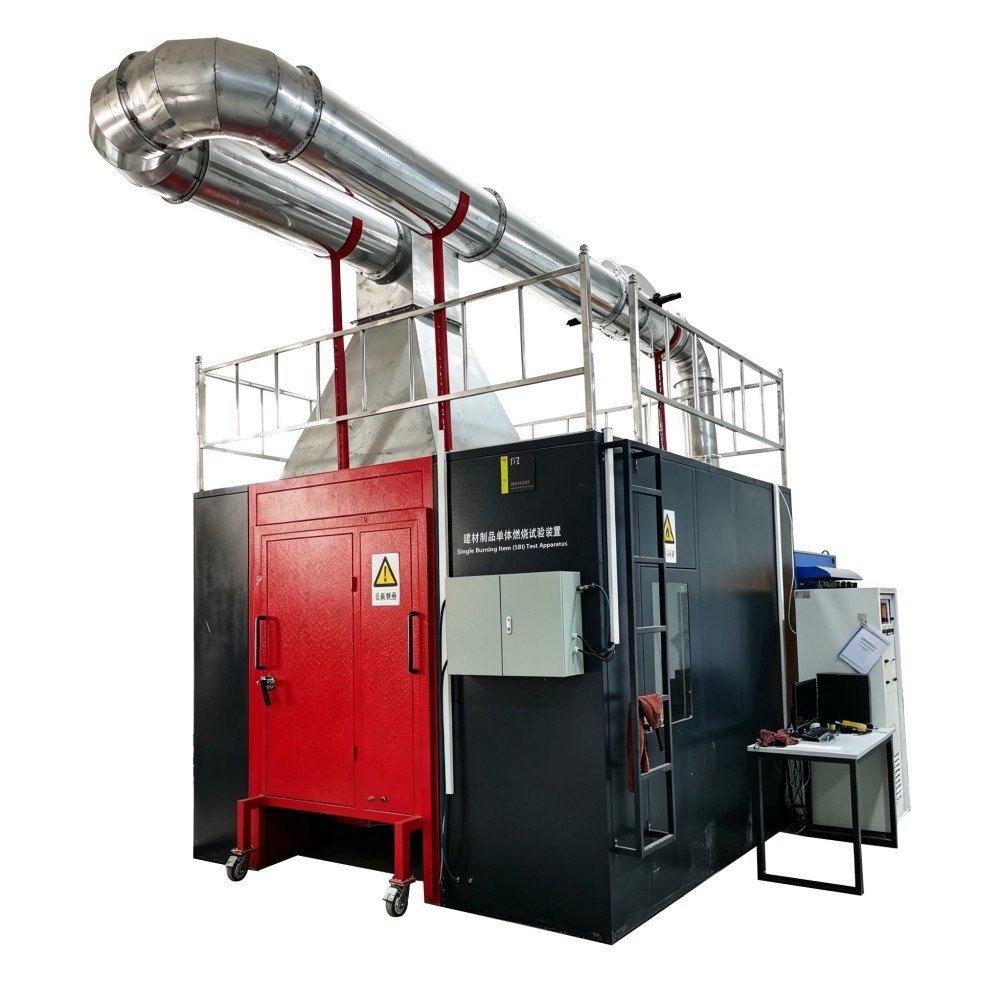
The SBI apparatus is where a composite’s two wings meet a real burner, and our guide to single burning item testing for façade materials covers the specimen build in detail. This article stays with the composite-specific question: which layer is being judged.
Heat Release: ISO 5660-1 on a Composite Specimen
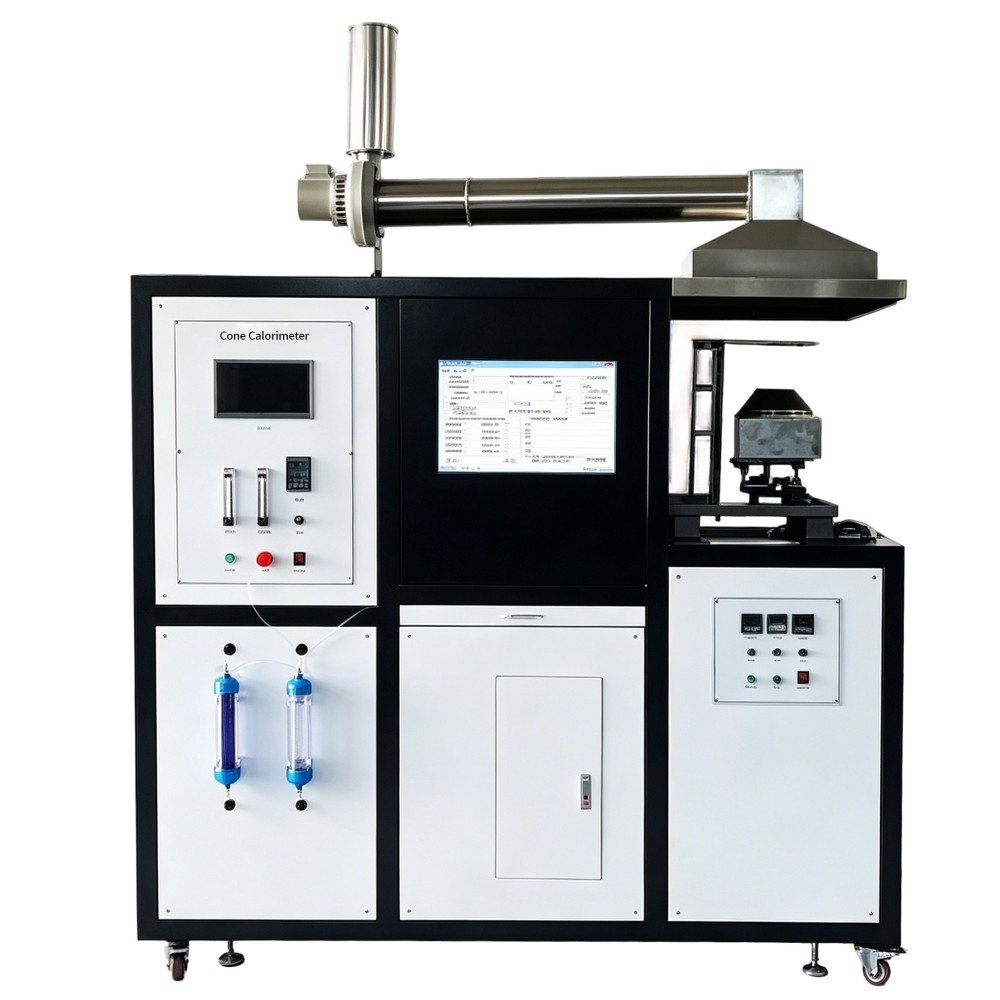
The cone calorimeter burns a horizontal specimen under a controlled irradiance and derives heat release rate from oxygen consumption 8. For composites it is the most informative single test after the SBI, because it exposes the moment the core joins in: a facing that resists ignition and a core that ignites twenty seconds later produce a two-peak curve, and the second peak is the one that matters for escape time.
ISO 5660-1:2015 güncel, in force since 20 March 2015 [8]. The koni kalorimetresi records time to ignition, peak heat release rate and total heat released, which is why it is the instrument of choice when two candidate core formulations have to be separated.
Smoke: ISO 5659 Names Composites Explicitly
Smoke is a separate judgement in the European system, written s1, s2 or s3 beside the main class, and for composites it is often the deciding one because a burning core produces dense smoke behind an intact skin.
ISO 5659 is the standard that settles the argument about how a composite should be mounted. Its scope specifies a method of measuring smoke production from the exposed surface of specimens of materials or composites, applicable to specimens with an essentially flat surface that do not exceed 25 mm in thickness when placed in a horizontal orientation, and based on exposure to 25 kW/m² and 50 kW/m² 9. ISO 5659:2026 is the current edition, in force since 27 Ocak 2026, and it replaces the former Part 2 designation [9].
That 25 mm limit is a practical constraint on composite testing: a thick sandwich panel is tested as a reduced-thickness specimen or by its components, and the resulting smoke figure belongs to what was actually burned. Bizim smoke density tester covers the chamber method used alongside it.
Yangına Dayanıklılık: the Assembly Is the Specimen
Fire resistance is a different question with a different specimen. İÇİNDE 1364-1 covers non-loadbearing wall elements and EN 1365-1 covers loadbearing walls; both are current, in force since 8 July 2015 Ve 10 Ekim 2012 respectively [6][7]. In neither case is the panel the test object. The specimen is the wall: panels, eklemler, fixings, alt tabaka, and the seams where a fire will find its way.
| Ne ölçülür | Non-loadbearing (İÇİNDE 1364-1) | Yük taşıma (İÇİNDE 1365-1) |
|---|---|---|
| Bütünlük (e) | Evet | Evet |
| Yalıtım (BEN) | Evet | Evet |
| Yük taşıma kapasitesi (R) | Not applicable | Evet |
| Specimen | Full wall with joints and fixings | Full wall under load |
This is the single most expensive misunderstanding in composite specification: a panel with a good Euroclass and no assembly test has no fire resistance rating at all, and no amount of component data substitutes for a wall test that includes the joints.
Large-Scale Tests: Where Composites Really Fail
Two test families exist because compartment tests miss the façade problem.
ISO 9705-1: the room corner
ISO 9705-1 is the room corner test, in which a lined room is exposed to a burner that grows from 100 kW to 300 kW, and the outcome is whether the lining contributes to flashover 10. It is current, in force since 18 February 2016 [10]. For a composite lining, the test is the first realistic look at how the layers interact once the room is hot.
NFPA 285: the assembly, not the product
NFPA 285 is the North American answer and its official title states the purpose precisely: a standard fire test method for evaluation of fire propagation characteristics of exterior wall assemblies containing combustible components 11. The specimen is a full exterior wall assembly with its cavity, insulation and cladding. A panel that passes every component test can still fail NFPA 285 because the cavity acts as a chimney, and that failure belongs to the assembly design rather than to the panel.
North America: ASTM E84 and What It Does Not Cover
ASTM E84 is the surface burning test — a horizontal tunnel that reports a flame spread index and a smoke developed index for a specimen mounted face down 12. It is the basis for the familiar Class A, B and C ratings used in North American codes, and Class A corresponds to a flame spread index of 0 ile 25.
What E84 does not do is measure calorific value, core behaviour or assembly performance. It is a surface test, and a composite with an inert facing will score well on it whatever the core contains. Treating an E84 Class A result as a statement about the whole panel is the most common North American misreading in this category.
A Test Matrix for Composite Building Materials
| Ürün | Yangına tepki | Heat and smoke | Assembly |
|---|---|---|---|
| Aluminium composite panel, PE core | İÇİNDE 13823 + ISO'DA 11925-2 on the product; ISO 1182 on skins | ISO 5660-1; ISO 5659 on the cut specimen | NFPA 285 veya ISO 9705-1 for the wall |
| Aluminium composite panel, FR mineral core | As above, plus ISO 1716 on the core | As above | As above |
| PIR or PUR sandwich panel | İÇİNDE 13823 on the panel; ISO 1182 on facings | ISO 5660-1 for the core contribution | İÇİNDE 1364-1 veya TR 1365-1 as a wall |
| Mineral wool sandwich panel | ISO 1182 on the wool; İÇİNDE 13823 on the panel | ISO 5659 | İÇİNDE 1364-1 |
| GRP or FRP cladding | İÇİNDE 13823; ISO'DA 11925-2 for edge ignition | ISO 5660-1 | NFPA 285 for the rainscreen build-up |
| SMC or BMC mouldings | İÇİNDE 13823; ISO 1182 on the resin system | ISO 5660-1 | Depends on the application |
| WPC decking | İÇİNDE 13823 for flooring family; ISO'DA 11925-2 | ISO 5660-1 | Not usually an assembly question |
The matrix is a starting point for composite building materials, not a quotation. The correct programme depends on the end use category in EN 13501-1, and on whether the client needs a CE-marked declaration, a building-code approval or both [1].
Five Failure Modes That Only Appear in Composite Building Materials Testing
- Core ignition behind a passing facing. The skin resists the small flame; the core ignites later and the failure appears in the heat release curve, not in the ignitability result.
- Delamination opening a chimney. The bond line fails first and the cavity becomes a flue, which is why NFPA 285 tests the assembly rather than the panel [11].
- The cut edge. A cut edge exposes the core, and it is the path a small flame takes. ISO'DA 11925-2 allows edge exposure for exactly this reason [5].
- Molten core material. Thermoplastic cores drip and pool, spreading fire below the tested zone.
- Component pass, assembly fail. Every coupon passes, the joints do not. This is the failure that costs the most to discover late.
Specifying Tests for a Composite: A Checklist
| Question to settle before testing | Why it changes the programme |
|---|---|
| Which EN 13501-1 category is the end use? | Construction product, flooring and linear pipe insulation are classified separately [1] |
| Is the product homogeneous or not? | Determines whether components are tested in their own right [2] |
| What is the core chemistry, in writing? | PE, FR mineral and PIR need different evidence |
| Is a fire resistance rating required? | Triggers an assembly test to EN 1364-1 veya TR 1365-1 [6][7] |
| Is the façade combustible? | Triggers NFPA 285 veya ISO 9705-1 [10][11] |
| Which market is the certificate for? | İÇİNDE, GB and North American routes are not interchangeable |
Equipment for Composite Testing
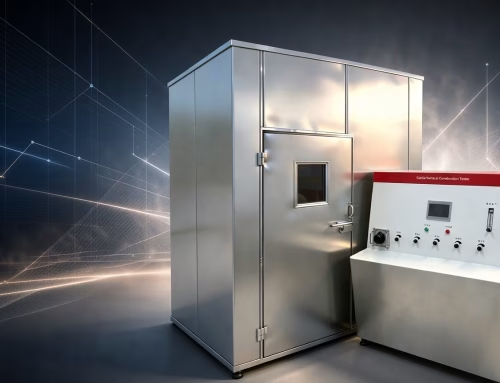
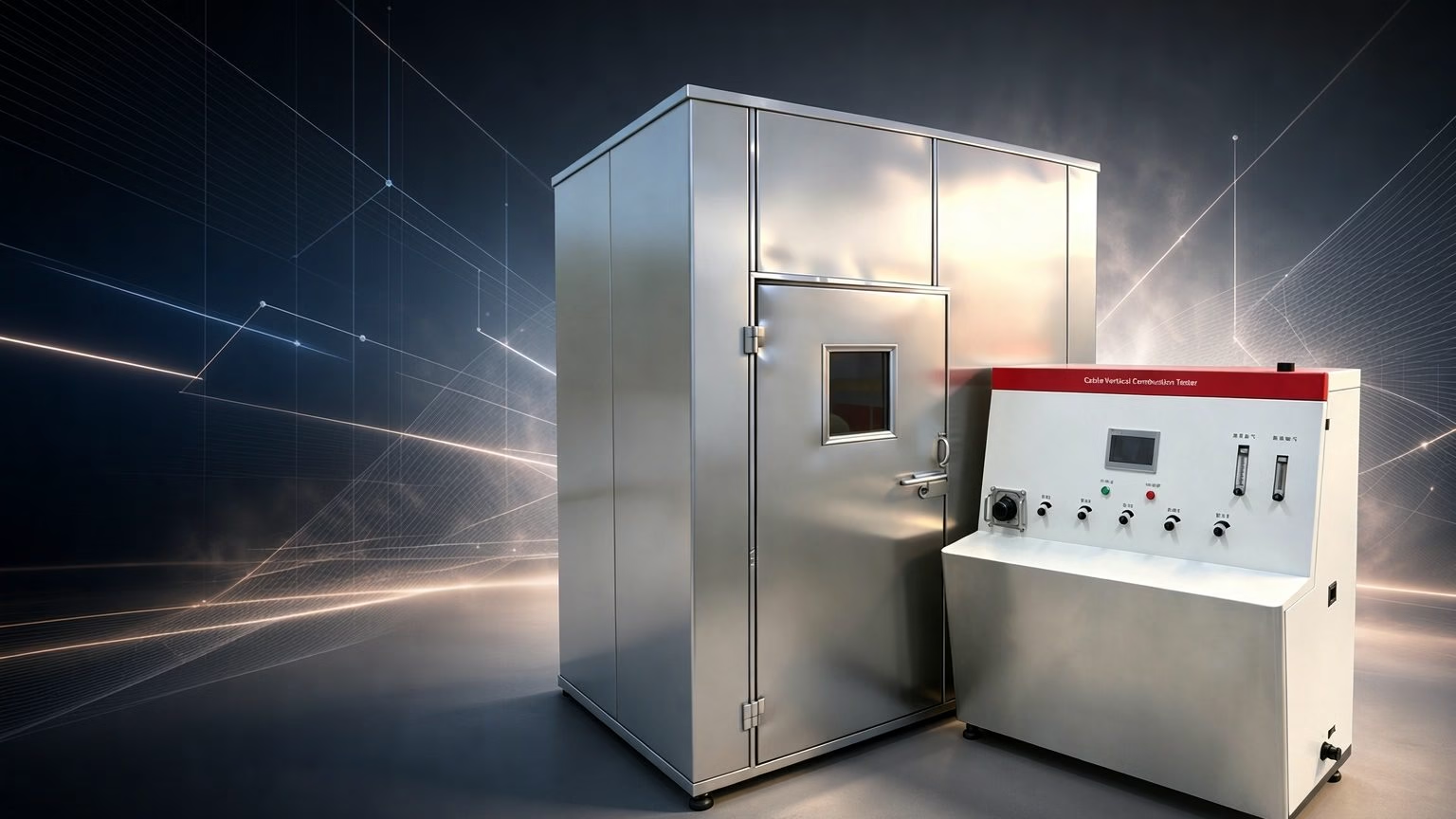
The four instruments behind a composite test programme are the SBI apparatus for EN 13823, the koni kalorimetresi for ISO 5660-1, the smoke density tester for the chamber smoke methods, ve non-combustibility apparatus for the ISO 1182 component route.
For the single-flame step the building material combustibility test apparatus runs EN ISO 11925-2, ve vertical fire resistance test furnace covers the assembly tests. The yangın ve alev test cihazları category lists the full range, ve A1 classification guide explains how the component results are turned into a class.
Sıkça Sorulan Sorular
What fire tests does a composite building panel need?
It needs reaction to fire under EN 13501-1, which normally means component tests for non-combustibility and calorific value plus an SBI and a single-flame test on the product, and it needs heat release and smoke data if the specification asks for performance beyond a class. If the panel forms a fire-rated wall or a façade, an assembly test is required as well.
Why is a composite tested by its components?
Because non-combustibility is a property of a homogeneous material. ISO 1182 applies to homogeneous products and to the substantial components of non-homogeneous products, so a panel arrives as a set of coupons and the laboratory decides which layers are substantial enough to test separately. The class is then built from those results plus the product tests.
Can a Euroclass B panel be used as a fire-rated wall?
HAYIR. Reaction to fire and fire resistance are separate judgements under separate documents. A Euroclass B classification describes how the material contributes to a fire. A fire resistance rating describes how a wall assembly performs under a standard time-temperature curve, and it requires a test to EN 1364-1 veya TR 1365-1 with the joints and fixings included.
Does passing ASTM E84 make a composite safe?
It makes the surface tested compliant with a surface burning requirement. ASTM E84 reports flame spread and smoke indices for a specimen in a horizontal tunnel; it does not measure calorific value, core behaviour or assembly performance. A panel with an inert facing can score well on E84 while its core remains the governing fire load.
What is the difference between NFPA 285 and a Euroclass test?
NFPA 285 tests an exterior wall assembly containing combustible components, including cavity and insulation, for fire propagation. A Euroclass test classifies the product. A panel can hold a good Euroclass and still fail NFPA 285 because the failure mechanism is the cavity, not the panel, which is why the assembly has to be tested as built.
Which smoke test applies to composite panels?
ISO 5659 is the one that names composites explicitly. It measures smoke production from the exposed surface of materials or composites with an essentially flat surface not exceeding 25 mm in thickness in a horizontal orientation, en 25 kW/m² and 50 kW/m². A panel thicker than that is tested as a reduced section or by components.
Does the cut edge need to be tested?
Evet, and it is routinely forgotten. A cut edge exposes the core, which is the path a small flame takes into the panel. ISO'DA 11925-2 permits edge as well as surface exposure, and a specification that only asks for surface results has left the weakest path unexamined.
Çözüm: A Decision Order
- Fix the end use category under EN 13501-1 before choosing any test, because flooring and construction products are classified on different scales.
- Establish whether the product is homogeneous, and list the substantial components in the build-up.
- Run the component tests for non-combustibility and calorific value, then the product tests for reaction to fire.
- Add heat release and smoke data when the specification asks for more than a class.
- Test the assembly when a fire resistance rating or a façade approval is required, and include the joints.
- Match the evidence to the market: İÇİNDE, GB and North American certificates are not interchangeable.
Talk to BRT Testing about a combined SBI, koni kalorimetresi Ve duman yoğunluğu programme for a composite build-up, veya get in touch with the layer schedule and the class you are targeting.
About the Author
Written by the BRT Testing application engineering team in Shenyang, Çin. BRT Testing builds reaction-to-fire, calorimetric and smoke equipment for construction product laboratories, and supports composite panel manufacturers preparing EN 13501-1, İÇİNDE 1364-1 and NFPA 285 submissions. Standard editions and status were checked against the UNI store, the ASTM store and the NFPA standards pages on 3 November 2026.
Kaynaklar
- UNI—EN 13501-1:2018, Fire classification of construction products and building elements, Part 1 (current, in force 19 December 2018) — https://webstore.uni.com/en/en-13501-1-2018
- UYKU — BÜYÜK 1182:2020, Non-combustibility test (current, 4 June 2020) — https://webstore.uni.com/en/iso-1182-2020
- UYKU — BÜYÜK 1716:2018, Determination of the heat of combustion (current, 4 May 2018) — https://webstore.uni.com/en/iso-1716-2018
- UNI—EN 13823:2020+A1:2022, Single burning item test (current, 20 July 2022) — https://webstore.uni.com/en/en-13823-2020-a1-2022
- UYKU – BÜYÜK DEĞİL 11925-2:2026, Ignitability under direct impingement of flame (current, 28 Ocak 2026) — https://webstore.uni.com/en/en-iso-11925-2-2026
- UNI—EN 1364-1:2015, Fire resistance tests for non-loadbearing elements, Walls (current, 8 July 2015) — https://webstore.uni.com/en/en-1364-1-2015
- UNI—EN 1365-1:2012, Fire resistance tests for loadbearing elements, Walls (current, 10 Ekim 2012) — https://webstore.uni.com/en/en-1365-1-2012
- UYKU — BÜYÜK 5660-1:2015, Cone calorimeter method for heat release rate (current, 20 March 2015) — https://webstore.uni.com/en/iso-5660-1-2015
- UYKU — BÜYÜK 5659:2026, Smoke production from materials and composites (current, 27 Ocak 2026) — https://webstore.uni.com/en/iso-5659-2026
- UYKU — BÜYÜK 9705-1:2016, Room corner test for wall and ceiling lining products (current, 18 February 2016) — https://webstore.uni.com/en/iso-9705-1-2016
- NFPA — NFPA 285, Standard Fire Test Method for Evaluation of Fire Propagation Characteristics of Exterior Wall Assemblies Containing Combustible Components — https://www.nfpa.org/codes-and-standards/nfpa-285-standard-development/285
- ASTM — E84, Surface Burning Characteristics of Building Materials — https://store.astm.org/e84.html