- What Fire Retardant Coating Testing Actually Measures
- The Six Methods That Carry Most Approvals
- 1. EN 13381-8: Reactive Protection Applied to Steel Members
- 2. ASTM E119 and ISO 834: Furnace Tests on Assemblies
- 3. ISO 5660-1 and ASTM E1354: Cone Calorimeter on Coating Films
- 4. EN 13823 SBI: Reaction to Fire of Surface Products
- 5. ASTM E84 and EN ISO 11925-2: Surface Spread and Ignitability
- 6. ISO 1182 and Oxygen Index: Screening Before the Furnace
- Matching the Method to the Product
- Equipment: What a Coating Test Programme Needs
- Reading a Test Report: What the Numbers Mean
- Common Failure Modes in Coating Test Programmes
- Frequently Asked Questions
- What is fire retardant coating testing?
- Is fire retardant coating testing the same as fire resistance testing?
- Which standard applies to intumescent coatings on structural steel?
- How thick should a fire retardant coating be for testing?
- How long does fire retardant coating testing take?
- Can a coating tested on steel be used on wood or concrete?
- What equipment is needed to start coating testing?
- Next Steps
Fire retardant coating testing is not a single test: it is three different questions asked with three different apparatus. Does the coated steel member still hold its fire resistance for the required period? How does the coating behave when it is the material burning? And does the formulation pass a fast check before anyone books a furnace? Confusing the three is the most common and most expensive mistake in the field, because a coating that scores well in a bench test can still fail a loaded-section furnace test, and a coating approved on one substrate is not automatically approved on another. This article separates the routes, names the standards behind each, and sets out the equipment a coating test programme actually needs.
What Fire Retardant Coating Testing Actually Measures
A fire retardant coating — intumescent, cementitious or a treated organic film — is judged by what it protects, not by how it looks. The chemistry matters only insofar as it changes heat transfer, ignition behaviour or flame spread.
Three Different Questions: Fire Resistance, Reaction to Fire, and Screening
Fire resistance asks how long a loaded or separating element keeps its function under a standard heating curve; the coating is part of a system, and the result is expressed in minutes plus a classification such as R 60 or EI 90. Reaction to fire asks how the coating contributes to fire growth when it is exposed as a surface product; the outputs are heat release, flame spread, smoke and burning droplets, which feed a Euroclass under EN 13501-1. Screening asks only whether the formulation is worth a full test — oxygen index, small-flame ignitability, non-combustibility of a sample. Each question has its own apparatus and its own report, and no result transfers between them.
Why Substrate, Thickness and Section Factor Decide the Result
Intumescent coatings work by expanding into an insulating char at a temperature that depends on the binder, and the protection they give depends on how much heat the steel beneath can absorb. That makes three variables dominant: dry film thickness, the section factor (heated perimeter divided by cross-sectional area, A/V) of the steel, and the design temperature the structural engineer allows. A test on a lightly loaded, low section factor column says nothing about a heavily loaded beam at high section factor. This is exactly why EN 13381-8 is written as an assessment method rather than a single test, and why its report states the ranges of thickness, section factor, design temperature and classification period within which the result may be applied 1.
The Six Methods That Carry Most Approvals
These six methods cover the majority of commercial fire retardant coating testing worldwide. They are listed from the largest scale down, which is also the order of cost and lead time.
1. EN 13381-8: Reactive Protection Applied to Steel Members
This is the European route for intumescent coatings on structural steel. The test exposes loaded and unloaded steel sections with the applied coating to the standard temperature/time curve of EN 1363-1, then analyses the temperature data to derive a correction factor, thermal properties and applicability limits [1]2. The standard considers sections without openings in the web, does not apply to solid bar or rod, and allows results from I and H sections to be extended to angles, channels and T sections at the same section factor. It covers reactive systems only, not passive boards or sprays.
2. ASTM E119 and ISO 834: Furnace Tests on Assemblies
In North America, ASTM E119 is the reference furnace method for building construction and materials, and it is the basis on which protected steel, floors, walls and doors are rated 3. Internationally, ISO 834-1 provides the equivalent cellulosic curve and general requirements; the 2025 edition replaced the 1999 text and aligned its curve and load-bearing criteria with EN 1363-1 7. Hydrocarbon-exposed plant is handled by separate procedures, of which UL 1709 is the best known. For coatings, the key output is a rating in hours for a described assembly — coating, thickness, substrate, restraint and loading — not a property of the paint.
3. ISO 5660-1 and ASTM E1354: Cone Calorimeter on Coating Films
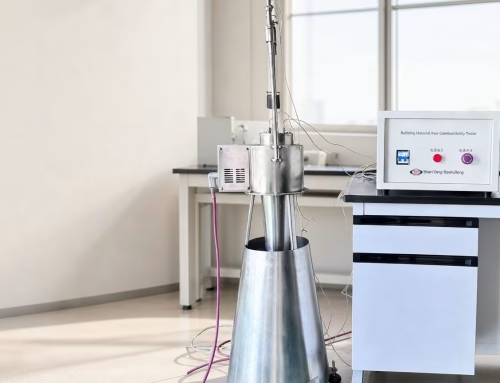
In fire retardant coating testing, the cone calorimeter is the standard bench tool for the reaction-to-fire contribution of a coating film. ISO 5660-1 exposes a horizontal specimen to controlled irradiance with an external igniter and derives heat release rate from oxygen consumption, together with time to ignition, mass loss and dynamic smoke production 4; ASTM E1354 covers the same measurement family 5. For coatings, the practical questions are peak heat release, time to ignition and whether the char is coherent. Results are sensitive to substrate, thickness and whether the coating is tested free-film or applied, so the specimen construction must be reported with the numbers.
4. EN 13823 SBI: Reaction to Fire of Surface Products
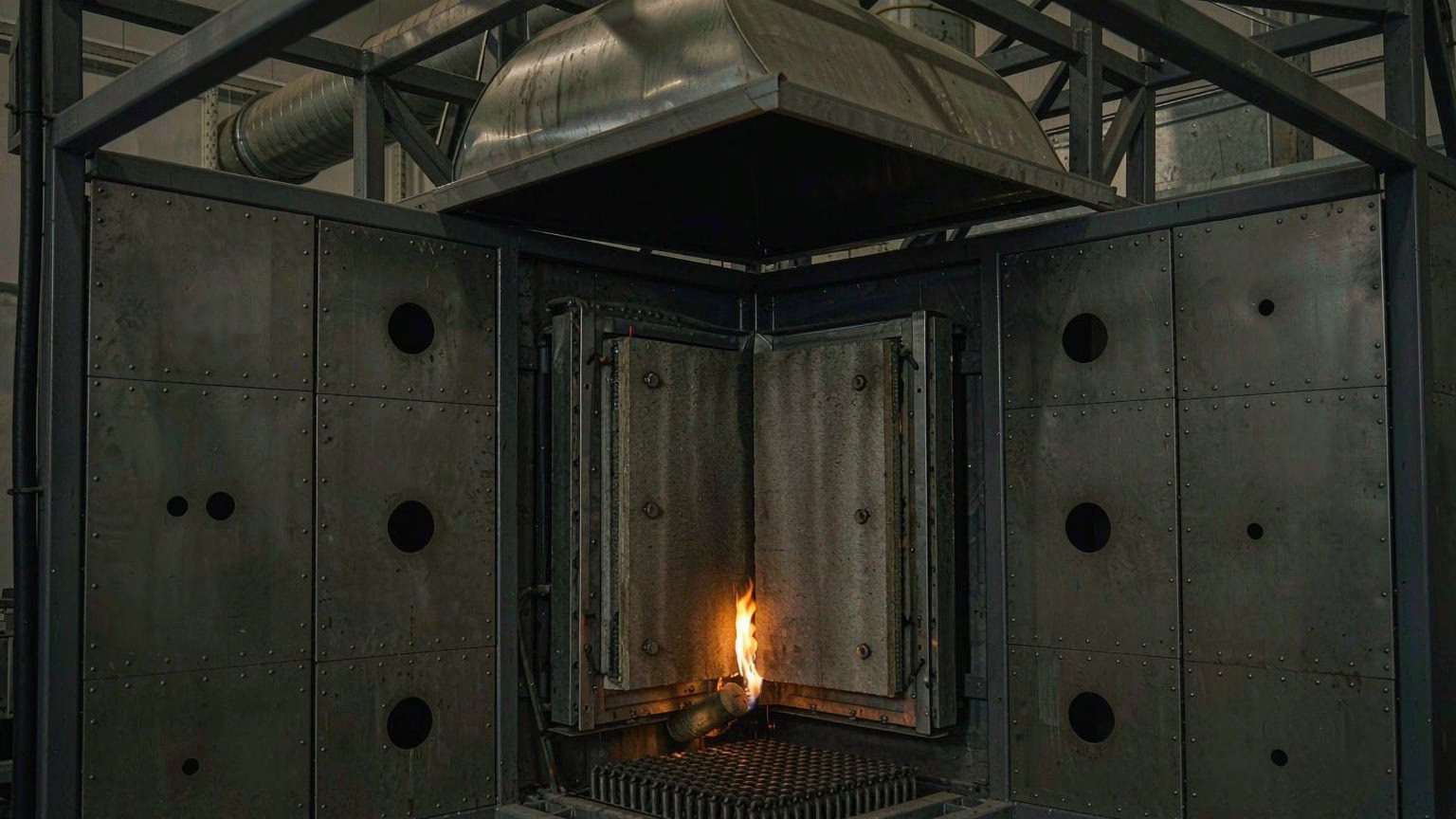
The Single Burning Item test exposes a corner specimen to a sandbox burner of roughly 30 kW under a hood and measures heat release, lateral flame spread and smoke production, producing the FIGRA and SMOGRA indices used in EN 13501-1 classification. It is the reference route for wall and ceiling products in Europe, and coatings applied to a defined substrate are tested as that product. SBI is a system test: the substrate and the coating thickness go into the report together, and our guide to how SBI results shape Euroclass classifications explains how the indices convert into a class.
5. ASTM E84 and EN ISO 11925-2: Surface Spread and Ignitability
ASTM E84 is the tunnel test that yields flame spread and smoke developed indices for interior finishes, and it remains the routine North American screening and code route for coating systems on walls and ceilings 6. EN ISO 11925-2 is the small single-flame-source test used to establish ignitability for construction products, and it frequently decides whether a product can even enter the EN 13501-1 classification table. Neither method measures fire resistance, and neither should be quoted as if it did.
6. ISO 1182 and Oxygen Index: Screening Before the Furnace
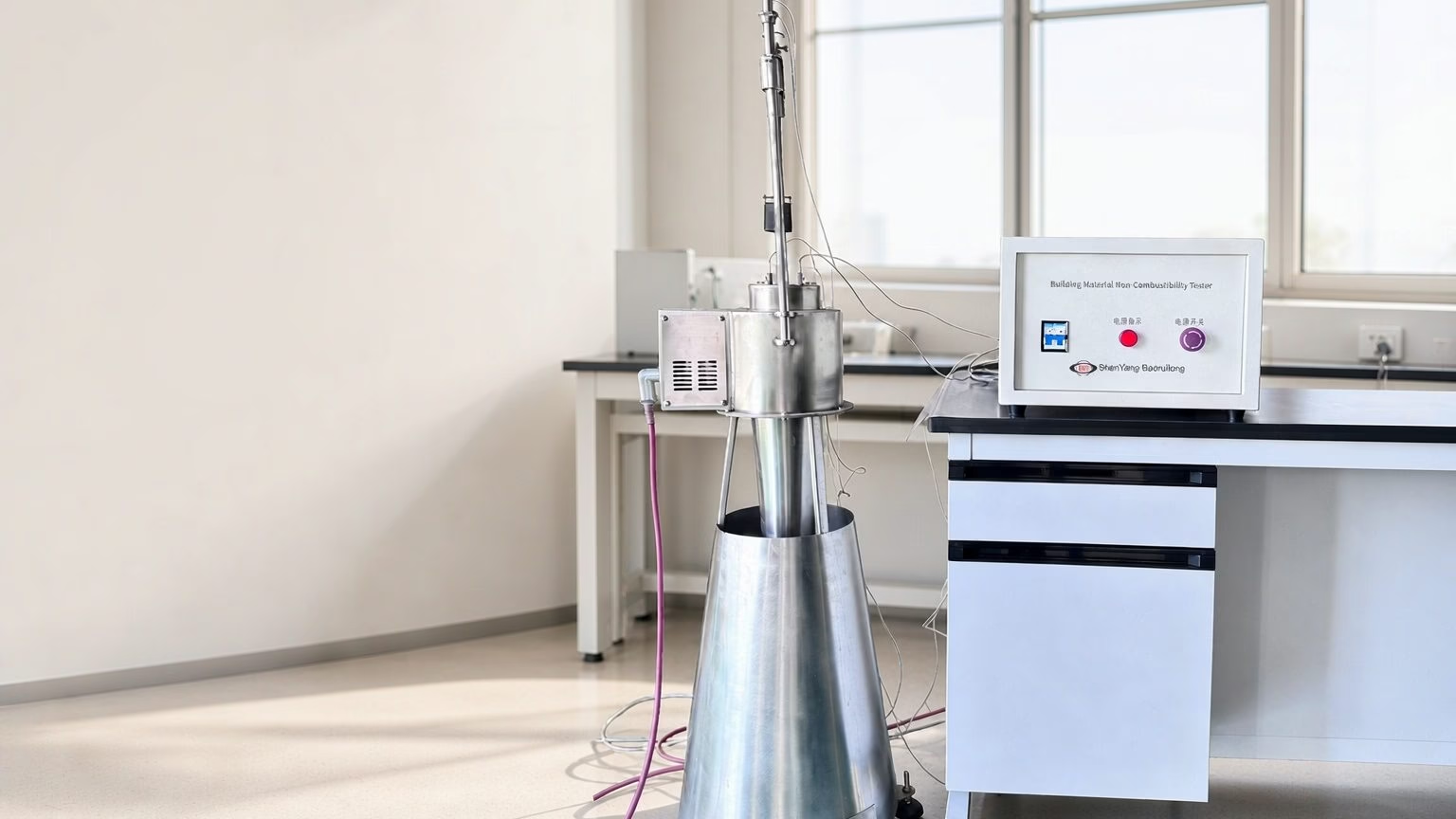
Non-combustibility testing in a vertical tube furnace at 750 °C, described internationally in ISO 1182 and in North America by ASTM E136, answers whether a material contributes calorific energy to a fire at all 8. Oxygen index testing per ISO 4589-2 or ASTM D2863 gives a single number for the minimum oxygen concentration that sustains combustion. Both are cheap, fast and useful for formulation screening and batch control; both are routinely over-interpreted as proof of performance in a real fire.
Matching the Method to the Product
The right starting point is the product’s place in the market, not the lab’s favourite instrument.
| Product situation | Route that usually applies | Output | Typical equipment |
|---|---|---|---|
| Intumescent coating on structural steel for EU projects | EN 13381-8 assessment | Classification period vs thickness, section factor, design temperature | Loaded-section furnace with multi-zone control and thermocouple trees |
| Protected steel or assembly for North America | ASTM E119 / UL 263 | Rating in hours for a described assembly | Horizontal or vertical furnace, loaded frame |
| Coating as a wall or ceiling finish in the EU | EN 13823 SBI plus EN ISO 11925-2 | Euroclass A2–D with smoke and droplet sub-classes | SBI rig with hood, analysers, trolley |
| Coating as an interior finish in North America | ASTM E84 | Flame spread index, smoke developed index | 25 ft tunnel |
| Formulation development or batch release | ISO 5660-1, ISO 4589-2, ISO 1182 | Heat release, oxygen index, non-combustibility | Cone calorimeter, OI tester, tube furnace |
| Coating on timber, paper or board | Product-specific national methods | Pass/fail or class for that product | Small flame and radiant panel rigs |
Note the direction of travel: bench tests screen, system tests approve. A supplier who offers only bench data for a structural steel application has not yet demonstrated anything the approving authority will accept.
Equipment: What a Coating Test Programme Needs
A programme that covers all three questions needs three kinds of apparatus, and buying them in the wrong order wastes money.
Furnaces for Loaded Sections and Assemblies
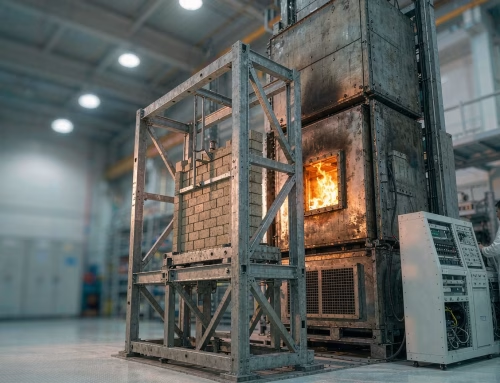
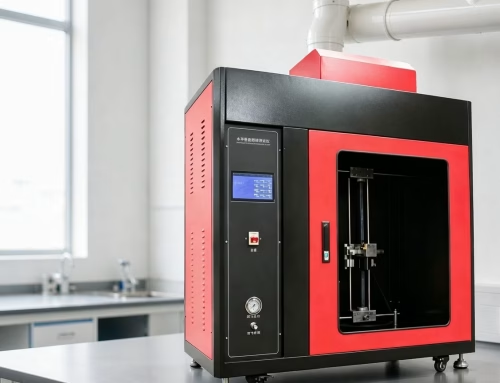
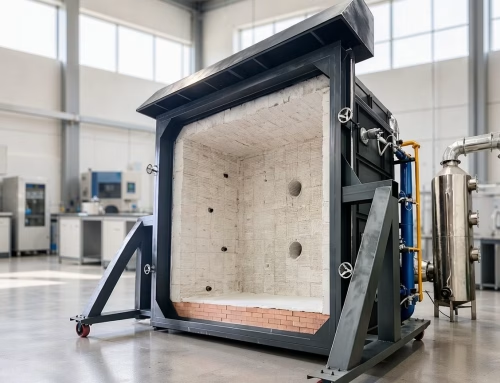
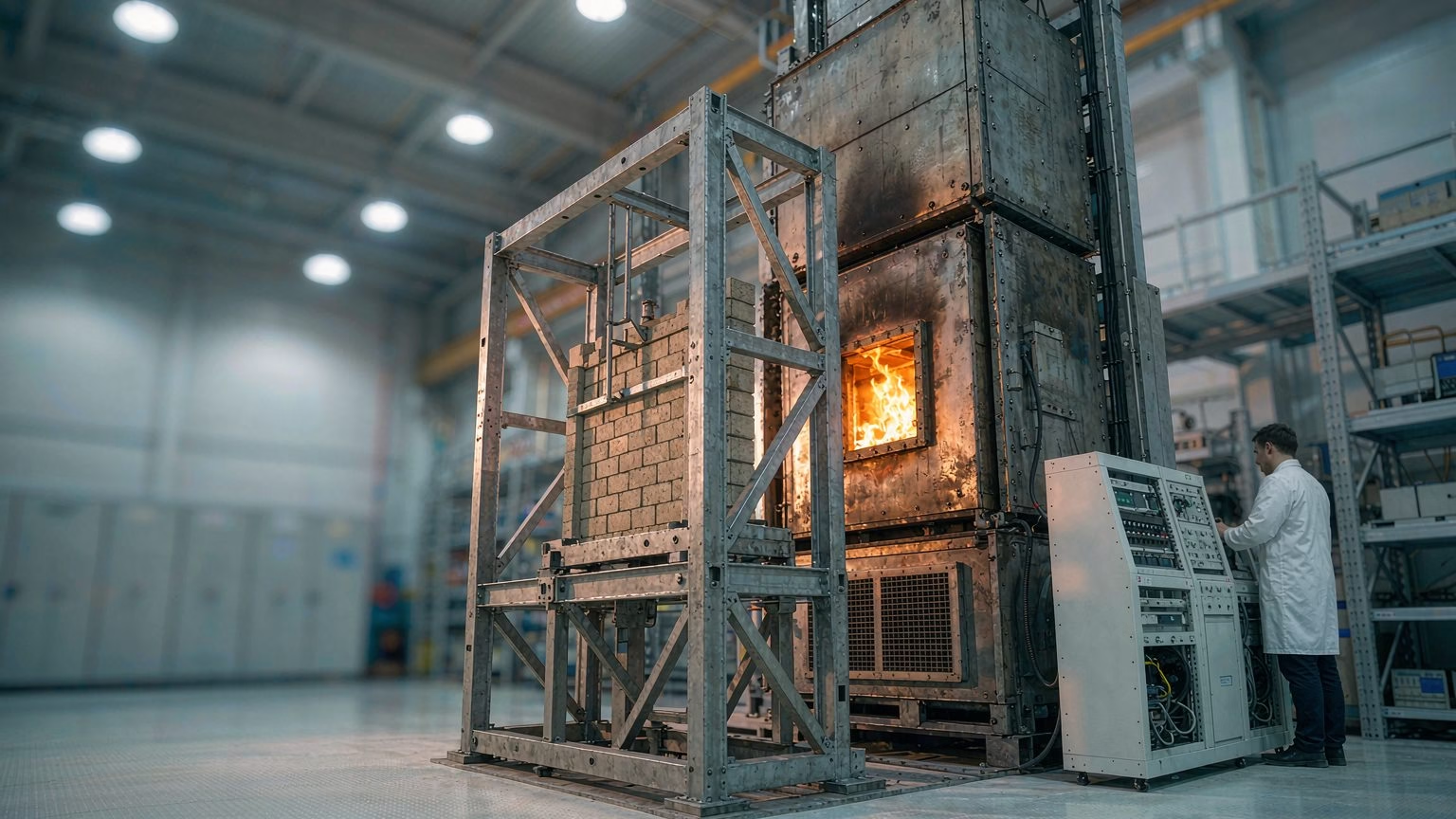
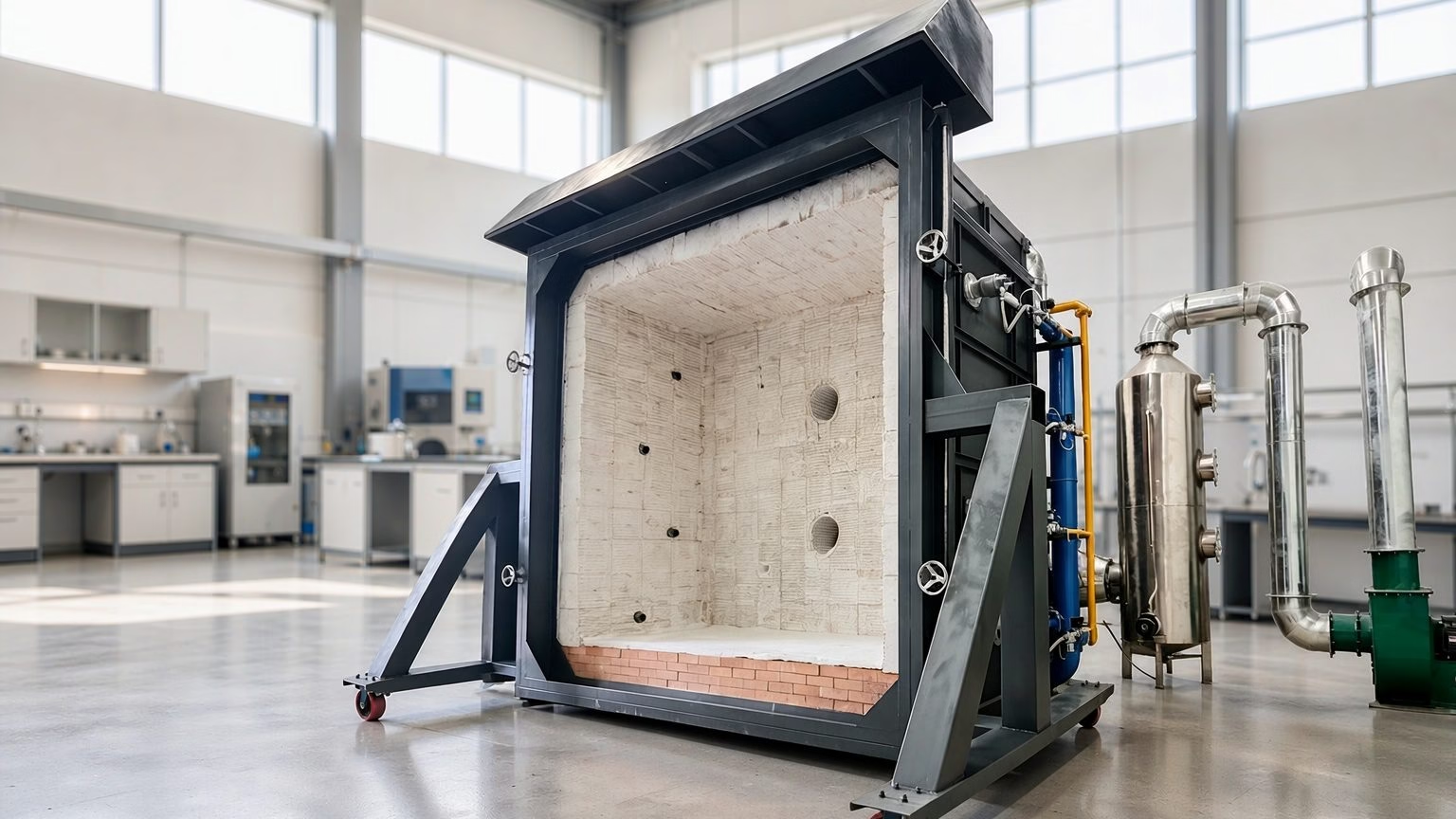
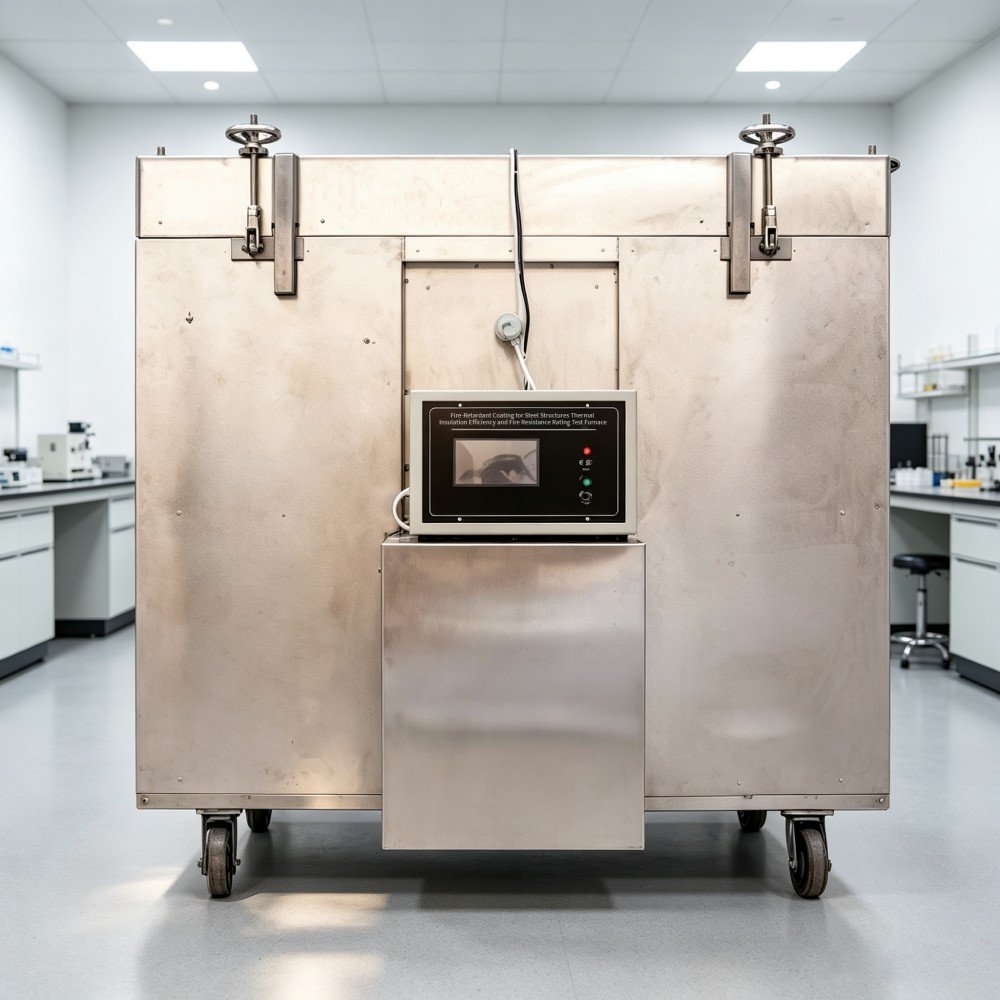
The furnace is the capital item. For coating work it must follow the standard curve within the tolerance of EN 1363-1 or ISO 834-1, hold a defined pressure profile over height, and carry load without losing alignment as the specimen deflects [2][8]. Instrumentation matters as much as the chamber: thermocouples on the unexposed face and inside the steel section, displacement measurement, and a data system that samples fast enough to resolve the curve. BRT Testing builds a steel fire retardant coating test furnace for this work and a horizontal fire resistance test furnace for slab and beam configurations; confirm the current load capacity and furnace class on each product page. Timber and paper coatings are handled on smaller rigs — the flame retardant timber test apparatus and the combustion tester for flame retardant paper and board.
Heat Release, Smoke and Ignitability Instruments
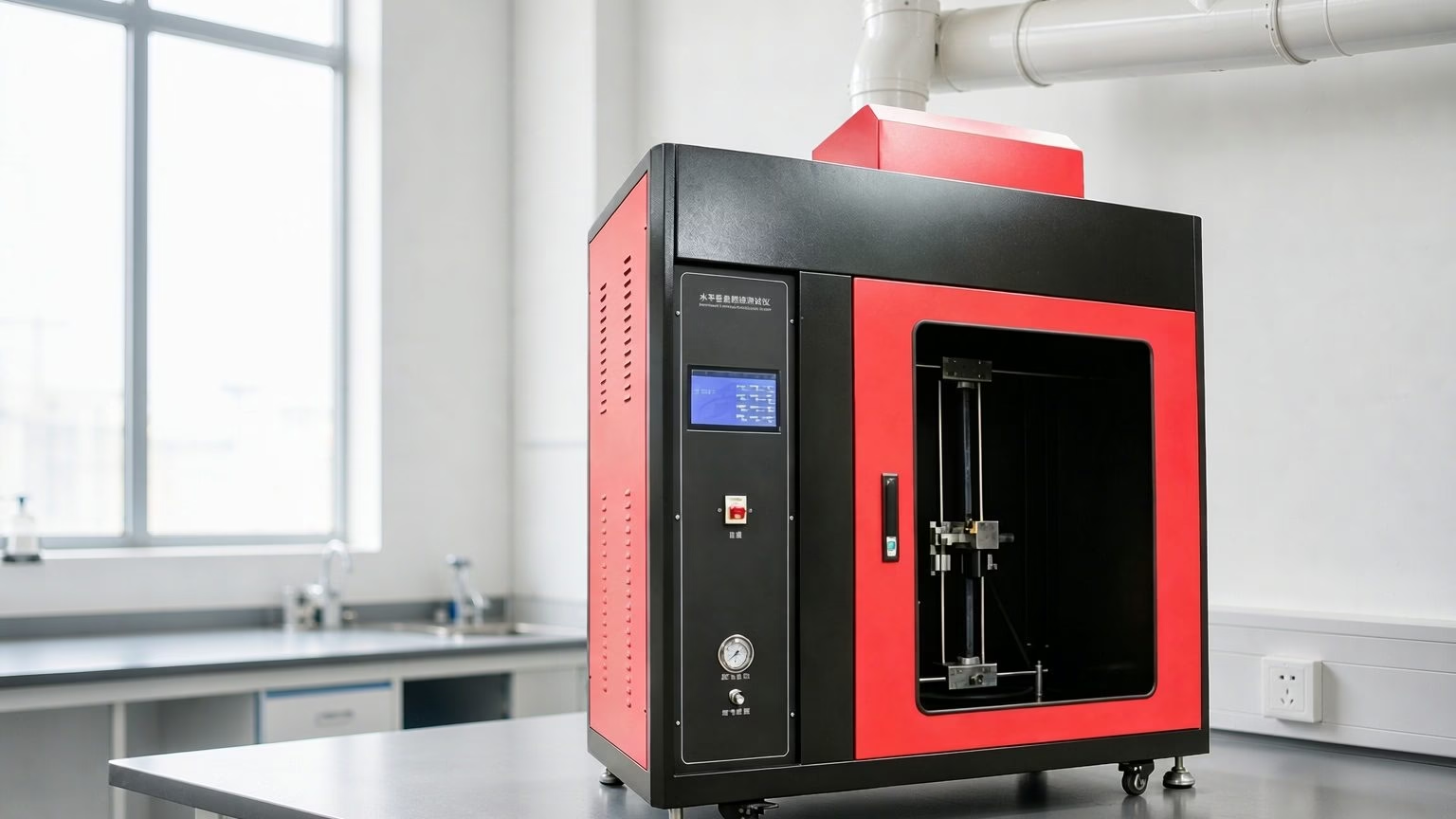
Below furnace scale, the workhorses are the cone calorimeter for heat release and smoke, an oxygen index tester for formulation ranking, and a non-combustibility apparatus for the A1/A2 question. Our ISO 5660 test explainer covers the calculation route, and the ISO 1182 walkthrough covers the tube-furnace procedure in detail. All of these instruments live in one category if you are scoping a laboratory: fire and flame testing equipment.
Specimen Preparation and Conditioning
The unglamorous equipment decides reproducibility. Coating thickness must be applied and measured to a stated dry film thickness, with the application method recorded; specimens must be conditioned to constant mass at the specified temperature and humidity; substrates must be the same grade and surface preparation as the intended use. A furnace test on a coating applied 20 per cent thicker than the declared thickness is a test of a different product, and no amount of instrument accuracy rescues it.
| Equipment group | What it is for | What to specify carefully |
|---|---|---|
| Loaded-section furnace | Fire resistance of protected steel | Curve tolerance, pressure profile, load capacity, thermocouple count |
| SBI rig | Euroclass reaction to fire | Hood flow, gas analysis, trolley calibration, burner output |
| Cone calorimeter | Heat release and smoke at bench scale | Irradiance calibration, specimen frame, oxygen analyser |
| Tube furnace | Non-combustibility screening | Furnace temperature stability, specimen holder, thermocouple placement |
| Thickness and conditioning | Reproducible specimens | DFT gauge range, conditioning chamber stability |
Reading a Test Report: What the Numbers Mean
A fire retardant coating testing report is only usable if it states the conditions. When reviewing one, check five things before reading any result.
- What was tested. Coating product, batch, dry film thickness, number of coats, substrate grade and surface preparation.
- How it was tested. Standard and edition, heating curve, load level, restraint conditions, instrumentation layout.
- What the result applies to. For EN 13381-8, the thickness range, section factor range, design temperature and classification period; for SBI, the substrate and product family.
- What the failure criterion was. Insulation, integrity, load-bearing capacity or a reaction-to-fire threshold — the same specimen can pass one and fail another.
- Who did the work. An accredited laboratory, with the scope of accreditation covering that specific test, is the only basis on which a third party will rely on the result.
The most common commercial dispute in this field is not a wrong number; it is a right number applied outside its stated range, and the general limits of fire testing are well documented by national fire research bodies 9.
Common Failure Modes in Coating Test Programmes
Thickness drift between application and declaration. The nominal thickness on the datasheet, the thickness applied to the specimen and the thickness measured on site are three different numbers. Align them before testing, not after.
Testing a coating on the wrong substrate. A coating qualified on a 10 mm steel plate is not qualified on a concrete soffit, a timber deck or a cable tray. Substrate changes heat sink behaviour and char formation.
Ignoring the section factor. Two steel sections with the same coating thickness but different A/V values reach different temperatures. A report that does not state the section factor cannot be applied.
Quoting screening data as approval. Oxygen index and cone data are development tools. They support a formulation decision; they do not replace a system test.
Skipping conditioning. Specimens tested wet, or tested before the coating has fully dried, under-perform or over-perform unpredictably. Condition to constant mass and record it.
Missing the smoke criterion. A coating can meet its insulation target and still fail the project because smoke production pushes the product into a worse Euroclass sub-category.
Frequently Asked Questions
What is fire retardant coating testing?
It is the set of laboratory methods used to establish how a fire retardant coating performs in fire. The methods fall into three groups: fire resistance tests on protected elements, such as EN 13381-8 for intumescent coatings on steel; reaction-to-fire tests on the coating as a surface product, such as SBI or cone calorimetry; and small-scale screening tests such as oxygen index.
Is fire retardant coating testing the same as fire resistance testing?
No. Fire resistance testing measures how long an element keeps its load-bearing or separating function under a standard heating curve. Reaction-to-fire testing measures how a material contributes to fire growth. A coating usually needs evidence from both directions, and the reports are not interchangeable.
Which standard applies to intumescent coatings on structural steel?
In Europe it is EN 13381-8, which assesses applied reactive protection to steel members and states the thickness, section factor and design temperature ranges within which the result may be used. In North America the equivalent evidence usually comes from ASTM E119 or UL 263 testing of a described assembly. National building codes decide which route is acceptable.
How thick should a fire retardant coating be for testing?
Thickness is not a fixed number; it is derived from the required classification period, the section factor of the steel and the design temperature. The test programme should bracket the intended thickness range rather than test one value, and the applied dry film thickness must be measured and reported.
How long does fire retardant coating testing take?
Bench tests such as cone calorimetry or oxygen index can be completed in days. A loaded-section furnace test per EN 13381-8 takes weeks, because it involves specimen preparation, several loaded and unloaded tests, and an assessment stage. Plan approval programmes around the assessment, not around the furnace time alone.
Can a coating tested on steel be used on wood or concrete?
Not automatically. Substrate changes heat sink behaviour, adhesion and char formation, so approval is normally substrate-specific. Timber and board products have their own test methods and classifications, and a steel coating approval does not transfer to them without separate evidence.
What equipment is needed to start coating testing?
A minimum development set is a cone calorimeter, an oxygen index tester and a non-combustibility tube furnace, plus thickness measurement and a conditioning chamber. Adding fire resistance capability means a loaded-section furnace with curve control, pressure control and instrumentation, which is a different order of investment and floor space.
Next Steps
If you are planning a fire retardant coating testing programme, sequence it before you buy anything:
- Decide which market the product will be sold into; that alone fixes the acceptable standard family.
- Establish the intended substrate, thickness range, section factor range and target classification period.
- Run bench screening first — cone calorimeter, oxygen index, non-combustibility — to reject weak formulations cheaply.
- Book the system test only when the formulation and thickness are frozen; furnace time is too expensive for exploration.
- Check that the laboratory’s accreditation scope covers the exact test and edition you need.
If you would like help mapping a coating product onto the right test route and the equipment that supports it, send us the product type, substrate and target classification, and our application team will set out the options. Get in touch with those details, or start from the fire and flame testing equipment range.
About the author. This article was prepared by the BRT Testing application engineering team at Shenyang Baoruitong Automation Equipment Co., Ltd., a manufacturer of fire testing, spectrophotometric and plastic pipe testing equipment. Method descriptions follow the published standards cited below; where a furnace or instrument capability is mentioned, the product page is the controlling document and specifications should be confirmed before ordering.