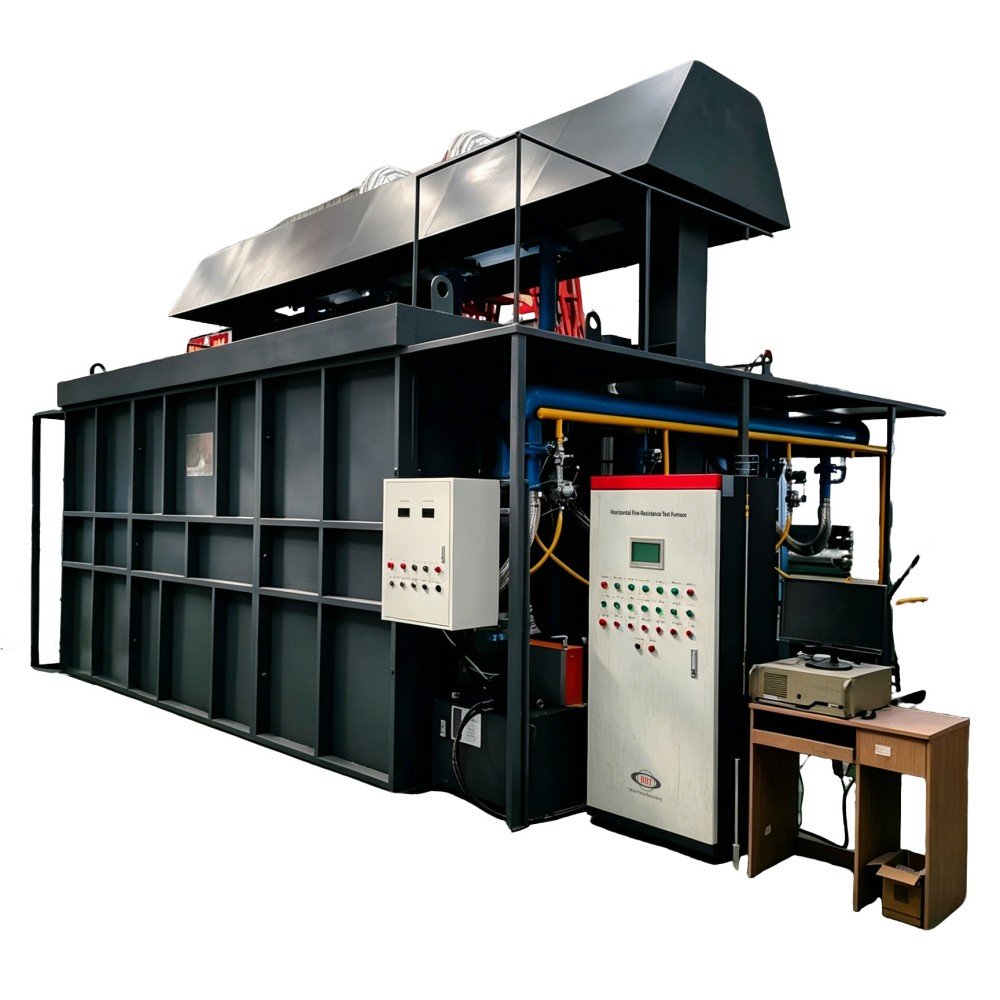
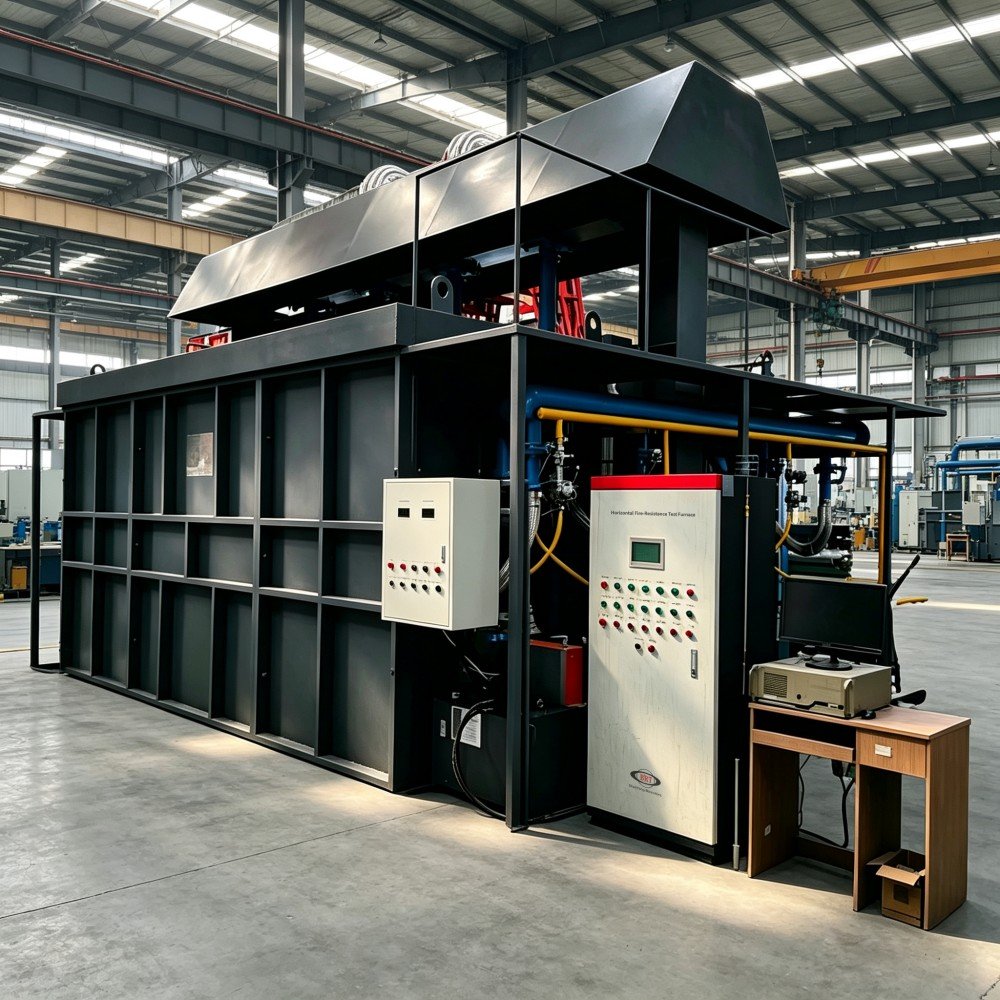
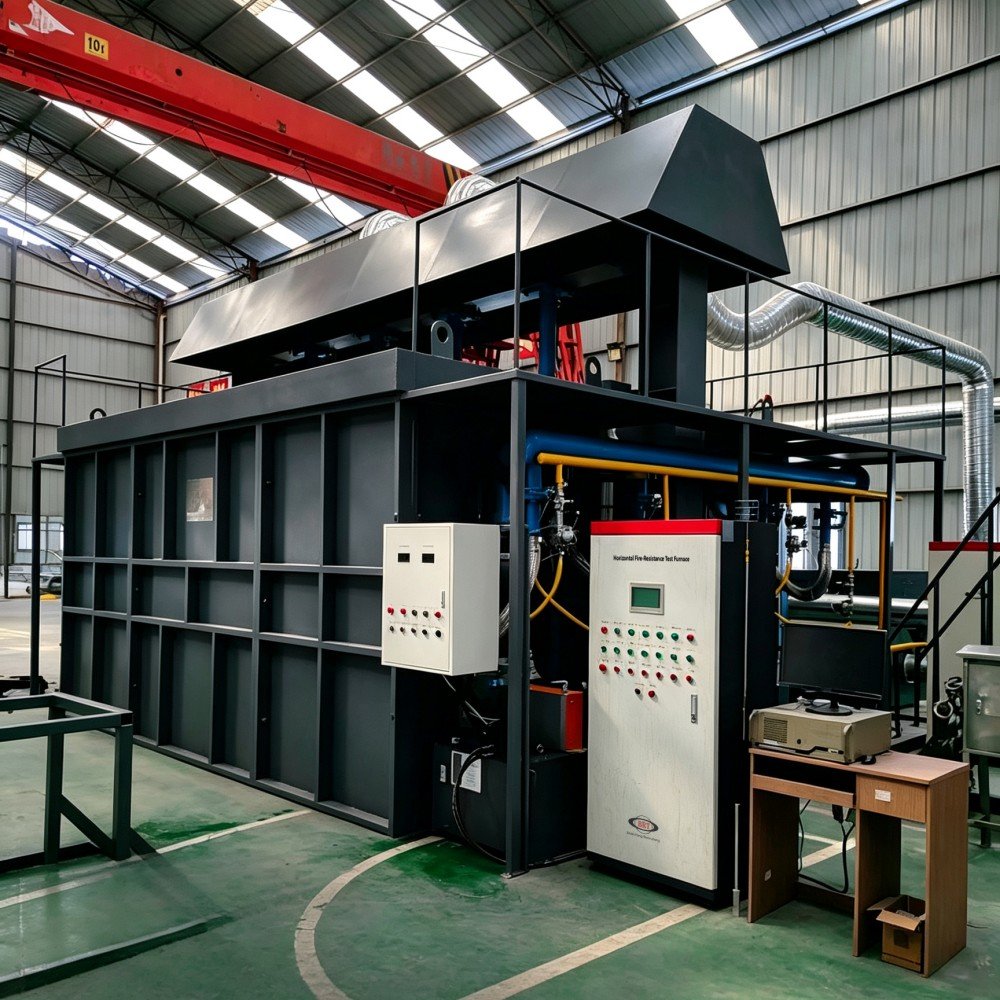
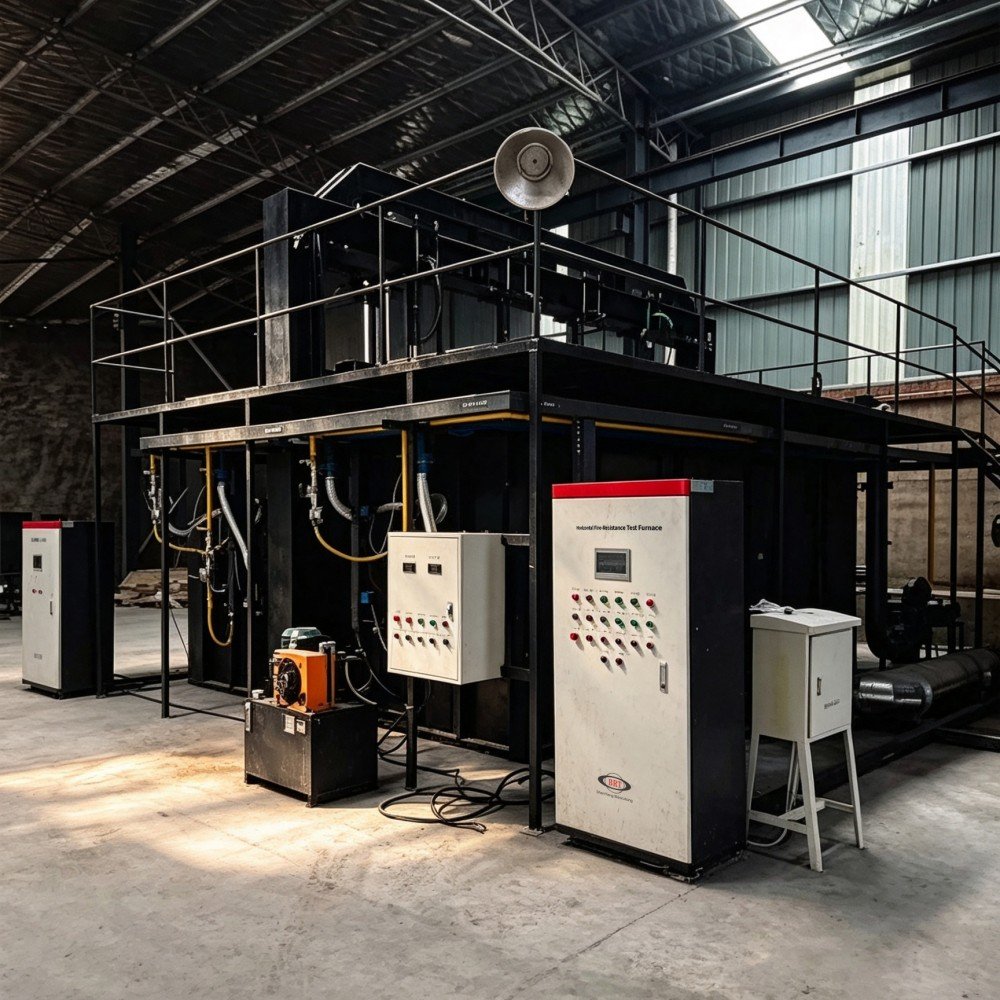
The NH-XW Horizontal Fire Resistance Test Furnace (Building Beam Slab Fire Limit Test Oven) is a full-scale industrial fire resistance test facility developed strictly in accordance with ISO 834-1/5/6, EN 1363 / EN 1365, BS 476, ASTM E119 / ASTM E1529 / UL 263 / UL 1709, AS 1530.4, GB/T 9978 series, and GB 14907-2018 standards. Featuring a spacious 4.2m × 3.0m × 1.5m combustion chamber, it is engineered to evaluate the fire resistance limit, structural load-bearing capacity, integrity, and thermal insulation performance of horizontal building components such as floor slabs, concrete beams, steel structures, marine decks, and fire-retardant coatings under both cellulosic and hydrocarbon time-temperature curves.
Driven by 8 proportional LPG burners, lightweight high-density refractory lining, and closed-loop computer control, this advanced Horizontal Fire Resistance Test Furnace regulates chamber temperature up to 1300°C and furnace pressure within ±2 Pa. Equipped with dual-side quartz observation windows, a 400°C smoke filtration exhaust system, and a surrounding steel safety platform, it provides reliable, repeatable testing for fire safety inspection institutes, steel coating manufacturers, and third-party laboratories.
Horizontal Fire Resistance Test Furnace Compliance & Standards
This building beam slab fire limit test oven allows certified facilities to conduct formal fire rating determinations across international and national structural fire testing frameworks:
| Standard Code |
Standard Title & Scope |
Primary Testing Application |
| ISO 834-1 / ISO 834-5 / ISO 834-6 |
Fire-resistance tests — Elements of building construction — General requirements, Loadbearing horizontal elements, and Beams |
International benchmark for standard cellulosic time-temperature fire curve testing on horizontal structures |
| EN 1363-1 / EN 1363-2 |
Fire resistance tests — Part 1: General requirements / Part 2: Alternative and additional procedures |
European standard framework for cellulosic, hydrocarbon, and external fire curve compliance |
| EN 1365-2 / EN 1365-3 |
Fire resistance tests for loadbearing elements — Part 2: Floors and roofs / Part 3: Beams |
European structural testing for horizontal load-bearing floors, roofs, and structural beams |
| EN 13381-3 / EN 13381-8 |
Test methods for determining the contribution to the fire resistance of structural members (Concrete / Steel coatings) |
Fire resistance assessment for intumescent and reactive fireproof coatings on structural steel and concrete |
| ASTM E119 / UL 263 / ASTM E1529 / UL 1709 |
Standard Test Methods for Fire Tests of Building Construction Materials & Structural Members in Large Hydrocarbon Pool Fires |
North American benchmark for cellulosic and high-heat hydrocarbon fire endurance tests on floors, roofs, and beams |
| BS 476-20 / BS 476-21 |
Fire tests on building materials and structures — Part 20: Method for fire resistance / Part 21: Loadbearing elements |
British standard certification for horizontal load-bearing structural beams, floors, and flat roofs |
| AS 1530.4 |
Methods for fire tests on building materials, components and structures — Part 4: Fire-resistance tests |
Australian national standard for horizontal building element fire testing |
| IMO FTP Code Part 11 |
International Code for Application of Fire Test Procedures — Tests for Fire Resisting Divisions |
Marine fire safety compliance for high-speed craft horizontal deck divisions and fire-rated insulation |
| GB/T 9978.1–9978.8 |
Fire-resistance tests — Elements of building construction (Beams, Slabs, Partition Walls) |
Mandatory Chinese national standard for horizontal load-bearing structural elements |
| GB 14907-2018 / GB/T 37267-2018 |
Fire resistive coating for steel structure & General technical requirements for building seismic supports |
Certification testing for steel coatings and seismic pipe supports under fire exposure |
Technological Features of NH-XW Building Beam Slab Fire Limit Test Oven
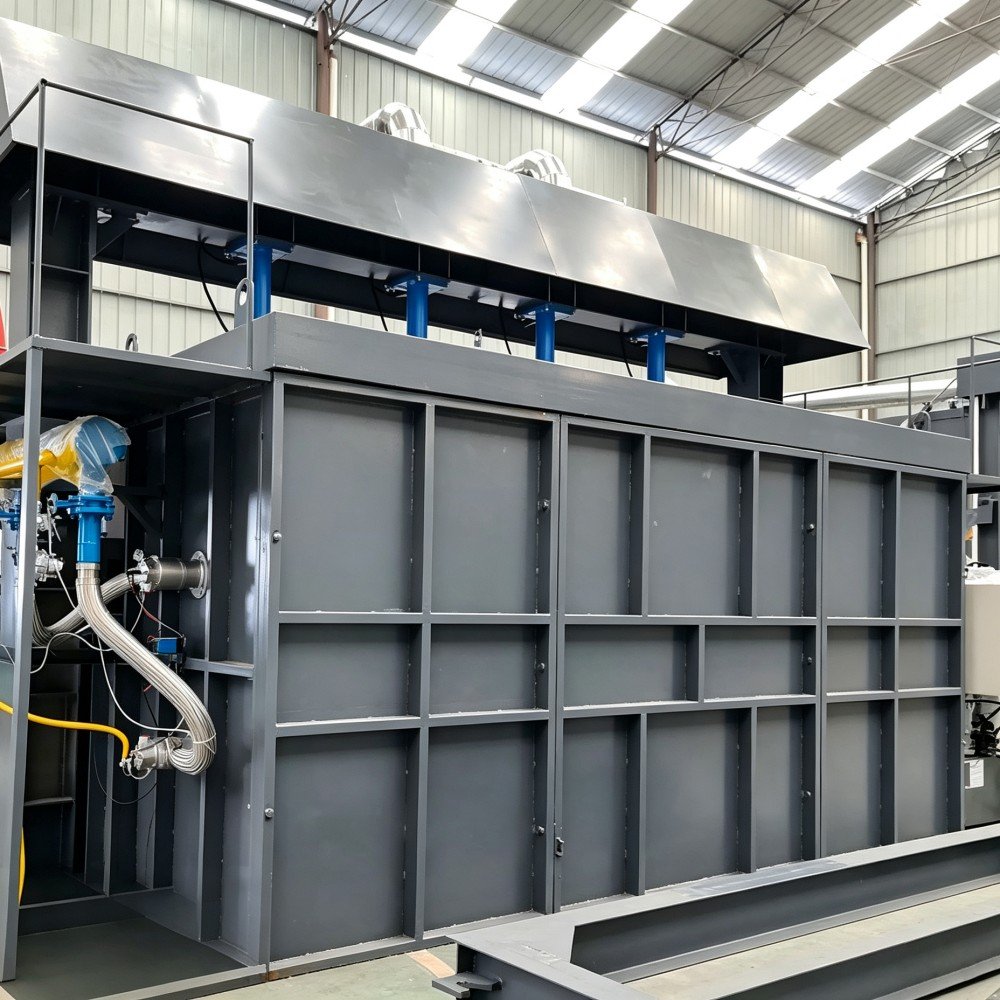
- 4.2m Large Chamber with Energy-Saving Refractory Lining: Constructed with a 4.2m × 3.0m × 1.5m internal chamber lined with 1400°C lightweight refractory bricks (density ≤1.0 g/cm³) and high-temperature thermal insulation wool. Keeps outer wall temperatures under 50°C and achieves rapid cool-down in less than 0.5 hours.
- 8-Burner Proportional LPG Combustion & Auto Temperature Tracking: Utilizes 8 sets of proportional LPG burners with high-voltage electronic ignition to strictly follow standard cellulosic (ISO 834, EN 1363, ASTM E119, BS 476) and hydrocarbon (ASTM E1529, UL 1709) time-temperature curves, ensuring uniform thermal exposure across horizontal beam and slab surfaces.
- Closed-Loop Furnace Pressure Control (±2 Pa Accuracy): Monitors chamber pressure via high-precision sensors (±250 Pa range, ±2 Pa accuracy). The computer automatically adjusts exhaust dampers to maintain required pressure (15 Pa ± 5 Pa at 5 min; 17 Pa ± 3 Pa at 10 min) with overpressure gas cut-off interlocks (>100 Pa).
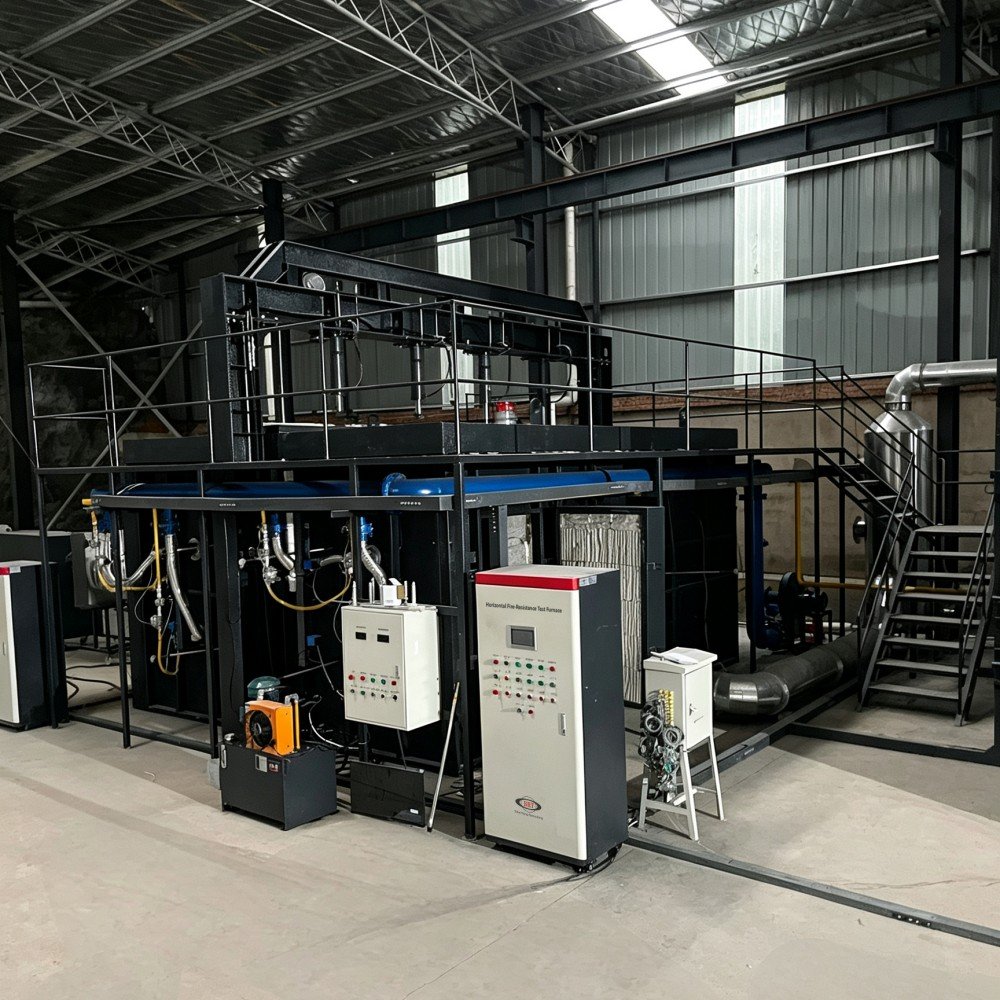
- High-Flow Exhaust Filtration & Environmental Safety System: Features a rear mechanical exhaust fan (>4000 m³/h capacity) paired with a high-temperature flue gas filter module (rated up to 400°C) to capture smoke and particulates generated during combustion before emission.
- Dual Quartz Viewports & Surrounding Steel Operation Platform: Equipped with dual-side 120×120mm quartz glass viewing windows for real-time monitoring of sample deflection, cracking, or coating expansion. Includes a full steel platform with guardrails for operator safety.
Technical Specifications of Horizontal Fire Resistance Test Furnace
| Governing Test Standards |
ISO 834-1/5/6, EN 1363-1/2, EN 1365-2/3, EN 13381-3/8, BS 476-20/21, ASTM E119, ASTM E1529, UL 263, UL 1709, AS 1530.4, IMO FTP Code Part 11, GB/T 9978.1~8, GB 14907-2018, GB/T 37267-2018 |
| Internal Chamber Dimensions |
4.2 m (L) × 3.0 m (W) × 1.5 m (H) |
| Maximum Operating Temperature |
1300 °C (Outer shell surface temperature ≤ 50 °C) |
| Combustion System & Fuel |
8 sets proportional LPG burners; High-voltage auto-ignition (Cellulosic & Hydrocarbon curves supported) |
| Furnace Pressure Regulation |
Range: ±250 Pa; Control accuracy: ≤ ±2 Pa; Auto gas cut-off at >100 Pa |
| Cool-down Time & Air Supply |
Cooling time < 0.5 h; Forced air supply capacity > 2600 m³/h |
| Exhaust & Filtration Capacity |
Exhaust volume > 4000 m³/h; Flue gas filter heat resistance up to 400 °C |
| Power & Space Footprint |
AC 380V ±10%, 50 Hz (65 kW); Overall Footprint: 10.0m × 8.0m × 5.0m |
System Architecture & Testing Workflow of Fire Resistance Furnace
Standardized Testing Workflow:
- Mount the horizontal beam, concrete slab, marine deck division, or coated steel specimen over the top opening of the 4.2m furnace chamber using external hoisting equipment.
- Attach surface thermocouples to the unexposed face and set structural loading parameters if evaluating load-bearing capacity.
- Initiate the automated computer program; 8 LPG burners ignite electronically to track the target cellulosic or hydrocarbon time-temperature curve (ISO 834 / EN 1363 / ASTM E119 / ASTM E1529 / BS 476).
- The closed-loop system monitors chamber temperature and regulates exhaust dampers to maintain target furnace pressure (15–17 Pa).
- Record structural deflections, unexposed side thermal insulation failure (average rise >140°C or single point >180°C), and integrity loss until fire limit criteria are met.
Target Customer Applications:
- Third-party fire safety certification laboratories and building material inspection centers.
- Steel structure manufacturers and fireproof coating production plants.
- Precast concrete slab, floor system, and seismic support engineering companies.
- Marine engineering and offshore structure safety certification laboratories.
- University structural engineering departments and fire research institutes.
Horizontal Fire Resistance Test Furnace FAQ
Q1: What structural elements can be tested in this horizontal fire furnace?
A: The NH-XW furnace is specifically designed for horizontal load-bearing and non-load-bearing elements, including precast floor slabs, composite decks, reinforced concrete beams, coated steel girders, fireproof ceiling assemblies, marine deck divisions, and seismic pipe supports.
Q2: How does the furnace control pressure according to ISO 834 / EN 1363 requirements?
A: ISO 834 and EN 1363 require specific positive pressure conditions inside the furnace during testing. The NH-XW uses high-precision pressure transducers connected to automated exhaust dampers, maintaining pressure at 15 Pa ± 5 Pa (at 5 min) and 17 Pa ± 3 Pa (at 10 min) with ±2 Pa accuracy.
Q3: What safety mechanisms are integrated into the gas combustion system?
A: The combustion system includes automated flame-out protection, high-voltage electronic ignition, emergency gas shut-off valves, and an overpressure interlock that immediately cuts off LPG supply if chamber pressure exceeds 100 Pa.

Reviews
There are no reviews yet.