A resposta curta
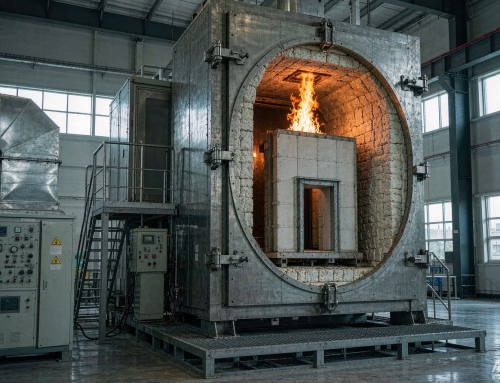
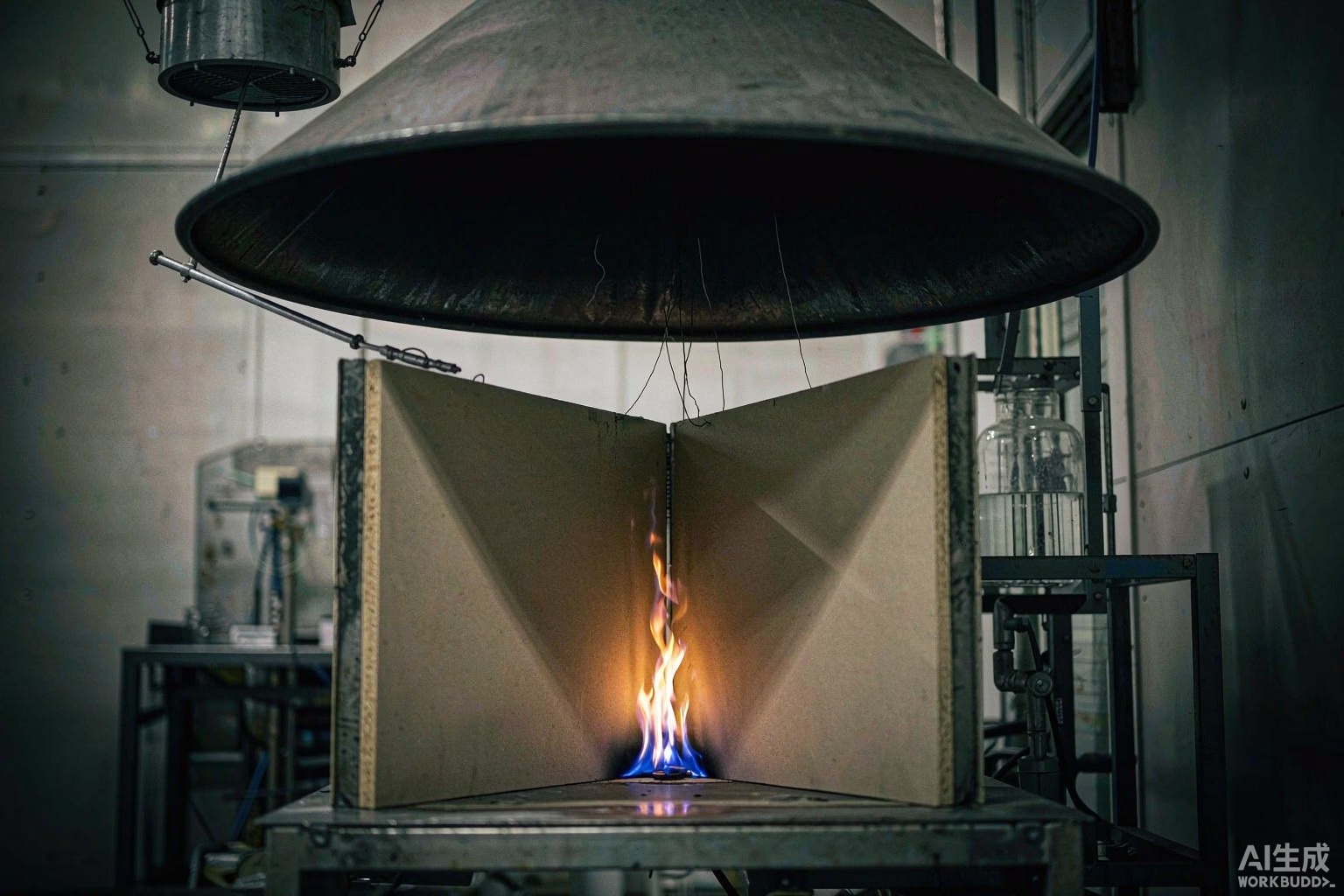
Plastic flammability testing is not one test — it is four families of test, and picking the wrong one is the most expensive mistake in this area. A small-flame ignitability test tells you whether a part self-extinguishes when a burner is taken away. An oxygen index test tells you the minimum oxygen concentration that keeps it burning. A glow-wire test tells you how it behaves when a hot or glowing element touches it inside a device. A cone calorimeter tells you how much heat and smoke it releases per unit area once it is burning 1234.
None of these substitutes for another, and each one is written into different product standards. An electrical enclosure is normally assessed under the IEC 60695 series, a building lining under a reaction-to-fire regime, and an automotive or appliance interior part under a manufacturer specification that usually names UL 94. So the first question is never “how flammable is this plastic”. It is which document does the finished product have to comply with, because that document names the method, and the method determines the specimen, the conditioning and the apparatus.
What “Flammability” Means for a Plastic
Ignitability, flame spread and heat release are three different properties
The word hides three separate behaviours that do not correlate as well as people expect.
| Property | Question it answers | Typical method |
|---|---|---|
| Ignitability | Does it catch, and does it keep burning after the source is removed? | Small-flame tests, glow-wire |
| Sustained combustion | What environment is needed to keep it alight? | Oxygen index |
| Flame spread | How fast does the flame travel across the surface? | Horizontal burning rate |
| Heat and smoke release | How much energy and smoke does it deliver once burning? | Cone calorimetry |
A material can be hard to ignite and still release very high heat once it does, or easy to ignite but self-extinguishing in a vertical geometry because its melt drips away from the flame. That is why a single “flammability” figure is meaningless without the method string.
Why thickness is part of the result
Flammability is thickness-dependent, and this is the trap that costs the most retesting. A thin section cools differently, melts away from the flame more readily, and reaches its decomposition temperature sooner than a thick one. A rating obtained at one thickness does not cover another, which is why the small-flame standards require a thickness series and why the report has to state the tested thickness next to every rating. If your product is moulded at three wall thicknesses, the rating programme has to cover three thicknesses.
The Four Test Families
Small-flame ignitability: UL 94, ASTM D3801, ASTM D635
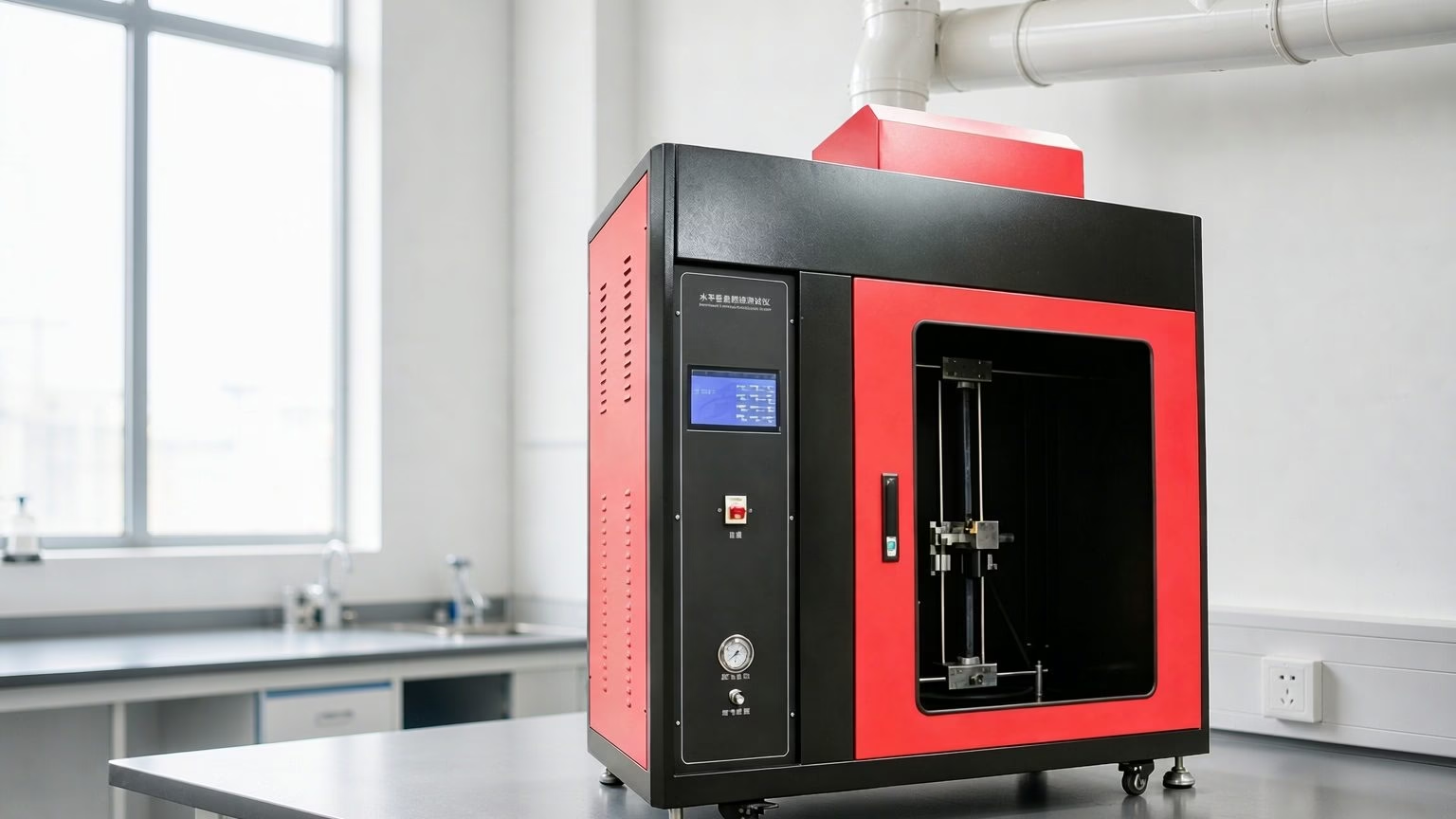
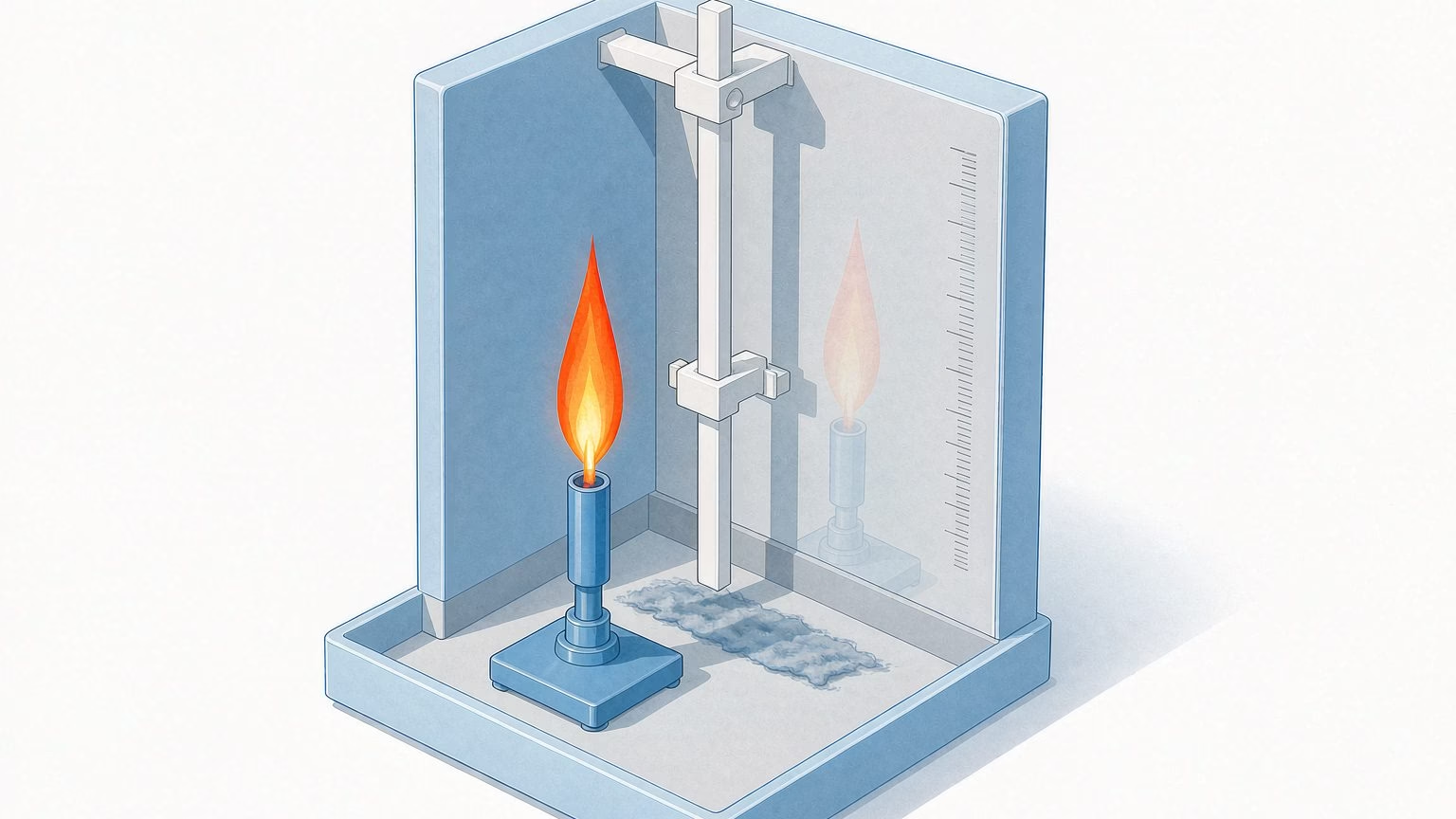
This is the family most people mean by “flammability testing”. A calibrated burner flame is applied to a conditioned bar for a defined time, withdrawn, and the afterflame time, the afterglow and whether flaming debris ignites a cotton indicator below are all recorded. ASTM D3801 covers measuring the comparative burning characteristics of solid plastics in a vertical position [1]; ASTM D635 covers the rate of burning and extent and time of burning of plastics in a horizontal position [2].
The classifications themselves — HB, V-0, V-1, V-2 — belong to the UL 94 scheme, and the detail of what separates them is set out in our dedicated UL 94 flammability guide. The orientation question — why a material can pass horizontally and fail vertically — is covered separately in horizontal versus vertical flammability testing for plastics.
Oxygen index: ASTM D2863
ASTM D2863 measures the minimum oxygen concentration, in a flowing mixture of oxygen and nitrogen, that will support candle-like combustion of a plastic [3]. The result is a percentage. Normal ambient air contains roughly 21 % oxigênio, so a material with an oxygen index comfortably above that figure will not sustain flaming combustion in air once the ignition source is removed, while one below it will.
This is the most useful screening test in the set, because it produces a single continuous number rather than a pass/fail class. That makes it ideal for comparing formulations, checking whether a flame-retardant package has been dosed correctly, and trending production consistency. It is not a substitute for a product classification, because almost no product standard accepts an oxygen index as its sole compliance evidence.
Glow-wire and hot-wire: the IEC 60695 series
Electrical and electronic products are assessed differently, because the realistic ignition source inside an enclosure is not a flame but an overheated or glowing component. The IEC 60695 series covers those ignition sources, and it is the regime an enclosure, a connector or a switch housing has to satisfy. Our CEI 60695 practical guide covers the series in detail.
Bench-scale calorimetry: ISO 5660-1 and ASTM E1354
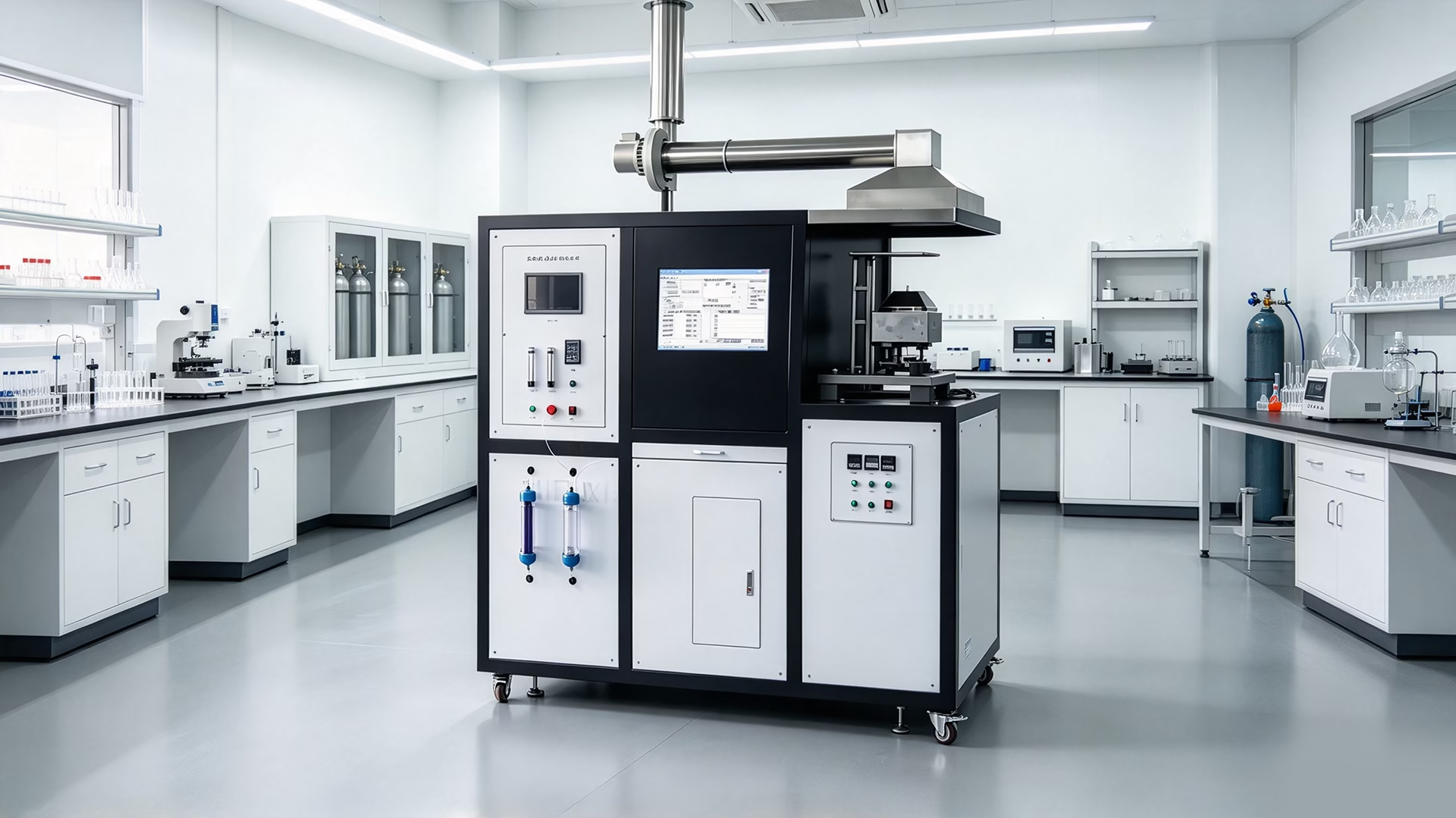
ASTM E1354 covers heat and visible smoke release rates for materials and products using an oxygen consumption calorimeter [4], e ISO 5660-1 is its international counterpart 5. Where the small-flame tests ask a yes/no question, this family produces a curve: heat release rate against time, plus smoke and mass loss. It is the method to reach for when the question is how a material behaves in a developing fire rather than whether it passes a component specification.
Ignition temperature: ISO 871
ISO 871 determines the ignition temperature of a plastic using a hot-air furnace 6. It sits between a screening test and a classification test, and it is useful for comparing the thermal stability of formulations. Note the edition: ISO 871:2006 was withdrawn on 23 February 2022 and is superseded by ISO 871:2022 7, so a test plan still citing the 2006 edition should be corrected before it is signed off.
Choosing by Product Type
| Product type | Method normally required | Why |
|---|---|---|
| Electrical enclosure, connector, switch housing | CEI 60695 glow-wire series | The realistic ignition source is an overheated component, not a flame |
| Appliance or automotive interior part | UL 94 vertical, per the manufacturer specification | Component-level small-flame rating is what the OEM specification names |
| Thin film, flexible sheet, wiring insulation | ISO 9773 thin flexible vertical specimens 8 | A thin flexible specimen behaves differently from a rigid bar |
| Cellular plastic and foam | ISO 9772 horizontal burning of small specimens 9 | Cell structure and melt behaviour make rigid-bar methods inappropriate |
| Building lining or insulation product | Reaction-to-fire regime, not a plastics method | The classification is on the product as installed, not on the resin |
| Formulation screening and R&D | ASTM D2863 oxygen index first, then cone calorimetry | Continuous numbers beat pass/fail classes when comparing formulations |
Thin and flexible materials
Thin flexible materials need their own method because a rigid-bar test will not hold them and because their melt behaviour dominates. ISO 9773 — Plastics — Determination of burning behaviour of thin flexible vertical specimens in contact with a small flame ignition source [8] — exists for exactly this case. The common failure is to test a thin film on a rigid-bar rig with a makeshift holder and then find the result does not survive review.
Cellular plastics and foam
Foams are covered by ISO 9772 — Plásticos celulares — Determinação das características de queima horizontal de pequenas amostras submetidas a uma pequena chama [9]. Cell structure, density and any skin all change the result, so the report has to record density and whether the specimen was tested with or without its skin.
Specimen Preparation and Conditioning
| Variable | Why it changes the result | Control |
|---|---|---|
| Thickness | Cooling, melt drip and time-to-decomposition all scale with thickness | Test the thickness series actually supplied, not one convenient bar |
| Density (foams) | Cell structure controls melt and flame spread | Record density and skin condition on every report |
| Orientation and flow direction | Filled and fibre-reinforced grades burn differently along and across flow | Cut specimens in a defined direction and record it |
| Conditioning | Absorbed moisture and residual volatiles change ignition behaviour | Follow the conditioning clause of the method being run, and record it |
| Cotton indicator | Flaming debris is a criterion in the vertical classes | Use the specified cotton and replace it between specimens |
| Burner calibration | Flame height and gas supply define the thermal input | Calibrate to the method, and log it |
The conditioning clause is the one most often skipped, and it is also the one that most reliably explains why two laboratories disagree. Each method in this article specifies its own conditioning regime; follow the one attached to the method you are running rather than a house default.
Two further variables deserve a line on every report because they are the ones a reviewer asks about first. O specimen cut direction matters for any filled or fibre-reinforced grade, since the flame travels differently along the flow direction than across it and a laboratory that cuts randomly will produce scatter that looks like instrument noise. And the cotton indicator condition matters wherever flaming debris is a criterion, because a pad that has already been scorched by an earlier specimen will ignite differently from a fresh one.
Building a Programme Rather Than Buying a Test
The pattern that works in practice is to screen first and certify second. Run an oxygen index on every candidate formulation or incoming lot. It is quick, it produces a continuous number, and it catches the two failures that matter most in production: a flame-retardant package that was under-dosed, and a lot that was contaminated with the wrong resin. Then run the named compliance method only on the material that has already passed the screen.
That ordering saves money in an obvious way, because the compliance methods are slower and consume more specimens. It also saves money in a less obvious way, because it converts a surprising failure into a boring one. When a V-0 programme fails, the first question is whether the material changed or the test was run incorrectly, and a screening number from the same lot answers that immediately.
The second principle is to fix the thickness series at the design stage rather than at the testing stage. A programme that discovers at the compliance stage that the product is moulded in four wall thicknesses will either test four series or issue a report that does not cover the product. Deciding that during design costs nothing; discovering it during qualification costs a retest.
Finally, decide in advance who owns the report. A plastics flammability testing programme produces data that a design engineer, a compliance officer and a purchaser all read differently, and the most common failure is a report that states a rating without stating the thickness, the conditioning and the method string that make the rating meaningful. Put those three items in the summary block of every report and most downstream disputes disappear.
Reading and Classifying Results
What a rating does and does not certify
A small-flame rating certifies that a specimen of a defined thickness, conditioned in a defined way, behaved in a defined manner in one apparatus. It does not certify the product in its assembled form, it does not cover a thickness that was not tested, and it says nothing about heat release or smoke.
Where a customer asks for both a rating and heat release data, they are asking for two different apparatus, and the honest answer is to quote both rather than to stretch one method to cover the other.
Equipment and Configuration
| Requirement | BRT apparatus | Product page | Note |
|---|---|---|---|
| Vertical and horizontal small-flame burning | Horizontal Vertical Combustion Tester | /product/horizontal-vertical-combustion-tester/ | Covers the UL 94 / D3801 / D635 family |
| Limiting oxygen index | Plastic LOI Limiting Oxygen Index Tester | /product/plastic-loi-limiting-oxygen-index-tester/ | ASTM D2863, continuous number |
| Oxygen index with touch-screen control | Intelligent Automatic Touch Screen Oxygen Index Tester | /product/intelligent-automatic-touch-screen-oxygen-index-tester/ | Higher-throughput LOI configuration |
| Foam and cellular plastics | Plastic Foam Vertical Horizontal Burning Tester | /product/plastic-foam-vertical-horizontal-burning-tester/ | ISO 9772 class |
| Heat release, smoke and mass loss | Calorímetro Cone | /product/cone-calorimeter/ | ISO 5660-1 / ASTM E1354 |
| Full fire and flame range | Fogo & Equipamento de teste de chama | /fire-flame-testing-equipment/ | Category page |
Common Mistakes in Plastic Flammability Testing
| Mistake | Consequence | Fix |
|---|---|---|
| Testing one thickness and reporting it as a material rating | Result does not cover the thicknesses actually supplied | Run the thickness series |
| Using a rigid-bar method on film or foam | Result does not survive review | Use ISO 9773 for thin flexible, ISO 9772 for cellular |
| Quoting an oxygen index as a classification | Product standard does not accept it | Use LOI for screening, and run the named method for compliance |
| Assuming an electrical enclosure can be assessed with a flame test | Wrong ignition source modelled | Use the IEC 60695 glow-wire series |
| Skipping the conditioning clause | Results disagree between laboratories | Follow the clause attached to the method |
| Citing a withdrawn standard edition | Report rejected at review | ISO 871:2006 was withdrawn in 2022; check every edition |
| Reusing the cotton indicator | Flaming debris criterion read incorrectly | Replace per specimen |
Perguntas frequentes
Which flammability test do I need for a plastic part?
Start from the document the finished product has to comply with, not from the material. An electrical enclosure is normally assessed under the IEC 60695 glow-wire series, an appliance or automotive interior part under a UL 94 rating named by the manufacturer specification, a foam under ISO 9772, and a thin film under ISO 9773. That document names the method, and the method fixes the specimen and conditioning.
Is a UL 94 V-0 rating enough on its own?
It is enough only for the scope it certifies: a defined thickness, conditioned in a defined way, in one apparatus. It does not cover a thickness that was not tested, it does not describe the assembled product, and it says nothing about heat release or smoke. Where a customer also wants heat release data, that is a separate cone calorimeter run.
What does the oxygen index number actually mean?
It is the minimum concentration of oxygen, in a flowing oxygen and nitrogen mixture, that will keep the material burning in a candle-like manner. Higher is less flammable. Because ambient air is roughly 21 % oxigênio, a material with an index comfortably above 21 will not sustain flaming once the ignition source is removed.
Can I test a thin film on a vertical burning rig?
Not properly. Thin flexible materials need ISO 9773, which is written for specimens that bend and melt away from the flame. A rigid-bar rig with a makeshift holder gives a result that will not survive review, because the specimen geometry is not the one the method describes.
Why do two laboratories get different results on the same material?
Most often it is conditioning, thickness or burner calibration rather than the instrument. Each method specifies its own conditioning regime, and skipping that clause is the single most common cause of disagreement. The second most common is comparing results obtained at different specimen thicknesses.
Do I need a cone calorimeter if I already have a UL 94 chamber?
They answer different questions. A UL 94 chamber gives a pass or fail on small-flame ignitability; a cone calorimeter gives a heat release rate curve plus smoke and mass loss. Formulation work, fire modelling and any specification that quotes heat release numbers need the calorimeter, and no small-flame apparatus can substitute for it.
Which standards in this area have been withdrawn?
ISO 871:2006 was withdrawn on 23 February 2022 and is superseded by ISO 871:2022. Edition status changes regularly, so check every standard in a test plan against the ISO, IEC or ASTM catalogue before the plan is signed off rather than copying a reference from an old report.
Conclusão: How to Decide
Plastic flammability testing only produces a defensible result when the method was chosen from the compliance document backwards, so resist the temptation to start from the apparatus you already own.
- Identify the document the finished product has to comply with, and read out the method it names.
- Match the method to the physical form — rigid bar, thin flexible film, or cellular foam each has its own standard.
- Build the thickness series from the wall thicknesses actually supplied, not from a convenient bar.
- Follow the conditioning clause attached to the method and record it on the report.
- Add oxygen index for formulation screening and cone calorimetry wherever the question is about heat release rather than ignitability.
- Check the edition of every standard in the plan before sign-off.
BRT builds the small-flame, oxygen index, foam and cone calorimeter apparatus used across all four families. Send us the compliance document and the product geometry and we will map it to a test programme and an instrument configuration. Start from the fire and flame testing equipment range, or read horizontal versus vertical flammability testing if the orientation question is still open.
Sobre o autor. This article was prepared by the BRT combustion testing application team at Shenyang Baoruitong Automation Equipment, which manufactures fire testing and laboratory instrumentation for plastics, electrical product, construction and transport laboratories. Standard titles and edition status were checked against ASTM and ISO catalogue entries on the dates given below.
Sources
- ASTM International — D3801-20a Standard Test Method for Measuring the Comparative Burning Characteristics of Solid Plastics in a Vertical Position
- ASTM International — D635-22 Standard Test Method for Rate of Burning and/or Extent and Time of Burning of Plastics in a Horizontal Position
- ASTM International — D2863-23 Standard Test Method for Measuring the Minimum Oxygen Concentration to Support Candle-Like Combustion of Plastics (Oxygen Index)
- ASTM International — E1354-23 Standard Test Method for Heat and Visible Smoke Release Rates for Materials and Products Using an Oxygen Consumption Calorimeter
- UNI Ente Italiano di Normazione — ISO 5660-1:2015
- UNI Ente Italiano di Normazione — ISO 871:2006
- UNI Ente Italiano di Normazione — ISO 871:2022
- UNI Ente Italiano di Normazione — ISO 9773:2024
- UNI Ente Italiano di Normazione — ISO 9772:2020