A resposta curta
A flame retardant material is one that has been formulated or treated to resist ignition, slow flame spread, or self-extinguish when a source of heat or flame is removed. The behaviour comes from additives or reactive chemistry that interfere with the combustion cycle — in the gas phase, in the condensed phase, or by cooling and dilution. It is not an inherent, permanent property of the base polymer: it is a result tied to a specific formulation, thickness and test method. A V-0 rating or a limiting oxygen index value describes performance under one defined test, not a guarantee of behaviour in a real fire.
Defining a Flame Retardant Material Precisely
The phrase gets used loosely in purchasing conversations, so it is worth being exact. A flame retardant material is a material to which a flame retardant — an additive or a reactive chemical group — has been added so that it meets a defined resistance-to-ignition or flame-spread performance under a specified test. Three parts of that sentence matter.
Primeiro, the material is formulated, not simply chosen. Some polymers are inherently more resistant to ignition because of their chemistry, but the commercial meaning of a flame retardant material is that something was done to the formulation to reach a target. Segundo, the performance is defined by a test. There is no universal number called “flame retardancy”. Terceiro, o resultado é conditional. Change the thickness, the pigment, the glass fibre content or the processing history and the same nominal material may behave differently.
This is where buyers most often misread a datasheet. A flame retardant grade of a polymer is not a different substance from the base resin in the way that steel is different from aluminium. It is the same resin with a package of additives, and the package is what produces the rating. When a supplier changes the package — even for a cost reason — the rating has to be re-established.
What a flame retardant material is not
It is not the same as a non-combustible material. Non-combustibility is tested by a different method: ISO 1182 specifies a test for determining the non-combustibility performance of homogeneous products and substantial components of non-homogeneous products 1. A material that passes a small-scale flame-retardancy test can still contribute heat in a calorimeter and will not pass non-combustibility. The two claims answer different questions.
It is also not the same as a fire-resistant assembly. Our article on the diferença entre resistência ao fogo e retardamento de chama sets out that distinction in full: flame retardancy is a material property under a defined ignition source, while fire resistance is a time-based property of an assembly. A flame retardant cable jacket does not make a cable fire-resistant, and a retardant coating on a steel member does not by itself give the member a fire resistance rating.
How Flame Retardants Actually Work
Combustion of a polymer is a feedback loop. Heat breaks the polymer down into combustible gases, those gases mix with oxygen and ignite, and the flame feeds heat back to the surface to continue decomposition. A flame retardant interrupts one or more links in that loop. The mechanisms are usually grouped into gas-phase and condensed-phase action, with a third physical mechanism based on cooling and dilution.
Gas-phase radical quenching
Halogenated and some phosphorus systems work mainly in the flame. They release species that scavenges the high-energy radicals — hydrogen and hydroxyl radicals — that sustain the flame chain reactions. With the radical concentration reduced, the flame cannot maintain itself and may extinguish when the external source is removed. This is why some halogenated systems are effective at very low addition levels, and why their effectiveness is strongly tied to the chemistry of the flame rather than to a change in the polymer itself.
Condensed-phase char formation
Phosphorus and nitrogen systems often act in the solid phase. On heating, they promote dehydration and crosslinking of the polymer so that a carbonaceous char forms instead of combustible volatiles. The char acts as a barrier: it insulates the underlying material, slows the escape of decomposition gases and limits oxygen diffusion. Intumescent systems take this further by swelling to form a thick, low-conductance foam layer. This mechanism is especially important for polymers that do not naturally char, such as polyolefins.
Resfriamento, dilution and physical barriers
Mineral fillers such as aluminium hydroxide and magnesium hydroxide release water on decomposition. The water dilutes combustible gases in the flame and absorbs heat, cooling the surface. Borates and some inorganic salts form a glassy or ceramic layer. These systems generally need high loading levels, which is a formulation trade-off: the retardancy improves, but mechanical properties and processing behaviour can suffer.
| Mecanismo | Typical chemistry | Where it acts | Formulation consequence |
|---|---|---|---|
| Radical quenching | Halogenated systems, some phosphorus compounds | Gas phase, in the flame | Effective at low loading; chemistry-sensitive |
| Char promotion | Phosphorus, nitrogen, intumescent systems | Condensed phase, at the surface | Char barrier; depends on polymer chemistry |
| Cooling and dilution | Aluminium hydroxide, magnesium hydroxide | Ambos, via released water | High loading needed; affects mechanical properties |
| Barrier formation | Borates, inorganic salts, some nanofillers | Condensed phase, surface layer | Can reduce dripping; dispersion is critical |
A real formulation often combines mechanisms. A commercial package may include a char former, a radical quencher and a synergist, because the combined effect is better than any one pathway. That is also why a flame retardant material cannot be judged by reading the name of a single additive.
The Main Families of Flame Retardant Material
Halogenated systems
Halogenated retardants, historically bromine- and chlorine-based, have been widely used because they are effective at relatively low concentrations. Their gas-phase radical quenching works across many polymers. Their use has declined in many markets for environmental and regulatory reasons, e “halogen free” has become a specification in its own right. Where a buyer requires a halogen-free material, the requirement needs to be stated explicitly: it is a compositional constraint, not a performance level.
Phosphorus and nitrogen systems
Phosphorus compounds act through both gas-phase and condensed-phase routes depending on the polymer. Nitrogen-containing systems, including melamine derivatives, often work alongside phosphorus in intumescent packages. These systems are central to many halogen-free formulations. Their performance is particularly sensitive to the polymer they are used in, so a retardant package that works in one resin family may not transfer to another.
Mineral and inorganic systems
Aluminium hydroxide and magnesium hydroxide are the most widely used mineral retardants. They decompose endothermically, release water and leave an oxide residue. Because the effect is physical, they are often described as less chemistry-specific than halogenated or phosphorus systems, but the high loading required makes dispersion and processing a real engineering problem. Magnesium hydroxide decomposes at a higher temperature than aluminium hydroxide, which matters for polymers processed at high melt temperatures.
Intrinsically retardant polymers
Some polymers have high char yield or high thermal stability without added retardants. Their limiting oxygen index can be relatively high, and they may self-extinguish in a small flame test. A buyer may describe these as flame retardant materials even though nothing was added. The distinction matters when a specification asks for a “flame retardant grade” — it is worth asking whether the supplier means an inherently resistant polymer or an additive formulation.
Additive vs Reactive: A Structural Difference
Two routes put retardancy into a material, and the difference affects durability and certification.
Additive flame retardants are mixed into the polymer during compounding. They are not chemically bonded to the chain. The advantage is flexibility: the same base resin can be supplied with different packages for different ratings. The disadvantage is that additives can migrate, bloom to the surface or be extracted by solvents over time, and they can affect mechanical properties. A test result belongs to the formulation as compounded, so any change to the package or the loading is a change to the material.
Reactive flame retardants are chemically built into the polymer chain. They cannot migrate out, and the retardancy is part of the resin itself. They are common in thermosets such as epoxies and polyesters. The trade-off is that the chemistry is fixed at the resin synthesis stage, so the range of achievable properties is narrower and changes are more costly.
For a procurement spec, the practical question is whether the retardancy can be lost in service. Where the part will be exposed to heat, solvents or repeated washing, a reactive system or a well-bound additive package is more defensible than a loosely compounded one. This is a service-condition question, not a question the small-scale test answers.
How a Flame Retardancy Claim Is Verified
This is the part that turns a material description into a defensible claim, and it is where the topic connects to testing. Because flame retardancy is not an intrinsic property, it has to be demonstrated under a named method.
Testes de chama pequena
UL 94 is the most widely recognized small-flame test for plastics, classifying materials by their burning behaviour after the flame is removed. Its V-0, V-1 and V-2 classifications are familiar in electrical and electronic products. ASTM D3801 is the standard test method for measuring the comparative extinguishing characteristics of solid plastics in a vertical position, and it is the basis for much of this classification practice 2. A V-0 result answers one question: how the specimen behaves in that specific vertical flame test, at that thickness.
Índice de oxigênio
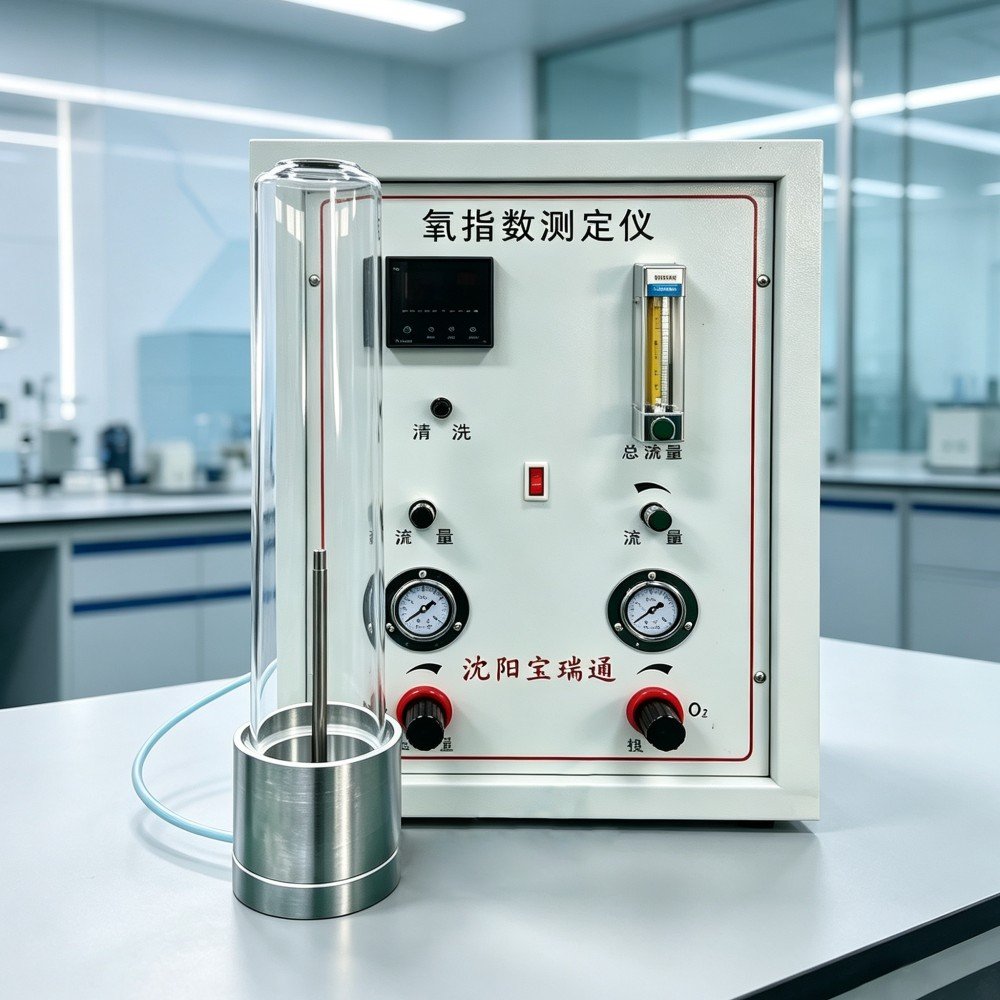
Limitando o índice de oxigênio, or LOI, measures the minimum oxygen concentration that will just support flaming combustion of a material. Under ASTM D2863 and the equivalent ISO 4589 série, a specimen burns in a controlled oxygen/nitrogen mixture and the oxygen concentration is reduced until the flame no longer sustains itself. A higher LOI means the material needs more oxygen to burn. It is a useful screening and research measurement, but it is a different test from UL 94 and the two results frequently disagree in rank order, for reasons set out in our guide to how to test flame retardant plastics.
Heat release and fire growth
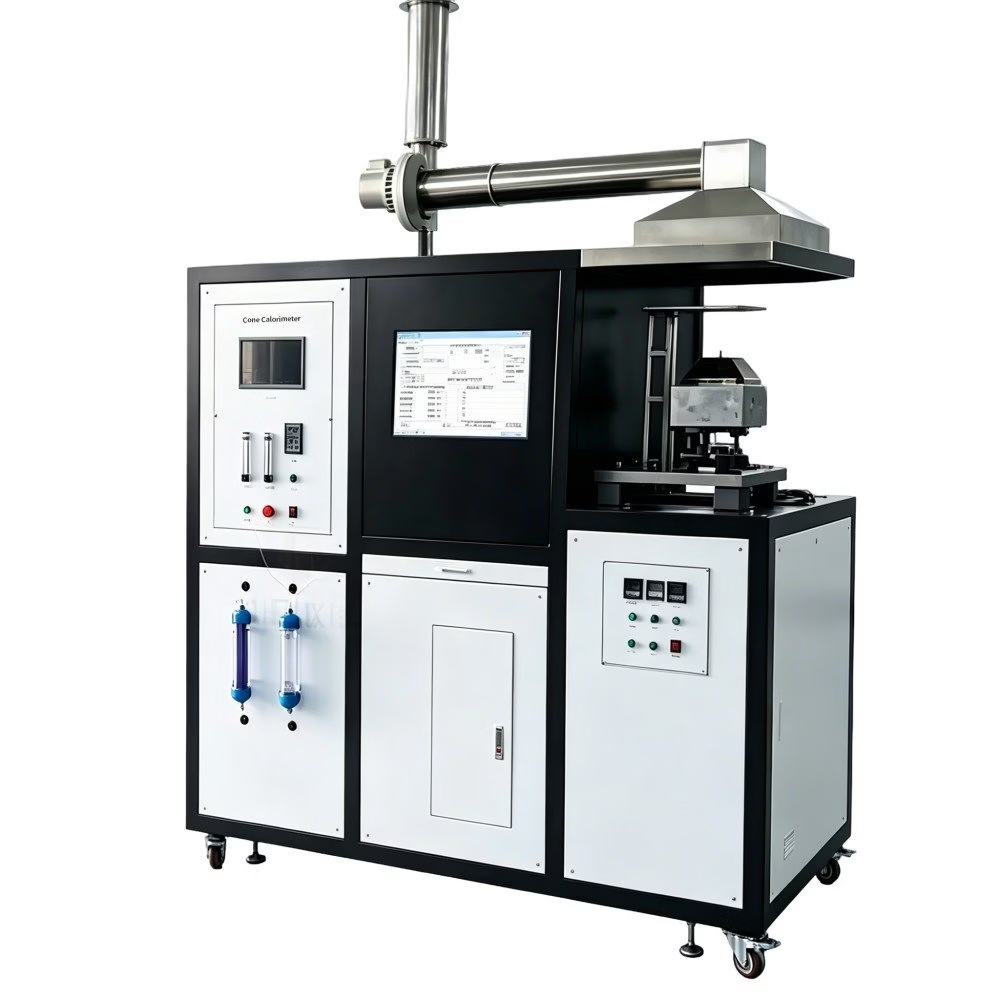
For engineering questions, a cone calorimeter measures heat release rate, mass loss and related quantities under a controlled radiant flux. It does not issue a pass/fail classification, but it answers what a classification cannot: how much heat the material contributes and how quickly. That is why specifiers working on fire growth often want calorimetry alongside a small-flame rating. The equipment behind these measurements is described in our article on what a cone calorimeter measures.
Classification in construction products
For construction products in Europe, reaction-to-fire behaviour is classified under EN 13501-1, which covers construction products other than power, control and communication cables 3. The classification draws on several test methods — EN ISO 11925-2 for ignitability under a small flame source, EM 13823 for the single burning item test, e EN ISO 1716 for gross heat of combustion. EM ISO 1716 specifies determination of gross heat of combustion at constant volume in a bomb calorimeter 4. A material described as flame retardant for a construction application normally needs this classification route, not just a small-flame rating.
Reading a Flame Retardant Data Sheet
A data sheet that says “retardador de chama” without a test reference is not a specification. The information that makes the claim usable is specific and short.
| O que procurar | Por que isso importa |
|---|---|
| The named test method and edition | A rating is only meaningful with the method that produced it |
| Espessura da amostra | Small-flame results are thickness-dependent; the same material can pass at one thickness and fail at another |
| Orientação | Vertical and horizontal specimens are classified differently |
| Cor e formulação | Pigments and additives change burning behaviour |
| Additive package and whether it is halogen free | A compositional constraint cannot be inferred from a performance class |
| After-flame time and dripping behaviour | These are separate observations within small-flame classifications |
Two questions expose most weak claims: at what thickness was this result obtained, and has the formulation changed since the test was run. If either is unclear, the rating should be treated as indicative rather than as evidence.

Building a Verification Programme
For a manufacturer launching a flame retardant grade, the order of testing is a cost decision as much as a technical one.
- Screen the formulation with LOI or a small horizontal flame test. This is fast and shows whether the additive package is doing anything at all.
- Confirm against the target classification with the method the customer actually specifies — UL 94 vertical testing, a construction-product classification, or another named standard.
- Test the extremes of the range — thinnest and thickest sections, with and without colourants or glass fibre — because ratings are thickness- and formulation-dependent.
- Add heat release data when the design question is about fire growth rather than pass/fail.
- Control the production formulation so the certified package is the one that ships. A change of supplier for a retardant additive is a change to the tested material.
The equipment behind this sequence is straightforward: um limitando o verificador do índice de oxigênio for screening, um horizontal/vertical combustion tester for small-flame classification, e um calorímetro de cone para liberação de calor. Construction-product classification adds a aparelho de queima única and a small flame source rig.
Perguntas frequentes
What is a flame retardant material?
A flame retardant material is one formulated or treated to resist ignition, slow flame spread, or self-extinguish when the heat or flame source is removed. The behaviour comes from additives or reactive chemistry that interrupt combustion in the gas phase, the condensed phase, or through cooling and dilution. It is a result tied to a formulation, thickness and test method, not a permanent property of the base polymer.
How do flame retardants work?
They interrupt the combustion feedback loop. Halogenated and some phosphorus systems quench flame radicals in the gas phase. Phosphorus and nitrogen systems often promote a protective char in the condensed phase. Mineral fillers such as aluminium hydroxide release water, cooling the surface and diluting combustible gases. Many commercial packages combine two or more of these mechanisms.
Is a flame retardant material the same as a non-combustible material?
Não. A flame retardant material resists ignition or slows flame spread under a specific test; it can still contribute heat. Non-combustibility is determined by a separate method such as ISO 1182, which tests homogeneous products and substantial components under specified conditions. Passing a small-flame retardancy test does not mean a material is non-combustible.
What is the difference between additive and reactive flame retardants?
Additive retardants are mixed into the polymer and are not chemically bonded to the chain, so they can migrate or be extracted and the formulation can be adjusted easily. Reactive retardants are built into the polymer chain, cannot migrate out, and are common in thermosets. The choice affects long-term durability and how easily the rating can be maintained in production.
Does V-0 mean a material will not burn in a real fire?
Não. V-0 is a classification under a specific vertical small-flame test at a stated thickness. It describes extinguishing behaviour under those conditions, not performance in a fully developed fire. For engineering questions about heat contribution and fire growth, heat release data from a cone calorimeter is more informative.
What does a higher limiting oxygen index mean?
It means the material needs a higher oxygen concentration to sustain flaming combustion, which generally indicates better resistance to ignition in that test. Limiting oxygen index is a screening measurement under a controlled atmosphere, not a classification, and it does not rank materials the same way as a vertical flame test.
Are halogen-free flame retardants better?
Halogen-free is a compositional requirement, not a performance level. It removes halogens from the formulation, often for environmental or regulatory reasons, but the resulting material must still be verified against a named test. A halogen-free system can be retardant or not depending on the chemistry and the polymer; the class has to be demonstrated.
Why can the same material have different ratings?
Because flame retardancy depends on thickness, orientação, cor, additives and test method. A specimen may pass a vertical test at one thickness and fail at another, or pass horizontally and fail vertically. A data sheet is only useful when it names the method and the exact specimen condition used.
Conclusão: Define, Explain, Verificar
Answering “what is a flame retardant material” properly takes three steps. Define it as a formulated material whose resistance to ignition or flame spread has been engineered in, not as an inherent property of a polymer. Explain the mechanism — radical quenching, char formation, cooling and dilution — because that determines which polymer and which additive package will work. Then verify the claim against the method the customer actually specifies, at the thickness and formulation that will ship.
The most expensive mistake in this area is treating a rating as a material identity. A V-0 resultado, an oxygen index value and a Euroclass answer different questions, and none of them survives a change in formulation. BRT Testing supplies the limiting oxygen index tester, the horizontal/vertical combustion tester, the single burning item apparatus and the cone calorimeter needed to move from screening to classification. Tell us the polymer, the target market and the claim you have to support, and we will match the test route.
Sobre o autor
Escrito pela equipe de conteúdo do BRT Testing — Shenyang Baoruitong Automation Equipment Co., Ltda., fabricante de equipamentos de teste de fogo e chama e instrumentos de análise de materiais. This article is written for polymer engineers, product managers and procurement specialists who specify or evaluate flame retardant materials.
Fontes
- SONO - GRANDE 1182:2020 Non-combustibility test for materials. Atual, À força 04 Junho 2020. https://webstore.uni.com/en/iso-1182-2020
- ASTM International — D3801 Standard Test Method for Measuring the Comparative Extinguishing Characteristics of Solid Plastics in a Vertical Position. https://store.astm.org/d3801.html
- UNI—EN 13501-1:2018 Fire classification of construction products and building elements — Part 1: Classification using data from reaction to fire tests. Atual, À força 19 dezembro 2018. https://webstore.uni.com/en/en-13501-1-2018
- SONO - NÃO GRANDE 1716:2018 Reaction to fire tests for products — Determination of the gross heat of combustion (valor calorífico). Atual, À força 11 Julho 2018. https://webstore.uni.com/en/en-iso-1716-2018
- SONO - NÃO GRANDE 11925-2:2026 Reaction to fire tests — Single-flame source test. https://webstore.uni.com/en/en-iso-11925-2-2026
- ASTM International — E84 Standard Test Method for Surface Burning Characteristics of Building Materials. https://store.astm.org/e84.html