Kısa Cevap
The fire growth rate index FIGRA is a number derived from the single burning item (SBI) test under EN 13823 that describes how quickly a construction product’s heat release grows during the first minutes of fire exposure. It is not a property measured by a cone calorimeter. İÇİNDE 13823 defines two versions, FIGRA0,2MJ and FIGRA0,4MJ, which differ by the total heat release threshold used to set the calculation window. A lower FIGRA means slower heat-release growth and better reaction-to-fire performance. The index drives the Euroclass B, C and D classifications in EN 13501-1, where FIGRA0,2MJ applies to class B and FIGRA0,4MJ to classes C and D 4.
Where FIGRA Comes From
FIGRA is not measured directly. It is calculated from data recorded during the single burning item test specified by EN 13823. The standard’s scope covers construction products excluding floorings when exposed to thermal attack by a single burning item 1 10. The current edition is EN 13823:2020+A1:2022, o zamandan beri yürürlükte 20 Temmuz 2022; the unamended EN 13823:2020 has been withdrawn 2.
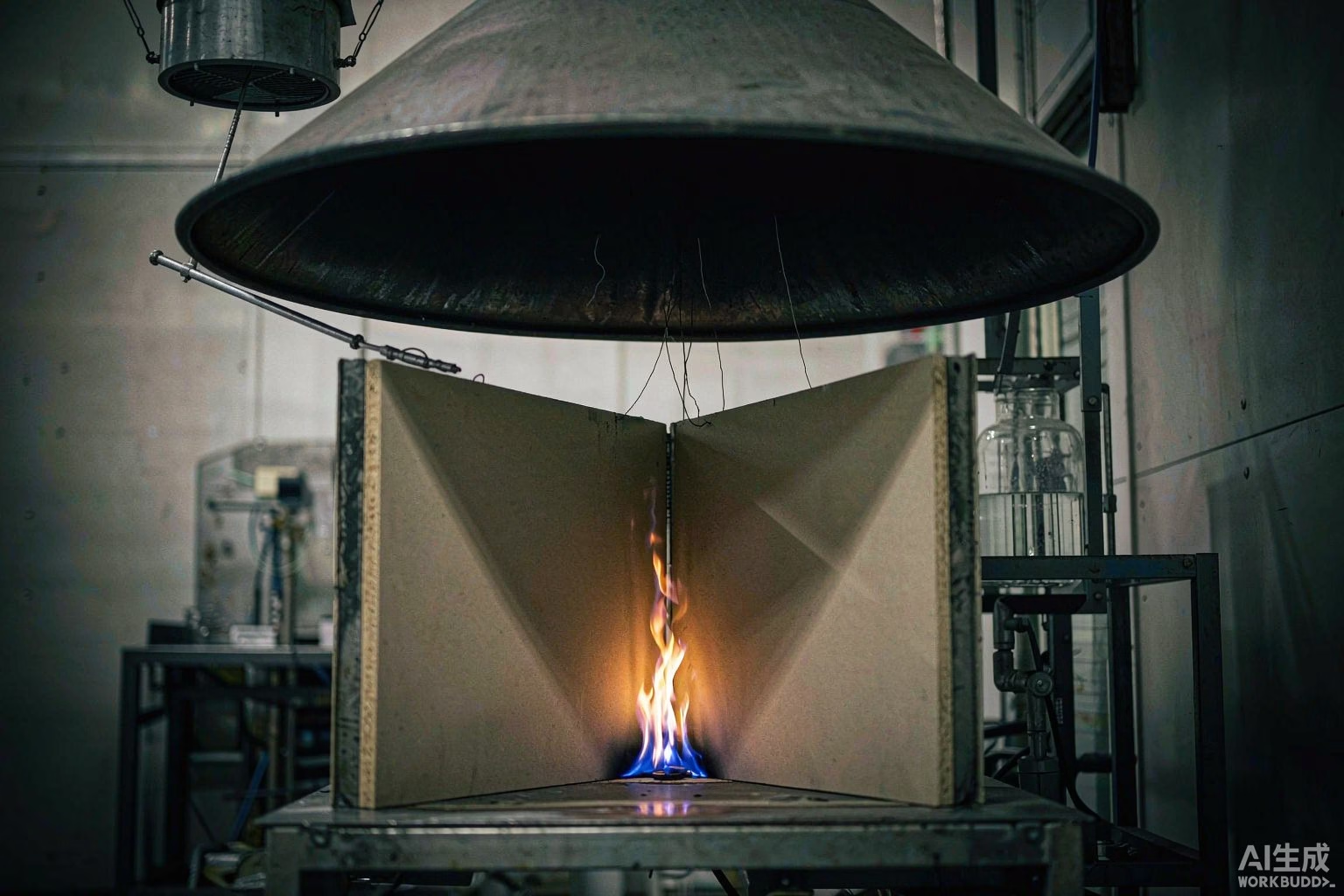
In the test, two specimen panels are mounted at right angles to form a corner inside a combustion enclosure. A propane burner burns against the corner at the lower junction while the specimen is also exposed to radiant heat from the enclosure. Heat release rate and smoke production rate are recorded over time, together with lateral flame spread and flaming droplets. FIGRA is extracted from the heat release rate curve, while the other observations feed separate classification parameters [1].
Numune, burner and enclosure geometry
The tek yanan eşya aparatı fixes a corner geometry that is essential to the meaning of the index. Two panels of defined dimensions form the re-entrant corner, with the burner at the bottom junction and the assembly enclosed so radiant heat and combustion products are controlled [1]. A FIGRA value is therefore specific to this configuration.
Why a rate index is needed
Peak heat release rate alone does not describe how fast a fire grows. A material can reach the same peak slowly or quickly, and the rate of growth governs how much time occupants have to escape and how rapidly a fire must be controlled. FIGRA converts the heat release rate curve into a single number that captures the steepest growth during the early exposure window, which is why it is used as a classification parameter rather than left as a raw observation [1][4].
The Two FIGRA Values
İÇİNDE 13823 defines two indices. Madde 3.7 defines “FIGRA0,2 MJ fire growth rate index maximum of the quotient of heat release rate from the specimen and the time of its occurrence using a THR-threshold of 0,2 MJ”. Madde 3.8 defines the same quantity with a THR threshold of 0,4 MJ [1].
| Index | THR threshold | Defined in | Used in EN 13501-1 |
|---|---|---|---|
| FIGRA0,2MJ | 0.2 MJ total heat release | İÇİNDE 13823 clause 3.7 [1] | Classes A2 and B [4] |
| FIGRA0,4MJ | 0.4 MJ total heat release | İÇİNDE 13823 clause 3.8 [1] | Classes C and D [4] |
The threshold does not change the form of the calculation. It changes the window over which the quotient is searched, and therefore the value that is reported. The two figures are distinct indices and must never be quoted as each other.
How the Index Is Calculated
The definition in EN 13823 is deliberately compact: FIGRA is the maximum of the quotient of the heat release rate from the specimen and the time of its occurrence, using a specified total heat release threshold [1]. Annex A.5.3 of the standard sets out the calculation of FIGRA0,2MJ and FIGRA0,4MJ [1]. Açıkça söylemek gerekirse, the software examines the heat release rate curve from ignition, divides each heat release rate value by the time at which it occurred, and takes the largest quotient within the window that opens once cumulative heat release passes the threshold.
The THR threshold gates the window
The threshold acts as a gate on the data. For FIGRA0,2MJ, values count only after 0.2 MJ of total heat release; for FIGRA0,4MJ, the gate opens at 0.4 MJ. The two indices are therefore not interchangeable.
Reading the quotient qualitatively
A high quotient means a large heat release rate was reached early, the signature of rapid growth; a low quotient means slower build-up. FIGRA is a rate expressed in watts per second (W/ler), a derived classification parameter rather than a direct reading, and it is interpreted with the other SBI observations [1][4].
Euroclass Thresholds under EN 13501-1
İÇİNDE 13501-1:2018 sınıflandırma standardıdır, currently in force from 19 Aralık 2018 3. It states that for classes A2 and B, FIGRA = FIGRA0,2MJ, while for classes C and D, FIGRA = FIGRA0,4MJ [4]. The fire growth rate index FIGRA is therefore central to these classes, and the European Commission’s Delegated Regulation (AB) 2016/364 publishes the official limits in Table 1 5.
| Avrupa sınıfı | FIGRA index used | FIGRA sınırı | Other conditions |
|---|---|---|---|
| B | FIGRA0,2MJ [4] | ≤ 120 W/ler [4][5] | LFS below edge, THR600'ler ≤ 7.5 MJ [5] |
| C | FIGRA0,4MJ [4] | ≤ 250 W/ler [4][5] | THR600'ler ≤ 15 MJ, no LFS to edge [4] |
| D | FIGRA0,4MJ [4] | ≤ 750 W/ler [4][5] | Reported with smoke and droplet subclasses [4] |
A frequent error is to quote FIGRA0,2MJ for class C. Class C uses FIGRA0,4MJ, not FIGRA0,2MJ [4][5]. Reading the wrong column of the table produces a false conclusion about compliance.
s1 and s2: the smoke subclasses
Smoke production is a separate axis of the Euroclass system. The s1 subclass requires SMOGRA ≤ 30 m²/s² and TSP600s ≤ 50 m², while s2 allows SMOGRA ≤ 180 m²/s² and TSP600s ≤ 200 m² [4][5]. A product can meet its FIGRA limit yet fall into a poorer smoke subclass.
d0 and flaming droplets
The d subclass concerns flaming droplets: d0 means none occur within 600 S [4]. FIGRA alone never establishes a class, since the heat-release index, smoke subclass and droplet subclass are reported together.
Worked Example: A Real D-s2,d0 Report
A published test report on a treated wood cladding product shows how these numbers appear in practice 8. The report, number O100609-1128066-4 dated 19 Eylül 2022, assessed the product against the D-s2,d0 criteria: FIGRA0,4MJ ≤ 750 W/ler, SMOGRA ≤ 180 m²/s², TSP600s ≤ 200 m², and no flaming droplets within 600 S [8].
| Parametre | Individual results | Mean | D-s2,d0 criterion |
|---|---|---|---|
| FIGRA0,4MJ (W/ler) | 691 / 691 / 639 / 674 [8] | 674 [8] | ≤ 750 [8] |
| SMOGRA (m²/s²) | 8 / 7 / 9 / 8 [8] | 8 [8] | ≤ 180 [8] |
| THR600'ler (MJ) | 18 / 18 / 17 / 17 [8] | — | Reported [8] |
| TSP600'ler (m²) | 30 / 49 / 30 / 36 [8] | — | ≤ 200 [8] |
What the report shows
The FIGRA values sit below the 750 W/s limit and the smoke values are far below the s2 ceiling [8]. The example is included to show how FIGRA and SMOGRA are reported side by side in a real document; it is a test report on one product, not a product endorsement or a recommendation for any application.
SMOGRA: The Smoke Counterpart
İÇİNDE 13823 clause 3.9 defines SMOGRA as the smoke growth rate index, the maximum of the quotient of smoke production rate from the specimen and the time of its occurrence [1]. Annex A.6.3 covers its calculation [1]. Where FIGRA describes the growth of heat release, SMOGRA describes the growth of smoke. Both come from the same SBI run and both feed the Euroclass classification, but they are independent: a material can show low FIGRA and high SMOGRA, veya tam tersi [4].
A yapı malzemeleri duman yoğunluğu test cihazı answers a different question from the SBI smoke parameter. For construction-product classification, smoke is classified through SMOGRA and TSP600s from the SBI test, not through the optical density produced by a separate smoke chamber [4].
FIGRA Is Not a Cone Calorimeter Number
This distinction matters when specifying equipment. ISO 5660-1:2015 is the cone calorimeter method for measuring heat release rate and smoke production rate 6. Its published preview contains no occurrence of the terms FIGRA or SMOGRA: those indices belong to the EN 13823 SBI method, not to cone calorimetry [1][6]. ASTM E1354 similarly provides for measuring the response of materials exposed to controlled levels of radiant heating, determining ignitability, ısı salınım oranları, kütle kaybı oranları, etkili yanma ısısı ve görünür duman oluşumu 7.
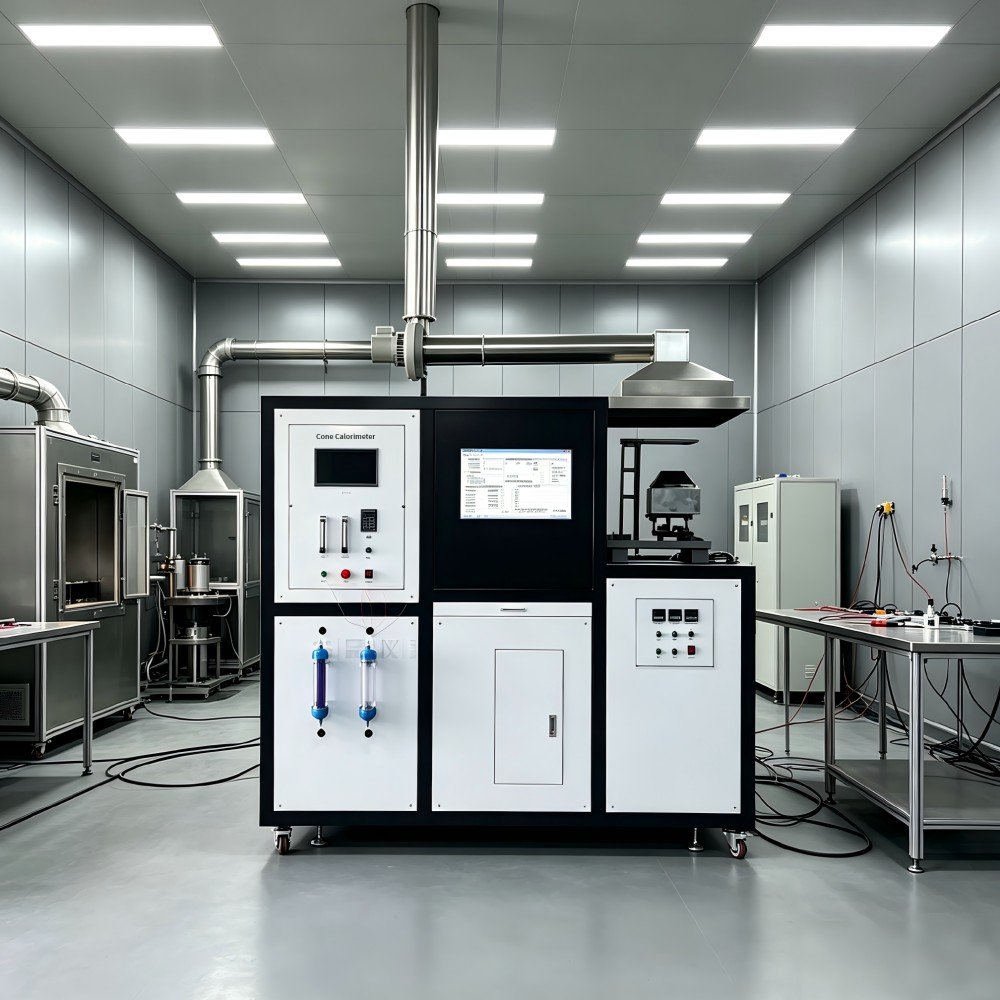
Cone calorimeter measures HRR, not FIGRA
A koni kalorimetresi produces a heat release rate curve from which researchers derive several parameters, but not a FIGRA value under EN 13823. Comparative work has contrasted the tunnel (ASTM E84), koni (ISO 5660 / ASTM E1354), SBI (İÇİNDE 13823) and room corner (ISO 9705) testler 9; their results are not interchangeable.
What FIGRA Does Not Tell You
The fire growth rate index FIGRA is a reaction-to-fire index used for classification, not the whole fire picture.
Fire resistance is a different question
Fire resistance concerns an element’s load-bearing capacity, integrity and insulation under furnace exposure. FIGRA describes early heat-release growth in the SBI test, not structural performance.
Toxicity is not measured
The SBI apparatus records heat release, smoke and flaming droplets; it does not analyse the toxicity of combustion gases. Smoke toxicity requires separate methods and cannot be inferred from a FIGRA value.
A full fire hazard assessment needs more
Real fires involve flame spread, flashover, smoke layering, toxicity and suppression. FIGRA is one input, not a complete hazard model.
Using FIGRA in Equipment Specification
For a laboratory setting up Euroclass testing, the question is which indices the reporting software must produce.
| Gereklilik | Equipment implication |
|---|---|
| FIGRA0,2MJ for B | SBI apparatus with software reporting the 0.2 MJ index [1][4] |
| FIGRA0,4MJ for C and D | Same apparatus reporting the 0.4 MJ index [1][4] |
| SMOGRA smoke subclass | SBI smoke measurement and exhaust chain [1][4] |
| Method verification | Routine checks under EN 13823 - bkz. SBI calibration guide |
| Classification context | Read the Euroclass SBI kılavuzu |
Common Misreadings
Linking the wrong threshold to a class
Class C uses FIGRA0,4MJ, not FIGRA0,2MJ [4][5]. This is the most frequent error in FIGRA references.
Treating FIGRA as a cone calorimeter result
FIGRA is an EN 13823 SBI index, not a result generated by ISO 5660-1 or ASTM E1354 [6][7].
Assuming a lower number is always better in every context
Within SBI classification a lower FIGRA means slower growth, but it does not override a poor smoke or droplet subclass or say anything about fire resistance.
For a direct comparison of the two apparatus, Görmek SBI apparatus vs cone calorimeter; for the wider framework, gör İÇİNDE 13501-1 Euroclass SBI kılavuzu.
Sıkça Sorulan Sorular
What does FIGRA stand for?
FIGRA stands for fire growth rate index. It is a value derived from the single burning item test under EN 13823 that describes how quickly the heat release from a specimen grows during the early minutes of exposure. A lower FIGRA indicates slower fire growth. The acronym is used both for the general index and for the two threshold-specific forms, FIGRA0,2MJ and FIGRA0,4MJ, that feed Euroclass classification.
Which test produces FIGRA?
FIGRA comes exclusively from the single burning item test specified in EN 13823, in which two panels form a corner exposed to a propane burner and radiant heat inside an enclosure. The heat release rate curve recorded during that test is processed to produce the index. It is not produced by a cone calorimeter, a smoke density chamber or a furnace fire resistance test, which measure other things.
What is the difference between FIGRA0,2MJ and FIGRA0,4MJ?
Both use the same calculation: the maximum quotient of heat release rate and its time of occurrence. They differ in the total heat release threshold that sets the start of the calculation window. FIGRA0,2MJ uses a 0.2 MJ threshold and applies to classes A2 and B; FIGRA0,4MJ uses 0.4 MJ and applies to classes C and D. The two values are not interchangeable.
What FIGRA value do I need for Euroclass B or C?
For class B the relevant index is FIGRA0,2MJ and the limit is 120 W/ler, together with lateral flame spread below the edge and THR600s of 7.5 MJ or less. For class C the index is FIGRA0,4MJ with a limit of 250 W/s and THR600s of 15 MJ or less. Remember that smoke and droplet subclasses are assessed separately.
Is SMOGRA the same as FIGRA?
HAYIR. Both are derived from the same EN 13823 SBI testi, but FIGRA describes the growth of heat release while SMOGRA describes the growth of smoke production. SMOGRA is the maximum quotient of smoke production rate and its time of occurrence. They are independent classification inputs, so a product can have a good FIGRA but a poor smoke subclass.
Can I calculate FIGRA from cone calorimeter data?
HAYIR. FIGRA is defined within EN 13823 and depends on the SBI specimen geometry, burner and enclosure. ISO 5660-1 cone calorimeter data are heat release rate and smoke production rate curves; the standard does not contain FIGRA or SMOGRA. Cone calorimetry answers related questions, but it does not yield a FIGRA value that can be reported against EN 13501-1.
Does a low FIGRA mean a product passes fire resistance tests?
HAYIR. A low FIGRA means slow heat-release growth in the SBI reaction-to-fire test. Fire resistance tests assess whether an element keeps its load-bearing capacity, integrity and insulation under furnace exposure, which is a different performance question. FIGRA also says nothing about smoke toxicity or gas composition, so it cannot stand in for a full fire hazard assessment.
Çözüm: A Five-Step Order for Reading FIGRA
Read the fire growth rate index FIGRA in the right order. Birinci, identify the test: an EN 13823 single burning item index, not a cone calorimeter result. Saniye, pick the threshold: 0.2 MJ for classes A2 and B, 0.4 MJ for C and D. Üçüncü, compare the value with the Euroclass limit in EN 13501-1 and the Delegated Regulation. Dördüncü, check the smoke and droplet subclasses, since FIGRA alone does not establish a class. Beşinci, keep fire resistance and toxicity separate.
BRT Testing supplies the single burning item apparatus and the supporting instruments for reaction-to-fire testing. Tell us the Euroclass you need and the products you test, and we will match the system and its reporting software to the method.
Yazar Hakkında
Written by the BRT Testing content team — Shenyang Baoruitong Automation Equipment Co., Ltd., a manufacturer of fire and flame testing equipment and materials analysis instruments. For laboratory managers, specification writers and engineers who interpret Euroclass results or configure SBI test systems.
Kaynaklar
- SIST — EN 13823:2020 preview, clauses 3.7, 3.8, 3.9 and Annexes A.5.3, A.6.3. https://cdn.standards.iteh.ai/samples/64502/bf4d4ec01bfc4071b247fd75f62107ea/SIST-EN-13823-2020.pdf
- UNI—EN 13823:2020+A1:2022, akım, yürürlükte 20 Temmuz 2022. https://webstore.uni.com/en/en-13823-2020-a1-2022
- UNI—EN 13501-1:2018, akım, yürürlükte 19 Aralık 2018. https://webstore.uni.com/en/en-13501-1-2018
- Wallbarn mirror — BS EN 13501-1:2018 full text, clauses 3.1.37 Ve 11.4 ile 11.6. https://www.wallbarn.com/wp-content/uploads/2024/04/BS-EN-13501-1-2018-Fire-classification-of-construction.pdf
- European Commission — Delegated Regulation (AB) 2016/364, Masa 1. https://eur-lex.europa.eu/legal-content/EN/TXT/HTML/?uri=CELEX:32016R0364
- BÜYÜK – BÜYÜK 5660-1:2015 preview, cone calorimeter method. https://cdn.standards.iteh.ai/samples/57957/f8435ec345ed438c92ff315d0cf0ed98/ISO-5660-1-2015.pdf
- ASTM International — E1354 standard. https://store.astm.org/e1354.html
- RISE / DiBK — Lunawood Termo D test report O100609-1128066-4, 19 Eylül 2022. https://www.dibk.no/byggevarer/finn-byggevare-og-dokumentasjonskrav/tilsyn-med-byggevarer/produsentene-av-behandlet-trekledning-leverer-det-de-lover/_/attachment/inline/96216619-dcc3-4f67-a7d6-ce74b11add81:e9cbcf226ff146c6cf03097916dc51cbf5c0f8af/Lunawood%20-%20Termo%20D.pdf
- FPInnovations — Forintek working paper E4071. https://library.fpinnovations.ca/media/WP/E4071.pdf
- iteh — EN 13823:2020 catalog page, scope. https://standards.iteh.ai/catalog/standards/sist/c64b7537-aed7-45a7-befb-5e592f605fa7/sist-en-13823-2020