EN ISO 11925-2 is the small-flame ignitability test that sits at the bottom of Europe’s reaction-to-fire framework. A vertically mounted specimen — 250 mm × 90 mm, at the product’s real thickness — is exposed to a 20 mm propane flame applied for either 15 s or 30 s. The specimen fails if the flame tip reaches the 150 mm mark within 20 s (15 s exposure) or 60 s (30 s exposure), or if flaming debris ignites a filter paper beneath the sample. It is the mandatory test behind every Euroclass E rating and the droplet/particle (d) classification for classes A2 to D, and the standard was technically revised in January 2026 (ISO 11925-2:2026, fifth edition).
This guide explains what the test measures, the apparatus it needs, the exact pass criteria, and what changed in the 2026 edition.
What Is EN ISO 11925-2?
EN ISO 11925-2 — full title Reaction to fire tests — Ignitability of products subjected to direct impingement of flame — Part 2: Single-flame source test — determines how easily a building product ignites when touched directly by a small flame, under zero impressed irradiance. No radiant panel, no furnace heat: just a match-sized propane flame against a vertical specimen.
The method is deliberately simple, and that is precisely why it matters. Most real fires start small — a discarded match, a faulty appliance, a lighter. The single flame source test answers the first question any classification system must ask: does the product catch fire from a small flame, and how quickly does the flame climb?
The standard is prepared jointly by ISO/TC 92/SC 1 (Fire initiation and growth) and CEN/TC 127 (Fire safety in buildings) under the ISO–CEN Vienna Agreement, so the ISO and EN texts are identical 1. Its results feed directly into the Euroclass system defined by EN 13501-1 under the EU Construction Products Regulation (CPR, Regulation (EU) No 305/2011) 2.
Although the standard is titled an ignitability test, ignition itself is hard to grade. So the method actually measures flame spread: how far up the vertical surface the flame tip travels in a fixed observation window, plus whether the specimen sheds flaming droplets 13. Those two observations are the whole verdict.
The Ignitability Test Building Products Cannot Skip
Under the CPR, no construction product can carry a declared fire class without test evidence from a notified laboratory. The Euroclass system runs from A1 (non-combustible) down to F (no performance determined), and EN ISO 11925-2 is written into the classification rules at almost every level below A1 3:
- Classes B, C, D — the test must be passed in addition to the SBI test (EN 13823), and it supplies the additional d0/d1/d2 classification for flaming droplets and particles.
- Class E — the ignitability test is essentially the whole classification: pass it and the product earns E; fail it and the product drops to F.
- Floorings — the same logic applies to Efl, combined with the radiant panel test EN ISO 9239-1 4.
- A2 — the droplet/particle classification (d0/d1/d2) still derives from this test, even though combustibility itself is measured by EN ISO 1182 and the gross heat of combustion test.
In other words: a product cannot reach class A2, B, C, D or E in Europe without an EN ISO 11925-2 result somewhere in its technical file. The same small-flame method is also referenced by other sectors — railway interior materials under EN 45545-2, for example — which makes it one of the most frequently requested fire tests in the building-products supply chain.
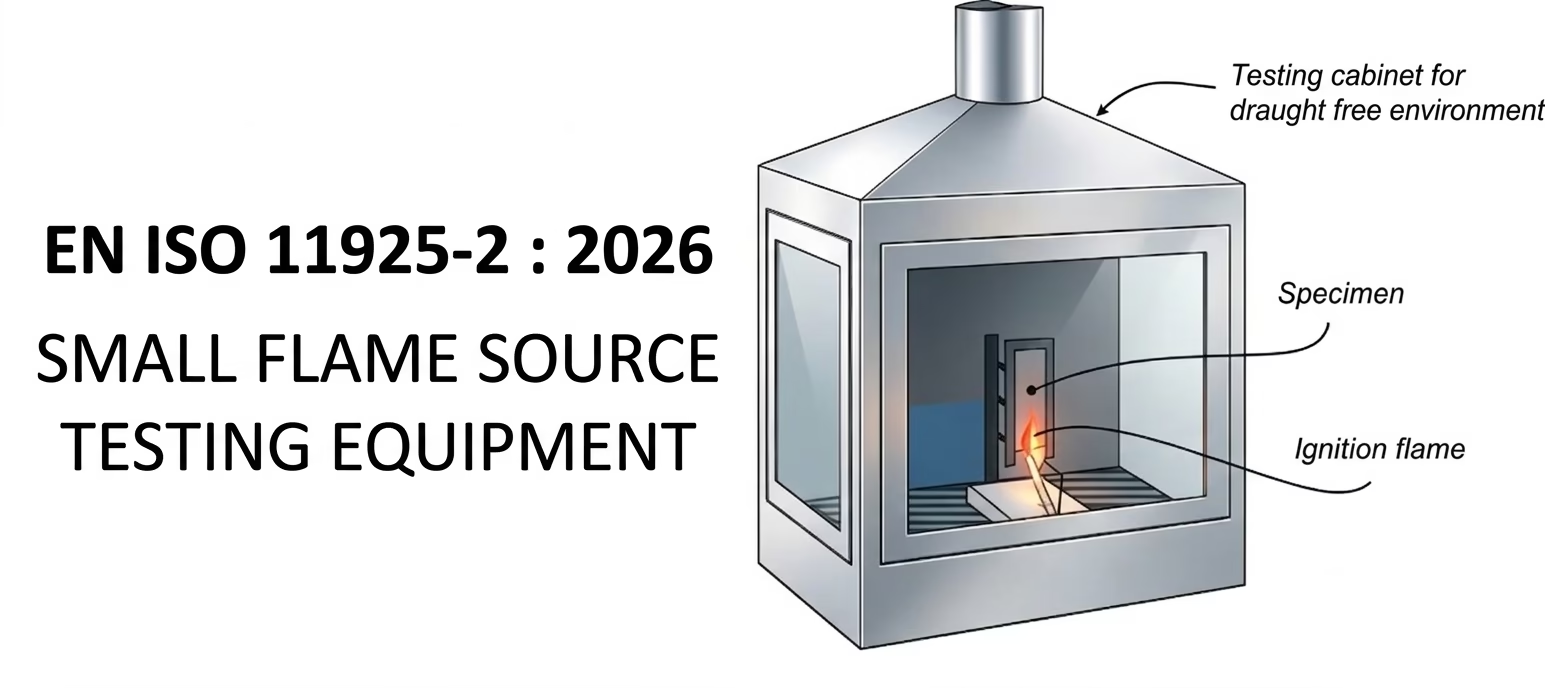
ISO 11925-2 Single Flame Source Test Apparatus: What the Setup Contains
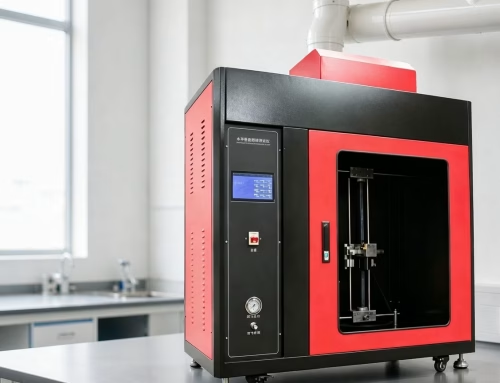
The equipment is compact compared with an SBI rig or a furnace, but every component is tightly specified 15:
| Component | Key specification | Why it matters |
|---|---|---|
| Test chamber | Stainless-steel enclosure with heat-resistant glass door and draught-free ventilation | Prevents external airflow from disturbing the small flame |
| Burner | Brass burner tube tilted at 45°, fed with ≥95 % commercial propane, adjustable gas valve | Delivers the standardised ignition source |
| Flame height | 20 mm, measured from the burner tube’s top edge to the yellow flame tip; checked before each test | The ignition source’s size and reproducibility define the whole test |
| U-shaped specimen holder | Stainless-steel frame ~5 mm thick, clamping the specimen at both sides and one end | Fixes the exposed geometry; 30 mm of specimen extends beyond the frame |
| Filter-paper tray | Two sheets of filter paper on a tray beneath the specimen | Catches flaming debris — its ignition is a pass/fail criterion |
| Timing and observation | Stopwatch/timer to 1 s; dimmed room for visibility of small flames | The 20 s and 60 s observation windows are measured from first flame contact |
Beyond the chamber itself, laboratories need the supporting chain: gas supply with pressure regulation, conditioning per EN 13238, and calibrated flame-height gauging. Because the flame is only 20 mm tall, draughts, gas-pressure drift or a wrongly set flame height move results more than most material differences — which is why the 2026 revision concentrated on clarifying exactly how to judge the flame tip 1.
Specimens and Conditioning
Specimen geometry is fixed and non-negotiable 3:
- Size: 250 mm long × 90 mm wide, cut at the product’s full thickness up to 60 mm; thicker products are reduced to 60 mm by cutting away the unexposed face.
- Number: a minimum of six specimens per exposure condition — three cut lengthwise and three crosswise — with more series when both surface and edge exposure apply.
- Mounting: vertically in the U-holder, either for surface exposure (flame applied 40 mm above the bottom edge on the centreline) or edge exposure (flame applied at the centre of the bottom edge), depending on how the product faces the flame in end use.
- Multi-layer products with total thickness ≥10 mm are additionally tested with the specimen rotated 90° on its vertical axis so each layer receives the flame 5.
- Conditioning follows EN 13238 (standard atmosphere 23 °C / 50 % RH); specimens are tested promptly after removal from the conditioning atmosphere so moisture content does not skew ignition behaviour.
Edge versus surface exposure is not a free choice — it is decided by the product’s end-use orientation, and getting it wrong invalidates the classification. For perforated products with openings larger than 1.5 mm, the substrate actually used in the finished product must be tested, because flames can penetrate through to layers behind the surface 1.
Test Procedure: 15 s vs 30 s Exposure
The procedure is one of the shortest in fire testing, but the two exposure regimes divide the classification ladder 346:
Step 1 — Set the flame. Ignite the burner, verify the 20 mm flame height, and confirm the chamber is draught-free.
Step 2 — Apply the flame. Bring the flame into contact with the specimen — surface or edge, per end use — and start the clock at the moment of contact.
Step 3 — Observe. Watch for ignition, flame-tip travel, glowing, and droplets or particles falling onto the filter paper. This is where the two regimes differ:
| Regime | Applied to | Flame application | Observation window | Pass criterion |
|---|---|---|---|---|
| 15 s exposure | Class E / Efl | 15 s | 20 s from start of test | Flame tip does not reach the 150 mm mark within 20 s |
| 30 s exposure | Classes B, C, D | 30 s | 60 s from start of test | Flame tip does not reach the 150 mm mark within 60 s |
Step 4 — Early termination. The test ends early if the specimen never ignites, self-extinguishes, or the flame reaches the top of the specimen — in which case the criterion is failed 6.
Step 5 — Record. For each specimen: whether ignition occurred; whether and when the flame tip reached 150 mm; whether flaming droplets/particles ignited the filter paper; and physical behaviour such as melting, shrinkage or charring 3.
The two-regime logic is easy to remember: the harder the class you are chasing, the longer the flame bites. A product that survives 15 s of flame but ignites at 30 s cannot be claimed as class B or C — the 30 s regime is what separates E-grade materials from the D–B band.
Pass and Fail Criteria, Term by Term
Reading an EN ISO 11925-2 report comes down to three parameters 34:
- Flame spread (Fs) and t₁₅₀. The distance the flame tip climbs above the application point, and the time to reach the 150 mm mark. The mark is painted on the specimen or holder; the judgment is binary (reached / not reached) plus a recorded time if reached. The 2026 edition added a clarifying note on how to evaluate the flame tip, precisely because borderline judgments at the mark were a known ambiguity 1.
- Filter-paper ignition (droplets/particles). If any flaming debris falling from the specimen ignites the filter paper beneath, the specimen fails the droplet criterion. In EN 13501-1 terms, filter-paper ignition forces a d2 additional classification on SBI-tested classes, and fails the specimen outright for class E 3.
- Flaming and glowing duration. Recorded for information and for classification tables — how long the specimen continues to burn or glow after the flame source is removed 4.
Six specimens per condition means the result is judged across the set, not on a single lucky pass. Laboratories report each specimen individually, and classification per EN 13501-1 is assessed from the group result — a reminder that specimen preparation and conditioning discipline drive reproducibility as much as the material itself 13.
EN ISO 11925-2’s Role in the Euroclass System
Putting the pieces together — which test, which exposure, which class 34:
| Euroclass | Test(s) required | EN ISO 11925-2 exposure | What it contributes |
|---|---|---|---|
| A1 | EN ISO 1182 + EN ISO 1716 | Not required | No ignitability input |
| A2 | EN ISO 1182 or EN ISO 1716 + SBI (EN 13823) | Required | d0/d1/d2 droplet classification |
| B / C / D | SBI (EN 13823) | 30 s | Pass criterion (150 mm in 60 s) + d-classification |
| E / Efl | EN ISO 11925-2 (floorings also EN ISO 9239-1) | 15 s | The classification test itself |
| F | — | — | Product fails the E criteria, or no data declared |
Two practical notes for specifiers. First, class E products often show flame spread beyond 150 mm during the longer window but pass the 20 s window comfortably — which is why a supplier’s “passes EN ISO 11925-2” claim must always state the exposure time. Second, for floorings the radiant panel test takes over above Efl, but the small-flame test remains the entry gate 4.
What Changed in the 2026 Edition
ISO 11925-2:2026 — the fifth edition — was published in January 2026 and cancels and replaces ISO 11925-2:2020, which it technically revises 1. Per the foreword of the new edition, the main changes are 7:
- A note on the evaluation of the flame tip — codifying how laboratories judge whether the flame has reached the 150 mm mark, closing the most common inter-laboratory ambiguity.
- Revision of all figures — redrawing the apparatus and mounting diagrams for clarity.
- Harmonised normative references (with ISO 13943 fire vocabulary and ISO 14697 test background) and updated editorial structure.
What did not change: the 250 mm × 90 mm specimen, the 20 mm flame, the 15 s / 30 s exposure regimes, and the 150 mm-within-20 s / 60 s criteria. Laboratories with existing rigs therefore face no hardware replacement for the 2026 text — but test reports, SOPs and workflow documentation should be re-issued against the fifth edition, and purchasers of new equipment should confirm the supplier certifies the current edition. European (EN) implementations followed promptly, with the BS EN version dated 31 January 2026 8.
Related Tests and Equipment
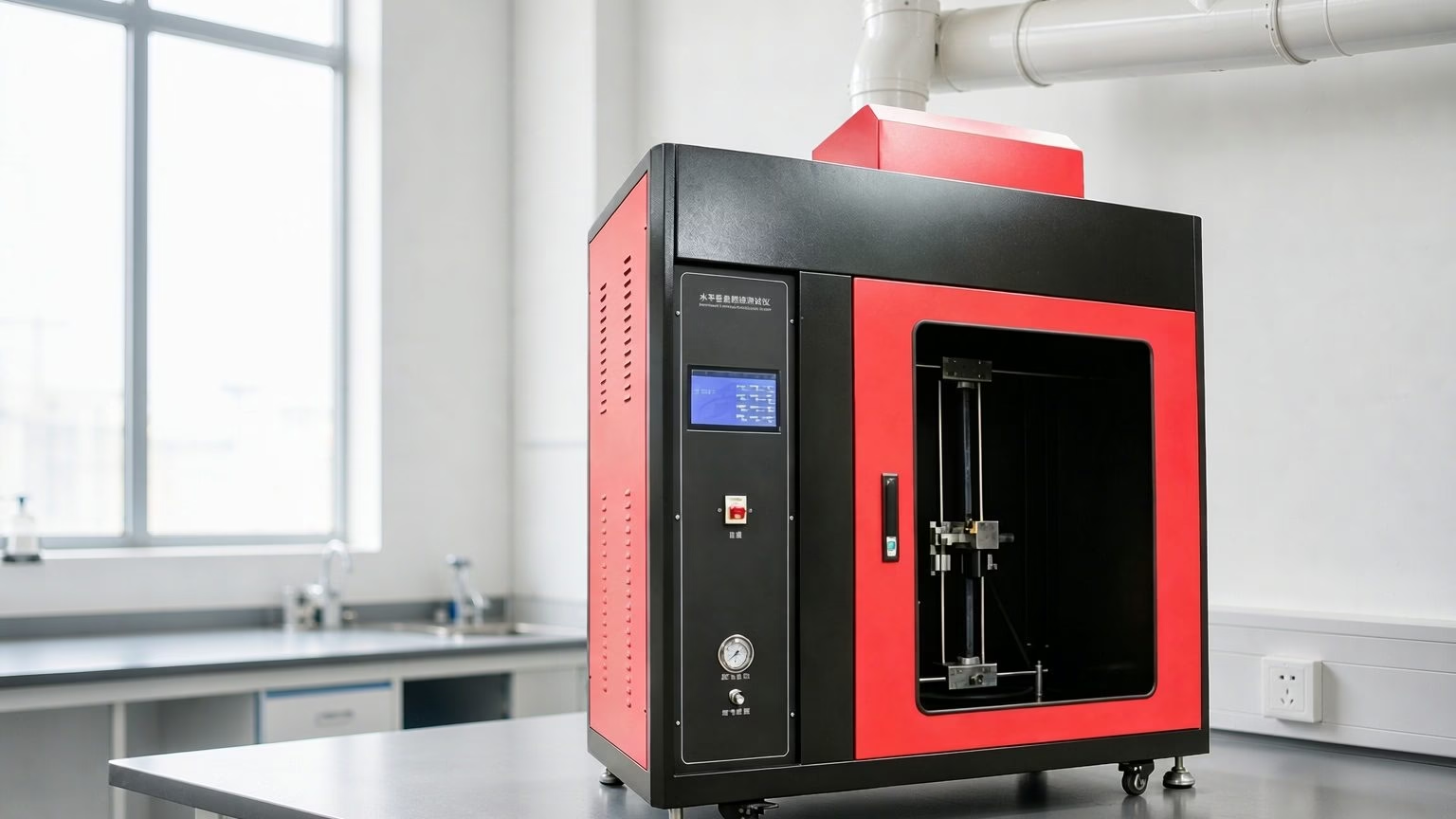
An EN ISO 11925-2 result is rarely the whole story. Classifying a product from E up to A2 is a chain of tests, and each link has its own instrument. The BRT Testing fire range maps one machine per link — the model that runs the single-flame source test itself is the JCKR building material combustibility test apparatus, specified for both the European and the Chinese route:
| Model | Instrument | Role in the classification chain | Standards covered |
|---|---|---|---|
| JCKR | Building material combustibility test apparatus | Runs the single-flame source test itself — edge and surface ignition, 15 s / 30 s exposure regimes | ISO 11925-2:2026, BS EN ISO 11925-2, GB/T 8626, EN 13238, GB 8624, EN 13501-1, GB/T 40238, DIN 4102-1 (B2), DIN 5510-2, TB/T 3237 |
| JCDT | Single burning item (SBI) test apparatus | Mandatory companion for classes B, C and D | EN 13823, EN 13501-1, GB/T 20284-2026, GB 8624-2025, DIN 50055 |
| JBR20 | Non-combustibility apparatus | A1/A2 combustibility — 750 °C furnace, ΔT and mass-loss criteria | EN ISO 1182, GB/T 5464, ASTM E2652, BS 476-4, IMO FTP Part 1 |
| JRZ10 | Gross heat of combustion tester | A1/A2 calorific potential (PCS) by oxygen bomb calorimetry | ISO 1716:2018, BS EN ISO 1716, GB/T 14402-2026, GB/T 213-2008, EN 45545-2, ASTM D5865, ASTM D240 |
| PDCL-01 | Radiant heat flux tester (flooring radiant panel) | Flooring classification — critical heat flux for Efl to Bfl | ISO 9239-1, EN ISO 9239-1, GB/T 11785-2005, ASTM E648, NFPA 253 |
| JYMD | NBS smoke density chamber | Smoke classification input for the s-ratings | GB/T 8627-2007, ASTM D2843, ISO 5659-2, NFPA 258, BS 2782 (Method 140A) |
| JCNR-60 | Building material hard-combustibility tester | B1 route — 10-minute shaft-furnace test (Brandschacht principle) | GB/T 8625-2026, GB 8624 (B1), DIN 4102-15/16 (non-equivalent reference) |
| CYD | Smoke toxicity test equipment | Toxicity classification for materials in escape routes | GB/T 20285-2006, DIN 53436, BS EN 17084, ISO 19702, JIS A 1321, NFPA-style smoke toxicity regimes |
| ZXLR | Cone calorimeter | HRR and fire-growth screening for R&D and rail programmes | ISO 5660-1/-2, GB/T 16172-2026, ASTM E1354, BS 6853, EN 45545-2, IMO FTP |
Laboratories building out a Euroclass testing capability generally add the small-flame rig first — it is the cheapest, fastest and most frequently requested — then layer SBI and non-combustibility capacity as demand grows. See the full fire and flame testing range for the complete list of models.
Frequently Asked Questions
What is the difference between the 15 s and 30 s exposure in EN ISO 11925-2?
The exposure time is dictated by the Euroclass being pursued. 15 s applies for class E (and Efl floorings): the flame touches the specimen for 15 seconds and the flame tip must not reach the 150 mm mark within 20 s of test start. 30 s applies for classes B, C and D: the flame is applied for 30 seconds and the flame tip must not reach 150 mm within 60 s. The 30 s regime is a harder test — roughly double the heat input — and is always run together with the SBI test.
What specimen size does the single flame source test use?
Specimens are 250 mm long × 90 mm wide, tested vertically in a U-shaped stainless-steel holder. Products up to 60 mm thick are tested at full thickness; anything thicker is cut back to 60 mm from the unexposed face. A minimum of six specimens per exposure condition is required — three cut lengthwise and three crosswise — conditioned per EN 13238 before testing.
What does the filter paper criterion mean?
A tray holding two sheets of filter paper sits beneath the specimen. If flaming droplets or particles falling from the specimen ignite the paper, the droplet criterion fails. In EN 13501-1 this forces a d2 additional classification on classes tested with the SBI, and it fails the specimen for class E outright. The filter paper is the test’s way of measuring a real-world hazard: burning debris setting fire to materials below.
Is EN ISO 11925-2 required for every Euroclass?
No. Class A1 does not use it, and F means the product failed class E or was never tested. It is mandatory for classes A2 through E: as the sole classification test for E, and as the droplet/particle (d0/d1/d2) and ignitability gate for A2, B, C and D in combination with EN ISO 1182, EN ISO 1716 and the SBI test EN 13823. Floorings follow the same pattern with Efl and EN ISO 9239-1.
What changed in the ISO 11925-2:2026 edition?
The fifth edition, published in January 2026, cancels and replaces the 2020 edition. The technical changes are focused: a clarifying note on evaluating the flame tip (the 150 mm judgment), a full revision of all figures, and harmonised normative references. The specimen geometry, flame height, exposure times and pass criteria are unchanged, so existing test rigs remain valid — but reports and procedures should be re-issued against the 2026 text.
Can one test rig serve both EN ISO 11925-2 and national small-flame standards?
The core components — vertical specimen holder, 20 mm propane burner, chamber with controlled ventilation, filter-paper tray — overlap heavily with other small-flame methods, and many laboratories run multiple national variants on the same bench. What must be verified per method is the burner geometry, flame-height setting, exposure timing and chamber airflow, because those details differ. When procuring, ask the manufacturer to state which standards the rig is certified against and whether exposure-timing presets are configurable.
Is GB/T 8626 the same test as EN ISO 11925-2?
They belong to the same family, not the same document. GB/T 8626 is China’s small-flame ignitability method for building products, applied with the GB 8624 classification scheme and GB/T 40238 for conditioning; EN ISO 11925-2 is the European and international text that feeds EN 13501-1 Euroclasses. Both mount the specimen vertically, use a small propane flame and judge the 150 mm flame-tip criterion plus filter-paper ignition, so one apparatus specification can cover both routes — the BRT JCKR rig is specified for ISO 11925-2:2026, BS EN ISO 11925-2, GB/T 8626, EN 13238, GB 8624 and GB/T 40238 at once. Reports still have to state which standard, exposure regime and conditioning procedure was used, because the classification tables behind each route differ.
EN ISO 11925-2 and GB/T 8626: Passing Two Markets With One Rig
Chinese manufacturers shipping to both Europe and the domestic market meet the same physical test under two standard numbers. GB/T 8626 is the Chinese small-flame ignitability method, used together with GB 8624 for the B1/B2 classification and GB/T 40238 for conditioning and specimen preparation. The observations are the same family as EN ISO 11925-2: does the flame front reach the 150 mm mark within the prescribed window, and do falling droplets ignite the filter paper beneath.
That overlap is why the JCKR rig in the table above is specified for both routes at once — ISO 11925-2:2026 and BS EN ISO 11925-2 on one side, GB/T 8626 with GB 8624 and GB/T 40238 on the other. Two practical consequences for anyone specifying apparatus:
- One bench can serve both markets, but the test report must state the standard, the exposure regime (15 s or 30 s) and the conditioning standard actually applied — the classification tables behind the two routes are not interchangeable.
- Rail and vehicle programmes add their own variants. The same rig family covers DIN 4102-1 class B2 and the railway specifications DIN 5510-2 and TB/T 3237, which is why buyers screening materials for rolling stock should confirm those standards are in the equipment’s scope before ordering.
Conclusion: One Small Flame, Most of the Euroclass Ladder
EN ISO 11925-2 looks like the simplest test in the reaction-to-fire family, and it is. It is also unavoidable. Read the system in order:
- Identify the target class for your product market — E for many linings and insulation products, B/C/D for higher-specification applications, A2 where “non-combustible-adjacent” is required.
- Pick the exposure regime that the class demands — 15 s for E, 30 s for B–D — and test both surface and edge if end use requires it.
- Pair the tests correctly: SBI for B/C/D, EN ISO 1182 and gross heat of combustion for A1/A2, radiant panel for floorings.
- Document against the 2026 edition — new reports should cite ISO 11925-2:2026, the fifth edition published January 2026.
- Source equipment that matches the standard’s geometry exactly — flame height, holder and airflow are where cheap rigs quietly fail qualification.
If you are equipping a laboratory or planning a test campaign against EN ISO 11925-2, contact BRT Testing for apparatus configuration and quotation support, or browse the complete fire and flame testing range.
Authored by the BRT Testing technical team — Shenyang Baoruitong Automation Equipment Co., Ltd., manufacturer of reaction-to-fire and flammability test instruments including non-combustibility, SBI and small-flame apparatus. Last updated: September 2026.