La réponse courte
UN cone calorimeter test measures how much heat a burning specimen releases, how quickly, and what else comes off it — smoke, mass loss and combustion gases — while the specimen is exposed to a controlled level of radiant heat from a conical heater. The instrument’s core outputs are heat release rate and its peak, dégagement de chaleur total, temps d'allumage, taux de perte de masse, chaleur de combustion efficace, smoke production rate and specific extinction area, plus carbon monoxide and carbon dioxide yields.
One version point is worth noting before anything else, because it appears constantly in older literature and in supplier datasheets. The third edition, OIN 5660-1:2015, cancelled and replaced both parts of the 2002 edition — ISO 5660-1:2002 et ISO 5660-2:2002 — and merged them into a single document 2. Any document still citing “ISO 5660-2” as a current test method is out of date, and the smoke measurement that used to sit in that part is now handled within the same run.
Everything else attributed to cone calorimeter testing is derived from those. MARHE, the maximum average rate of heat emission used in the European railway standard, is a calculation on the heat release curve, not a separate sensor reading. If you want to know which instrument you need rather than what it reports, our comparison of SBI versus cone calorimeter systems covers that decision directly.
The Nine Outputs a Cone Calorimeter Test Produces
| 输出量 | 物理含义 | 单位 | 为什么有人要它 |
|---|---|---|---|
| 热释放速率 HRR | 单位面积单位时间释放的热量 | kW/m² | 火势增长的直接度量 |
| 峰值热释放速率 pkHRR | HRR 曲线的最大值 | kW/m² | 最常被引用,也最易受噪声影响 |
| 总热释放 THR | 累计释放热量 | MJ/m² | 材料「燃料总量」的度量 |
| 点燃时间 TTI | 从开始受辐照到持续火焰 | s | 材料被点燃的难易 |
| 质量损失速率 MLR | 热解与燃烧造成的失重 | g/(m²·s) | 热解动力学的入口 |
| 有效燃烧热 EHC | 单位质量损失对应的放热 | MJ/kg | 判断气相燃烧完全程度 |
| 产烟速率 SPR | 烟的生成速率 | m²/s | 排烟与能见度设计 |
| 比消光面积 SEA | 单位质量损失产生的烟 | m²/kg | 材料固有发烟特性 |
| CO / CO₂ 产率 | 燃烧气体产物 | kg/kg | 毒性评估的输入 |
Heat release rate and peak heat release rate
HRR is the reason the instrument exists. It is derived, not measured directly: the machine measures the oxygen consumed by the fire and converts it using the oxygen consumption principle, which ISO 5660-1 states as 13.1 × 10³ kJ of heat released per kilogram of oxygen consumed 1. Peak HRR is simply the maximum of that curve — and it is the figure most often quoted and most often misused, because a single spike on one replicate can move it substantially.
Time to ignition and total heat release
Time to ignition is measured from the start of irradiation to sustained flaming, with the spark igniter positioned above the specimen centre [1]. It is strongly irradiance-dependent, which is why it is only comparable between runs at the same flux. Total heat release integrates the HRR curve and answers a different question: not how fierce, but how much fuel is in the specimen.
Mass loss and effective heat of combustion
The specimen sits on a balance recording mass continuously. Dividing heat release by mass loss gives the effective heat of combustion — the heat actually obtained per kilogram of material consumed. Comparing it with the gross heat of combustion determined by a bomb calorimeter method such as ISO 1716 10 tells you how completely the material is burning in the gas phase, which is exactly the question a flame-retardant formulation is trying to answer.
Smoke production and specific extinction area
A laser beam across the exhaust duct measures the attenuation caused by smoke, giving smoke production rate and, normalised by mass loss, the specific extinction area. This is where the cone calorimeter overlaps with dedicated smoke apparatus: for classification purposes in Europe, smoke is normally taken from the SBI run, while the cone provides the material-level figure used in research and in transport frameworks.
Carbon monoxide and carbon dioxide yields
Gas analysis on the duct gives CO and CO₂ concentrations, from which yields per kilogram of material are calculated. Carbon monoxide yield is the input to toxic potency assessments, and it rises sharply under ventilation-limited conditions — a reason to treat it as scenario-dependent rather than a material constant.
How a Cone Calorimeter Test Derives Those Numbers
Oxygen consumption calorimetry
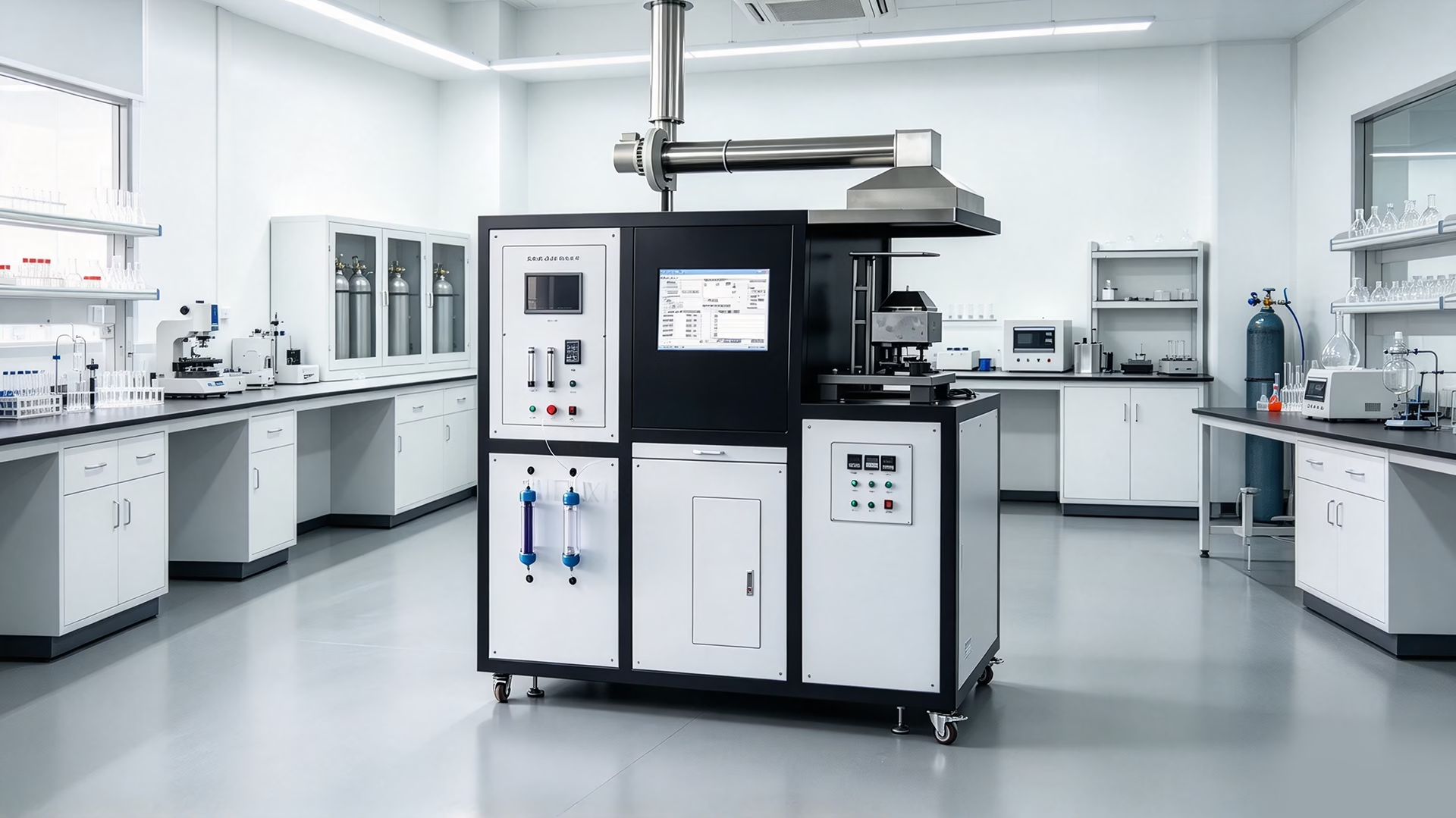
Most organic materials release close to the same amount of heat per unit mass of oxygen consumed, which is why measuring the oxygen depletion in the exhaust is a robust way to measure heat release without building a calorimeter around the fire. OIN 5660-1 fixes the constant at 13.1 × 10³ kJ per kg of O₂ [1], and the oxygen analyser is specified as a paramagnetic type with a range of at least 0–25 % and a response better than 12 s, because the whole heat release calculation inherits the analyser’s speed and stability [1].
The exhaust duct and the gas analysis chain
All combustion products are collected by a hood above the specimen and drawn through a duct at a nominally constant volumetric flow. In that duct sit the gas sampling ring, the smoke attenuation measurement and the thermocouples and orifice plate used to derive the flow. Because every reported quantity downstream depends on that flow being known and stable, the duct and its orifice plate are calibration items, not plumbing.
What a Cone Calorimeter Does Not Measure
It is not a classification test on its own
A cone calorimeter test produces data, not a class. In the European construction products route, the classification is issued under EN 13501-1 on the basis of the designated test programme; the cone appears as a supplementary method and, for certain classes, as part of the evidence. In the railway framework, the cone’s outputs are compared against thresholds in EN 45545-2, where MARHE is the criterion and the reported value is the mean of three specimens 67. In both cases the instrument supplies numbers to somebody else’s decision rule.
It does not measure flame spread or fire resistance
Two clarifications that come up constantly in procurement conversations. D'abord, the cone is a bench-scale, horizontally oriented, radiatively heated test on a 100 mm × 100 mm specimen — it does not measure how far a flame travels across a surface. That is the job of lateral flame spread methods and of the SBI. Deuxième, it measures reaction to fire, not fire resistance: it says nothing about whether a wall, door or floor assembly maintains loadbearing capacity, integrity or insulation in a furnace test. Confusing the two families is the single most common specification error in this field.
A third boundary is worth stating explicitly because it causes arguments in project meetings: cone calorimeter data describes the material under one specific thermal insult, not the product in its installed geometry. A laminate that delaminates, a coating that intumesces, a panel that falls away from its substrate — none of those system behaviours are reproduced on a 100 mm square held flat in a frame. That is exactly why the intermediate-scale tests exist, and why a good development programme runs both rather than trying to make one stand in for the other.
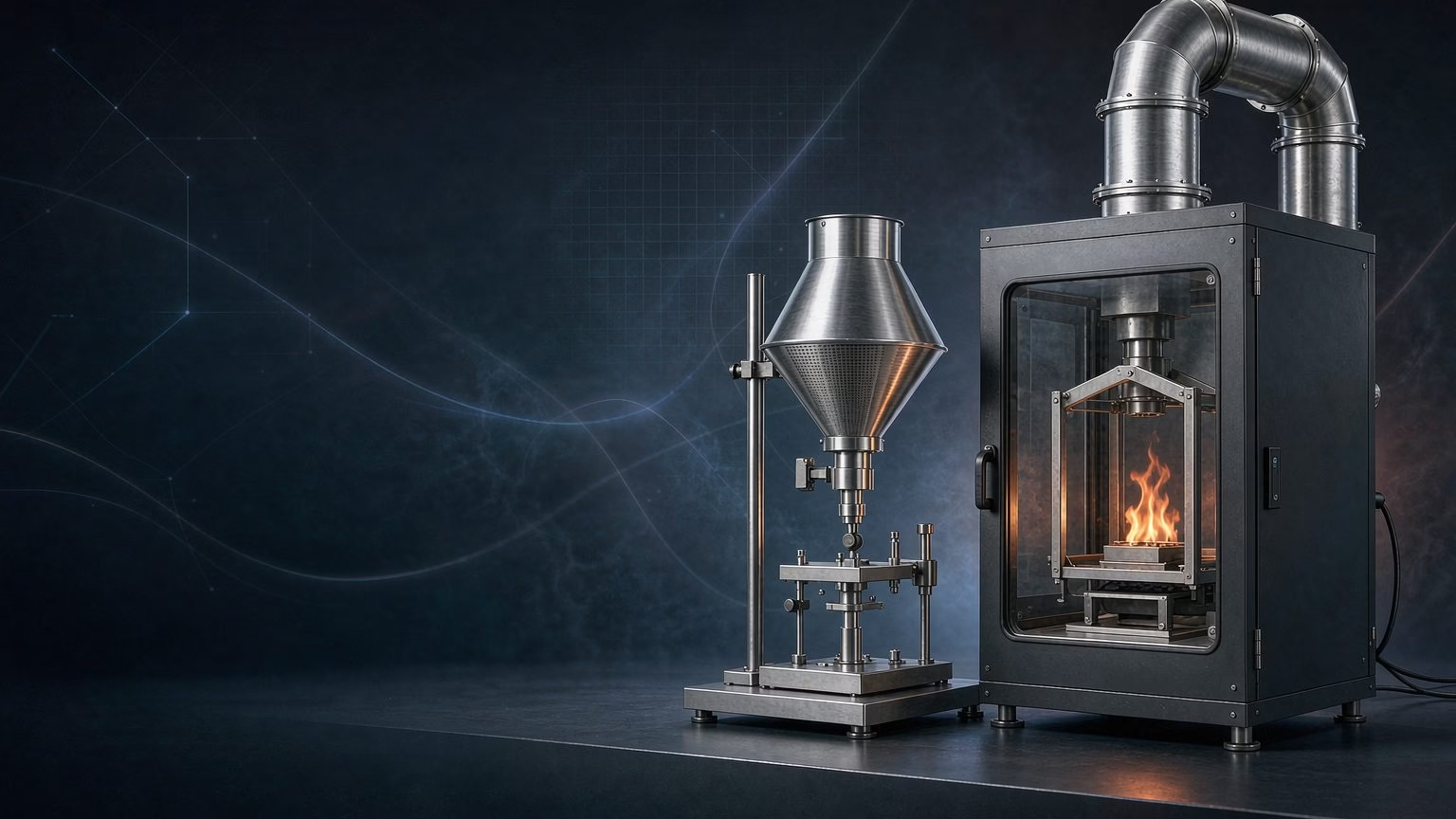
There is also a size correction worth making, because it appears in competitor material: the name refers to the shape of the heater, a truncated cone, not to a conical specimen. The specimen is a flat square plate [1].
Irradiance: The Cone Calorimeter Test Setting That Changes Every Number
| 设定辐照度 | 代表场景 | 对结果的影响 |
|---|---|---|
| 25 kW/m² | 早期 / 阴燃阶段火 | 点燃时间显著变长,部分材料不点燃 |
| 35 kW/m² | 常用中间档 | 多数材料稳定燃烧 |
| 50 kW/m² | 发展中的室内火 | 常用对照档,点燃快 |
| 75 kW/m² | 轰燃前 / 充分发展火 | 点燃极快,峰值最高 |
How long a run lasts and what the sampling rate means
Run length is set by the material, not by the operator: the test continues until the specimen stops releasing heat. What the standard does control is how often data is captured — for short burns of three minutes or less the sampling interval is tightened, and for longer runs it is relaxed, so that a fast-developing material is not smoothed away and a long smouldering run does not produce an unmanageable dataset [1]. For reporting, this matters because a peak read from coarse sampling on a rapidly burning specimen will understate the true maximum.
OIN 5660-1 permits irradiance over a 0–75 kW/m² range [1], and the choice is not cosmetic: every output shifts with it. Reports must state the flux, and comparisons across different fluxes are invalid. Where a framework prescribes a flux — as the railway standard does with two levels — that prescription overrides laboratory convenience.
Where the Numbers Get Used
| 框架 / 用途 | 引用的量 | 说明 |
|---|---|---|
| 轨道交通 EN 45545-2 | MARHE、按危险等级分阈值 | 三个试样的平均值判据 [6][7] |
| 北美材料研究 ASTM E1354 | HRR、pkHRR、THR、TTI | 与 ISO 5660-1 原理相同 3 |
| NFPA 271 | 热释放与产烟 | 北美编号的同原理方法 4 |
| 中国 GB/T 16172 | 同 ISO 5660-1 | 现行版为 2026 版 8 |
| 科研与配方开发 | EHC、SEA、CO 产率 | 阻燃机理研究的主力数据 |
| 火灾模型输入 | HRR 曲线、TTI | 供区域模型与场模型使用 |
The two bottom rows are where the instrument earns its keep outside compliance work. Composite laminates are a case in point: the cone has been used at national laboratories to evaluate the flammability of composite materials, where the shape of the heat release curve — a single sharp peak or a broad double hump — tells the formulator more than any single number does 5. Fire modelling is the other major consumer, because a heat release curve at a known irradiance, paired with an ignition time, is exactly the input a zone or field model needs.
Terminology matters in all of this. The fire safety vocabulary published as ISO 13943 9 is the reference that fixes what terms such as heat release rate, ignitability and fire performance mean across the ISO fire standards, and using its definitions avoids the situation where two laboratories mean different things by the same phrase.
Sample Preparation and Reproducibility
| 变量 | 实务要点 | 后果 |
|---|---|---|
| 试样尺寸 | 100 mm × 100 mm 平板,暴露面由保持框界定 | 尺寸错误直接改变受热面积 |
| 厚度与构造 | 按最终使用状态,含基材与粘结 | 结果与系统绑定 |
| 状态调节 | 规定温湿度至恒重 | 含水率改变点燃与热释放 |
| 辐照度设定 | 按框架或对照需求固定并记录 | 跨辐照度比较无效 |
| 不稳定材料的处理 | 熔化、收缩、卷曲者需用保持框或改变间距 | 处理不当使 TTI 不可比 [1] |
| 重复数量 | 通常至少三块 | 峰值量对单次波动敏感 |
Common Misreadings of Cone Calorimeter Data
| 误读 | 正确理解 |
|---|---|
| 把峰值 HRR 当材料常数 | 峰值受噪声、试样构造与辐照度影响,看曲线形状更稳 |
| 跨辐照度比较结果 | 每个辐照度是一组独立条件 |
| 把锥形量热仪结果当分级 | 分级由分级标准发布,仪器只提供数据 |
| 认为试样是圆锥形 | 试样是平板,锥形指加热器形状 |
| 用它评价构件的耐火性能 | 那是耐火试验炉的范畴,机理完全不同 |
| 忽略保持框与边缘条件 | 边缘与边框显著改变小尺寸试样行为 |
Equipment for Cone Calorimeter Testing
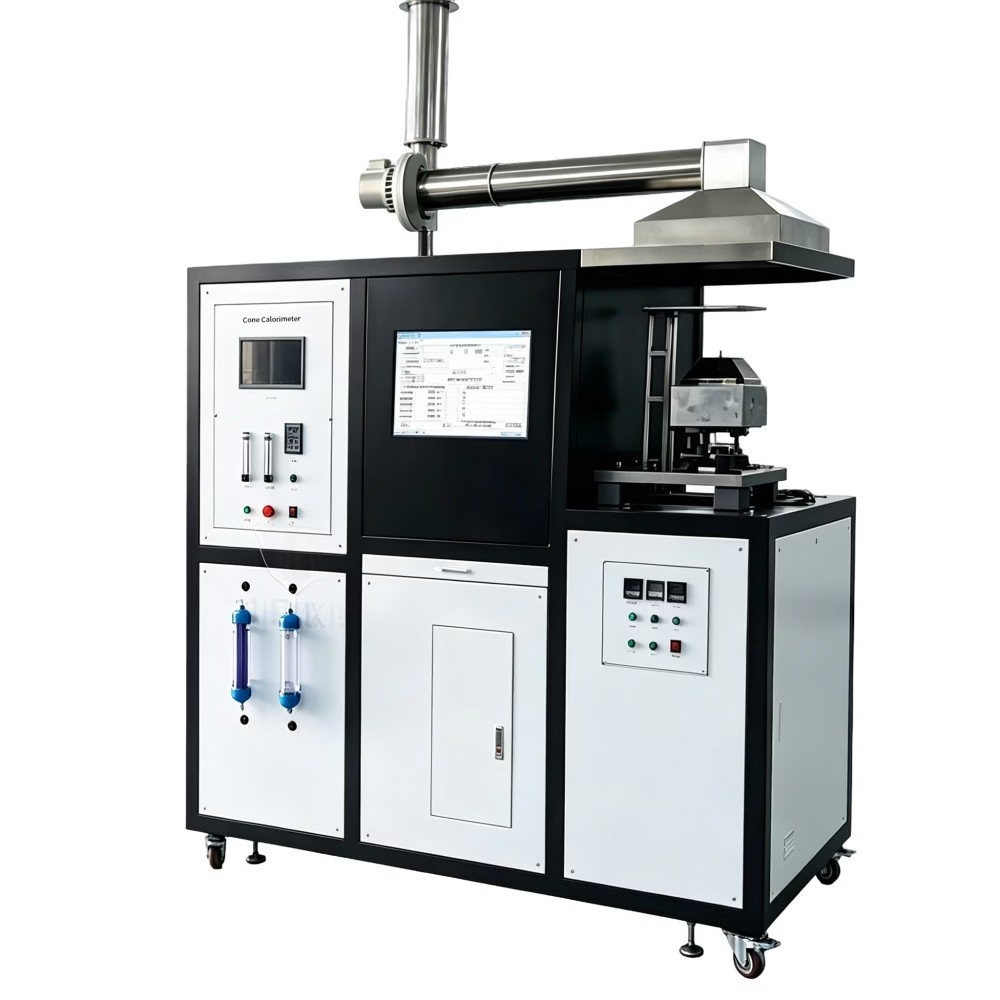
A cone calorimeter test is only as defensible as the calibration behind it, so the equipment decision is really a decision about the gas analysis train, the heat flux meter and the documentation that comes with them. Three items deserve specific scrutiny before any purchase order: the oxygen analyser type and its response time, because it drives every heat release value; the heat flux meter and its calibration chain, because it sets the irradiance the specimen actually sees; and the balance, because mass loss underpins two of the nine outputs. Ask for all three as written specifications with traceability, not as marketing bullets.
| 设备 | 用途 | 适用 |
|---|---|---|
| 锥形量热仪 | OIN 5660-1 全套输出 | 材料热释放与产烟研究 |
| 建材燃烧热值试验仪 | OIN 1716 总燃烧热 | 与 EHC 对照判断燃烧完全程度 [10] |
| 烟气毒性试验装置 | 燃烧气体毒性 | 与 CO 产率配套 |
| SBI 试验装置 | DANS 13823 | 欧盟制品分级路线 |
| 建筑材料不燃性试验装置 | OIN 1182 | A1/A2 级路线 11 |
For the clause-by-clause apparatus requirements, calibration evidence and procurement checks, see our detailed guide to the OIN 5660 calorimètre à cône.
Foire aux questions
What does a cone calorimeter measure?
It measures heat release rate and its peak, dégagement de chaleur total, temps d'allumage, mass loss, chaleur de combustion efficace, smoke production and specific extinction area, plus carbon monoxide and carbon dioxide yields. Heat release is derived from oxygen consumption, not measured as temperature rise.
What is the cone calorimeter specimen size?
The specimen is a flat plate, 100 mm by 100 mm, held horizontally under a conical radiant heater with the exposed area defined by a holder. The word “cone” refers to the shape of the heater, not to the shape of the specimen.
What is the difference between heat release rate and total heat release?
Heat release rate is the instantaneous rate, in kilowatts per square metre, and describes how fierce the burning is at a moment. Total heat release is the integral of that curve and describes how much energy the specimen contained.
What irradiance level should I use?
Use the level your target framework prescribes, or a level already used in the literature you want to compare against, and state it in the report. OIN 5660-1 permits 0–75 kW/m², and results at different levels are not comparable.
Is a cone calorimeter result a fire classification?
Non. The instrument produces measured data. A classification is issued under a classification standard by the body authorised to do so, using the designated test programme for the product and market in question.
What is MARHE?
MARHE is the maximum average rate of heat emission, a value calculated from the heat release curve rather than read from a sensor. It is used as the criterion in the European railway fire standard, evaluated against thresholds that depend on hazard level, and taken as the mean of three specimens.
Does a cone calorimeter measure flame spread?
Non. It is a bench-scale test on a small horizontal specimen under a radiant heater, and it does not measure how far a flame travels across a surface. Flame spread is assessed by other methods, including lateral flame spread tests and the Single Burning Item test.
Conclusion: A Sequence for Using Cone Calorimeter Data
The value of a cone calorimeter test comes from treating it as nine correlated measurements rather than one headline number. A formulation that lowers peak heat release but shortens ignition time has not obviously improved anything; one that cuts total heat release while raising carbon monoxide yield has traded one hazard for another. Read the set, against the flux you chose, and against the framework you are answering to.
- Decide what question you are answering — material screening, formulation comparison, or input to a named framework.
- Fix the irradiance from that answer, and record it.
- Run at least three replicates; treat the peak as a distribution, not a number.
- Report the derived quantities you actually need, with units and flux stated.
- Hand the data to the classification route; do not present it as a class.
- Where combustion completeness matters, pair the run with a gross heat of combustion measurement.
BRT Testing supplies calorimètres à cône construit selon ISO 5660-1, together with the gas analysis, calibration and commissioning documentation that makes the data defensible. Send us your target framework and product construction, and we will specify the configuration and the acceptance checks in writing.
Shenyang Baoruitong Automation Equipment Co., Ltée.
BRT Testing manufactures fire testing and spectroscopic instruments in Shenyang, Chine, including cone calorimeters, Single Burning Item apparatus, non-combustibility furnaces, gross heat of combustion testers and smoke toxicity equipment. Our technical team supports method selection, installation, calibration and operator training for laboratories working to ISO, DANS, ASTM and GB frameworks.
Sources
- Normes iTeh — ISO 5660-1:2015
- UNI Ente Italiano di Normazione — ISO 5660-1:2015
- ASTM International — E1354-23 Standard Test Method for Heat and Visible Smoke Release Rates for Materials and Products Using an Oxygen Consumption Calorimeter
- NFPA — NFPA 271
- NIST — Cone Calorimeter Evaluation of the Flammability of Composite Materials
- Fire Testing Technology — EN 45545-2 in the EU railway industry
- CURRENTA — EN 45545-2 heat release testing to ISO 5660-1 (technical note)
- SAMR (Chine) — GB/T 16172-2026 standard record
- UNI Ente Italiano di Normazione — ISO 13943:2017
- UNI Ente Italiano di Normazione — ISO 1716:2018
- UNI Ente Italiano di Normazione — ISO 1182:2020