La réponse courte
Fire resistance testing for concrete is less about whether the material burns — it does not — and more about whether the element keeps its load, its separation and its shape for the required time. The test is run to EN 1363-1, which supplies the furnace, the heating regime, the instrumentation and the failure criteria 1, on the ISO 834-1 time-temperature curve 2. The element standard then decides the specimen: slabs and roofs go to EN 1365-2 3, columns to EN 1365-4 4, loadbearing walls to EN 1365-1 9. Three criteria are judged — R. pour la capacité portante, E for integrity and je for insulation — and the result is expressed in minutes. What makes concrete unusual is that the decisive events are often invisible from outside: explosive spalling can remove cover in minutes, and a section that looks intact can fail R on rate of deflection while its unexposed face is still cool.
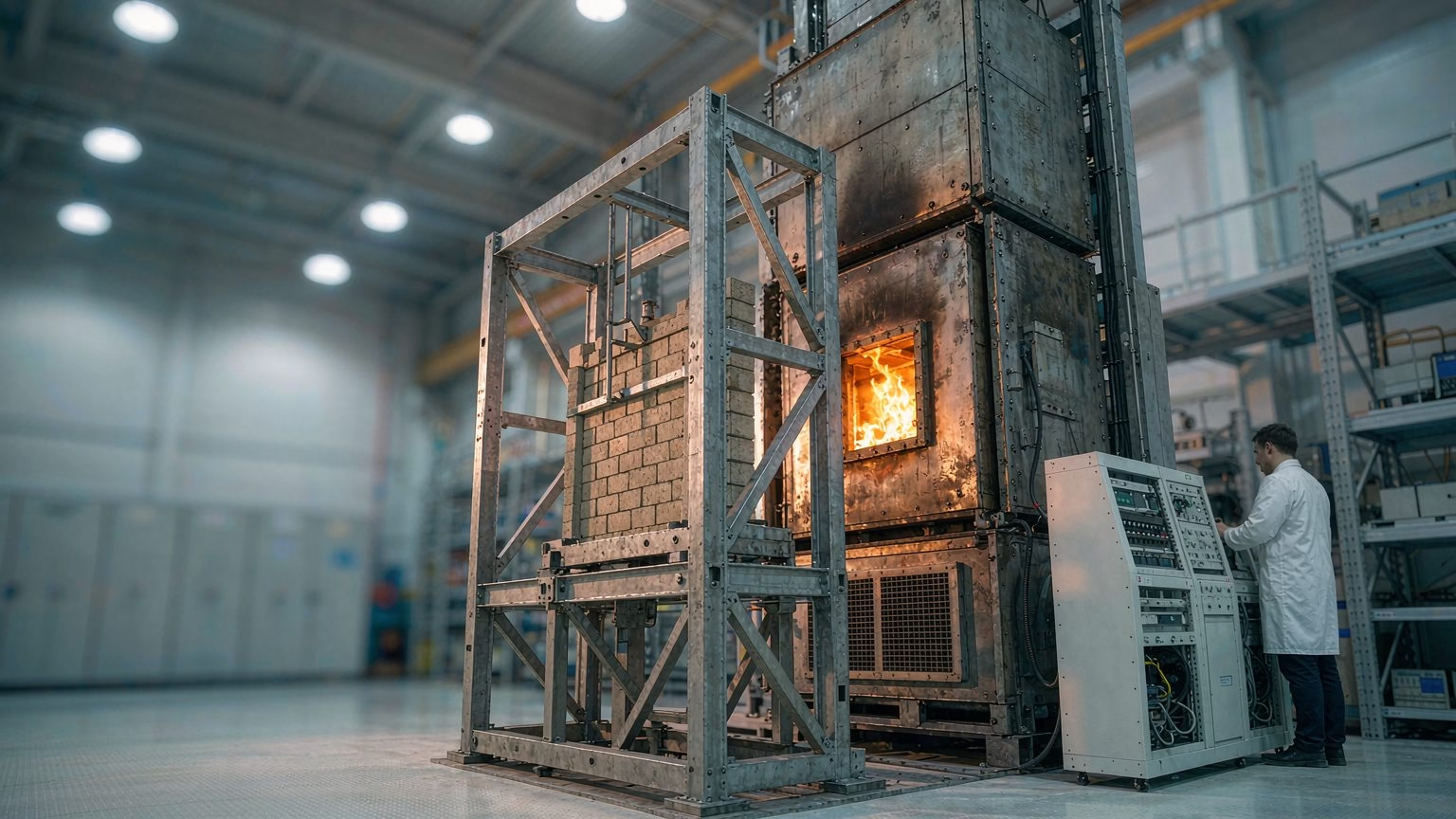
Why Concrete Behaves Differently in a Furnace
Concrete is a poor conductor with a lot of thermal mass, and that single property explains most of its fire behaviour. Heat penetrates slowly, so the core of a section stays cool long after the surface has reached several hundred degrees.
That is good for the steel inside, which is protected by whatever cover sits between it and the fire. It is also why the fire performance of a concrete element is largely a geometry question — cover depth and section size do most of the work, and the mix design does the rest.
Thermal mass and the slow temperature rise
In a standard furnace run, un 200 mm slab will show a steep temperature gradient through its thickness for the whole exposure. The exposed face may be at 900 °C while the unexposed face has risen by only a few kelvin, which is why the insulation criterion is rarely the governing one for thick sections.
Thin sections are a different story. UN 60 mm cement-based board or a thin precast panel can heat through quickly, and then the insulation criterion starts to bite.
Cover depth is the real fire protection
Reinforcement loses a large part of its strength at elevated temperature, and the design assumption is that the steel stays below a critical temperature for the required period. Cover depth, not concrete strength, is what buys that time.
This is why a fire test on a concrete element is also a test of its detailing. A specimen with the specified cover and the specified bar spacing will behave differently from one built with cover reduced to fit a congested cage, and the test report only covers what was built.
Fire Resistance Testing for Concrete: Which Standard Applies
The method standards and the element standards are separate documents, and using the wrong one is the most common submission error in the category.
The element routes
| Élément | Test standard | Criteria normally claimed |
|---|---|---|
| Sols, roofs and flat slabs | DANS 1365-2 | R., E, je |
| Columns | DANS 1365-4 | R only |
| Murs porteurs | DANS 1365-1 | R., E, je |
| Non-loadbearing partitions (concrete panels) | DANS 1364-1 | E, je |
| Beams | DANS 1365-3 | R. |
A column is tested for R alone because it separates nothing. A floor slab claims all three because it carries load, separates two compartments and must not let heat through. Getting the criteria set right at the quotation stage saves a re-test later.
The heating curve and what it does to a section
The ISO 834-1 curve is defined by an equation, not a table, and the values below are computed from it rather than copied from a secondary source [2].
| Exposure time | Furnace temperature |
|---|---|
| 5 min | 576 °C |
| 30 min | 842 °C |
| 60 min | 945 °C |
| 90 min | 1,006 °C |
| 120 min | 1,049 °C |
The derivation of the curve, and how the element standards apply it, is set out in our OIN 834 temperature-time curve guide.
The curve rises steeply in the first minutes and then flattens. For concrete this shape is significant: most of the thermal shock, and therefore most of the spalling risk, occurs in the first ten to twenty minutes, while the long plateau does the work of driving heat through the section.
Spalling in Fire Resistance Testing for Concrete: The Failure Mode That Decides the Result
Explosive spalling is the sudden loss of chunks of concrete from the heated face, sometimes with a report like a gunshot. It matters because it removes cover, exposes reinforcement directly to the fire and reduces the section that is carrying load.
What drives it
Two mechanisms act together. Water in the pore system turns to steam faster than it can escape through a dense matrix, so pore pressure builds behind the heated face. At the same time the surface layer wants to expand while the cooler core restrains it, producing tensile stress near the surface.
Dense, high-strength mixes are the most vulnerable, which is counter-intuitive: the stronger the concrete, the less permeable it tends to be, and the less easily steam escapes. Silica fume and low water-binder ratios make the effect worse.
What reduces it
The most widely used mitigation is a polypropylene fibre addition. The fibres melt at a low temperature and leave a network of channels that lets vapour escape, dropping the pore pressure before it can spall the surface.
Moisture control matters as much as the mix. A specimen that has been drying for months behaves very differently from one tested soon after casting, which is why the conditioning of the specimen has to be defined in the test plan and reported with the result.
Cover depth, bar spacing and the presence of a sacrificial layer all change the outcome too. None of these is captured by a single number in a datasheet.
Reading R, E and I on a Concrete Specimen
The three criteria are judged with different instruments, and each can govern the classification independently.
R.: loadbearing capacity and rate of deflection
R is judged by whether the specimen continues to carry its applied load. For flexural elements the practical indicator is deflection: once the mid-span deflection exceeds a defined fraction of the span, the rate of deflection has to stay below a limit set in EN 1363-1 [1].
A slab can therefore fail R while still looking intact and while its unexposed face is well within the insulation limits. This is the failure mode that surprises owners most often, because nothing visible has happened.
E: intégrité
Integrity is about whether flames or hot gases pass through. For a solid concrete element E rarely governs; it becomes relevant at joints, at penetrations and in thin panels where cracking can open a path.
je: insulation
The insulation criterion uses temperature rise on the unexposed face: a mean rise limit and a higher maximum limit at any single point. Thick sections pass easily; thin sections and boards are where the criterion decides the classification.
Design Side: DANS 1992-1-2:2023 Replaced the 2004 Edition
The design code that predicts fire performance has changed, and a lot of project documentation still points at the old one. DANS 1992-1-2:2023 est actuel, in force since 22 November 2023; le 2004 edition was withdrawn on the same date 5 6.
That matters for anyone preparing a test programme, because the test is often designed to validate a calculation. If the calculation follows a superseded edition, the test may be verifying the wrong prediction.
The three design routes
The code offers three approaches to a fire-exposed concrete section, and they differ in effort and in accuracy.
| Route | What it does | Where it breaks down |
|---|---|---|
| Tabular data | Minimum dimensions and cover for a given period, read by element type | Any spalling event, because the tables assume the cover is still there |
| 500 °C isotherm method | Treats concrete above 500 °C as lost and keeps ambient strength below it | Sections with steep gradients, and thin elements |
| Zone method | Calculates the actual temperature distribution through the section | Needs a reliable thermal model and more engineering time |
The tabular route is what most specifications implicitly assume, and it is the one a spalling event invalidates most directly.
What the second generation changed
Le 2023 edition is part of the second-generation Eurocode set, and its national annexes are being redrawn across Europe. For a manufacturer or a testing laboratory the practical consequences are procedural: check which edition a project’s national annex references, and state the edition in the test plan and in the report.
A test report that cites “EN 1992-1-2” without an edition is now ambiguous, in a way it was not in 2022.
Cement-Based Boards, Mortars and Renders
Cement products that are not structural concrete follow a different path, and conflating the two is a frequent source of confusion in submittals.
A cement-based board used as a lining is usually assessed as part of an assembly — the board plus its substrate plus its fixings — and the classification belongs to that assembly. A render or a spray-applied mortar may be assessed as a fire protection material applied to a substrate, in which case the relevant programme is about thickness and adhesion rather than about the board’s own combustibility.
For reaction to fire, cement boards sit in the top classes because of their chemistry, and that result is a separate classification from the fire resistance of the assembly they form part of.
Fire Resistance Testing for Concrete: Specimen Preparation and Instrumentation
Most disputed concrete results trace back to the specimen rather than to the furnace.
| Item | What the test plan should fix | Why it changes the result |
|---|---|---|
| Moisture condition | Age at test and drying regime | Wet concrete spalls; dry concrete usually does not |
| Cover and bar arrangement | Cover to the specified value, with the specified spacing | Cover is the insulation for the steel |
| Thermocouple positions | Depth and location of internal couples | The reported temperatures are only as good as their placement |
| Load level | The design load, applied before heating | R is judged against the applied load, not against a nominal one |
| Support conditions | Restraint and end conditions | Restraint changes deflection and cracking |
| Fibre content | Type and dose, if spalling mitigation is claimed | The claim applies only to the tested mix |
The moisture item is the one that decides outcomes most often. Two nominally identical slabs, one tested at 28 days and one after six months of drying, can produce different classifications, and neither result is wrong.
North America and Tunnels: Two Other Curves
The ISO 834-1 curve is not the only exposure a concrete element may have to survive.
Concrete is only one of the loadbearing materials tested this way; notre steel structure fire resistance guide covers the steel route.
In North America, ASTM E119 supplies a comparable time-temperature exposure, and many assemblies are also subjected to a hose stream after the fire exposure 7. A concrete element that passes the furnace phase can still be judged on what the stream does to it; notre ASTM E119 explainer sets out how the North American exposure differs.
For tunnels and for hydrocarbon risks, DANS 1363-2 provides alternative heating regimes, including a hydrocarbon curve that reaches high temperatures far faster than the cellulosic curve 8. Concrete in a tunnel fire is exposed to a much steeper thermal shock, which is exactly the condition that produces spalling, and the mitigation measures that work for a building fire may not be enough.
Equipment for Fire Resistance Testing for Concrete
A concrete programme needs a furnace matched to the element, a loading system, and instrumentation that can survive the exposure.
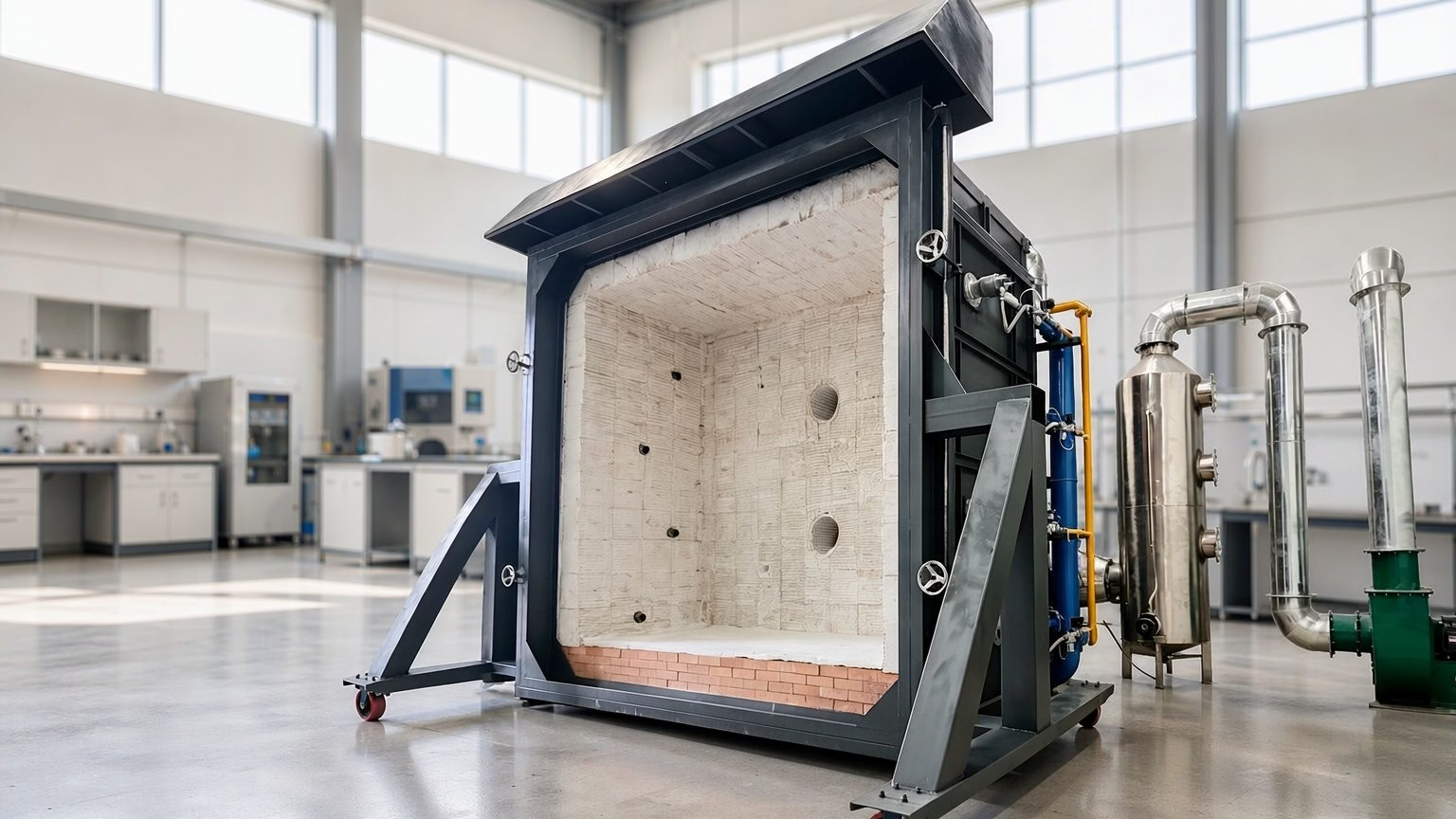
BRT Testing supplies the vertical integrated fire resistance test furnace for walls and columns and the horizontal fire resistance test furnace for slabs and floors, both configured to the EN 1363-1 instrumentation and control requirements. Le fire and flame testing equipment category covers the wider range, and our guide to what a fire resistance test furnace is sets out the hardware chain in more detail.
Foire aux questions
Does concrete need fire resistance testing if it cannot burn?
Oui. Fire resistance is not about whether the material burns; it is about whether the element keeps its load, its integrity and its insulation for the required period. Concrete loses strength at temperature, spalls under pore pressure, and its reinforcement heats through the cover. All three can produce a failure in a furnace even though nothing is flaming.
What is explosive spalling in a fire test?
It is the sudden loss of pieces of concrete from the heated face, driven by pore pressure and restrained thermal expansion. It can remove cover in minutes and expose reinforcement directly to the furnace. Dense, high-strength, low-permeability mixes are the most vulnerable, and polypropylene fibres are the most common mitigation because they melt and leave escape channels for vapour.
Which standard applies to a concrete slab?
DANS 1365-2 covers floors, roofs and flat slabs and is read together with EN 1363-1 for the furnace, instrumentation and criteria. A slab normally claims R, E et moi. In North America the equivalent programme is ASTM E119, which uses a comparable exposure and, for many assemblies, adds a hose stream after the fire phase.
How does cover depth affect the fire rating?
Cover is the insulation between the fire and the reinforcement. The design assumption is that the steel stays below a critical temperature for the rating period, and the thickness of concrete between the exposed face and the bar is what delays that rise. Reducing cover to fit a congested cage changes the fire performance even though the concrete itself is unchanged.
What changed in EN 1992-1-2:2023?
It replaced the 2004 edition, which was withdrawn on 22 November 2023. Le 2023 edition belongs to the second-generation Eurocode set, and its national annexes are being revised across Europe. In practice the change means a project must state which edition its national annex references, and a test report should name the edition it was designed against.
Can a cement board be classified on its own?
Usually not for fire resistance. A cement board is normally assessed as part of an assembly — board, substrate and fixings — and the classification belongs to that build-up. Reaction to fire is a separate classification about the board’s own contribution, and it does not tell you how long an assembly will hold.
Why do two identical slabs give different results?
Almost always because they were not identical where it counts: moisture content at test, cover, bar spacing, restraint or load level. Wet concrete spalls and dry concrete often does not, so the conditioning regime belongs in the test plan. A report that does not state the moisture condition cannot be compared with another report that does.
Conclusion: A Decision Order
- In fire resistance testing for concrete, identify the element and its criteria — R, E and I — before choosing a standard.
- Fix the specimen: mix, fibre content, cover, moisture condition and load level, all in writing.
- Decide the exposure: cellulosic to ISO 834-1, or an alternative curve for a tunnel or hydrocarbon risk.
- Prepare for spalling, because it is the failure mode that invalidates a design calculation fastest.
- Check which edition of EN 1992-1-2 the project’s national annex references, and state it in the report.
Talk to BRT Testing about a horizontal fire resistance test furnace for slabs or a vertical integrated furnace for columns and walls, ou entrer en contact with the element and rating you need to demonstrate.
About the Author
Written by the BRT Testing application engineering team in Shenyang, Chine. BRT Testing builds vertical and horizontal fire resistance test furnaces for construction element testing to EN 1363-1, DANS 1364, DANS 1365 and ASTM E119. Standard status was checked against the UNI store and the ASTM store on 2 November 2026.
Sources
- UNI — EN 1363-1:2020, Fire resistance tests, general requirements — https://webstore.uni.com/en/en-1363-1-2020
- UNI — ISO 834-1:2025, Fire-resistance tests, elements of building construction — https://webstore.uni.com/en/iso-834-1-2025
- UNI — EN 1365-2:2014, Fire resistance tests for loadbearing elements, floors and roofs — https://webstore.uni.com/en/en-1365-2-2014
- UNI — EN 1365-4:1999, Fire resistance tests for loadbearing elements, columns — https://webstore.uni.com/en/en-1365-4-1999
- UNI — EN 1992-1-2:2023, Design of concrete structures, structural fire design — https://webstore.uni.com/en/en-1992-1-2-2023
- UNI — EN 1992-1-2:2004, superseded edition, withdrawn 22 November 2023 — https://webstore.uni.com/en/en-1992-1-2-2004
- ASTM — E119, Fire Tests of Building Construction and Materials — https://store.astm.org/e119.html
- UNI — EN 1363-2:1999, Alternative and additional procedures — https://webstore.uni.com/en/en-1363-2-1999
- UNI — EN 1365-1:2012, Fire resistance tests for loadbearing elements, walls — https://webstore.uni.com/en/en-1365-1-2012