A resposta curta
ISO 834 fire resistance testing exposes a building element to a single, standardised temperature-time curve and measures how long the element survives before it fails one of three criteria. The curve is a cellulosic (ordinary combustibles) fire curve, written as one equation:
T = 20 + 345 log₁₀(8t + 1)
where T is the average furnace temperature in degrees Celsius and t is the time in minutes from the start of the test 1. The furnace is controlled so that its measured average temperature tracks that curve, and the element — a wall, a floor, a beam, a column or a door — is loaded and instrumented on one face while the other is exposed.
The failure criteria are three, and they are independent: R for loadbearing capacity, E for integrity, e I for insulation. An element is rated to the number of minutes it holds all the criteria it is required to hold. The single most important practical point in 2026 is that the edition changed: ISO 834-1:1999 was withdrawn on 30 May 2025, e ISO 834-1:2025, published the same day, is the current edition [1]2. Any test plan still citing the 1999 edition should be corrected before it is signed off.
Where the Curve Comes From
Why it is a convention rather than a physical law
The curve is not a physical law and it is not a measurement of any particular real fire. It is a convention, adopted so that two laboratories on different continents can produce comparable ratings for the same element. It rises steeply in the first minutes and then flattens, which is what a ventilation-controlled compartment fire was understood to do when the convention was set.
Understanding that it is a convention matters for two reasons. Primeiro, it means a rating in minutes is not a prediction of how long the element survives in an arbitrary fire — it is a statement about performance under this specific thermal insult. Segundo, it means the curve’s realism can be argued about without invalidating its use, which is exactly why alternative curves exist for applications where a cellulosic fire is the wrong model.
What the curve is not
The most common misuse of the ISO 834 curve is to read it as an ordinary-compartment fire and then design around it. It is not that. It has no ventilation term, no fuel load term, no compartment geometry term, and no cooling phase — it rises monotonically and never decays. A real compartment fire grows, peaks and decays, and the decay phase is exactly where many assemblies either recover or finally fail.
It is also not a hydrocarbon curve. Where the fire load is dominated by liquid or gaseous fuels — petrochemical, tunnel, or some marine and offshore applications — the temperature rise is faster and the specified curve is different. Choosing ISO 834 for those applications produces a rating that looks reassuring and models the wrong fire.
What the Curve Actually Produces
Substituting into the equation gives the values a furnace controller is chasing. These are computed from the equation, not quoted from a table:
| Time t (min) | 8t + 1 | log₁₀(8t + 1) | Furnace temperature T (°C) |
|---|---|---|---|
| 5 | 41 | 1.6128 | 576 |
| 10 | 81 | 1.9085 | 678 |
| 15 | 121 | 2.0828 | 738 |
| 30 | 241 | 2.3820 | 842 |
| 45 | 361 | 2.5575 | 902 |
| 60 | 481 | 2.6821 | 945 |
| 90 | 721 | 2.8579 | 1,006 |
| 120 | 961 | 2.9827 | 1,049 |
| 180 | 1,441 | 3.1584 | 1,110 |
| 240 | 1,921 | 3.2835 | 1,153 |
Three things are worth reading out of that table. The curve gains about 270 °C in the first five minutes and only about 100 °C between two and four hours, so the severity is front-loaded. The 60-minute value of roughly 945 °C is the figure most people quote from memory, and it is the number to sanity-check a controller log against. And the increments get small enough that beyond about three hours the test is increasingly about the element’s slow thermal response rather than about rising severity.
ISO 834 and ASTM E119 are not the same curve
ASTM E119, Standard Test Methods for Fire Tests of Building Construction and Materials 9, specifies its furnace control as a tabulated set of temperature-time points rather than an equation. The two curves sit close together but are not identical, and the differences are largest in the first ten minutes. The practical consequence is that an “hour” under one standard is not interchangeable with an “hour” under the other, and a report has to name the standard it was run to.
European practice reproduces the ISO 834 equation inside its own test method: EM 1363-1, Fire resistance tests — Part 1: General requirements 7, is the general requirements document, and EN 1363-2 covers alternative and additional procedures 8.
How the Furnace Is Controlled
Temperature control
Getting the average furnace temperature to follow the curve is the engineering problem. It is done with an array of sheathed thermocouples whose tips project into the furnace space, a set of burners whose fuel and air are modulated continuously, and a controller that compares the measured average against the target curve several times a minute and trims the firing rate to close the gap.
The thermocouple count and placement are specified by the standard rather than left to the manufacturer, and that matters because the “average furnace temperature” is literally the average of those readings. A probe that has drifted, or one that has been pushed back so its tip no longer projects into the furnace space, changes the number the controller is chasing and therefore changes the severity the specimen actually experiences. Routine verification of probe position and calibration is not optional maintenance; it is part of the test’s validity.
Pressure and exhaust
Two control variables matter beyond temperature itself. Furnace pressure matters because a furnace running at negative pressure draws cold laboratory air in and a furnace at excessive positive pressure leaks hot gas into the room; one furnace manufacturer’s description of the ISO 834-1 regime gives a positive pressure at the top of the furnace reaching 15 ± 5 Pa within five minutes of the start and holding 17 ± 3 Pa after ten minutes 10. Exhaust handling matters because the gas leaving the furnace is hot enough to damage ductwork, and a cooling stage before discharge is standard practice.
What an assessor will ask to see
The tolerances on how closely the measured average must track the target curve are set by the standard itself, and they are the first thing an accreditation assessor will ask to see documented. A laboratory should be able to produce a controller log showing measured versus target for the whole duration of every test, not just a pass statement. The same applies to the pressure record. In our experience the laboratories that struggle at assessment are not the ones with poor furnaces; they are the ones that never archived the trace.
The Three Criteria: R, E and I
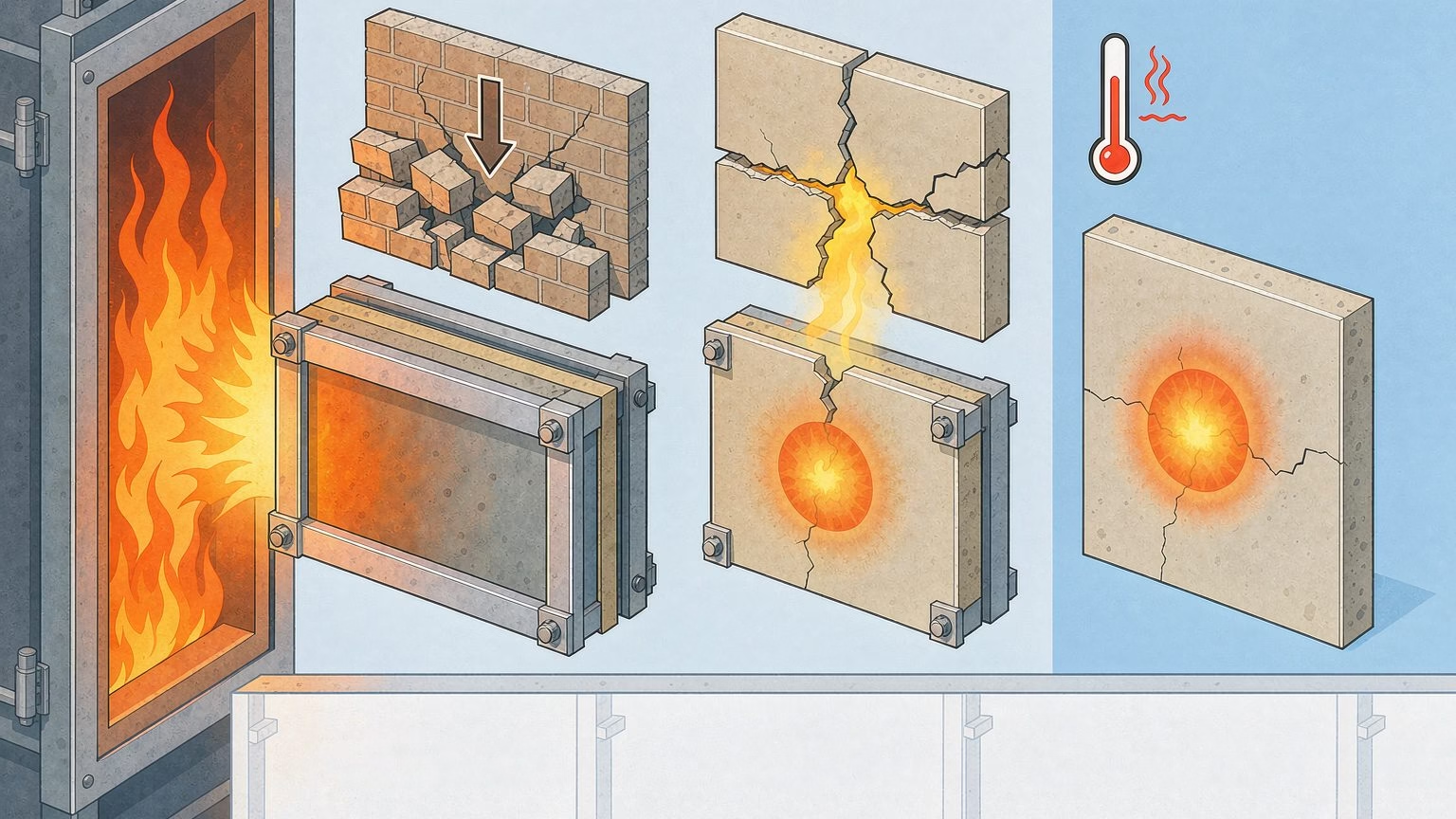
| Criterion | What it asks | Failure is taken as |
|---|---|---|
| R loadbearing capacity | Does the element still carry its load? | The element can no longer support the applied load; judged from deformation and rate of deformation |
| E integrity | Does the element still separate the two sides? | A cotton pad ignites on the unexposed face; um 6 mm gap gauge penetrates the specimen and can be moved 150 mm along a crack; um 25 mm gauge penetrates fully; flaming on the unexposed face persists longer than 10 é |
| I insulation | Does the element still stop heat passing through? | The mean temperature rise on the unexposed face exceeds 140 K above the initial mean, or the rise at any single point, including the moving thermocouple, exceeds 180 K |
Two features of that table decide most disputes. The insulation criterion is dual: it is failed by an average, and it is also failed by any single point, so an element with a cold average and one hot spot fails on the point. And the three criteria are independent, so a loadbearing wall that loses insulation at 60 minutes but keeps carrying load at 120 minutes has a 60-minute I rating and a 120-minute R rating, and both have to be reported.
O 140 K and 180 K figures are the conventional limits used across the European fire resistance methods, and EN 1363-1 is the document to cite for them [7].
Reading the insulation criterion in practice
The insulation criterion is the one that most often ends a test early, and it is the one most often misread. Because it is judged on both an average and a single point, the thermocouple layout on the unexposed face decides the outcome. A layout that misses a local hot area — a fixing point, a joint, a thinner section of the element — will report a comfortable average while the element is in fact conducting heat through that spot. This is why the standard specifies both fixed thermocouples at defined positions and a moving thermocouple used to search for the hottest region.
The corollary is that the rating is specific to the element as built and as tested. Change the fixing centres, change the joint detail, or change the board thickness, and the insulation performance can move substantially without any change to the material. A report that states a rating without stating what was built is not a report that can be reused.
A ISO 834 Série: Which Part Applies
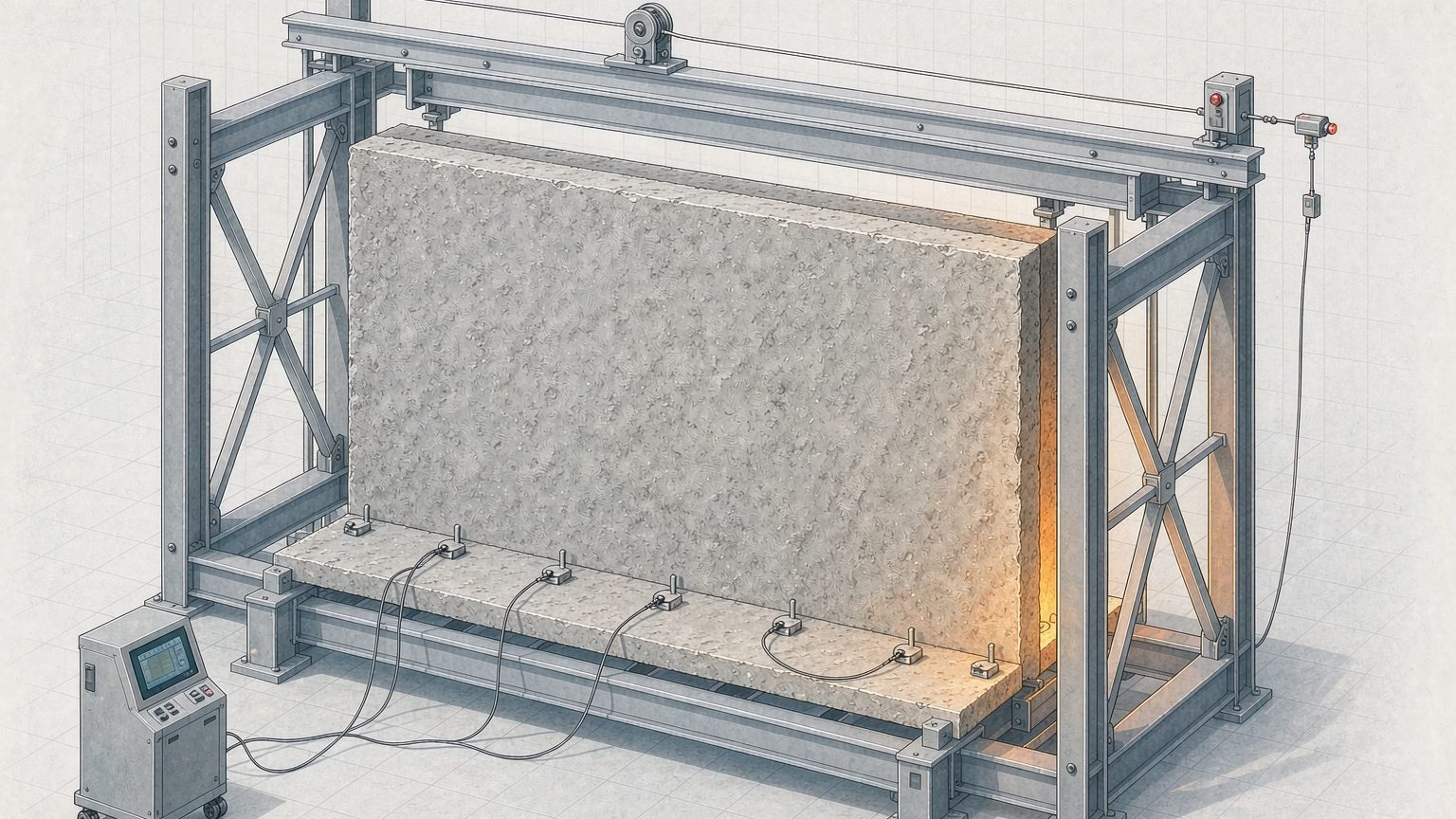
ISO 834-1 gives the general requirements [1]. The element-specific requirements sit in the later parts, and using Part 1 alone for a specific element type is a common error.
| Papel | Element covered | Reference |
|---|---|---|
| ISO 834-1 | General requirements | [1] |
| ISO 834-4 | Loadbearing vertical separating elements | 3 |
| ISO 834-5 | Loadbearing horizontal separating elements | 4 |
| ISO 834-8 | Non-loadbearing vertical separating elements | 5 |
| ISO 834-9 | Non-loadbearing ceiling elements | 6 |
A test programme for a loadbearing wall therefore cites Part 1 for the general apparatus and procedure and Part 4 for the element-specific requirements, and the report has to name both.
Why the edition change matters to a laboratory
ISO 834-1:1999 was the edition most laboratories built their procedures around, and it was withdrawn on 30 May 2025 [2]. ISO 834-1:2025 was published the same day [1]. For a working laboratory the practical task is a documentation one: find every place the 1999 edition is named — test procedures, report templates, quotation boilerplate, accreditation scope statements — and update the citation. The apparatus does not change because the edition changed, but a report citing a withdrawn standard is a report that will be queried.
We have not verified clause-by-clause what the 2025 edition changed, and this article does not claim to. Where a procedure depends on a specific clause, tolerance or criterion, confirm it against the 2025 text rather than against an inherited procedure document.
Specifying and Buying a Furnace
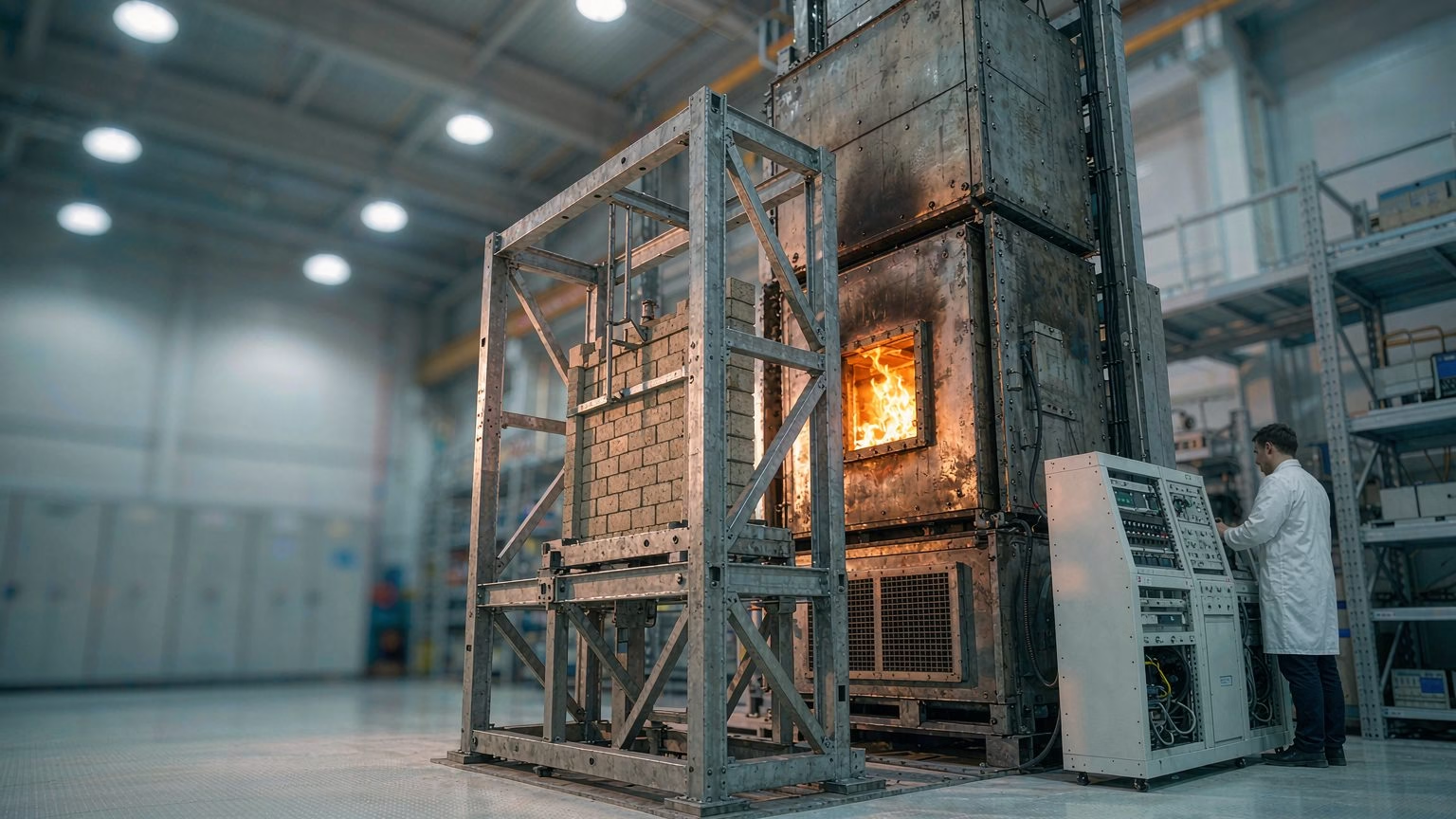
ISO 834 fire resistance testing is a furnace-bound method, so the apparatus decision is really an element decision. The geometry of the furnace follows the element, and this is the first purchasing decision. A vertical furnace takes walls, doors and other vertical separating elements; a horizontal furnace takes floors, beams and horizontal elements. Laboratories that test both need both, and the horizontal furnace is the more demanding purchase because the element has to be loaded in a way that reproduces its real support conditions.
| Requirement | BRT apparatus | Product page | Note |
|---|---|---|---|
| Walls, doors and vertical separating elements | Vertical Integrated Fire Resistance Test Furnace | /product/vertical-integrated-fire-resistance-test-furnace/ | ISO 834-1 with the vertical element parts |
| Floors, beams and horizontal elements | Forno horizontal de teste de resistência ao fogo | /product/horizontal-fire-resistance-test-furnace/ | ISO 834-5 and related parts |
| Coated steel sections | Forno de teste de revestimento retardador de fogo de aço | /product/steel-fire-retardant-coating-test-furnace/ | For intumescent coating assessment |
| Full range | Fogo & Equipamento de teste de chama | /fire-flame-testing-equipment/ | Category page |
For the wider context of how a fire resistance test is run end to end, see how fire resistance is tested for building materials; for steel specifically, see fire resistance testing for steel structures.
Common Mistakes
| Mistake | Consequence | Fix |
|---|---|---|
| Citing ISO 834-1:1999 | The edition was withdrawn on 30 May 2025 | Cite ISO 834-1:2025 |
| Using Part 1 without the element-specific part | Element-specific requirements missed | Name ISO 834-1 plus the relevant part on the report |
| Treating an ISO 834 hour as an ASTM E119 hour | Two different curves, not interchangeable | Name the standard on every rating |
| Reading the insulation criterion as an average only | A single hot spot is missed and the element is wrongly passed | Judge average and hottest single point |
| Reporting a single rating for R, E and I | The element’s real performance is misrepresented | Report each required criterion separately |
| No controller log of measured versus target | Accreditation assessor cannot verify curve tracking | Retain the log for the whole duration |
| Ignoring furnace pressure control | Cold air ingress, or hot gas leaking into the room | Control and record pressure from the start |
Perguntas frequentes
What is the equation for the ISO 834 temperature-time curve?
T = 20 + 345 log₁₀(8t + 1), where T is the average furnace temperature in degrees Celsius and t is the elapsed time in minutes from the start of the test. It gives roughly 842 °C at 30 minutos, 945 °C at 60 minutos, 1,006 °C at 90 minutes and 1,049 °C at 120 minutos.
Is ISO 834 the same as ASTM E119?
Não. ISO 834 specifies the curve as a single equation, while ASTM E119 specifies a tabulated set of temperature-time points. The two curves are close but not identical, with the largest differences in the first ten minutes, so a rating of one hour under one standard is not interchangeable with an hour under the other.
What do R, E and I mean in a fire resistance rating?
They are three independent criteria. R is loadbearing capacity, whether the element still carries its applied load. E is integrity, whether it still separates the two sides against flame and hot gas. I is insulation, whether it still limits heat passing through. An element is rated to the time it holds every criterion it is required to hold, and each is reported separately.
What temperature rise fails the insulation criterion?
The insulation criterion is failed when the mean temperature rise on the unexposed face exceeds 140 K above the initial mean temperature, or when the rise at any single point, including the moving thermocouple, exceeds 180 K. Because both the average and the hottest single point are judged, one local hot spot can fail the element even when the average looks acceptable.
Which edition of ISO 834-1 is current?
ISO 834-1:2025, published on 30 May 2025, is the current edition. ISO 834-1:1999 was withdrawn on the same day. Test plans and reports still citing the 1999 edition should be updated before they are signed off.
Do I need a vertical or a horizontal furnace?
It depends on the element. Vertical furnaces take walls, doors and other vertical separating elements; horizontal furnaces take floors, beams and horizontal elements. A laboratory that tests both categories needs both, because the horizontal furnace also has to reproduce the element’s real support conditions.
Why does the curve flatten out after the first hour?
Because the equation is logarithmic, so each additional minute adds less temperature than the one before. The curve gains roughly 270 °C in the first five minutes but only about 100 °C between two and four hours, which means the severity is heavily front-loaded and later failures are driven by the element’s slow thermal response.
Conclusão: How to Decide
- Confirm the edition — ISO 834-1:2025 is current and the 1999 edition was withdrawn on 30 May 2025.
- Identify the element type and name the right part of the series alongside Part 1.
- Decide which of R, E and I the element is required to hold, and report each separately rather than as one number.
- Choose furnace geometry from the element: vertical for walls and doors, horizontal for floors and beams.
- Require a controller log of measured versus target temperature, and a pressure record, for the full duration of every test.
- If the product is sold into North America as well, plan a separate ASTM E119 programme rather than assuming the ISO rating carries over.
BRT builds vertical and horizontal fire resistance test furnaces configured to the ISO 834 series. Send us the element types you need to test and the ratings you are targeting, and we will map that to a furnace, a control system and an installation plan. Start from the fire and flame testing equipment range, or read how to choose a fire testing laboratory equipment supplier if you are at the supplier-selection stage.
Sobre o autor. This article was prepared by the BRT combustion testing application team at Shenyang Baoruitong Automation Equipment, which manufactures fire testing and laboratory instrumentation for construction product, steel, transport and plastics laboratories. Edition dates and withdrawal dates were checked against ISO, CEN and ASTM catalogue entries on the dates given below. Curve values were computed from the equation in ISO 834-1.
Sources
- UNI Ente Italiano di Normazione — ISO 834-1:2025
- UNI Ente Italiano di Normazione — ISO 834-1:1999
- UNI Ente Italiano di Normazione — ISO 834-4:2000
- UNI Ente Italiano di Normazione — ISO 834-5:2000
- UNI Ente Italiano di Normazione — ISO 834-8:2002
- UNI Ente Italiano di Normazione — ISO 834-9:2003
- UNI Ente Italiano di Normazione — EN 1363-1:2020
- UNI Ente Italiano di Normazione — EN 1363-2:1999
- ASTM International — E119-24 Standard Test Methods for Fire Tests of Building Construction and Materials
- Torontech — Horizontal fire resistance furnace (manufacturer technical page)