- The Short Answer
- What IEC 60332 Does and Does Not Cover
- The Single Cable Route: IEC 60332-1
- The Small Cable Route: IEC 60332-2
- The Bunched Cable Route: IEC 60332-3
- Choosing the Right Route
- What an IEC 60332 Cable Flame Testing Report Has to Carry
- Putting IEC 60332 Into a Cable Specification
- Where Cable Flame Test Programmes Go Wrong
- Equipment for IEC 60332 Testing
- Frequently Asked Questions
- What does IEC 60332 actually test?
- Is a single-wire pass enough for a bunched installation?
- What is the difference between category A, B, C and D?
- Which IEC 60332-1-2 edition is current?
- When do I use IEC 60332-2 instead of IEC 60332-1?
- Does IEC 60332 cover smoke or halogen content?
- What changed in the 2018 editions of the 60332-3 series?
- Conclusion: A Decision Order
- Sources
The Short Answer
IEC 60332 cable flame testing measures one thing: how far a flame travels along a cable, not whether the cable keeps working. The series splits on installation geometry. A single insulated wire or cable is tested with a 1 kW pre-mixed flame under IEC 60332-1-2, whose current edition is edition 2.0 published on 10 June 2025 1. A small conductor that would melt under that flame is tested with the diffusion flame of IEC 60332-2-2 instead 2. Cables installed together as a bundle are tested on a vertical ladder under the IEC 60332-3 series, where the category — A, B, C or D — is set by how much non-metallic material is on the ladder and how long the burner runs 345. The most expensive mistake in this family is treating a single-wire pass as evidence for a bunched installation. IEC says explicitly that it is not [1].
What IEC 60332 Does and Does Not Cover
The series is titled Tests on electric and optical fibre cables under fire conditions, and every part is a flame propagation method. It is maintained by IEC technical committee TC 20 (Electric cables), and the parts are published as group safety publications under IEC Guide 104 [1][3].
Flame Propagation, Not Circuit Integrity
A cable that limits flame spread can still stop functioning within seconds of a fire starting. Circuit integrity under fire — the ability to keep carrying current or signal while burning — is a different question answered by the IEC 60331 series. Specifying 60332 where the project actually needs 60331 is routine and expensive to discover late. Our IEC 60331 cable fire resistance test explained article covers that route.
Flame Propagation, Not Material Flammability
There is a second boundary. IEC 60332 tests a cable, which is a product with a defined construction. The small-flame methods used for plastic materials and for components of equipment — the 50 W and 500 W tests that produce HB, V-0 and 5VA classifications — belong to the IEC 60695 series and are described in our practical guide to IEC 60695 flammability testing. A polymer rated V-0 does not automatically give a compliant cable, and a compliant cable does not tell you anything about the enclosure it is installed in.
The Single Cable Route: IEC 60332-1
| Part | What it specifies | Current status |
|---|---|---|
| IEC 60332-1-1 | Apparatus for the 1 kW pre-mixed flame | 2004 edition with Amendment 1:2015 consolidated [2] |
| IEC 60332-1-2 | Procedure for the 1 kW pre-mixed flame | Edition 2.0, published 10 June 2025 [1] |
| IEC 60332-1-3 | Procedure for determination of flaming droplets and particles | 2004 edition with Amendment 1:2015 consolidated [2] |
Why a Single-Wire Pass Does Not Cover a Bunched Installation
IEC 60332-1-2 sets the procedure for a single vertical insulated conductor, cable or optical fibre cable using a 1 kW pre-mixed flame, with the apparatus defined in IEC 60332-1-1 [1]. Two notes in the scope do most of the practical work. The first says the test can be run simultaneously with IEC 60332-1-3 when flaming droplets also need to be assessed. The second is the one that gets ignored: performing this test on a single insulated conductor or cable does not provide compliance with fire propagation requirements where that cable is installed with or amongst other cables as a group — that case belongs to the IEC 60332-3 series [1].
The 2025 edition matters for anyone holding an older report. It is edition 2.0 and it replaced the 2004 edition together with Amendment 1:2015, which was withdrawn on 10 June 2025 [1]6. Test reports and cable datasheets that cite IEC 60332-1-2:2004 should be re-checked against the current edition before they are accepted into a new specification.
The Small Cable Route: IEC 60332-2
Where the conductor is small enough that a 1 kW pre-mixed flame melts it before the test finishes, the IEC 60332-1 route cannot be used. IEC 60332-2-1 specifies the apparatus and IEC 60332-2-2 specifies the diffusion flame procedure for a single small insulated wire or cable [2]. The same logic applies to small optical fibre cables that would break before the test completes. In practice this part is the one most often omitted from a test programme, and then discovered to be the applicable one once the conductor cross-section is checked.
Why the Diffusion Flame Is Gentler
A pre-mixed flame delivers its heat fast and locally, which is exactly what makes it unsuitable for a conductor that will melt before the exposure ends. The diffusion flame of IEC 60332-2-2 spreads its energy differently, so the small specimen survives long enough for the propagation behaviour itself to be observed rather than for the test to be ended by a melted conductor [2]. The result is still a flame propagation result and is interpreted the same way — by the extent of damage — so it can be reported alongside a 60332-1 result without changing how the number is read. What it cannot do is stand in for a bunched-cable result; the same group-installation caveat applies.
The Bunched Cable Route: IEC 60332-3
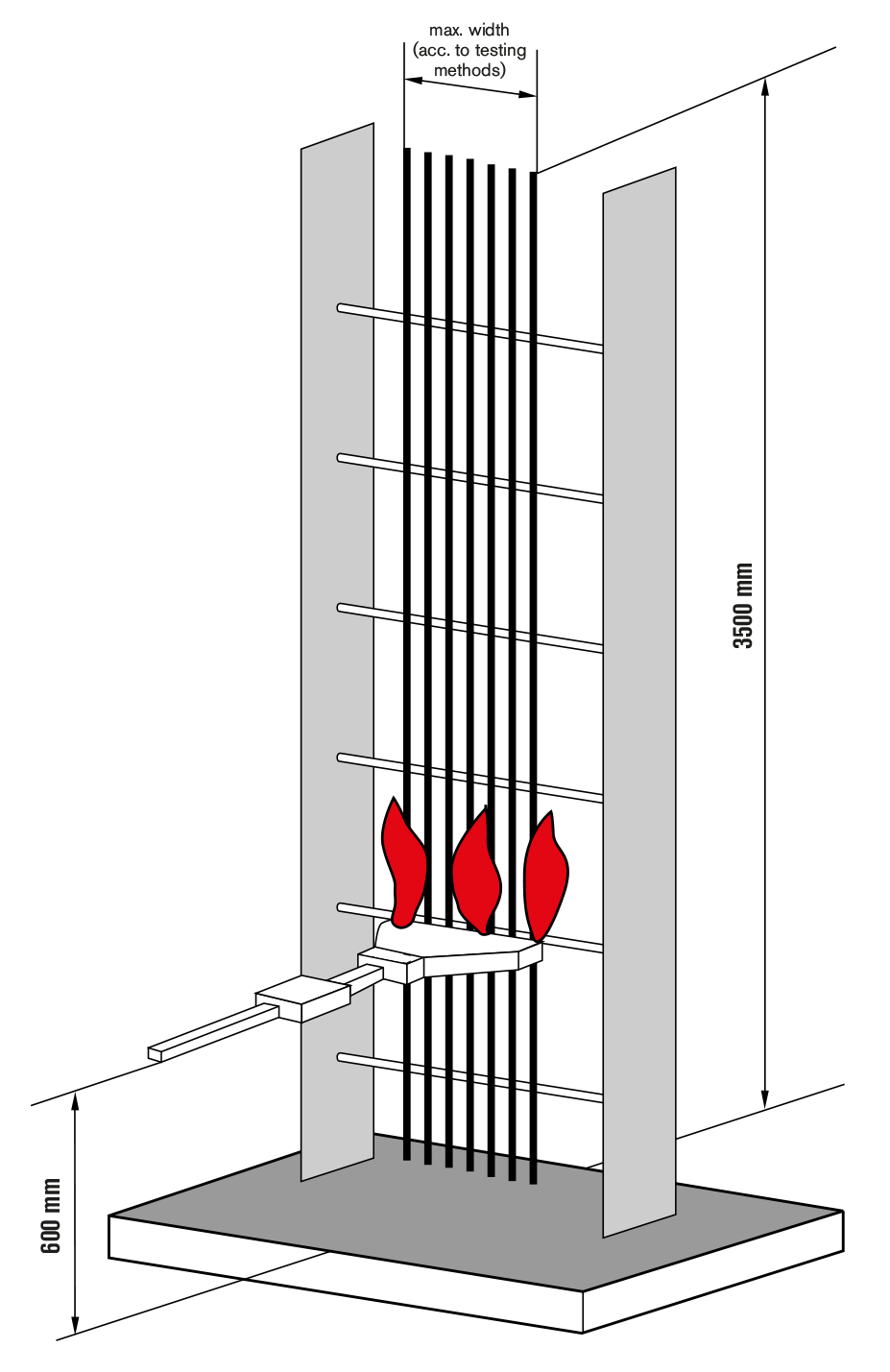
This is the part of the series that decides most cable specifications, because most cables are installed in groups. IEC 60332-3-10 specifies the apparatus: the ladder, the burner, the enclosure and the calibration [3]. The individual categories are set in separate parts, and the relevant current editions are all the 2018 second editions published on 13 July 2018 [3][4][5].
| Category | Part | Non-metallic volume on the ladder | Flame application time | Mounting | Intended use |
|---|---|---|---|---|---|
| A F/R | IEC 60332-3-21 | Category A F/R arrangement | Defined in the part | Per the part | Special cable constructions |
| A | IEC 60332-3-22 | 7 litres per metre of sample | 40 min | Front of the ladder; standard or wide ladder depending on conductor cross-section | High volumes of non-metallic material [4] |
| B | IEC 60332-3-23 | 3.5 litres per metre of sample | 40 min | Front of the standard ladder | Medium volumes [5] |
| C | IEC 60332-3-24 | 1.5 litres per metre of sample | 20 min | Front of the ladder | Low volumes, general use [5] |
| D | IEC 60332-3-25 | 0.5 litres per metre of sample | 20 min | Front of the standard ladder, touching formation only | Small cables of 12 mm overall diameter or smaller [5] |
Annex A and Annex B Do the Quiet Work
The category parts are short, and none of them repeats the same material twice. Annex A of a category part carries the requirements for selecting the cables to be tested: which sizes, which constructions and how many test pieces are needed before a result can represent a product family. Annex B carries the recommended performance requirement against which the measured damage is judged [4][5]. Together they answer both halves of the question a laboratory actually has — which samples go on the ladder, and what the result has to look like. They are also where most disputes between laboratories begin. Two labs can run the same ladder, the same burner and the same flame application time and still disagree, because they selected different cable sizes to represent the same family. Any test programme should therefore fix the selection rule in writing before the first specimen is mounted.
What Actually Gets Measured
The measured quantity is the extent of damage to the cable sample, expressed as the distance the flame has spread up the ladder [4]. The tests are intended for type approval, the parts give requirements for the selection of cables to be tested, and they carry a recommended performance requirement against which the measured damage is judged [4][5]. Nothing in this series reports a heat release rate, a smoke density or an acidity figure — those are separate cable fire tests outside IEC 60332, and treating a category C pass as evidence of low smoke is a different category of error.
The 2018 Revision Changed Three Things
The second editions published in 2018 are technical revisions, not reprints [3][4][5]. First, the titles and text were adjusted throughout to make explicit that the methods apply to optical fibre cables as well as metallic conductor types. Second, the way cables are mounted on the ladder was defined more precisely, specifically to improve repeatability and reproducibility between laboratories — which means pre-2018 and post-2018 results are not always comfortable to compare. Third, the connection of the venturi mixer to the burner was better defined in the apparatus part. Category D was added to cater for testing at very low non-metallic volumes, which is why it did not exist in the original 2000 series [5].
Choosing the Right Route
| Question | Answer | Route |
|---|---|---|
| Is the cable installed alone or with others? | With others | IEC 60332-3 [3] |
| Is the conductor under about 0.5 mm²? | Yes | IEC 60332-2-2 diffusion flame [2] |
| Do flaming droplets matter? | Yes | IEC 60332-1-3 alongside 60332-1-2 [1] |
| How much non-metallic material per metre? | 7 l/m → A, 3.5 l/m → B, 1.5 l/m → C, 0.5 l/m → D | IEC 60332-3-22 / -23 / -24 / -25 [4][5] |
| Does the cable have to keep working during fire? | Yes | IEC 60331 series, not 60332 |
What an IEC 60332 Cable Flame Testing Report Has to Carry
A report that only says “passed category C” is not a usable document, because the category is meaningless without the construction it was measured on. The report has to identify the cable construction in enough detail to be reproduced: conductor cross-section and material, insulation and sheathing compounds, overall diameter, and the number of test pieces actually mounted. It has to state the part and the edition tested against, so that a reader can tell whether the result predates the 2018 technical revision of the 60332-3 series or the 2025 edition of 60332-1-2 [1][3]. It has to record the mounting arrangement — front of the ladder, standard or wide ladder, touching or spaced formation — because that is what the 2018 revision tightened. And it has to report the measured extent of damage, not just a verdict, because the measured distance is what an engineer needs when a later design change is being judged.
The practical test is simple: hand the report to someone who has never seen the cable and ask whether they could rebuild the specimen. If they cannot, the report will not survive review, regardless of the pass line.
Putting IEC 60332 Into a Cable Specification
| Specification line | Why it belongs there | Consequence if omitted |
|---|---|---|
| Part and edition | Editions change the mounting rules and the scope | A pre-2018 result accepted as current [3] |
| Category, not “flame retardant” | Category is measurable; “flame retardant” is not | Unenforceable requirement |
| Installation volume in litres per metre | That number selects A, B, C or D | Wrong category chosen for the project [4][5] |
| Circuit integrity as a separate line | 60332 does not measure it | Cable passes and still fails in service |
| Smoke and gas as separate lines | 60332 measures neither | Compliance claimed on the wrong evidence |
The pattern behind all five lines is the same: IEC 60332 cable flame testing answers exactly one question, and a specification that lets it answer four will fail. Writing the part, the edition and the category onto the drawing is a few words of work and removes most of the arguments that otherwise surface during approval.
Where Cable Flame Test Programmes Go Wrong
| Pitfall | Why it happens | What to do instead |
|---|---|---|
| Citing a 60332-1-2 pass for a bunched installation | IEC states the single-cable test does not cover grouped installation | Test to the 60332-3 category that matches the installed volume [1] |
| Still writing IEC 60332-1-2:2004 into a spec | Edition 2.0 published 10 June 2025 replaced it | Cite edition 2.0 and re-check old reports [1][6] |
| Choosing category C because it is the shortest | Category follows installed non-metallic volume, not convenience | Calculate litres per metre first [4][5] |
| Assuming a 60332 pass covers smoke or acidity | The series measures flame spread only | Specify the separate smoke and gas tests as well |
| Using 60332 where the project needs circuit integrity | Different failure question entirely | Move to the IEC 60331 route |
| Ignoring the 2018 mounting definitions | Pre-2018 results may not reproduce | Re-test to the current edition [3] |
Equipment for IEC 60332 Testing
| Equipment | Used for | Product page |
|---|---|---|
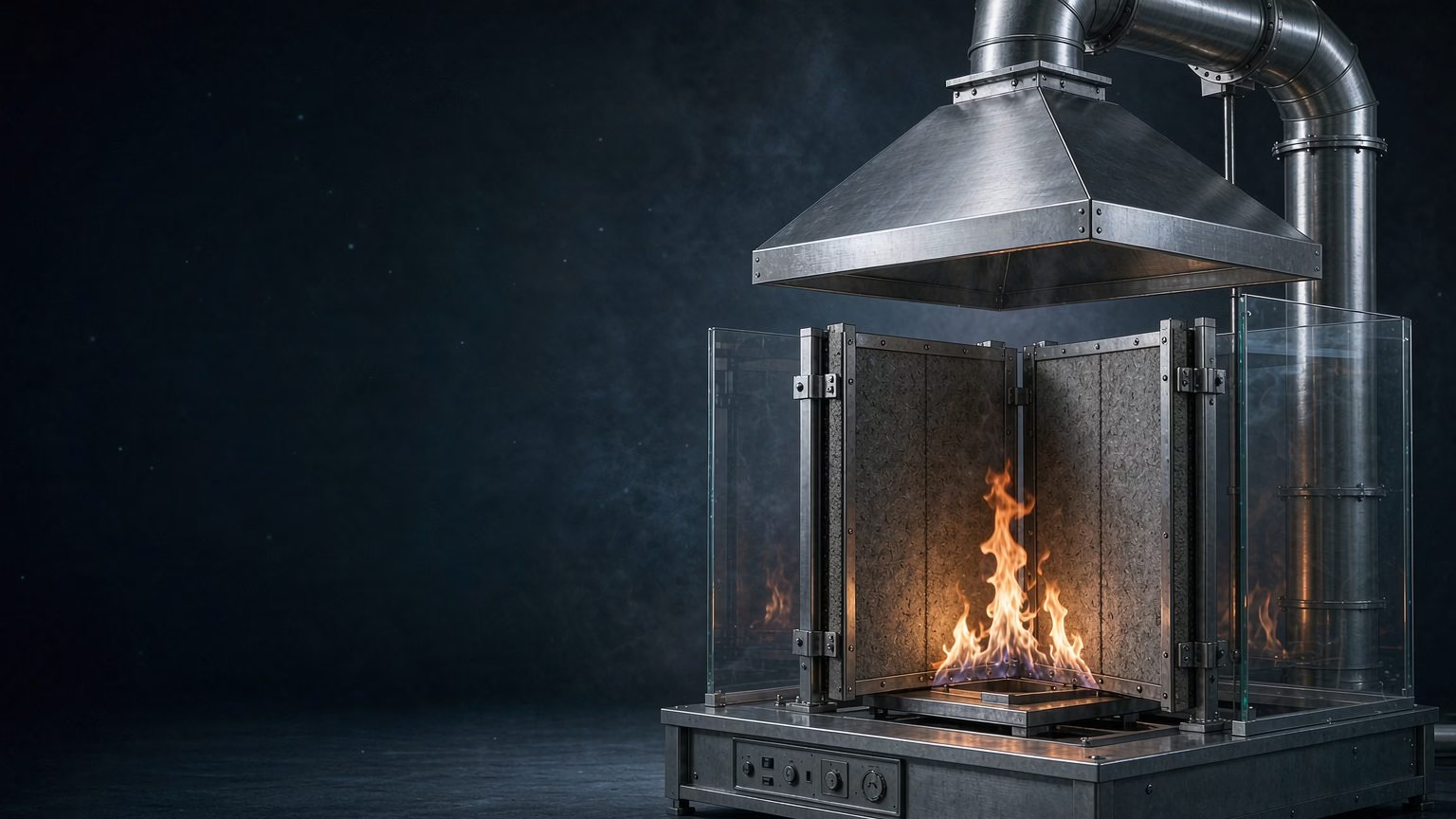
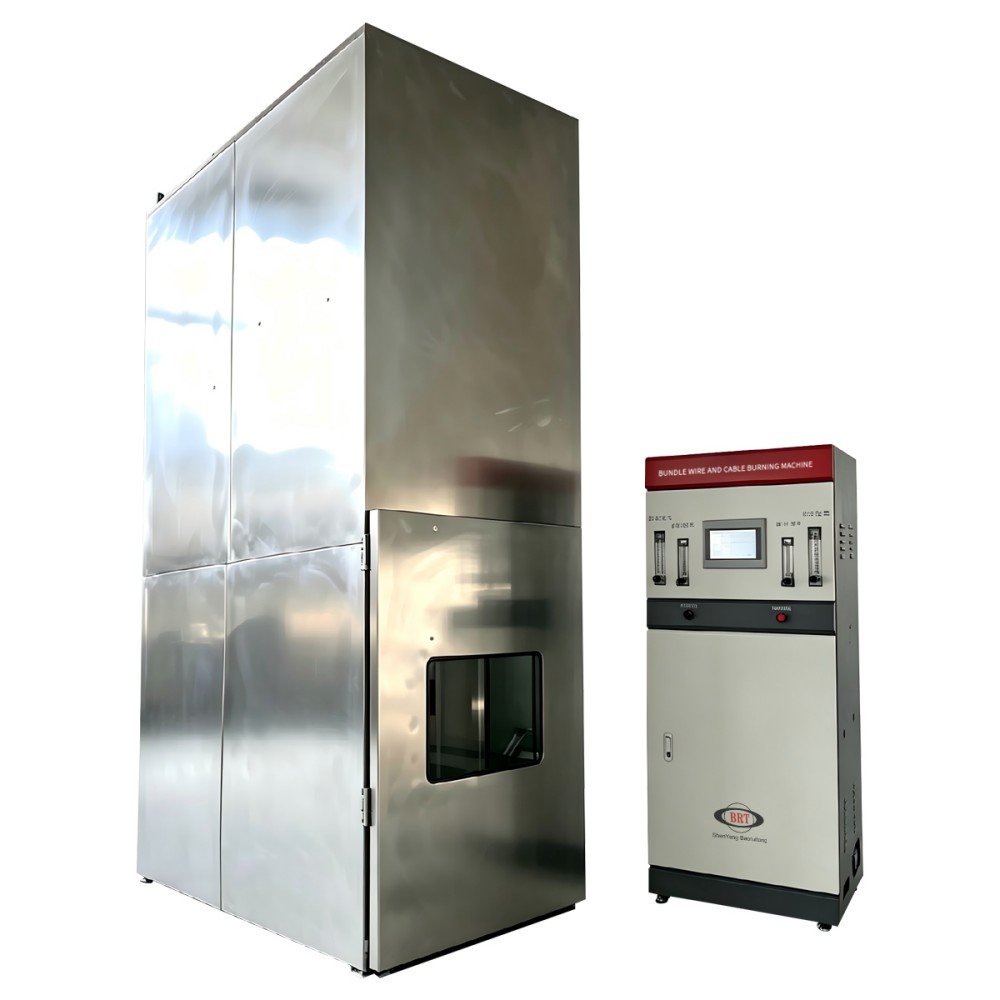
| Bundled cable vertical flame test equipment | IEC 60332-3-10 apparatus: ladder, burner, enclosure and calibration for categories A to D | Bundled cable vertical flame test equipment |
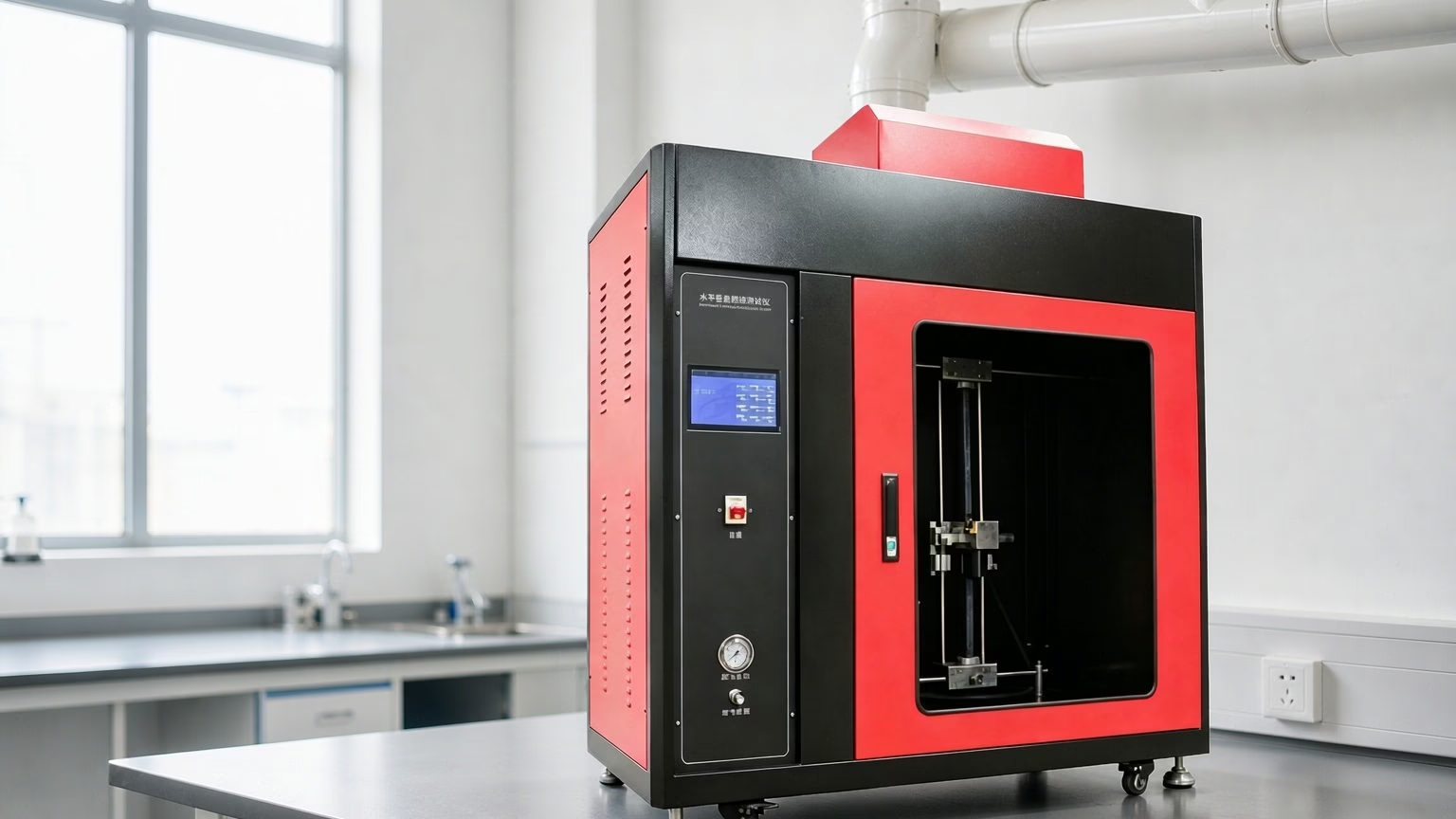
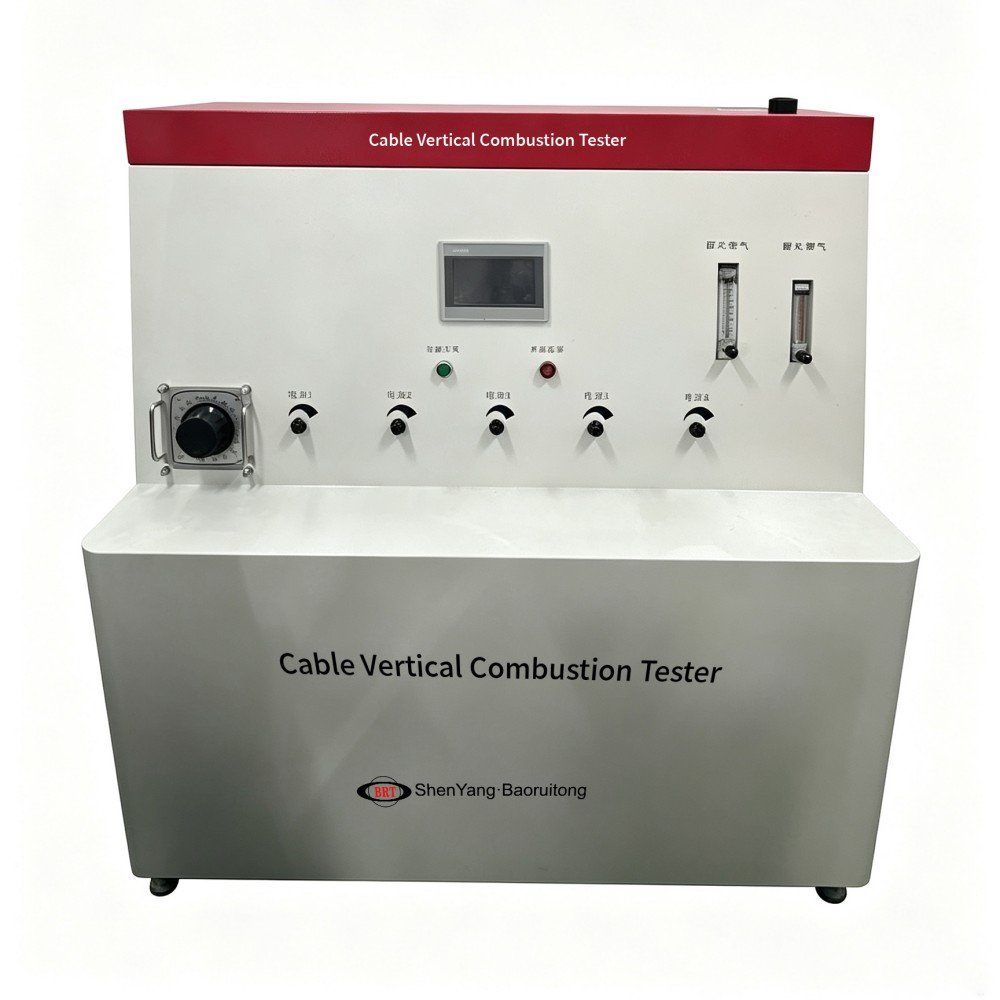
| Cable vertical combustion tester | Single-wire vertical flame propagation work and circuit-integrity screening on the same frame family | Cable fire resistance tester |
| Horizontal and vertical combustion tester | Small-flame methods on cable accessories and component plastics alongside the cable programme | Horizontal and vertical combustion tester |
A laboratory building a cable capability normally starts from the 60332-3 apparatus, because categories A to D are the ones that decide specifications, and adds a single-wire chamber for 60332-1 work. Where the same team also has to answer the enclosure question, see fire testing methods for electrical enclosures.
Frequently Asked Questions
What does IEC 60332 actually test?
It tests flame propagation along a cable. The measured result is the extent of damage, expressed as how far the flame spread up the specimen or up the test ladder. It does not test whether the cable keeps functioning, and it does not measure heat release, smoke density or gas acidity.
Is a single-wire pass enough for a bunched installation?
No. IEC 60332-1-2 states explicitly that passing the test on a single insulated conductor or cable does not provide compliance with fire propagation requirements where that cable is installed with or amongst other cables as a group. That case belongs to the IEC 60332-3 series.
What is the difference between category A, B, C and D?
They are defined by the volume of non-metallic material on the test ladder and the flame application time. Category A uses 7 litres per metre with a 40 minute flame, category B uses 3.5 litres per metre with 40 minutes, category C uses 1.5 litres per metre with 20 minutes, and category D uses 0.5 litres per metre with 20 minutes on small cables.
Which IEC 60332-1-2 edition is current?
Edition 2.0, published on 10 June 2025. It replaced the 2004 edition together with Amendment 1:2015, and those were withdrawn on 10 June 2025, so specifications still citing the 2004 edition should be updated.
When do I use IEC 60332-2 instead of IEC 60332-1?
When the conductor is too small for the 1 kW pre-mixed flame. If the conductor melts before the test is completed, or a small optical fibre cable breaks before it is completed, IEC 60332-2-2 specifies the diffusion flame procedure to use instead.
Does IEC 60332 cover smoke or halogen content?
No. IEC 60332 measures flame spread only. Smoke density and the acidity or halogen content of the combustion gases are separate cable fire tests outside this series, and a category rating must not be read as evidence about them.
What changed in the 2018 editions of the 60332-3 series?
The title and text were revised to make clear the methods apply to optical fibre cables as well as metallic conductors; cable mounting on the ladder was defined more precisely to improve repeatability; the venturi mixer connection to the burner was better defined; and category D was added for very low non-metallic volumes.
Conclusion: A Decision Order
- Start from the installation, not the datasheet. Cables installed as a group go to IEC 60332-3; a single wire goes to IEC 60332-1 [1][3].
- Check the conductor size first. Too small for a 1 kW flame means IEC 60332-2-2 [2].
- Calculate litres of non-metallic material per metre. That number, not convenience, sets category A, B, C or D [4][5].
- Cite the current edition. IEC 60332-1-2 edition 2.0 of 10 June 2025; IEC 60332-3 parts in their 2018 second editions [1][3].
- Do not let one test answer a different question. Circuit integrity is IEC 60331; smoke and gas are separate methods; component plastics are IEC 60695 [1].
- Write the part, the edition and the category onto the drawing. IEC 60332 cable flame testing answers one question well, and a specification that names all three removes most approval arguments before they start [1][3][4][5].
If you are specifying a cable capability, the ladder apparatus comes first and the single-wire chamber second, because the category result is the one that will be challenged in review.
Talk to BRT Testing about bundled cable vertical flame test equipment configured for IEC 60332-3-10 and categories A to D, or get in touch with your cable construction and target category.
Written by the BRT Testing application engineering team. BRT Testing manufactures fire and flame testing equipment for cables, construction products and plastics. Editions and publication dates in this article were verified against the IEC Webstore on 28 October 2026.
Sources
- International Electrotechnical Commission (IEC), TC 20 — IEC 60332-1-2:2025 (Edition 2.0, published 10 June 2025), Tests on electric and optical fibre cables under fire conditions — Part 1-2: Test for vertical flame propagation for a single insulated wire or cable — Procedure for 1 kW pre-mixed flame — https://webstore.iec.ch/en/publication/80873
- International Electrotechnical Commission (IEC), TC 20 — IEC 60332:2026 SER, Tests on electric and optical fibre cables under fire conditions — ALL PARTS — https://webstore.iec.ch/en/publication/62423
- International Electrotechnical Commission (IEC), TC 20 — IEC 60332-3-10:2018 (Edition 2.0, published 13 July 2018), … Part 3-10: Test for vertical flame spread of vertically-mounted bunched wires or cables — Apparatus — https://webstore.iec.ch/en/publication/33848
- International Electrotechnical Commission (IEC), TC 20 — IEC 60332-3-22:2018 (Edition 2.0, published 13 July 2018), … Part 3-22: … — Category A — https://webstore.iec.ch/en/publication/31166
- International Electrotechnical Commission (IEC), TC 20 — IEC 60332-3-25:2018 (Edition 2.0, published 13 July 2018), … Part 3-25: … — Category D — https://webstore.iec.ch/en/publication/32722
- International Electrotechnical Commission (IEC), TC 20 — IEC 60332-1-2:2004 (withdrawn 10 June 2025), … Part 1-2: … Procedure for 1 kW pre-mixed flame — https://webstore.iec.ch/en/publication/1475