The Short Answer
Electrical enclosure fire testing is not one test — it is a matrix, and the row is decided by the ignition scenario you are protecting against. Four scenarios cover almost every enclosure question. A small flame from outside is answered by the 50 W horizontal and vertical flame test in IEC 60695-11-10, which produces the familiar HB and V-0, V-1, V-2 classifications 1. A larger flame is answered by the 500 W method in IEC 60695-11-20, which adds a plaque burn-through check and yields 5VB and 5VA 2. An overheated internal connection is answered by the glow-wire family — IEC 60695-2-11 for finished parts, اللجنة الانتخابية المستقلة 60695-2-12 for the material flammability index and IEC 60695-2-13 for the ignition temperature 4567. A small flame from a fault condition inside the equipment is answered by the needle-flame test in IEC 60695-11-5 3. Start from the end-product standard, not from the material datasheet: the product standard names the test, the severity and the specimen, and the material rating is only evidence submitted into that test.
What Electrical Enclosure Fire Testing Actually Covers
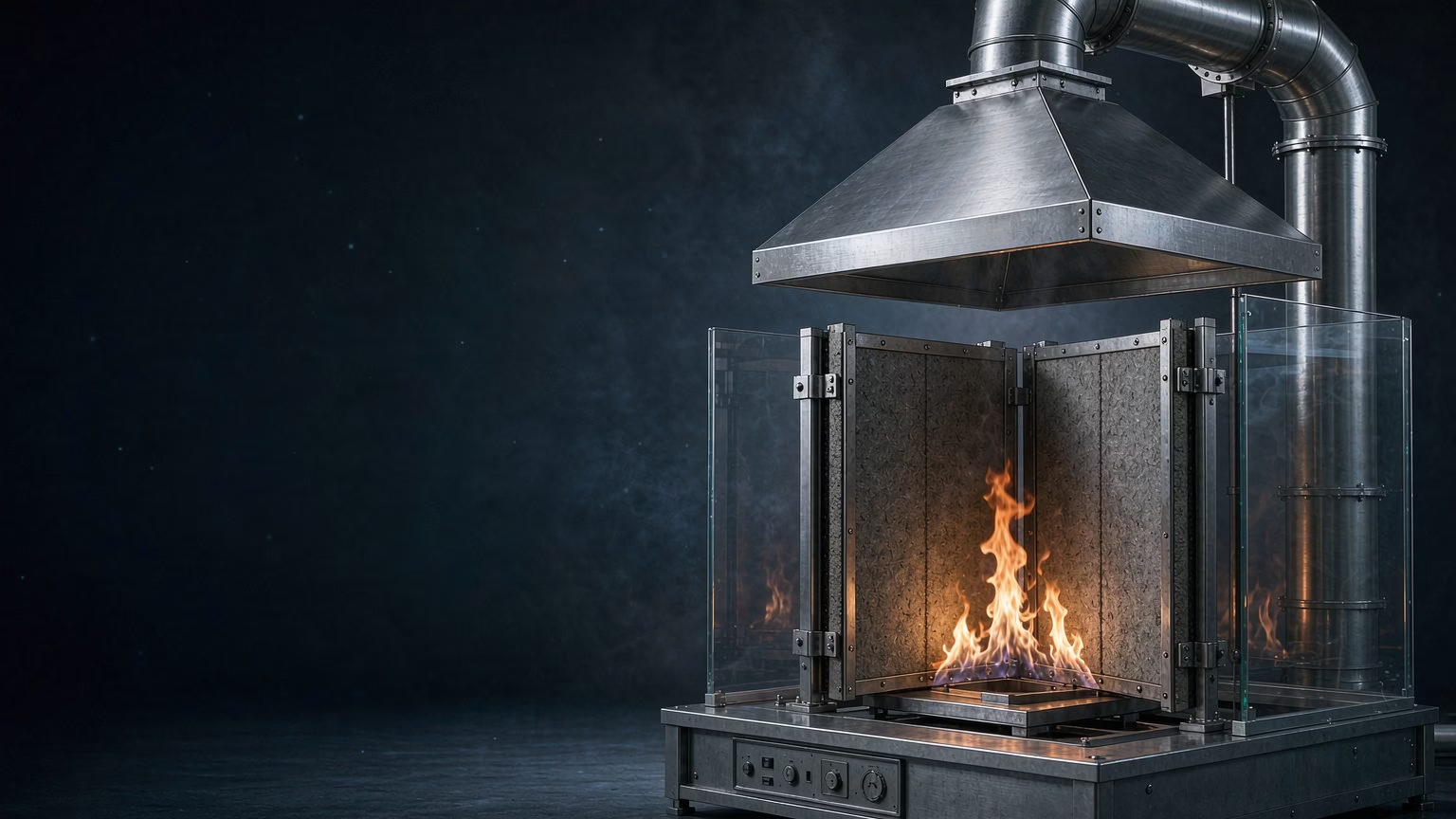
The reason enclosure testing feels complicated is that a single enclosure can be asked to resist four physically different events, and no one test models more than one of them.
| Ignition scenario | What it simulates | طريقة | معيار | What comes out |
|---|---|---|---|---|
| Small external flame | A nearby fire or a discarded match | 50 W horizontal and vertical flame | اللجنة الانتخابية المستقلة 60695-11-10 [1] | غ.ب, or V-0 / V-1 / V-2 |
| Large external flame | A developed fire against a barrier | 500 W vertical flame | اللجنة الانتخابية المستقلة 60695-11-20 [2] | 5VB, 5VA |
| Overheated internal connection | A glowing or hot wire inside the equipment | Glow-wire | اللجنة الانتخابية المستقلة 60695-2-11 / 2-12 / 2-13 [5][6][7] | Pass at temperature, GWFI, GWIT |
| Small flame from a fault | An arc or a failing component | Needle flame | اللجنة الانتخابية المستقلة 60695-11-5 [3] | Pass or fail |
Notice the split in the third column. Two of the four are material tests — they are run on standard bar or plaque specimens and produce a classification the material carries. The other two are finished-part tests — they are run on the enclosure itself, mounted in its normal position, and produce a pass or fail at a stated temperature or application time. Confusing the two is the single most common reason an enclosure submission comes back from a certifier.
Material-Level Flame Tests
ال 50 W horizontal and vertical flame test
اللجنة الانتخابية المستقلة 60695-11-10:2013 specifies small-scale laboratory procedures that compare the burning behaviour of materials used in electrotechnical products when vertically or horizontally oriented bar specimens are exposed to a small flame ignition source with a nominal thermal power of 50 W [1]. Two methods are published. Method A is the horizontal burning test and determines the linear burning rate. Method B is the vertical burning test and determines whether a material self-extinguishes. The scope is explicit about what is excluded: the methods apply to solid and cellular materials with an apparent density of more than 250 kg/m³ determined in accordance with ISO 845, so a low-density foam does not belong in this test [1]. The edition currently listed by IEC is 2.0, published 2013-05-21, with a stability date of 2028 [1].
In the UL system the same 50 W experiment produces the V-0, V-1 and V-2 classifications, and we set the criteria out in our guide to UL 94 غ.ب, V-0, V-1 and V-2. The flame itself is a calibrated artefact: IEC publishes the 50 W flame specification and its confirming test separately as IEC 60695-11-3 8.
ال 500 W flame test
Where an enclosure wall has to keep acting as a barrier rather than merely stop burning, ال 500 W method applies. اللجنة الانتخابية المستقلة 60695-11-20 is the IEC publication of that method, with the current consolidated text being the 1999 edition together with amendment 1 of 2003 [2], و 500 W flame itself is specified with its confirming test in IEC 60695-11-4 9. The practical difference from the 50 W test is the addition of plaque specimens judged on burn-through, which is what separates 5VA from 5VB. We cover the whole 500 W series in أول 94 5V testing: what makes it different.
Oxygen index as a formulation screen
Neither flame test is a good tool for ranking candidate formulations, because both return a classification rather than a number. ايزو 4589-2 returns a number — the minimum oxygen concentration that supports candle-like combustion — which makes it far more sensitive to small formulation changes 10. Use it upstream: screen three or four candidates, then submit the winner to the conditioned flame tests rather than paying for five full submissions.
Finished-Part Tests
Electrical enclosure fire testing splits cleanly at this point: two of the four scenarios are material tests and two are finished-part tests, and the second pair is the one that catches design problems.
Glow-wire flammability: GWEPT and GWFI
The glow-wire family simulates thermal stress from an electrically heated source. اللجنة الانتخابية المستقلة 60695-2-10:2013 is the apparatus and common test procedure; the three application standards that sit on top of it are deliberately separated by what is being tested [4].
GWEPT, the glow-wire flammability test for end products in IEC 60695-2-11:2014, is run on the finished article. Its stated purpose is to simulate the effects of thermal stresses produced by an electrically heated source, and to check that an end product exposed to that source has either a limited ability to ignite or, if it ignites, a limited ability to propagate flame [5]. This is the test that catches a design problem no material test can find — a rib, a boss or a wall thickness that concentrates heat in one place.
GWFI, the glow-wire flammability index in IEC 60695-2-12:2021, is a materials test. IEC defines it precisely: GWFI is the highest temperature, determined during the standardised procedure, at which the material does not ignite, or if it does, extinguishes within 30 s after removal of the glow-wire and is not totally consumed, and molten drips, if they occur, do not ignite the wrapping tissue [6]. Note the form of the result — it is a temperature, not a pass or fail, which is exactly what a materials specifier needs.
Glow-wire ignition temperature: GWIT
اللجنة الانتخابية المستقلة 60695-2-13:2021 is the companion materials test for ignitability, and its definition is worth quoting rather than paraphrasing. The glow-wire ignition temperature is the temperature which is 25 K (or 30 K) higher than the maximum test temperature, determined during the standardised procedure, at which the material does not ignite, or at which sustained flaming combustion does not occur for longer than 5 s for any single flame event and the specimen is not totally consumed [7]. ال 25 K or 30 K margin is not a rounding convention — it is built into the definition, because the index is meant to be used as a design headroom figure rather than as a measured physical threshold.
The needle flame test
اللجنة الانتخابية المستقلة 60695-11-5:2016 specifies a needle-flame test to simulate the effect of a small flame that may result from fault conditions, in order to assess fire hazard by a simulation technique [3]. It applies to electrotechnical equipment, its sub-assemblies and components, and to solid electrical insulating materials or other combustible materials. The second edition, published in 2016, cancels and replaces the first edition of 2004 [3] — worth checking, because a great deal of older test documentation still cites the 2004 طبعة. In use, a small calibrated flame is applied to the part, typically for a defined application time, and the part passes if it does not ignite or if flaming and glowing cease within the specified period and the tissue paper beneath is not ignited.
Matching the Method to the Question
The point of electrical enclosure fire testing is to answer one question per scenario, and the table below is the shortest route from question to method.
| Question you are actually asking | Run this | Do not run this |
|---|---|---|
| Will this grade self-extinguish? | اللجنة الانتخابية المستقلة 60695-11-10 Method B [1] | Glow-wire — it answers a different ignition source |
| Will this wall stay intact as a barrier? | اللجنة الانتخابية المستقلة 60695-11-20 [2] | ال 50 W test — it never asks about burn-through |
| Does this finished enclosure survive an overheated terminal? | اللجنة الانتخابية المستقلة 60695-2-11 GWEPT [5] | A bar test — geometry is not represented |
| What temperature headroom does this grade have? | اللجنة الانتخابية المستقلة 60695-2-12 GWFI [6] or 2-13 GWIT [7] | A single pass or fail at one temperature |
| Does a fault-induced small flame propagate? | اللجنة الانتخابية المستقلة 60695-11-5 [3] | Anything run on a bar |
| Which of four formulations should be submitted? | ايزو 4589-2 [10] | A full conditioned flame series on all four |
What the End-Product Standard Actually Asks For
This is the step that saves the most money, وهو الذي يتم تخطيه في أغلب الأحيان. Electrical enclosure fire testing is almost never self-directed: an assembly standard, a product family standard or a customer specification calls up the method, the severity and the specimen. Read that clause first and copy it into the test request verbatim.
Three things in that clause do the damage when they are missed. ال severity — a glow-wire temperature of 550 °C and one of 850 °C are different submissions, and a material that passes one may fail the other. ال specimen — finished part or standard bar, and if a finished part, whether it is mounted in its end-use position. And the طبعة — IEC 60695-11-5 moved from 2004 ل 2016 [3], and IEC 60695-2-12 و 2-13 both moved to 2021 editions [6][7], so a request quoting the old number may be tested to the wrong procedure.
If your products sit under the IEC 60695 umbrella rather than a specific assembly standard, our practical guide to IEC 60695 flammability testing walks through the series part by part.
Setting Up an Electrical Enclosure Fire Testing Capability
A laboratory that wants to answer all four scenarios needs three instruments, not one, and they are bought in this order in most cases.
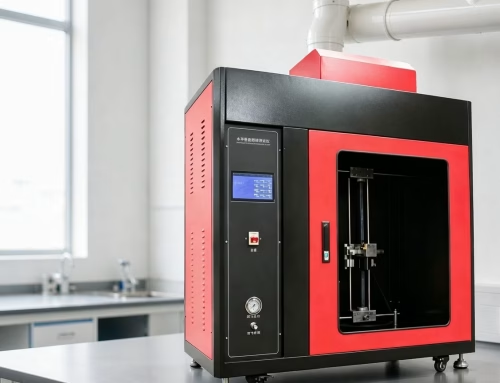
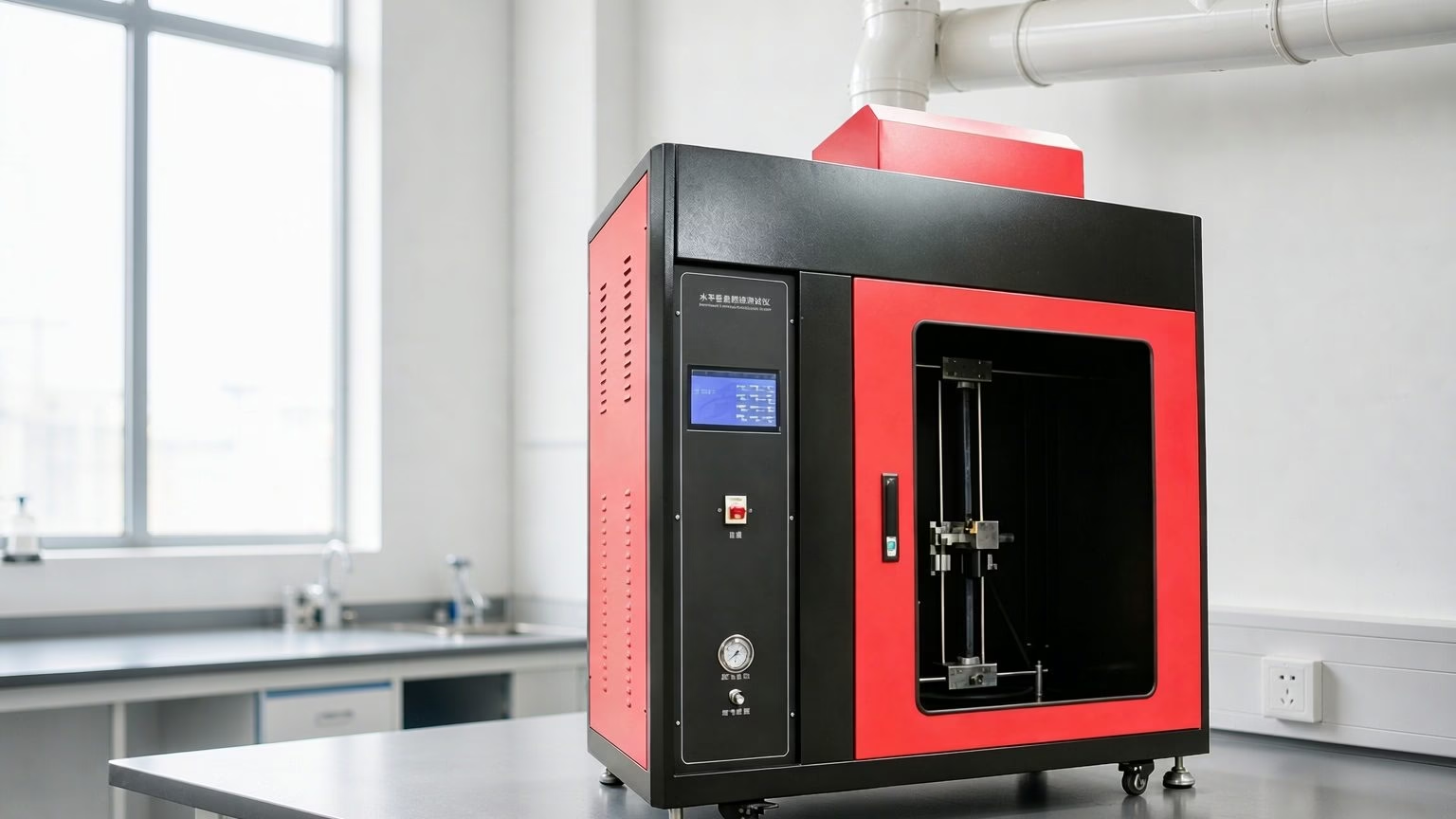
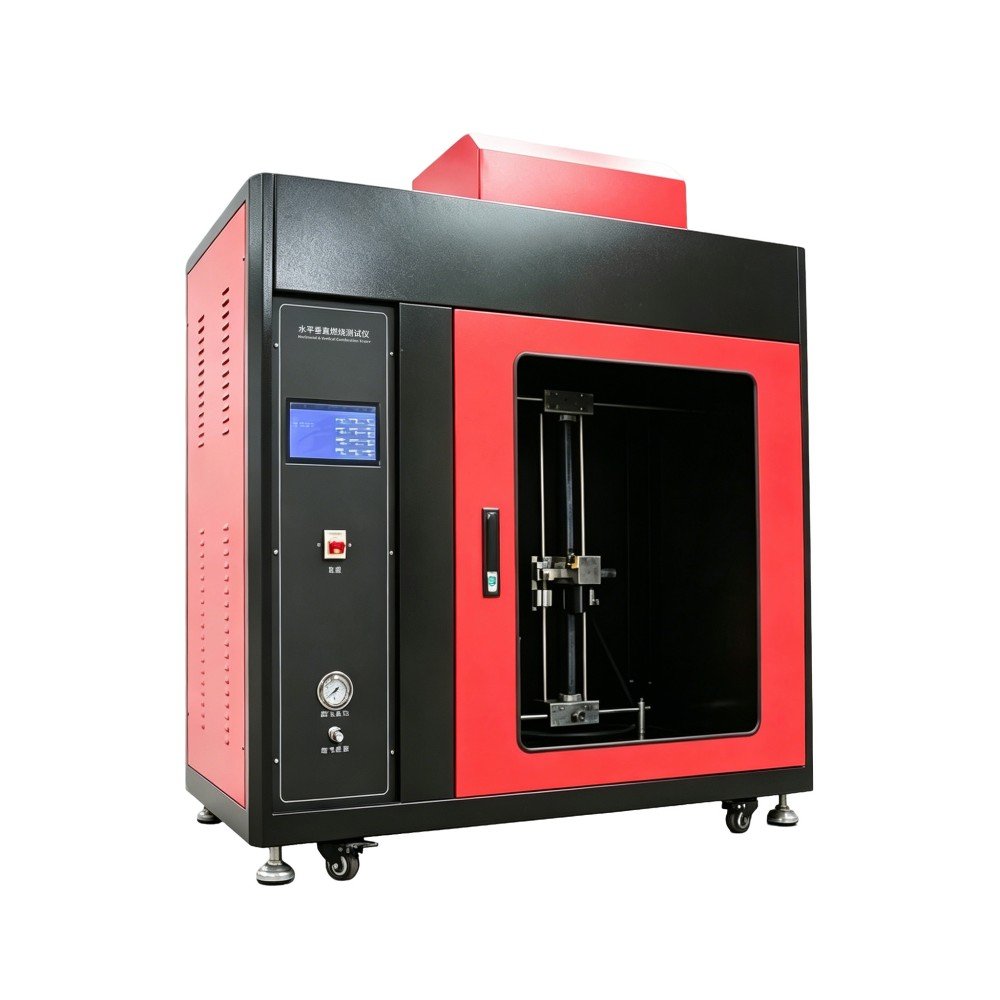
A small-flame chamber comes first, because it covers the two material classifications that almost every enclosure datasheet quotes. It needs both burner positions — a 50 W flame and a 500 W flame — plus bar clamps and a plaque holder. Our horizontal and vertical combustion tester is configured for exactly that pairing, و plastic foam vertical and horizontal burning tester covers the cellular materials that IEC 60695-11-10 excludes by density [1].
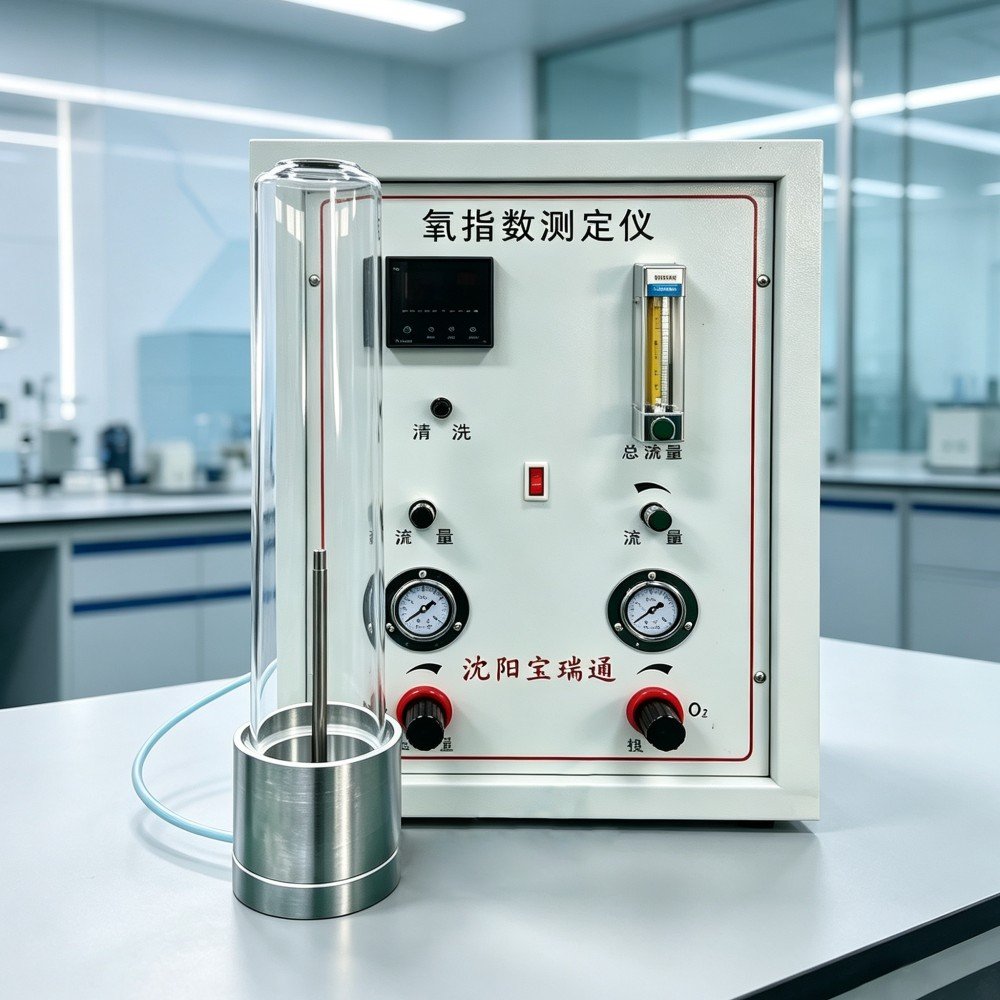
An oxygen index tester comes second, and it is the one that changes how the laboratory works. Because ISO 4589-2 returns a continuous scale [10], formulation screening stops being a queue of four-week flame submissions. Both the automatic touch-screen oxygen index tester و limiting oxygen index tester for plastics are built to that method.
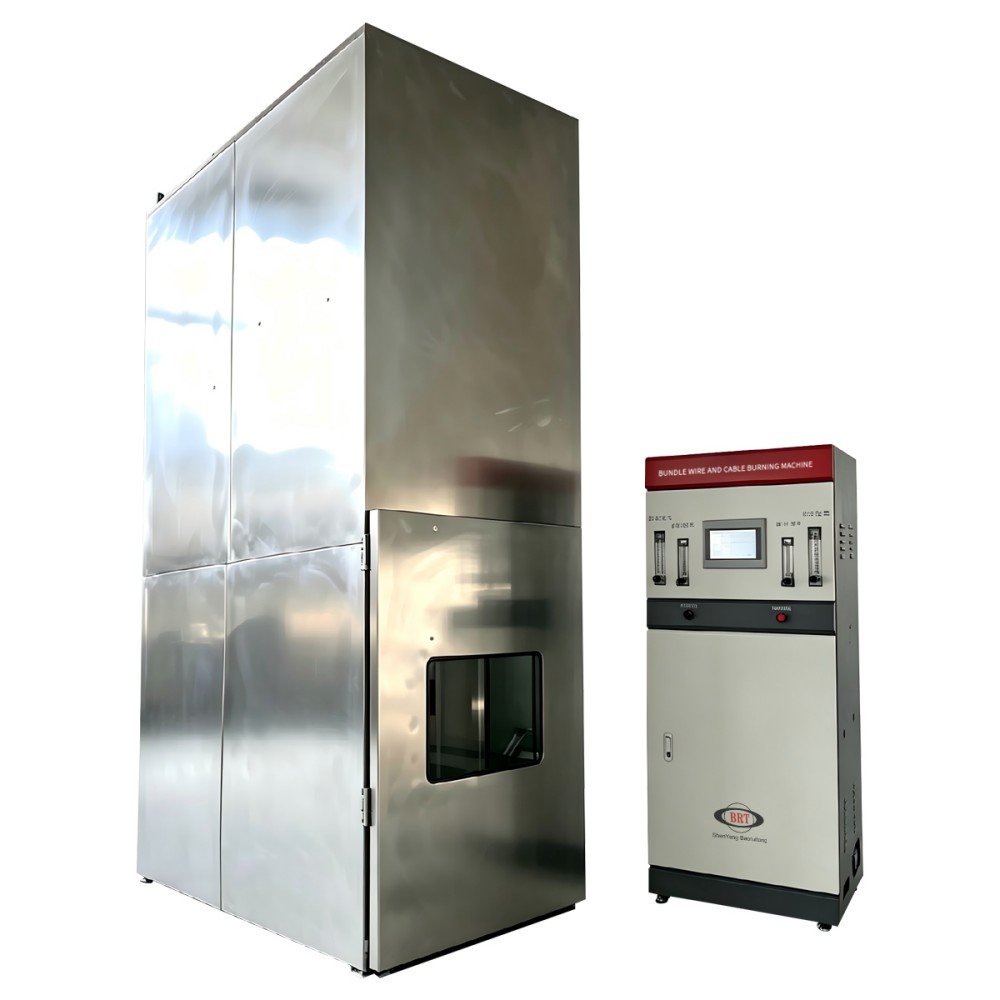
A glow-wire apparatus comes third, and it is the only one of the three that tests the enclosure rather than the material. If the products in scope include cable and wiring systems, أ cable fire resistance tester و bundled cable vertical flame test equipment extend coverage into those methods; we cover the cable side in اللجنة الانتخابية المستقلة 60331 cable fire resistance testing.
Mistakes That Delay an Enclosure Submission
| Mistake | Why it costs time | What to do instead |
|---|---|---|
| Submitting a material classification as if it were a product approval | Material tests and finished-part tests answer different questions | Read the end-product clause and test what it names |
| Running glow-wire at one temperature and reporting “glow-wire compliant” | The result is a temperature, not a pass | Report GWFI and GWIT as temperatures [6][7] |
| Testing foams to IEC 60695-11-10 | The method excludes materials below 250 kg/m³ apparent density [1] | Use the foam-specific procedure |
| Quoting the 2004 edition of IEC 60695-11-5 | It was cancelled and replaced by the 2016 طبعة [3] | Check the edition in the current catalogue |
| Screening formulations with flame tests | They return classes, not numbers | Screen with ISO 4589-2 first [10] |
| Assuming 5VA and V-0 are interchangeable | 5VA adds a plaque burn-through requirement | Specify the rating the standard calls up |
الأسئلة المتداولة
Which fire test does an electrical enclosure actually need?
It depends on the end-product standard, not on the material. Most enclosures need a small-flame material classification under IEC 60695-11-10 and a glow-wire test on the finished part under IEC 60695-2-11. If the enclosure wall has to act as a fire barrier, ال 500 W method in IEC 60695-11-20 is added, and if internal faults are a concern, the needle-flame test in IEC 60695-11-5 applies.
Is a UL 94 V-0 rating enough to prove an enclosure is safe?
No. V-0 is a material classification from a 50 W flame test on a standard bar. It says nothing about how the finished enclosure behaves around an overheated terminal, which is what the glow-wire test on the end product is for, and nothing about burn-through, which is what the 500 W plaque test is for.
What is the difference between GWEPT and GWFI?
GWEPT, in IEC 60695-2-11, is run on a finished end product and gives a result for that product. GWFI, in IEC 60695-2-12, is run on standard material specimens and returns the highest temperature at which the material does not ignite or self-extinguishes within 30 s. One tests a design, the other grades a material.
How is GWIT different from GWFI?
GWFI is a flammability index: the highest temperature at which the material does not ignite, or ignites and extinguishes within 30 s of removing the glow-wire. GWIT is an ignitability index, defined as the temperature 25 K or 30 K above the highest test temperature at which the material did not ignite or did not sustain flaming for longer than 5 s.
Do I need both a bar test and a plaque test?
Only if you are claiming 5VA. ال 50 W methods and the 5VB classification are decided on bars alone. Plaques of 150 mm by 150 mm are required for 5VA, because burn-through cannot be assessed on a bar.
Can I use one instrument for all the enclosure methods?
No. The flame tests, the glow-wire tests and the needle-flame test use different apparatus, and the flame test itself needs two burner configurations for the 50 W and 500 W methods. A practical capability is three instruments, and they are usually bought in that order.
Why does the edition of the standard matter so much here?
Because several parts of IEC 60695 have been revised recently. The needle-flame method moved from the 2004 edition to the 2016 طبعة, and the glow-wire materials tests moved to 2021 editions. A test request quoting an old edition may be run to a procedure the certifier no longer recognises.
The Decision Sequence
- Read the end-product clause and copy it verbatim into the test request. طريقة, severity, specimen and edition all come from there.
- Classify the question as material or finished part. Material questions use IEC 60695-11-10, 11-20 و ايزو 4589-2; finished-part questions use IEC 60695-2-11 و 11-5.
- Screen formulations with ISO 4589-2 before spending money on conditioned flame submissions.
- Decide whether burn-through matters. If it does, ask for 5VA and commission plaques; if it does not, 5VB on bars is sufficient.
- Report glow-wire results as temperatures, with the edition of the standard stated.
- Check every edition against the current catalogue before the request goes out.
If you are specifying a capability rather than a single instrument, contact the BRT application team with the standards your products are certified to, and we will map them to an instrument configuration. Our guide to choosing a fire testing laboratory equipment supplier lists the questions worth putting to any vendor, و how to test the flammability of plastic materials covers the wider plastics picture.
About the Author
This article was prepared by the BRT combustion testing application team at Shenyang Baoruitong Automation Equipment Co., المحدودة., which supplies small-flame chambers, oxygen index testers and cable and wiring fire test equipment to electrical and electronics laboratories. Standard scope statements are quoted from the publishers’ own catalogue entries, and edition and date information is taken from the IEC webstore and ASTM International.
مصادر
- IEC Webstore — IEC 60695-11-10:2013, 50 W horizontal and vertical flame test methods
- IEC Webstore — IEC 60695-11-20:1999+AMD1:2003, 500 W flame test methods
- IEC Webstore — IEC 60695-11-5:2016, needle-flame test method
- IEC Webstore — IEC 60695-2-10:2013, glow-wire apparatus and common test procedure
- IEC Webstore — IEC 60695-2-11:2014, glow-wire flammability test for end products (GWEPT)
- IEC Webstore — IEC 60695-2-12:2021, glow-wire flammability index (GWFI) for materials
- IEC Webstore — IEC 60695-2-13:2021, glow-wire ignition temperature (GWIT) for materials
- IEC Webstore — IEC 60695-11-3:2012, 50 W test flame apparatus and confirming test
- IEC Webstore — IEC 60695-11-4:2011, 500 W test flame apparatus and confirming test
- UNI Ente Italiano di Normazione — ISO 4589-2:2017, oxygen index at ambient temperature
- ASTM International — D3801-20a, comparative burning characteristics of solid plastics in a vertical position