The Short Answer
In quality control, a UV-Vis spectrophotometer is judged by one thing: whether its results survive an audit. That reframes what UV-Vis spectrophotometer applications are actually buying you: not a spectrum, but a defensible decision recorded in a way an auditor can follow. The instrument does four recurring jobs — identity confirmation, assay of an active or a specified component, impurity and degradation measurement, و routine checks on water, solvents and raw materials — and each of them turns an absorbance reading into a release or a rejection decision 2. What separates a QC result from a research result is not the measurement but the evidence around it. Wavelength accuracy has to be checked against a traceable reference material rather than assumed, photometric accuracy and stray light have to be verified on a schedule, and the method itself has to be shown to do what it claims under the validation characteristics that ICH sets out 35. If you are specifying an instrument for this work, buy for the verification chain first — reference materials, certified cuvettes and a documented qualification procedure — and for optical specifications second.

What Quality Control Asks a UV-Vis Spectrophotometer to Prove
The three recurring jobs
If you are new to the technique, our overview of the working principle and main applications of a UV-Vis spectrophotometer covers the optics behind what follows. Almost every QC method built on UV-Vis absorption reduces to one of three questions. Is this the right material? Identity methods compare a spectrum, or the ratio of absorbances at two wavelengths, against a reference. How much of it is there? Assay methods apply the Beer-Lambert relationship at a chosen wavelength, using a calibration established with the same solvent, pathlength and bandwidth. Is anything else present? Impurity and degradation methods look for a shoulder, a second maximum, or a rise at a wavelength where the analyte does not absorb. The three are not equally demanding: identity is usually robust, assay is sensitive to wavelength and photometric error, and impurity work is the most demanding of all because it asks the instrument to resolve a small signal sitting on a large one. Underneath all three is the same measurement, and if the absorbance step itself is unfamiliar, how a spectrophotometer measures absorbance explains it from first principles.
Why QC is harder than the application note suggests
Most UV-Vis spectrophotometer applications are demonstrated on an application note, and an application note demonstrates that a measurement is possible. A QC method has to demonstrate that it is reproducible in someone else’s hands, on a different instrument, over months. That difference moves the burden from the chemistry to the metrology. The wavelength you measure at has to be the wavelength the method specifies — not nominally, but verifiably. The absorbance scale has to be linear over the range the method uses. Stray light has to be low enough that a high-absorbance sample does not read falsely low, which is the classic failure when a concentrated solution is measured without dilution. ASTM E275 exists precisely to put names and definitions around those performance parameters so that two laboratories mean the same thing by them 1.

Four UV-Vis Spectrophotometer Applications That Dominate QC
| Workflow | What is measured | What governs it | Where it usually goes wrong |
|---|---|---|---|
| Incoming raw material identity | Spectrum match, or an absorbance ratio | Reference spectrum obtained on the same solvent and bandwidth | Reference spectrum recorded at a different bandwidth |
| Assay of an active or specified component | Absorbance at a specified wavelength against a calibration | Linearity, wavelength accuracy, pathlength | Calibration prepared in a different solvent or at a different pH |
| Impurity and degradation | Secondary maximum, shoulder, or absorbance at a non-absorbing wavelength | ضوء طائش, bandwidth, baseline flatness | Stray light flattens a high-absorbance peak and hides the shoulder |
| Water, solvent and environmental checks | Absorbance at specified wavelengths against a limit | Method-specified wavelengths and cell path | Using the wrong wavelength pair for the parameter |
Pharmacopoeial and regulated QC
Pharmaceutical QC is the most documented case, and the useful general point is that the documentary burden is not optional. A method has to be shown to be suitable for its purpose before it is used for release, and the instrument has to be shown to be performing on the day the result was generated. That second requirement is what system suitability exists for: a short set of checks run alongside the samples, with acceptance criteria, so that a failing result can be attributed to the instrument rather than to the batch. Where a UV-Vis method is used for release testing, the validation characteristics are those set out in the ICH quality guidelines, and the specific chapter requirements come from the pharmacopoeia being cited [5].
Water and environmental QC
Water QC is the highest-volume UV-Vis work in many laboratories, and it is the one most tightly tied to named methods. Colour, and a range of determinands measured at specified wavelengths, are reported against method-defined procedures; ايزو 7887 is the current international reference for the examination of colour, and the US EPA maintains the approved chemical test methods used for compliance reporting 67. The practical trap here is wavelength discipline: these methods specify the wavelength and the cell path for a reason, and substituting a “near enough” wavelength invalidates the comparison against the limit. We go through the water methods in detail in our guide to قياس الطيف الضوئي للأشعة فوق البنفسجية والمرئية (UV-Vis) لاختبار جودة المياه.
طعام, beverage, chemical and materials QC
The remaining QC work is heterogeneous — colour index, additive content, peroxide value, polymer additives, plating bath composition — and the shared characteristic is that each method carries its own wavelength, solvent and calibration instructions. There is no general answer to “which wavelength”, only the method-specific one, and a laboratory that inherits a method from a customer inherits those instructions with it rather than being free to optimise them.
Two equipment consequences follow. These laboratories need a wide photometric range, because a colour measurement on a dark sample and an additive determination at trace level sit at opposite ends of the absorbance scale on the same instrument. And they need a straightforward way to store and recall methods, because operator-to-operator consistency matters more here than the last decimal place of a specification: a method that must be re-entered by hand each shift is a method that will drift. Where the same laboratory also runs infrared identification work, the two techniques answer different questions and are frequently used together — see FTIR versus UV-Vis for where each one belongs.
The Numbers That Decide Whether a QC Result Is Defensible
Every one of the UV-Vis spectrophotometer applications above ends at the same place: a wavelength and an absorbance. The full procedure for checking those numbers — the reference materials, the acceptance limits and the failure signatures — is set out in our guide to دقة الطول الموجي والتحقق من الضوء الشارد; the table below is the QC view of why each one matters.
| Parameter | Why QC cares | How it is checked |
|---|---|---|
| Wavelength accuracy | A method specifies a wavelength; measuring at the wrong one biases an assay | Certified wavelength standard: NIST SRM 2034 certifies the wavelength of minimum transmittance for 14 العصابات من 240 نانومتر ل 650 نانومتر, at six spectral bandwidths from 0.1 نانومتر ل 3 نانومتر [3] |
| الدقة الضوئية | The absorbance scale is what an assay is read from | Certified neutral-density filters or a certified solution, measured on a defined schedule |
| ضوء طائش | Stray light makes a high-absorbance sample read low, hiding impurities | Cut-off filters or a solution with a sharp absorption edge, at the wavelength the method uses |
| عرض النطاق الترددي الطيفي | Bandwidth changes peak height and peak shape, so a ratio method is bandwidth-dependent | Verified with the same standard used for wavelength; note SRM 2034 is certified only for instruments of nominal bandwidth ≤ 3 نانومتر [3] |
| التسطيح الأساسي والانجراف | Impurity methods read small differences on a large signal | Blank-to-blank scan over the method range |
| Wavelength repeatability | Day-to-day comparability | Repeated scans of the same standard |
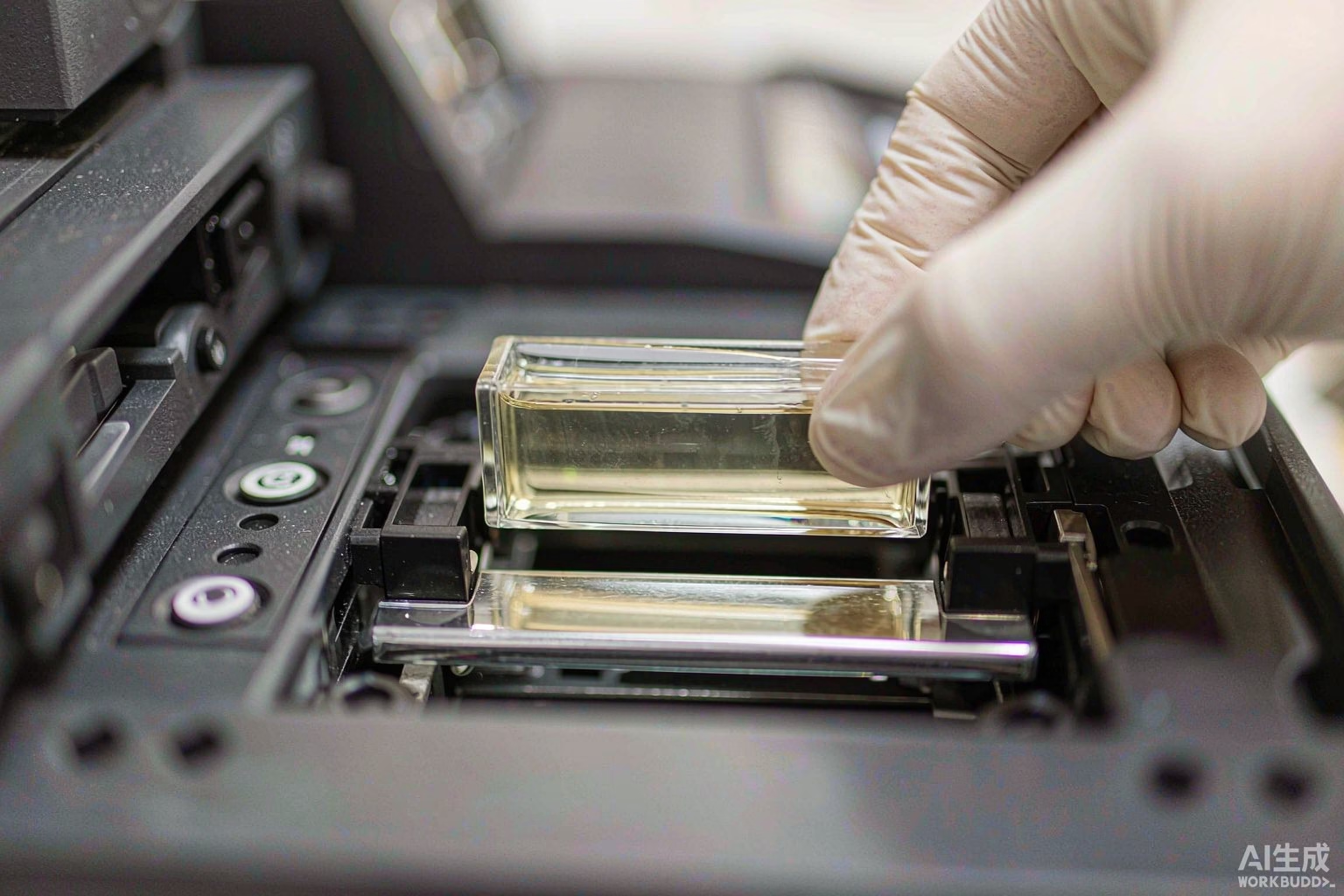
Of all the checks that support UV-Vis spectrophotometer applications, the single most useful object in that table is the wavelength standard. NIST SRM 2034 is a certified transfer standard for verifying and calibrating the wavelength scale of UV-Vis absorption spectrophotometers, supplied as a holmium oxide solution — 4 % mass fraction holmium oxide in 10 % volume fraction perchloric acid — sealed in a fused-silica cuvette of nominal 10 mm pathlength [3]. Read the scope line carefully: it is certified for instruments whose nominal spectral bandwidth does not exceed 3 نانومتر [3]. An instrument specified at a wider bandwidth cannot be verified with it, which is an argument for checking bandwidth before choosing a verification route. NIST maintains a spectrophotometry programme behind these materials, and the certificate is the document an auditor will ask for [3]4.
How QC Failures Show Up in the Data
| Symptom in the result | Usual cause | What to check first |
|---|---|---|
| Assay drifts low on concentrated samples | ضوء طائش, or absorbance above the validated range | Stray light at the method wavelength; dilute and re-measure |
| Peak maximum appears at a different wavelength than the method states | Wavelength scale error | Certified wavelength standard |
| Calibration is curved where it should be linear | Concentration beyond the linear range, or a bandwidth too wide | Dilution series; bandwidth setting |
| Two operators get different results on the same sample | Method re-entered by hand, or cell handling | Method storage and cuvette cleanliness |
| Impurity shoulder disappears | Bandwidth too wide, or scan step too coarse | Bandwidth and data interval |
| Blank drifts over a long run | Source warm-up or lamp ageing | Warm-up time; lamp hours |
That table is worth printing and keeping next to the instrument, because most QC investigations start with the symptom rather than the cause and the mapping is not obvious. The third row is the one that produces the most wasted work: a curved calibration is usually a range problem, not an instrument fault, and the fix is a dilution series rather than a service call.
Method Validation and System Suitability
Matching the method to the instrument’s capability
A method written on one instrument does not automatically transfer to another. Before adopting an inherited method, check four things against the receiving instrument: ال nominal bandwidth, because a wider bandwidth reduces peak height and can change an absorbance ratio; ال wavelength accuracy at the method wavelength; ال photometric range the method needs; و cell path and cell type the method specifies. If any of those four differ, the method has to be partially re-validated rather than simply loaded. This is the point at which laboratories discover that a method transferred between sites was never actually comparable, and it is cheaper to find it during adoption than during an audit.
What validation asks of a UV-Vis method
| Validation characteristic | What it means for a UV-Vis method |
|---|---|
| Specificity | The analyte’s absorbance is separated from everything else that absorbs at that wavelength |
| Linearity | Absorbance is proportional to concentration over the range the method reports |
| Range | The interval between the upper and lower concentrations that have been shown to work |
| دقة | Recovery against a reference material or a comparison method |
| Precision | Repeatability and intermediate precision, usually expressed as relative standard deviation |
| Detection and quantitation limit | Where the impurity methods sit, and whether the instrument can reach them |
| Robustness | How sensitive the result is to small changes in wavelength, pH, solvent or bandwidth |
Those characteristics are the ones set out in the ICH quality guidelines, and the point of the table is that a UV-Vis method is not exempt from any of them just because the instrument is simple [5]. Robustness is where UV-Vis methods most often fail an audit, because a method written without a stated bandwidth or pH tolerance cannot be shown to be robust — the information needed to demonstrate it was never recorded.
System suitability that catches a bad day
System suitability is the short list of checks run with the samples, with acceptance criteria agreed in advance. For UV-Vis work it normally covers wavelength check against the certified standard, photometric check against a certified filter, a resolution or ratio check where the method depends on one, و replicate precision on a standard solution. The discipline is in the acceptance criteria: a check with no stated limit is decoration. Written properly, the criteria let a laboratory distinguish “the batch failed” من “the instrument failed”, which is the difference between a rejection and an investigation.
Qualifying UV-Vis Spectrophotometer Applications: The OQ Checklist
| Check | Instrument | مرجع | Frequency driver |
|---|---|---|---|
| Wavelength accuracy | Scan the certified wavelength standard and compare band minima with the certificate | NIST SRM 2034 or equivalent [3] | Installation, then periodic; also after any lamp or grating service |
| الدقة الضوئية | Measure certified filters at specified wavelengths | Certified neutral-density filter set | Installation, then periodic |
| ضوء طائش | Measure a cut-off filter at the method’s critical wavelength | Cut-off filter | Installation, then periodic |
| دقة / bandwidth | Bandwidth-sensitive standard | Same standard as wavelength check | Installation, then periodic |
| Baseline and noise | Blank scan over the method range | — | Each session or each batch |
| Software and audit trail | Confirm method storage, user levels and record retention | Internal procedure | Installation and after upgrades |
General practice for the quantitative technique itself is covered by ASTM E169, which sets out the general techniques of ultraviolet-visible quantitative analysis, and the performance descriptors are those of ASTM E275 [1][2]. Both are worth having on the shelf because they give the vocabulary an auditor will use.
Buying Checklist for UV-Vis Spectrophotometer Applications in QC
| Question | Why it matters |
|---|---|
| What is the nominal spectral bandwidth? | SRM 2034 is certified only for instruments of nominal bandwidth ≤ 3 نانومتر [3] |
| Are certified reference materials and cuvettes in the quote? | Verification is impossible without them, and they are consumables |
| Does the software support method storage, user levels and an audit trail? | Regulated QC requires it |
| What are the stated wavelength accuracy and photometric accuracy figures, and how are they verified? | These are the two numbers an auditor asks about first |
| Is stray light specified at the wavelengths your methods use? | A single figure at one wavelength is not enough |
| Do you need single or double beam? | See single beam versus double beam for the trade-off |
| What is the cell holder and accessory list? | Thermostatted holders and autosamplers change throughput more than specifications do |
| How does this compare with the wider market? | Our دليل شراء مقياس الطيف الضوئي للأشعة فوق البنفسجية والمرئية (UV-Vis). sets the selection argument out step by step |
| What does the qualification package include? | Installation and operational qualification documentation, not just a calibration certificate |
BRT’s UV-Vis line runs from the 1100UV through the 1800UV و 3200UV to the 5600UV و 6100UV, and the selection argument is a QC argument rather than a specification argument: start from the bandwidth your verification route requires, then from the accessory list your throughput needs.
الأسئلة المتداولة
What are the main UV-Vis spectrophotometer applications in quality control?
Four recurring jobs: confirming the identity of an incoming material, assaying how much of a specified component is present, detecting impurities or degradation products, and running routine checks on water, solvents and raw materials. Each turns an absorbance reading into a release or rejection decision, which is why the evidence around the measurement matters as much as the measurement itself.
How often should wavelength accuracy be checked?
At installation, on a periodic schedule set by your own procedure, and after any event that could move the optical train — a lamp change, a grating service or a move. The check itself is a scan of a certified wavelength standard against the certificate values rather than a comparison against a nominal setting.
What is NIST SRM 2034 and why is it used?
It is a certified transfer standard for verifying and calibrating the wavelength scale of ultraviolet and visible absorption spectrophotometers. It consists of a holmium oxide solution sealed in a fused-silica cuvette of nominal 10 mm pathlength, certified for the wavelength of minimum transmittance of 14 bands between 240 nm and 650 nm at six spectral bandwidths from 0.1 نانومتر ل 3 نانومتر.
Can SRM 2034 be used on any UV-Vis spectrophotometer?
No. Its certified values apply to instruments whose nominal spectral bandwidth does not exceed 3 نانومتر. An instrument specified at a wider bandwidth needs a different verification route, which is a reason to check the bandwidth specification before choosing how you will verify wavelength accuracy.
Why does stray light matter more in QC than in research?
Because impurity and degradation methods ask the instrument to detect a small signal on top of a large one. Stray light makes a high-absorbance sample read falsely low, flattening the main peak and hiding the shoulder or secondary maximum the method is looking for. In research that costs accuracy; in QC it can cost a false release.
What is the difference between method validation and system suitability?
Validation shows that the method does what it claims — specificity, linearity, accuracy, precision, range, detection limit and robustness. System suitability shows that the instrument and the method were performing on the day the samples were run. Validation is done once per method; system suitability is done with every batch.
Does a QC laboratory need a double beam instrument?
It depends on the method and on throughput. A double beam design compensates for source drift and solvent blank changes during a scan, which helps long scans and kinetic work; a single beam design is simpler and often adequate for fixed-wavelength assays where a blank is measured immediately before the sample. The decision is a method decision, not a specification contest.
خاتمة
Specify in this order when you are matching UV-Vis spectrophotometer applications to a QC workload. أولاً, list the methods the instrument will run and the wavelength, solvent and bandwidth each one states — that list, not the brochure, sets the specification. ثانية, choose the verification route and confirm the bandwidth is compatible with it; if you intend to use a certified holmium oxide wavelength standard, the nominal bandwidth has to be within its certified range [3]. ثالث, buy the reference materials, certified cuvettes and filters as part of the instrument order, because a verification schedule without the materials is a schedule that will slip. Fourth, write system suitability criteria with numbers before the first batch runs. Fifth, document installation and operational qualification, and re-run the checks after any service.
For UV-Vis spectrophotometer applications in regulated QC, the instrument is the smaller half of the purchase. BRT supplies UV-Vis spectrophotometers across the range with the accessories and consumables QC workflows need. Send us the methods you run and the wavelengths they specify, and we will return a configuration with the verification chain and the qualification checklist spelled out.
BRT 光谱应用团队 — Shenyang Baoruitong Automation Equipment. Spectroscopy application engineering; sources are the ASTM, NIST, ICH, ISO and US EPA documents cited below.
مصادر
- ASTM International — E275 Standard Practice for Describing and Measuring Performance of Ultraviolet and Visible Spectrophotometers
- ASTM International — E169 Standard Practices for General Techniques of Ultraviolet-Visible Quantitative Analysis
- NIST — SRM 2034, holmium oxide solution wavelength standard (certificate)
- NIST — Spectrophotometry
- ICH — Quality guidelines
- UNI Ente Italiano di Normazione — ISO 7887:2011
- US EPA — Approved CWA Chemical Test Methods
- NIST — Standard Reference Materials