- الجواب القصير
- Why a Window Is Not a Small Door
- What “Pass” Actually Permits
- The Three Test Routes
- Glazing Type Drives the Result
- The Specimen Is the Product, Not a Sample
- Instrumentation: What Is Actually Recorded
- Reading the Classification
- What Voids a Report
- What the Test Does Not Tell You
- Equipment for Window Testing
- الأسئلة المتداولة
- Can a fire-rated window pass with the glass broken?
- What is the difference between E, EW and EI for a window?
- Why does furnace pressure matter so much for windows?
- Do I need EN 1634-1 or NFPA 257?
- Is a fixed window tested the same way as an openable one?
- Can I change the glazing after the test?
- Does the rating cover smoke?
- خاتمة: Five Decisions Before You Book a Furnace
- مصادر
الجواب القصير
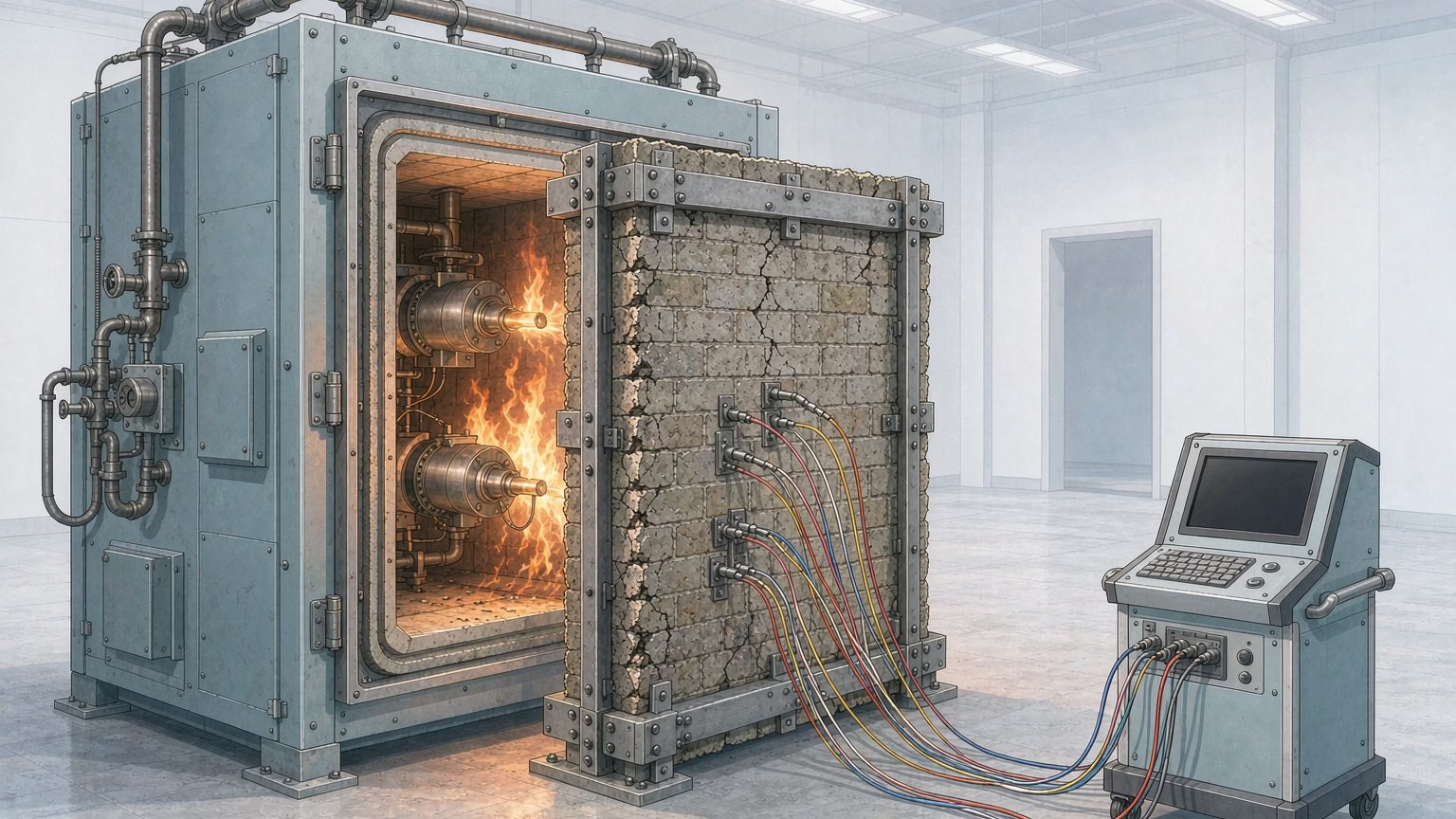
Fire resistance testing of a fire-rated window measures an assembly, not a pane of glass, and it can pass with the glazing partly gone. That is the single fact that separates window testing from every intuition about it. In Europe the method is EN 1634-1, whose Part 1 covers openable windows alongside door and shutter assemblies and is used together with EN 1363-1 1. In North America the method is UL 9 2 or NFPA 257 3, both of which apply to window, glass block and other light-transmitting assemblies in openings in fire-resistance-rated walls. The window is mounted in a furnace wall, exposed to a standard fire, and then, in the North American methods, struck with a hose stream.
What the test produces is a rating for that assembly in that wall, and a set of measured quantities: integrity, heat flux through the specimen, and unexposed-face temperature. Which of those the customer actually needs is the decision that shapes the whole programme.
Why a Window Is Not a Small Door
The two assemblies are tested in the same furnaces by closely related standards, which encourages the assumption that a window rating is a door rating with different numbers. The test logic is different in three ways.
| Aspect | Fire door assembly | Fire window assembly |
|---|---|---|
| What is being protected | A circulation opening that must stay usable and self-closing | A light-transmitting opening that must stay in the wall |
| Glazing loss | Not permitted — the leaf is the barrier | Permitted within specified limits [2][3] |
| Heat transmission | Not the primary criterion | Explicitly measured, because protection from heat is limited [2] |
| Post-exposure water test | Hose stream, per the door method 6 | Hose stream, per the window method [2][3] |
| What the rating promises | Fire protection rating for the opening | Fire protection rating for the opening [3] |
The row that matters is the second one. أول 9 states that its methods permit loss of glass lights and through openings, provided such loss and openings do not exceed specified limits [2]. NFPA 257 says the same thing in different words, permitting through-openings created by cracking, separation or loss of glazing material within specified limits [3]. A door that opened a hole would have failed; a window that opens a bounded hole has not.
ماذا “Pass” Actually Permits
Lost glazing is a defined outcome, ليس عيبا
Both North American standards treat glazing loss as an anticipated event with a size limit rather than as a failure. That is a rational position: glass cracks under thermal gradient, and the assembly’s job is to keep the opening bounded so that the fire does not pass freely into the room. It also means a test report that records glazing loss is not, by itself, a bad report.
For a specifier the consequence is practical. If the design intent is that the window must remain visually intact — a vision panel in a corridor, an atrium screen, a stair enclosure — then a rating alone does not deliver it, and the specification needs to say so explicitly.
Heat flux is measured because the rating does not promise insulation
أول 9 is unusually direct about this. It states that assemblies classified in accordance with the standard provide only limited protection from the transmission of heat, and that the standard provides guidance to measure the heat flux emitted through the test specimen during the fire exposure as well as temperatures on the unexposed surface [2]. A number comes out of the test, and that number is often the one that decides whether the window can be used on an escape route.
Furnace pressure changes the result
أول 9 defines two pressure conditions for controlling the furnace during the exposure: a positive pressure condition and a neutral pressure condition [2]. This is not a laboratory preference. A positive-pressure furnace pushes hot gas toward the joints, the perimeter gap and the glazing bead, so leaks and gaps that are harmless under neutral pressure become paths for flame. A specimen that passes one way has not automatically passed the other, and a report that does not name the pressure condition is incomplete.
The Three Test Routes
| Route | Market | Specimen | Exposure | Post-exposure | What is classified |
|---|---|---|---|---|---|
| في 1634-1, جزء 1 | Europe and adopters of EN | Door, shutter or openable window assembly in a supporting construction, used with EN 1363-1 [1] | Standard fire per EN 1363-1 | National annex requirements | Integrity, and where claimed radiation and insulation, in minutes |
| أول 9 | North America | Window, glass block or other light-transmitting assembly [2] | Standard fire, positive or neutral pressure | Hose stream [2] | Fire protection rating |
| NFPA 257 | North America | Window, glass block or other light-transmitting assembly [3] | Standard fire with defined time-temperature curve, furnace temperatures and pressure | Hose stream [3] | Fire protection rating |
The European route
في 1634-1 is titled as a fire resistance and smoke control test for door and shutter assemblies, openable windows and elements of building hardware, and Part 1 is the fire resistance test for door and shutter assemblies and openable windows. Openable windows are named as a specimen type in the scope, and the standard is used together with EN 1363-1, which supplies the general principles and the furnace control [1]. Fixed windows sit outside Part 1’s specimen list and are generally handled as part of the wall or as a glazed element under the wall standard, which is why our guide to fire resistance testing for walls and partitions is the right companion piece for a fixed-glazing project.
The North American route
أول 9 and NFPA 257 do not separate openable from fixed windows: both address window assemblies including glass block and other light-transmitting assemblies intended to retard the spread of fire through openings in fire-resistance-rated walls [2][3]. NFPA 257 is the document that supplies the fire protection rating, and its purpose clause describes evaluating the ability of a window, glass block or other light-transmitting assembly to remain in a wall opening during a prescribed fire exposure followed by a hose stream [3]. Installation then falls under NFPA 80, which regulates assemblies and devices used to protect openings 5.
Where the routes disagree
The two families differ in what they name and in how much they leave to the national annex. European reports are written as a classification in minutes against a lettered scheme; North American reports are written as a fire protection rating attached to a listed assembly. They are not convertible by arithmetic, and a specifier who needs one market’s document cannot substitute the other’s — which is the same trap described in our note on fire rating versus fire resistance rating.
Glazing Type Drives the Result
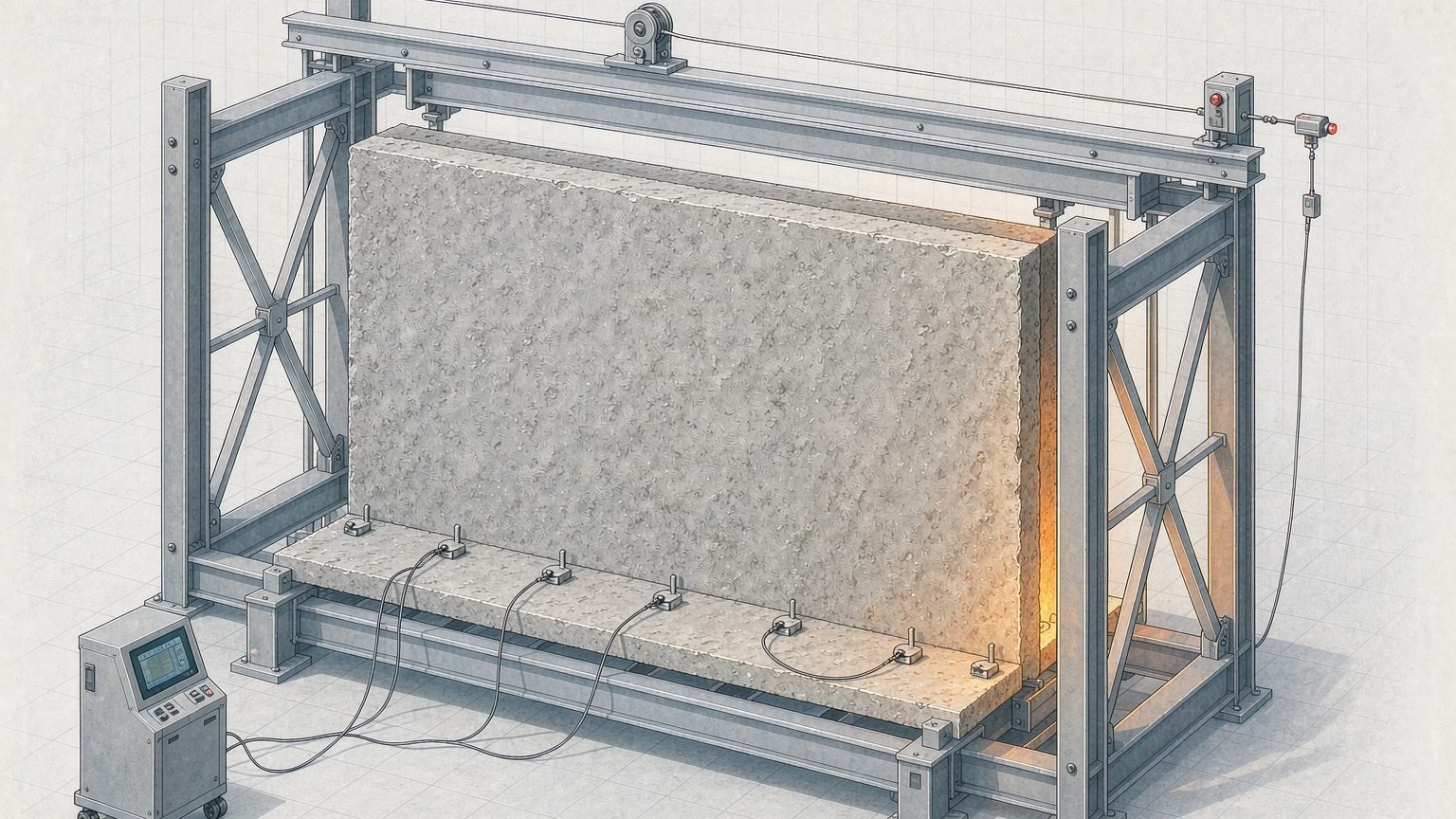
The frame decides whether the assembly stays in the wall; the glazing decides how long it takes to stop being a barrier. The table below describes expected behaviour by product family, not measured data.
| Glazing | Behaviour under fire exposure | What usually ends the test | Typical role |
|---|---|---|---|
| Wired glass | Cracks early, wires hold the pieces in place | Radiant heat through the cracked pane | Integrity-only ratings, older stock |
| Borosilicate | High softening point, resists thermal shock | Frame and bead failure rather than glass | Integrity and some radiation ratings |
| Ceramic glass | Very low expansion, stays intact longest | Perimeter seal and frame distortion | Higher classifications, larger panes |
| Intumescent-laminated | Interlayer foams and opacifies, forming an insulating char | Interlayer exhaustion, edge delamination | Ratings that need an insulation component |
| Tempered or heat-strengthened | Fails suddenly into granules | Immediate loss of the light, bounded opening | Not a fire-rated glazing on its own |
| Glass block | Masonry-like, mortar joints govern | Joint cracking and through-openings | Vision and light with integrity ratings |
Two rules follow. أولاً, the glazing cannot be upgraded after the test — swapping an intumescent-laminated pane for a ceramic one in the same frame produces an untested assembly, which is exactly what UL 9 warns about when it says any variation from the construction or conditions tested may substantially change the performance characteristics of the assembly [2]. ثانية, the frame and the glazing have to be assessed together, because a glazing that survives is useless if the bead releases.
The Specimen Is the Product, Not a Sample
A window test is a test of a built assembly, and the report describes that assembly. Both North American standards state that they do not provide full information about performance in walls built from materials other than those tested [2][3]. That single limitation explains why a manufacturer’s report cannot simply be dropped into a different wall build-up.
What therefore has to match production is longer than most first-time submitters expect: the frame profile and its material, the glazing product and thickness, the glazing bead or gasket, the perimeter gap and its sealant, the fixing method and spacing, and the supporting wall construction including its density and thickness. The listed assembly is the whole list. Our walkthrough of how fire doors are tested makes the same point about doorsets, and the logic transfers unchanged.
Instrumentation: What Is Actually Recorded
| Measurement | Where it sits | What it decides |
|---|---|---|
| Furnace temperature | Control thermocouples in the furnace | Whether the exposure followed the standard curve 4 |
| Furnace pressure | Pressure tap in the furnace | Whether the test ran positive or neutral [2] |
| Unexposed-face temperature | Thermocouples on the cold face | The insulation criterion, where claimed [2] |
| Heat flux | Radiometer facing the specimen | The radiation criterion, where claimed [2] |
| Integrity observations | Visual and cotton-wool or gap-gauge checks | Whether a through-opening exceeded the permitted limit [3] |
| Hose stream result | Water jet after the fire exposure | Whether the assembly survives mechanical impact [2][3] |
The furnace itself is normally qualified against a standard exposure, which for wall and partition work is the same curve that governs the wall: ASTM E119 describes a standard fire exposure with an optional hose stream application per E2226 for assemblies including walls, partitions, columns, beams and floor or roof assemblies [4]. في 1634-1 delegates the equivalent control to EN 1363-1 [1].
Reading the Classification
A European window classification is a set of letters and a time. The letters describe which criteria were maintained, and they are the part most often misread.
| تعيين | Criteria maintained | What it means for the occupant | الاستخدام النموذجي |
|---|---|---|---|
| E | Integrity only | The fire does not pass through, but radiant heat does | Vision panels where egress is remote |
| EW | Integrity plus limited radiation | A person can pass at a defined distance | Escape routes and corridor glazing |
| EI | Integrity plus insulation | The cold face stays below the insulation threshold | Where the window must behave like the wall |
North American reports express the same physical outcome differently, as a fire protection rating for a listed assembly [3], and the underlying test is not obliged to produce an insulation number at all. The practical translation rule is that a rating and a classification are two vocabularies for measured quantities, and comparing them requires the measured quantities rather than the labels.
What Voids a Report
A fire resistance testing report describes a tested assembly rather than a product family, so the list of changes that invalidate it is longer than most submitters expect.
| Change | Why it invalidates the result |
|---|---|
| Different glazing product or thickness | The glazing is part of the tested assembly [2] |
| Different frame profile or material | Geometry governs heat transfer to the frame |
| Different perimeter sealant or gap | Leak paths change the positive-pressure result [2] |
| Different supporting wall | Performance in other wall constructions is not provided [2][3] |
| Different fixing spacing | Restraint governs how long the frame stays put |
| Different pressure condition assumed | Positive and neutral are separate conditions [2] |
| Changed hardware or operators on an openable sash | The closing and latching mechanism is part of the assembly |
What the Test Does Not Tell You
أول 9 and NFPA 257 both decline the same three questions. Neither provides a full assessment of performance in walls of other materials, an evaluation of how much the assembly contributes to the fire hazard through smoke, toxic gases or other products of combustion, and a measurement of how well the assembly limits the passage of smoke [2][3]. NFPA 257 adds the explicit warning that the result is not to be construed as determining the suitability of the assembly for continued use after fire exposure [3].
Smoke is the gap that surprises people most, because a window that lights a corridor is often specified for smoke as well as fire. That is a different test with a different apparatus; the wider picture is in our note on why smoke production matters in fire testing.
Equipment for Window Testing
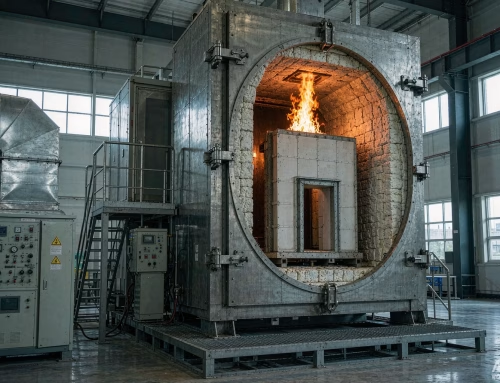
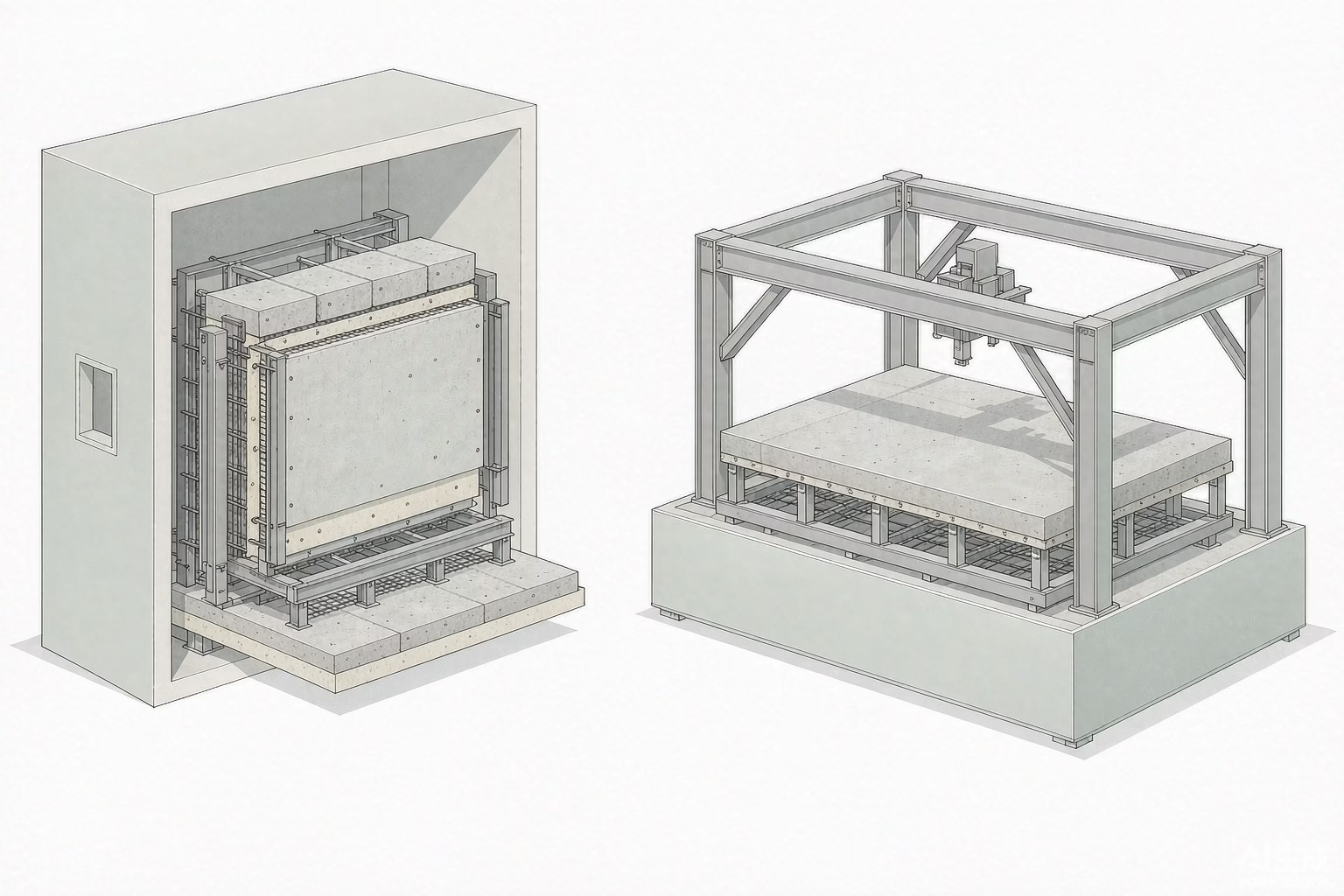
A window programme needs a furnace that can take a wall panel with the assembly built into it, hold a controlled pressure regime, and record unexposed-face temperature and heat flux at the same time. BRT’s vertical integrated fire resistance test furnace is the configuration used for vertical specimens of this kind, و horizontal fire resistance test furnace covers the floor and ceiling orientation for assemblies tested that way.
الأسئلة المتداولة
Can a fire-rated window pass with the glass broken?
نعم, within limits. أول 9 permits loss of glass lights and through openings provided they do not exceed specified limits, and NFPA 257 permits through-openings created by cracking, separation or loss of glazing material under the same condition. The assembly is being judged on whether the opening stays bounded, not on whether the glass survives intact.
What is the difference between E, EW and EI for a window?
E is integrity: the fire does not pass through, but radiant heat does. EW adds a limit on radiation, which is what allows people to pass at a defined distance. EI adds insulation, so the unexposed face stays below the insulation threshold. The letters describe which criteria were maintained, so a higher letter is a stronger claim about the cold face rather than about the glass.
Why does furnace pressure matter so much for windows?
Because a positive-pressure furnace drives hot gas toward joints, perimeter gaps and glazing beads. أول 9 defines two separate pressure conditions, positive and neutral, and a specimen that holds under one has not automatically held under the other. A report that does not state the pressure condition cannot be compared with one that does.
Do I need EN 1634-1 or NFPA 257?
It depends on the market the product is sold into, and the two are not interchangeable. في 1634-1 جزء 1 covers openable windows and is used with EN 1363-1; NFPA 257 and UL 9 cover window assemblies for fire-resistance-rated walls in North America and produce a fire protection rating. A project that needs both markets needs both tests.
Is a fixed window tested the same way as an openable one?
Not under EN 1634-1, whose Part 1 scope lists openable windows among its specimen types. Fixed glazing is normally assessed as part of the wall or as a glazed element under the wall standard. The North American standards take the broader view and address window assemblies including glass block and other light-transmitting assemblies without splitting them by operation.
Can I change the glazing after the test?
لا. أول 9 warns that any variation from the construction or conditions tested may substantially change the performance characteristics of the assembly, and the glazing is part of the tested construction. A different glazing product or thickness in the same frame is an untested assembly, and so is the same glazing in a different frame.
Does the rating cover smoke?
لا. أول 9 and NFPA 257 both state that they do not evaluate the assembly’s contribution to the fire hazard through smoke or other products of combustion, nor measure how well it limits the passage of smoke. Smoke leakage is a separate test, and a window specified for both needs two reports.
خاتمة: Five Decisions Before You Book a Furnace
A fire resistance testing programme for windows is really five decisions taken before the specimen is built, and each one narrows the options for the next.
- Name the market first, because EN 1634-1 and the UL 9 or NFPA 257 route produce different documents and neither substitutes for the other [1][2][3].
- Decide whether integrity is enough, or whether the design needs radiation or insulation as well, because that decision fixes the glazing family and the frame detail.
- Fix the wall build-up before the specimen is built, since performance in other wall constructions is outside what the report provides [2][3].
- Record the pressure condition, and make sure the laboratory’s regime matches the one the project will be assessed against [2].
- Write the smoke and post-fire questions down separately, because neither is answered by a fire resistance classification [3].
If you are planning a window programme and need to know which furnace configuration and instrumentation set will carry it, send BRT your specimen details and we will map the assembly to a test arrangement.
Written by the BRT fire testing applications team, شركة شنيانغ باورويتونج لمعدات التشغيل الآلي, المحدودة. Scope and limitation statements are quoted from the EN, أول, NFPA and ASTM documents cited; the glazing behaviour table is an expectation guide, not measured data.
مصادر
- Swedish Institute for Standards — SS-EN 1634-1:2014+A1:2018 Fire resistance and smoke control tests for door and shutter assemblies, openable windows and elements of building hardware – Part 1: Fire resistance test for door and shutter assemblies and openable windows — https://www.sis.se/en/produkter/construction-materials-and-building/elements-of-buildings/doors/ss-en-1634-12014a120182/
- UL Standards & Engagement — UL 9 Standard for Fire Tests of Window Assemblies, طبعة 8 — https://www.shopulstandards.com/ProductDetail.aspx?productId=UL9
- National Fire Protection Association — NFPA 257 Standard on Fire Test for Window and Glass Block Assemblies, 2022 edition — https://www.nfpa.org/codes-and-standards/nfpa-257-standard-development/257
- ASTM International — E119 Standard Test Methods for Fire Tests of Building Construction and Materials — https://store.astm.org/e119.html
- National Fire Protection Association — NFPA 80 Standard for Fire Doors and Other Opening Protectives — https://www.nfpa.org/codes-and-standards/nfpa-80-standard-development/80
- National Fire Protection Association — NFPA 252 Standard Methods of Fire Tests of Door Assemblies — https://www.nfpa.org/codes-and-standards/nfpa-252-standard-development/252