- The Short Answer
- What Counts as a Wall, a Partition and a Loadbearing Element
- The Three Criteria: ر, E and I
- The Heating Curve and What It Does to a Wall
- Fire Resistance Testing for Walls in Europe: The EN Route
- The North American Route: ASTM E119
- Reading a Fire Resistance Classification
- Where Wall Tests Go Wrong
- Equipment for Wall and Partition Fire Resistance Testing
- الأسئلة المتداولة
- Is a partition tested the same way as a wall?
- What does REI 60 actually mean?
- Which standard decides the classification, في 1364-1 or EN 13501-2?
- How hot does the furnace get during a wall test?
- Why does a wall pass integrity but fail insulation?
- Do I need a hose stream test for a European wall classification?
- Can a 60-minute partition result be used for a wall with a door in it?
- خاتمة: A Decision Order
- مصادر
The Short Answer
Fire resistance testing for walls and partitions is not one test, and the deciding question is whether the element carries load. Non-loadbearing walls and partitions are tested to EN 1364-1 2; loadbearing walls are tested to EN 1365-1 3. Both are read together with EN 1363-1, which supplies the furnace, the heating curve, the instrumentation and the failure criteria 1. In North America the same question is answered by ASTM E119, which uses a comparable time-temperature exposure but different temperature-rise limits and, for many assemblies, a hose stream test applied immediately afterwards 8. The result of any of these tests is never a simple pass or fail. It is a number of minutes held against three separate criteria — ر for loadbearing capacity, E for integrity and I for insulation — which EN 13501-2 then converts into a classification written as, for example, REI 60 or EI 30 4.
What Counts as a Wall, a Partition and a Loadbearing Element
The vocabulary matters because the standards are organised around it. In the EN system a wall is a vertical element that separates spaces and is expected to resist fire from one side; أ partition is the non-loadbearing version of the same idea.
Non-Loadbearing Walls and Partitions
في 1364-1:2015 specifies the method for non-loadbearing walls and is used in conjunction with EN 1363-1 [1][2]. Its scope explicitly covers partitions with and without glazing, which is why glazed screens, framed partitions and glazed screens with transoms are all tested to this part rather than to a separate glass standard. The current edition has been in force since 8 July 2015. Because no structural load is applied, the only criteria against which the specimen is judged are integrity and insulation, and the classification it can support is written as EI plus a number of minutes [4].
Loadbearing Walls
في 1365-1:2012 covers loadbearing walls and is explicitly applicable to both internal and external walls [3]. It is in force in its 2012 طبعة. Two things distinguish it from the EN 1364 route. أولاً, the specimen is loaded in compression during the test, so the ر criterion becomes available and the standard classification becomes REI. ثانية, the standard notes that the fire resistance of an external wall can be determined under either internal or external fire exposure, and that the performance is normally evaluated without perforations such as doors or glazing — a restriction that matters when a designer wants to reuse a plain wall result for a wall with an opening [3].
The practical consequence is that a 60-minute result on a non-loadbearing partition does not transfer to the same construction used as a loadbearing wall. The load path changes the failure mode, and the standard that governs the claim changes with it.
The Three Criteria: ر, E and I
| Criterion | What it protects | How failure is judged | Defined in |
|---|---|---|---|
| R — loadbearing capacity | Structural stability | Specimen collapses, or deflection and rate of deflection exceed the limits in EN 1363-1 | في 1363-1 [1] |
| E — integrity | Passage of flame and hot gases | Sustained flaming on the unexposed face; opening large enough for the specified gap gauges | في 1363-1 [1] |
| I — insulation | Heat transfer to the unexposed side | Mean unexposed-face temperature rise exceeds 140 K, or any single point exceeds 180 K above the initial temperature | في 1363-1 [1] |
Integrity and Insulation Are Measured on the Same Face
Both E and I are assessed on the unexposed face, and both are time-dependent, which is why a single specimen can hold E for 90 minutes and I for only 45. Integrity is checked by watching for sustained flaming and by probing openings with gap gauges of defined sizes; insulation is checked with an array of thermocouples, conventionally five, one at the centre and four distributed over the specimen, plus additional thermocouples at defined positions near joints and fixings [1]. A wall that is crack-free at 30 minutes can still fail I at 30 minutes if the mean temperature rise has already passed the 140 K limit.
The Loadbearing Criterion Requires a Real Load
The R criterion only means something if the test applies the load the wall will actually see in service. في 1363-1 defines the loading and the deflection measurement; في 1365-1 defines how loadbearing wall specimens are built and supported [1][3]. This is the single most common reason a wall classification is challenged during review: the result is real, but the load level used in the test was not the load level of the building.
The Heating Curve and What It Does to a Wall
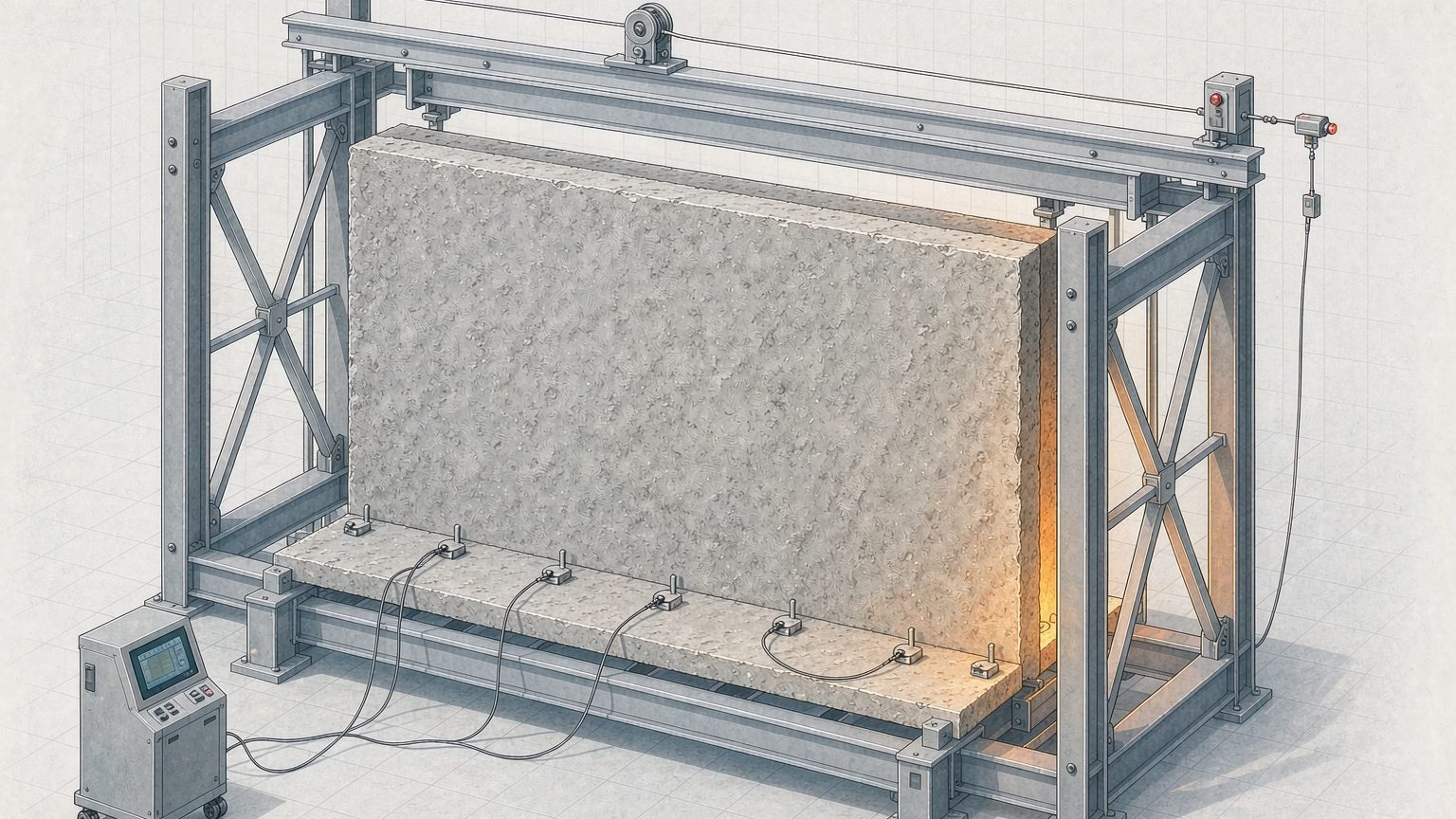
The standard fire exposure is the ISO 834-1 curve, now published in its 2025 طبعة, which came into force on 30 May 2025 and replaced the 1999 طبعة 5. The furnace atmosphere is controlled so that the average temperature follows
T = 20 + 345 log₁₀(8t + 1)
where T is in degrees Celsius and t is in minutes. Because it is a logarithmic curve, the furnace rises very fast at the start and then flattens — which is exactly why the first ten minutes are the hardest on thin boards and why the difference between a 30-minute and a 60-minute wall is far smaller than a linear reading would suggest.
| Time (min) | Furnace temperature (درجة مئوية) |
|---|---|
| 5 | 576 |
| 10 | 678 |
| 15 | 739 |
| 30 | 842 |
| 60 | 945 |
| 90 | 1 006 |
| 120 | 1 049 |
The Curve Is a Reference Exposure, Not a Fire
Two caveats follow from that. The standard curve is a reference exposure for comparison, not a prediction of a real compartment fire, and the standard itself frames the output as data for subsequent classification rather than as a fire safety assessment of the building [5]. Where a different exposure is genuinely required — hydrocarbon fires in process plant, or the slower heating used for certain elements — EN 1363-2 supplies alternative heating curves and additional procedures, including an impact test and a radiation measurement, and remains current in its 1999 طبعة 6. Curtain walling has its own part, في 1364-3, which covers the full configuration for curtain walling type B 7.
Fire Resistance Testing for Walls in Europe: The EN Route
| معيار | نِطَاق | الطبعة الحالية (verified) |
|---|---|---|
| في 1363-1 | General requirements: furnace, curve, instrumentation, criteria | 2020, in force 19 February 2020 [1] |
| في 1364-1 | Fire resistance of non-loadbearing walls and partitions | 2015, in force 8 July 2015 [2] |
| في 1365-1 | Fire resistance of loadbearing walls | 2012, in force 10 أكتوبر 2012 [3] |
| في 1364-3 | Curtain walling, full configuration | 2014, in force 29 January 2014 [7] |
| في 1363-2 | Alternative heating curves and additional procedures | 1999, in force 18 August 1999 [6] |
| في 13501-2 | Fire resistance classification from test data | 2023, in force 31 May 2023 [4] |
Specimen, Support and Conditioning
Fire resistance testing for walls is built from four documents that have to be read together: في 1363-1 for the method, في 1364-1 or EN 1365-1 for the element, and EN 13501-2 for the class.
The Test Result Belongs to the Assembly
The test result belongs to the specimen as built, not to the product family. A representative full-size assembly is required, including the joints, fixings, boards, studs and any penetrations that are part of the construction, and the specimen is conditioned before the test so that moisture content does not drive the early part of the curve. This is why manufacturers who change a board supplier, a stud gauge or a joint detail often have to re-test: the classification is attached to the assembly, and only extended application rules can carry it to a variant without a new furnace run. Our guide to how fire resistance is tested for building materials covers the specimen and conditioning logic in more detail.
The North American Route: ASTM E119
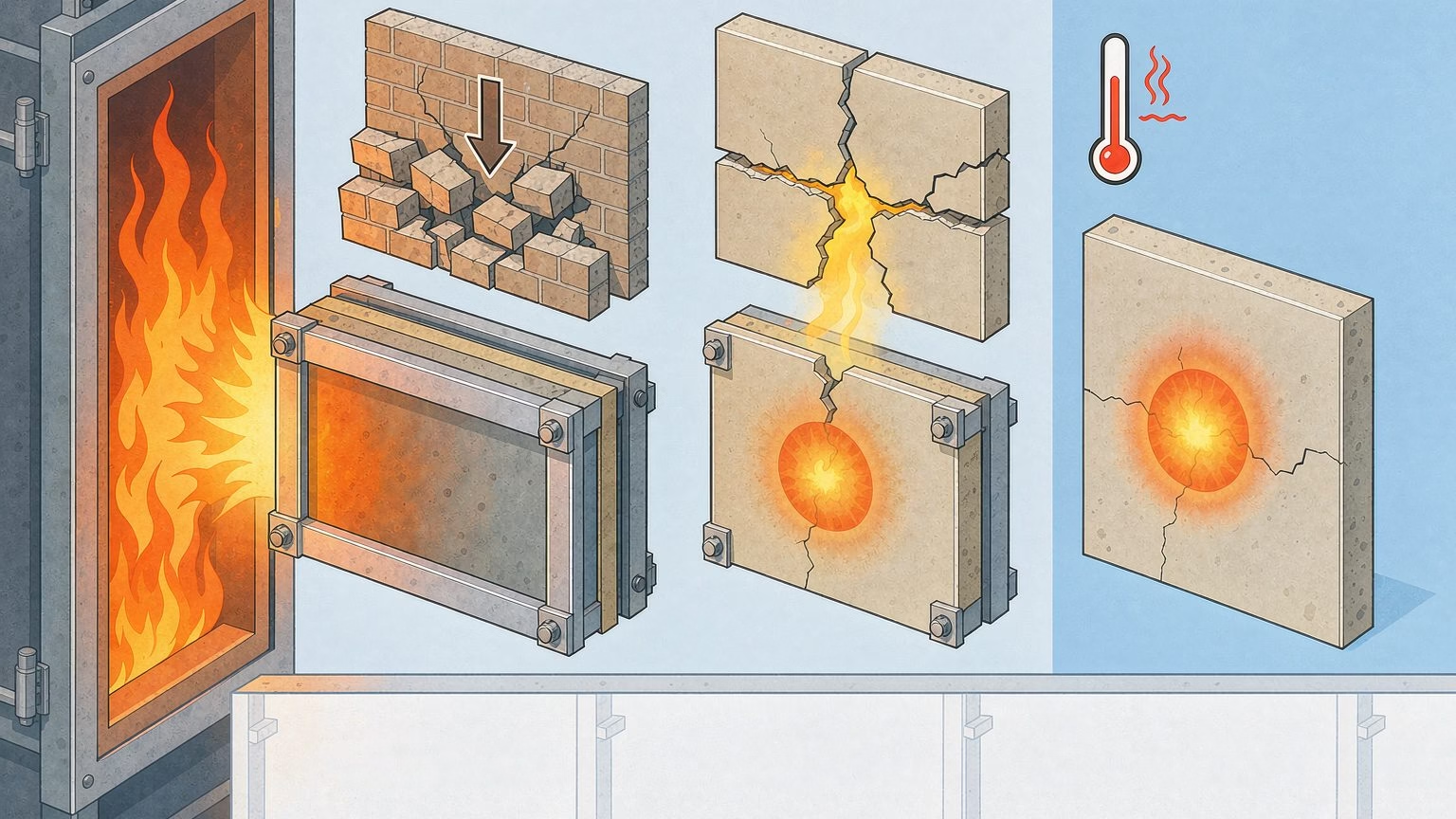
ASTM E119 is the counterpart standard for building construction and materials in the United States [8]. The architecture of the result is the same — an assembly is exposed to a standard time-temperature fire and held to defined limits — but the insulation criterion is expressed differently: failure is taken as an average unexposed-surface temperature rise of 250 °F (about 139 درجة مئوية) above the initial temperature, or a rise of 325 °F (about 181 درجة مئوية) at any single point. ASTM reissues E119 regularly, so the edition year should be confirmed on the ASTM store page before it is written into a specification.
The Hose Stream Test
The most visible difference from the European route is the hose stream test. After the fire exposure, many wall assemblies are subjected to a water stream from a defined nozzle at a defined pressure and duration, and the assembly must stay in place and not permit water to pass through. An assembly that satisfied every thermal criterion in the furnace can still fail on the hose stream, because the exposure cools and erodes the degraded face. European wall testing to the EN 1364 and EN 1365 series does not apply a hose stream as part of the standard method.
Reading a Fire Resistance Classification
في 13501-2 takes the minutes achieved against each criterion and writes them as a class [4].
| Class notation | معنى | ينطبق على |
|---|---|---|
| ر 60 | Loadbearing capacity held for 60 minutes | Loadbearing elements only |
| E 60 | Integrity held for 60 minutes | Separating elements |
| EI 60 | Integrity and insulation held for 60 minutes | Non-loadbearing walls and partitions |
| REI 60 | Loadbearing, integrity and insulation held for 60 minutes | Loadbearing walls |
| RE 60 | Loadbearing and integrity, insulation not claimed | Where insulation is not required |
The minutes are drawn from a standard series rather than reported as raw test time, so a specimen that survived 72 minutes in the furnace is normally classified at the next lower step of the series. Two further points prevent most misreadings. A classification without ر says nothing about structural stability, so an EI 60 partition must not be used where a loadbearing wall is required. And a classification is only valid for the exposure and the orientation tested — an external wall rated under internal exposure is not automatically rated under external exposure [3]. For the classification ladder that sits alongside this one, see في 13501-1 Euroclass and SBI testing.
Where Wall Tests Go Wrong
| Pitfall | Why it happens | What to do instead |
|---|---|---|
| Reusing a partition result for a loadbearing wall | The load path changes the failure mode and R is untested | Test the loadbearing configuration to EN 1365-1 [3] |
| Assuming EI covers structural stability | No load was applied, so no R was measured | Specify REI where the wall carries load [4] |
| Ignoring the joints | Most insulation failures start at board joints and perimeter fixings | Include the real joint detail in the specimen |
| Quoting the furnace survival time | في 13501-2 classifies to a standard minute series | Quote the classification, not the test duration [4] |
| Mixing EN and ASTM numbers | 140 K / 180 K and 250 °F / 325 °F are different limits | Keep the two systems separate in one specification |
| Overlooking openings | Perforations are normally excluded from the standard wall evaluation | Test the door or the penetration as its own element |
Equipment for Wall and Partition Fire Resistance Testing
| Equipment | Used for | Product page |
|---|---|---|
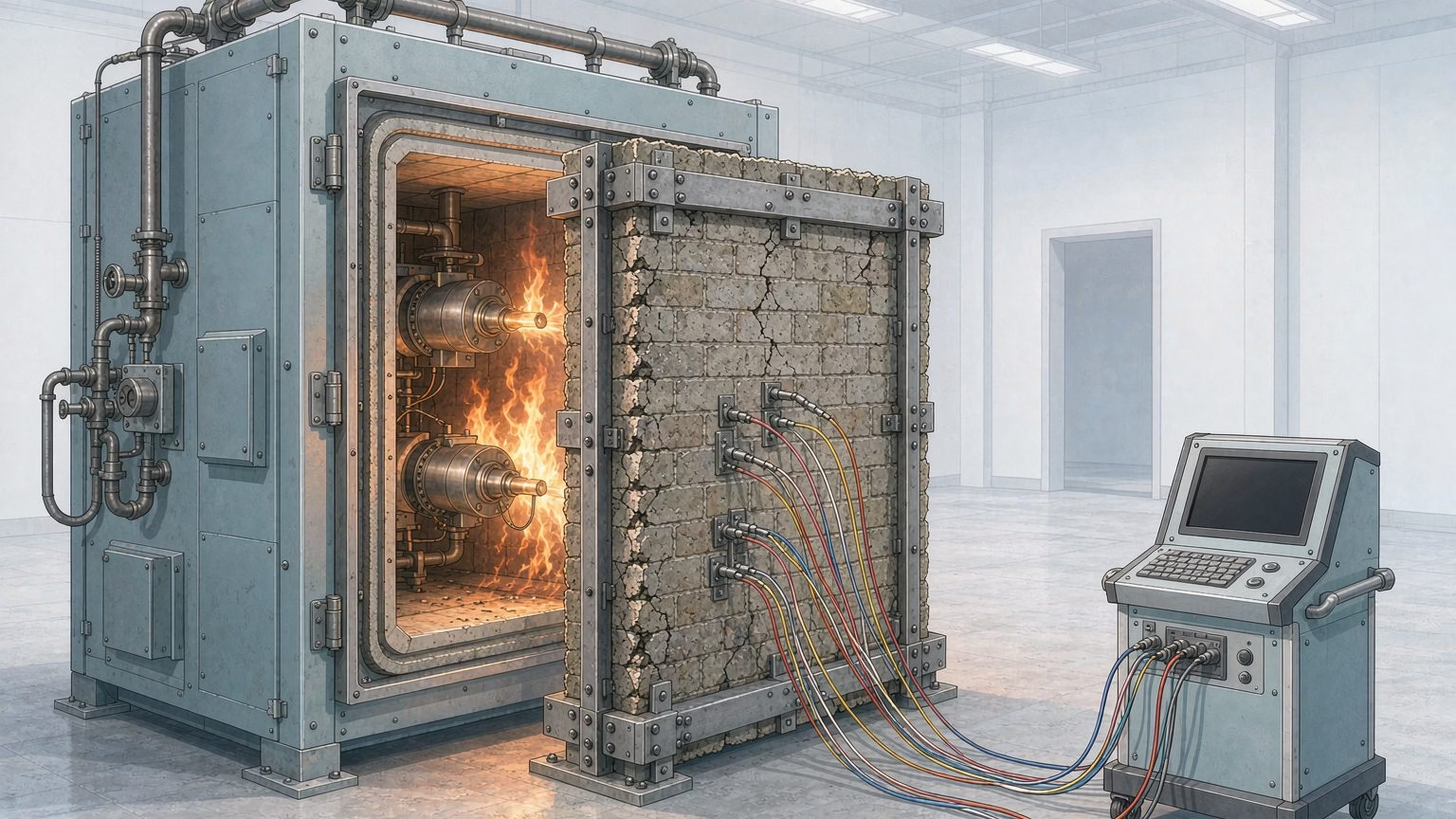
| Vertical integrated fire resistance test furnace | Walls, partitions, doorsets and other vertical separating elements | Vertical integrated fire resistance test furnace |
| Horizontal fire resistance test furnace | Floors, roofs and horizontal elements, plus furnace calibration and research work | Horizontal fire resistance test furnace |
| Non-combustibility apparatus | Material-level screening to ISO 1182 before an assembly test is commissioned | Non-combustibility apparatus |
A wall programme is usually built around one vertical furnace with a load frame, because the same frame has to supply the compression load for REI work and the deflection measurement for the R criterion. If the laboratory also has to classify the materials rather than the assembly, ال ايزو 834 temperature-time curve explained article sets out what the furnace control has to prove, و what a fire resistance test furnace is covers the furnace hardware itself. For steel-framed walls, ال steel structure fire resistance requirements article is the closer reference, and for openings in the wall, see how to test fire resistance of fire doors.
الأسئلة المتداولة
Is a partition tested the same way as a wall?
No. A non-loadbearing partition is tested to EN 1364-1 and can only be classified for integrity and insulation, written as EI plus minutes. A loadbearing wall is tested to EN 1365-1 with a compressive load applied, so it can also claim the R criterion and is classified as REI. The two results are not interchangeable.
What does REI 60 actually mean?
It means the specimen held loadbearing capacity, integrity and insulation for at least 60 minutes under the standard ISO 834-1 heating curve. Each letter is judged independently, so the same specimen could hold R and E for 60 minutes and I for only 45, which would produce a lower overall classification.
Which standard decides the classification, في 1364-1 or EN 13501-2?
في 1364-1 is the test method and EN 13501-2 is the classification. The furnace run produces times against R, E and I; في 13501-2 converts those times into a class drawn from a standard minute series such as 30, 60, 90 or 120.
How hot does the furnace get during a wall test?
The ISO 834-1 curve reaches 576 °C at 5 minutes, 842 °C at 30 minutes, 945 °C at 60 minutes and 1 049 °C at 120 minutes. It is a logarithmic reference exposure used for comparison between assemblies, not a prediction of a real compartment fire.
Why does a wall pass integrity but fail insulation?
Because they measure different things. Integrity is about holes and flames passing through; insulation is about heat conducted through the assembly. A board system can stay intact and intact-looking while its unexposed face passes the 140 K mean temperature rise limit.
Do I need a hose stream test for a European wall classification?
Not under the EN 1364 and EN 1365 series — the hose stream is a feature of ASTM E119 testing in North America. If you are certifying for a US project, the hose stream applies and an assembly can fail there after passing the furnace exposure.
Can a 60-minute partition result be used for a wall with a door in it?
Not directly. Perforations such as doors and glazing are normally outside the standard wall evaluation, so the door or the penetration is tested as its own element and the wall classification covers the plain construction only.
خاتمة: A Decision Order
- Decide whether the element carries load. If it does, في 1365-1 with a compressive load and an REI classification; if it does not, في 1364-1 and EI [2][3].
- Fix the exposure. Standard ISO 834-1 heating unless the application genuinely needs an alternative curve under EN 1363-2 [5][6].
- Build the specimen as the building will. Same boards, studs, fixings, joints and openings — the classification follows the assembly.
- Name the market. European work classifies through EN 13501-2; North American work runs ASTM E119 with its own temperature limits and hose stream [4][8].
- Quote the classification, not the furnace time. Minutes come from the standard series, and each letter has to be claimed separately.
- Confirm the edition before you specify. في 1363-1:2020, في 1364-1:2015, في 1365-1:2012, في 13501-2:2023 و ايزو 834-1:2025 are the versions verified for this article [1][2][3][4][5].
If you are building or upgrading a wall fire resistance capability, start from the vertical furnace and its load frame, then add the material-level screening that tells you whether an expensive assembly test is worth commissioning.
Talk to BRT Testing about a vertical integrated fire resistance test furnace configured for EN 1364-1 and EN 1365-1 عمل, or تواصل معنا with your wall build-up and target classification.
Written by the BRT Testing application engineering team. BRT Testing manufactures fire and flame testing equipment for construction products, cables and plastics. Standard editions in this article were verified against the UNI standards store and the ASTM store on 28 أكتوبر 2026.
مصادر
- UNI Ente Italiano di Normazione — EN 1363-1:2020, Fire resistance tests — Part 1: General requirements — https://webstore.uni.com/en/en-1363-1-2020
- UNI Ente Italiano di Normazione — EN 1364-1:2015, Fire resistance tests for non-loadbearing elements — Part 1: Walls — https://webstore.uni.com/en/en-1364-1-2015
- UNI Ente Italiano di Normazione — EN 1365-1:2012, Fire resistance tests for loadbearing elements — Part 1: Walls — https://webstore.uni.com/en/en-1365-1-2012
- UNI Ente Italiano di Normazione — EN 13501-2:2023, Fire classification of construction products and building elements — Part 2: Classification using data from fire resistance tests, excluding ventilation services — https://webstore.uni.com/en/en-13501-2-2023
- UNI Ente Italiano di Normazione — ISO 834-1:2025, Fire resistance tests — Elements of building construction — Part 1: General requirements — https://webstore.uni.com/en/iso-834-1-2025
- UNI Ente Italiano di Normazione — EN 1363-2:1999, Fire resistance tests — Part 2: Alternative and additional procedures — https://webstore.uni.com/en/en-1363-2-1999
- UNI Ente Italiano di Normazione — EN 1364-3:2014, Fire resistance tests for non-loadbearing elements — Part 3: Curtain walling, full configuration (complete assembly) — https://webstore.uni.com/en/en-1364-3-2014
- ASTM International — E119, Standard Test Methods for Fire Tests of Building Construction and Materials — https://store.astm.org/e119.html
- ASTM International — E1966-15, Standard Test Method for Fire-Resistive Joint Systems — https://store.astm.org/e1966-15.html
- National Fire Protection Association (NFPA) — NFPA 251, Standard Methods of Tests of Fire Resistance of Building Construction and Materials — https://www.nfpa.org/codes-and-standards/nfpa-251-standard-development/251