- EN 13823 SBI Test: The Short Answer
- What the EN 13823 SBI Test Records
- How Test Data Becomes a Classification
- The Classification Limits the EN 13823 SBI Test Feeds
- Which Products the EN 13823 SBI Test Applies To
- What the EN 13823 SBI Test Cannot Tell You
- What Changed in the 2020+A1:2022 Edition
- Running an EN 13823 SBI Test
- Related Standards and Equipment
- Frequently Asked Questions
- What is the difference between EN 13823 and EN 13501-1?
- How long does the EN 13823 SBI test last?
- Why do classification reports show two FIGRA values?
- Can a product be classified without an EN 13823 SBI test?
- Does the substrate used in the test affect the classification?
- Why do repeat tests on the same product give different results?
- Is the EN 13823 SBI test the same as a fire resistance test?
- Reading a Classification: A Decision Sequence
EN 13823 SBI Test: The Short Answer
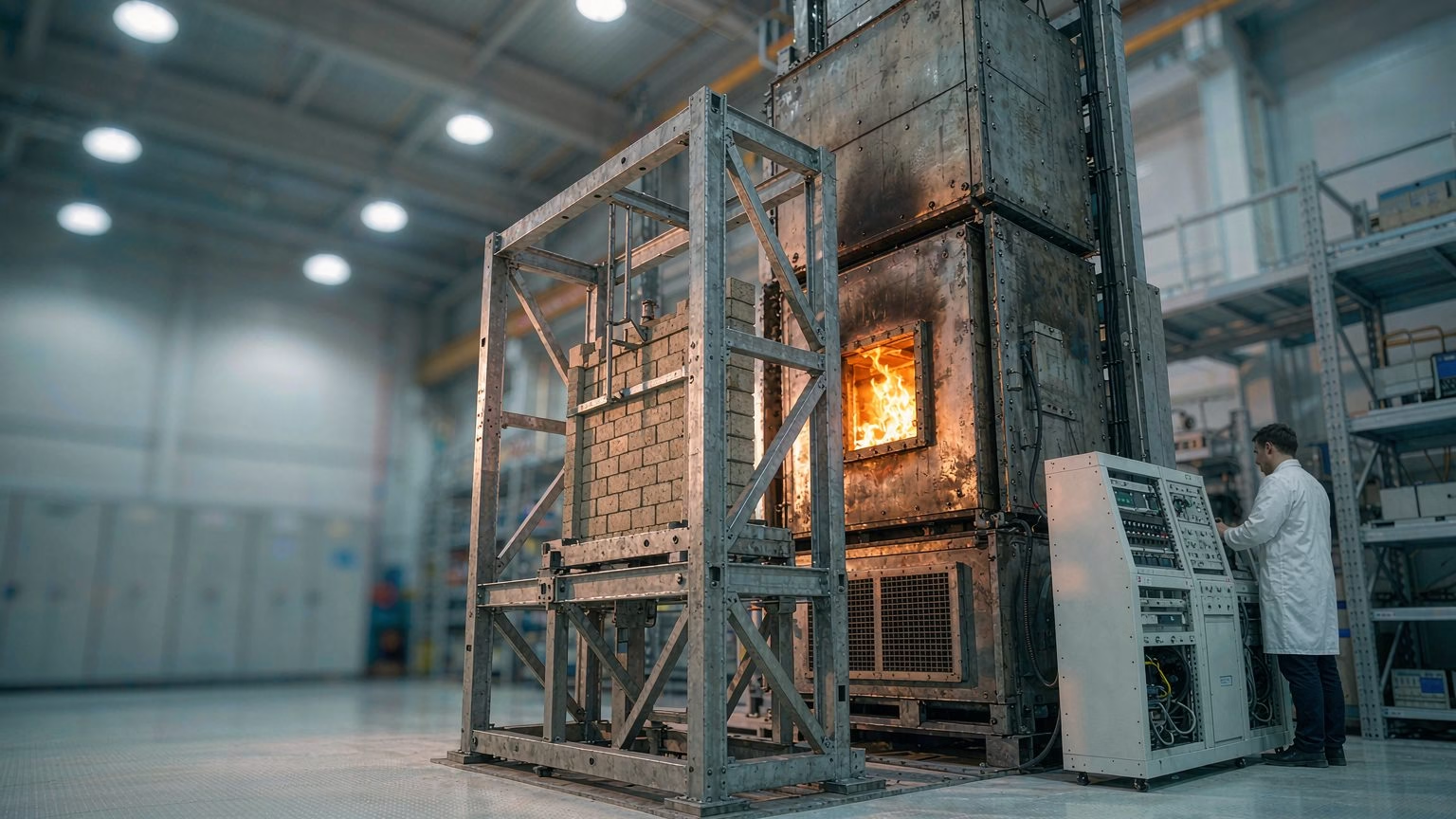
The EN 13823 SBI test is the intermediate-scale reaction-to-fire method that separates European classes A2, B, C and D for construction products other than floorings. Two specimen wings are mounted at 90° to form a corner, a 30.7 kW propane burner is placed at the foot of that corner, and the test runs for 20 minutes while heat release and smoke production are measured in the exhaust duct. The outputs — FIGRA, THR600s, SMOGRA, TSP600s, lateral flame spread and flaming droplets — are then converted into a classification string such as B-s2,d0 under EN 13501-1.
Two things surprise most people reading a classification report. First, the class is not a single number but a set of independent limits, and failing any one of them moves the product down. Second, the classification describes the product as tested — substrate, thickness and fixing method included — not the material in the abstract.
What the EN 13823 SBI Test Records
The apparatus records continuous measurements throughout the run and derives a small set of classification quantities from them. Understanding which quantity controls which decision is the key to reading a classification report.
Heat Release Parameters
Heat release rate is obtained by oxygen-consumption calorimetry: the instrument measures how much oxygen the exhaust stream loses, and converts that deficit into energy. FIGRA (fire growth rate index) is calculated as 1,000 × max[HRRav(t) / (t − 300)], where HRRav is the heat release rate averaged over 30 seconds and t is the time elapsed since ignition. The search for that maximum only begins once the specimen’s total heat release has passed a threshold — 0.2 MJ for the class B evaluation and 0.4 MJ for classes C and D.
THR600s is simply the total heat released by the specimen in the first 600 seconds of exposure. It answers a different question from FIGRA: not how fast, but how much. A product can burn steadily with a modest FIGRA and still accumulate a large THR600s, and it must satisfy both limits.
Smoke Parameters
Smoke production rate is derived from the attenuation of a white-light beam across the duct. SMOGRA (smoke growth rate index) is the smoke equivalent of FIGRA, computed as 10,000 × max[SPRav(t) / (t − 300)]. TSP600s is the total smoke produced in the first 600 seconds. Together they set the smoke sub-class — s1, s2 or s3 — which is reported alongside the main class.
Visual Observations
Not everything is instrumented. Two observers watch the specimen through the window and record lateral flame spread (whether flame reaches the outer edge of the long wing) and the occurrence of flaming droplets or particles, including how long each one persists. Those observations produce the d sub-class. A product that meets every numeric limit but sheds droplets that burn for more than 10 seconds cannot claim d0.
How Test Data Becomes a Classification
The conversion is mechanical but unforgiving, and three rules govern it.
Choosing the Right FIGRA Threshold
Two FIGRA values are calculated from the same test. FIGRA0.2MJ starts its search once 0.2 MJ has been released; FIGRA0.4MJ waits until 0.4 MJ has been released. The class B limit is applied to FIGRA0.2MJ, while the class C and D limits are applied to FIGRA0.4MJ.
A higher threshold can only move the start of the search window later, so the two indices coincide whenever the peak occurs after both thresholds. They diverge only for products that peak very early — precisely the behaviour the lower threshold catches. Quoting a single FIGRA number without stating which threshold applies makes it meaningless.
Why Means Are Used, Not Single Results
The continuous parameters that enter a classification are the arithmetic means of the specimens tested. This matters because SBI results scatter: repeat tests on nominally identical assemblies can land in different places, and a multi-laboratory round-robin is the only way to establish how large that scatter should be.
This is where Annex B of the standard earns its keep. It reports precision data from an early round-robin and from a later exercise run in 2015–2016. When a laboratory or a client argues about whether two results differ, Annex B is the reference — not intuition about how much fire tests “usually” vary.
Combining Results From Different Tests
The EN 13823 SBI test rarely stands alone. Which other methods are required depends on the class being claimed and the product category, and the combinations are fixed by the classification standard.
| Class | Test methods involved | What the EN 13823 SBI test contributes |
|---|---|---|
| A1 | EN ISO 1182 non-combustibility; EN ISO 1716 gross calorific potential | Not required |
| A2 | EN ISO 1182 or EN ISO 1716, plus EN 13823 | Supplies the FIGRA and THR600s evidence the classification needs |
| B, C, D | EN ISO 11925-2 small flame, plus EN 13823 | Determines the class boundary; supplies smoke and droplet sub-classes |
| E | EN ISO 11925-2 | Not required |
| F | No performance determined | Not required |
The small flame test in that table is covered separately in our guide to EN ISO 11925-2, and the non-combustibility route is served by dedicated non-combustibility and gross heat of combustion equipment.
The Classification Limits the EN 13823 SBI Test Feeds
These are the limits the SBI outputs are compared against. They are set by the classification standard, not by the test method.
| Class | FIGRA limit | THR600s limit | Additional condition |
|---|---|---|---|
| B | ≤ 120 W/s (FIGRA0.2MJ) | ≤ 7.5 MJ | No lateral flame spread reaching the edge of the long wing |
| C | ≤ 250 W/s (FIGRA0.4MJ) | ≤ 15 MJ | Same lateral spread condition |
| D | ≤ 750 W/s (FIGRA0.4MJ) | No THR600s limit at this class | Same lateral spread condition |
| s1 | SMOGRA ≤ 30 m²/s² | TSP600s ≤ 50 m² | Best smoke performance |
| s2 | SMOGRA ≤ 180 m²/s² | TSP600s ≤ 200 m² | Intermediate |
| s3 | Neither s1 nor s2 | — | Highest smoke production |
| d0 | — | — | No flaming droplets or particles in the first 600 s |
| d1 | — | — | No droplet persisting longer than 10 s |
| d2 | — | — | Neither d0 nor d1 |
Read a classification string with that table in hand and it becomes legible immediately. B-s2,d0 means the heat release limits for class B were met, smoke production fell in the middle band, and no flaming droplet was observed during the first ten minutes. The full classification framework, including how A1 and A2 are reached through the non-combustibility route, is set out in our guide to EN 13501-1 Euroclass classification.
Which Products the EN 13823 SBI Test Applies To
The method covers essentially flat construction products exposed to a corner fire, with clearly defined exclusions and category-specific rules.
Non-Flooring Construction Products
Wall panels, insulation boards, cladding, ceiling systems, composite panels and similar flat products form the main population. The standard notes that it was developed for essentially flat products and that some product families — linear products such as pipes, ducts and cables — may need special rules. Specimens are conditioned to constant mass before testing, with a minimum conditioning period of 72 hours, because moisture content changes how a product burns.
Floorings, Linear Pipe Insulation and Cables
Floorings are excluded outright. They are classified through a different test programme built around the radiant panel method, and their classes carry the subscript “fl”. Linear pipe thermal insulation products carry the subscript “L”. Power, control and communication cables sit under a separate classification standard entirely. Trying to have a flooring tested to EN 13823 will be refused by any competent laboratory, because the method does not represent a flooring fire scenario at all.
What the EN 13823 SBI Test Cannot Tell You
Three limits cause most of the argument between manufacturers and specifiers.
- It is not a fire resistance test. Reaction to fire describes what a product contributes to a growing fire; fire resistance, classified separately, describes how long an assembly holds one back. A specification often needs both.
- The classification belongs to the assembly, not the material. The substrate, the thickness, the joints and the fixing method all influence the result. A classification report documents the configuration tested; changing any of those parameters can invalidate it for the intended application.
- It is an intermediate scale, not a full scale. The SBI test is a deliberate compromise between repeatability and realism. Real façade fires involve whole systems and larger ignition sources, which is why large-scale façade tests exist alongside it.
The relationship between the intermediate scale and the larger-scale methods, and where each one sits in a global compliance programme, is covered in our guide to global building material fire testing standards.
What Changed in the 2020+A1:2022 Edition
The current consolidated edition is EN 13823:2020+A1:2022, published as a 101-page document organised into clauses 1–10 and annexes A through G. Amendment A1 was issued in July 2022 and updated calibration procedures and precision data.
For anyone interpreting test data, three changes matter. The duct flow probe changed from bi-directional to hemispherical, and the Reynolds correction coefficient moved from 1.08 to 1.24, so airflow is computed on a different basis. A CO₂ correction was introduced into the heat release calculation, which uses a general energy value of 17.2 MJ per cubic metre of oxygen consumed. And the smoke production rate baseline window moved from 390–450 s to 210–270 s, shifting the reference level against which every smoke figure is measured.
The classification parameters themselves — FIGRA, THR600s, SMOGRA, TSP600s, lateral flame spread and droplets — were not changed. Edition differences therefore live in the measurement and calculation chain rather than in the pass criteria.
Running an EN 13823 SBI Test
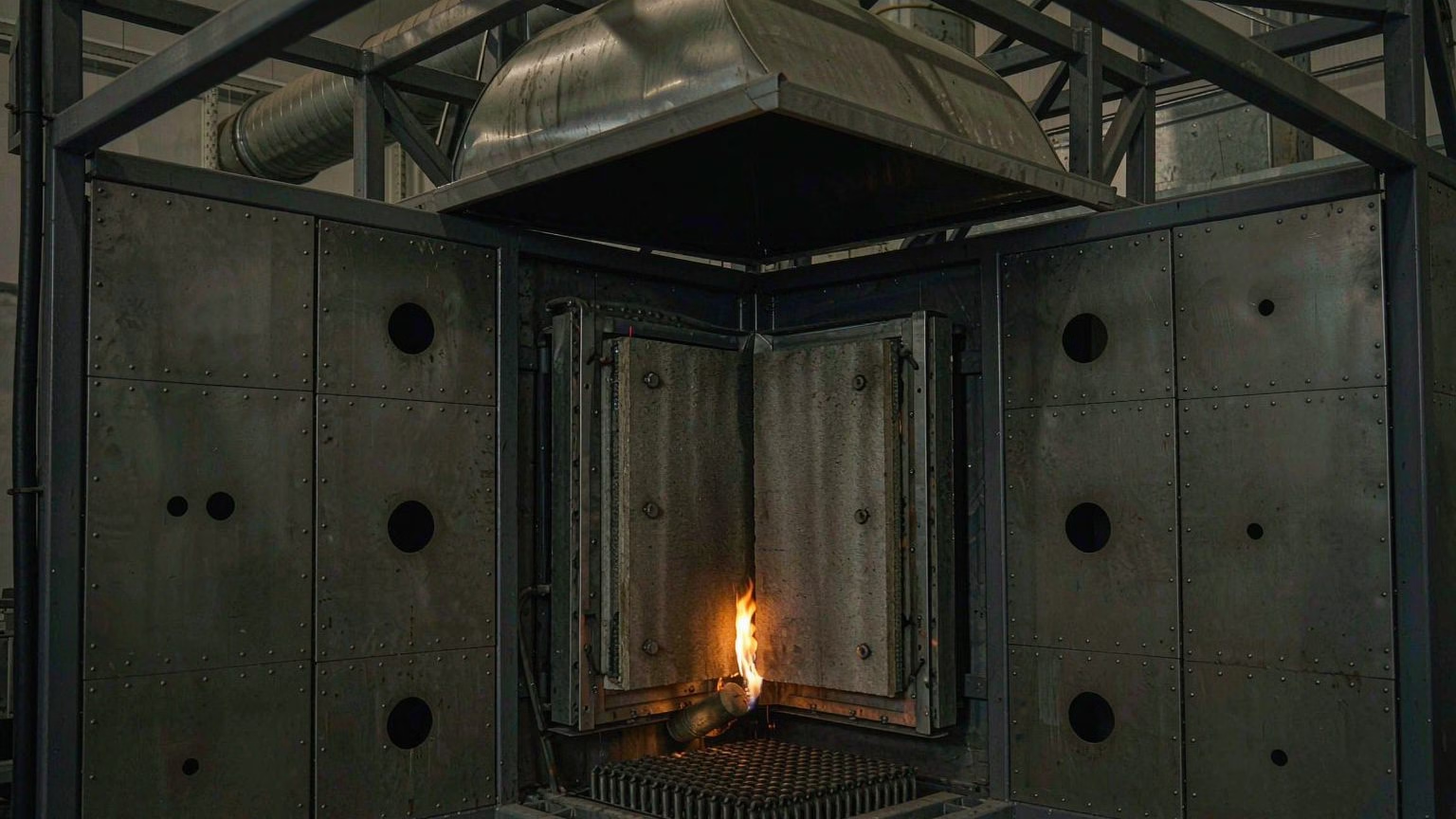
A test sequence in outline: build the specimen as the two-wing corner using the intended in-service fixing method; condition it to constant mass in accordance with the conditioning standard; mount it on the trolley and dock it into the frame; establish the exhaust flow at 0.50–0.65 m³/s normalised to 298 K; run the auxiliary burner to establish a baseline; ignite the main burner at t = 300 s; record for the full 21-minute sequence; and observe flame spread and droplets throughout.
Before any of that, the instrument must have passed its calibrations. The step calibration verifies that measured heat release tracks the burner’s known gas output continuously within 100 ± 5%, and the n-heptane calibration checks the whole chain against a fuel of known calorific value with a target of 4,456 ± 222.8 MJ/kg. When results look strange, the calibration record is the first place to look — and the order of checks matters.
Related Standards and Equipment
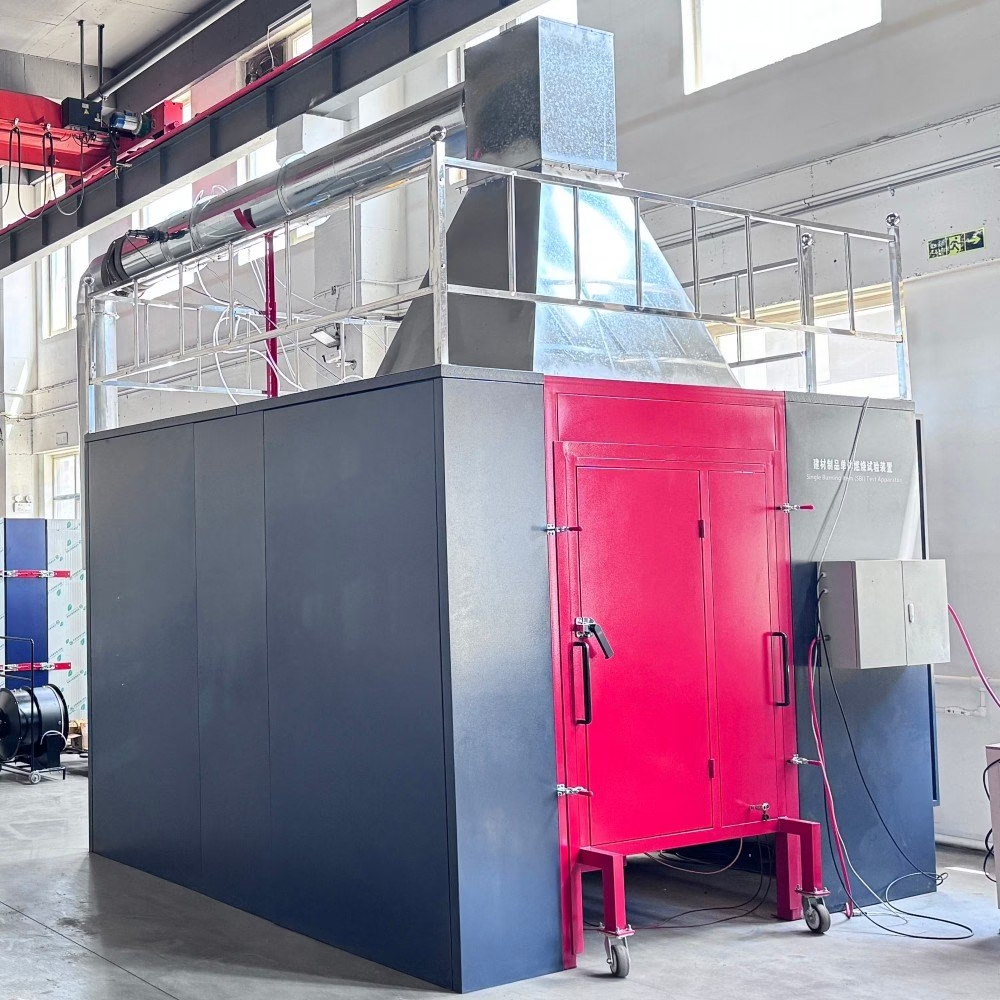
The instrument itself is described on our single burning item SBI test apparatus page, with the full parameter set on the fire test parameters page. Readers weighing the SBI test against bench-scale calorimetry will find the trade-offs in SBI versus cone calorimeter, and the overall selection logic in the SBI test apparatus compliance guide. Equipment for the wider fire testing programme sits under fire and flame testing equipment.
Frequently Asked Questions
What is the difference between EN 13823 and EN 13501-1?
They do different jobs. EN 13823 is the test method: it defines the apparatus, the specimen, the procedure and the calculations that produce FIGRA, THR600s, SMOGRA and TSP600s. EN 13501-1 is the classification standard: it takes those results, combines them with results from other tests where required, and assigns the final class. One produces data, the other produces the label.
How long does the EN 13823 SBI test last?
The recorded sequence runs 21 minutes, with the main burner ignited at 300 seconds so the specimen is exposed for 20 minutes. Most classification quantities use only the first 600 seconds after ignition. Total laboratory time is much longer, because specimens must be conditioned to constant mass for at least 72 hours before the run and multi-layer assemblies can take hours to build.
Why do classification reports show two FIGRA values?
Because two are calculated from the same run. FIGRA0.2MJ begins its search after 0.2 MJ has been released and is used for the class B limit; FIGRA0.4MJ waits for 0.4 MJ and is used for the class C and D limits. The two coincide whenever the peak occurs after both thresholds, and diverge only for products that release heat very early — which is the behaviour the lower threshold exists to catch.
Can a product be classified without an EN 13823 SBI test?
For classes A1, E and F, yes. Class A1 is reached through the non-combustibility and gross calorific potential tests, class E through the small flame test alone, and class F means no performance was determined. Classes A2, B, C and D all require the SBI test, because those classes are separated by FIGRA and THR600s values that only this method produces.
Does the substrate used in the test affect the classification?
Yes, substantially. The classification describes the product as tested, and the substrate, thickness, joints and fixing method are all part of that configuration. A thin render or a change of substrate can shift the measured FIGRA meaningfully, which is why the specimen must be built to the intended end-use construction and why the test report documents the build-up in detail.
Why do repeat tests on the same product give different results?
Because the method has real scatter, both between specimens and between test campaigns. The standard addresses this through Annex B, which reports precision data from an early round-robin and from a later exercise in 2015–2016. Those figures — not assumptions about how much fire tests usually vary — are what should be used when deciding whether two results differ beyond expected variation.
Is the EN 13823 SBI test the same as a fire resistance test?
No. Reaction to fire, which the SBI test measures, describes how a product contributes to a fire’s growth in its early stages: how much heat it releases, how fast, how much smoke it produces and whether it sheds burning droplets. Fire resistance describes how long an assembly prevents a fully developed fire from passing through, and it is classified under a separate standard. A specification frequently calls for both.
Reading a Classification: A Decision Sequence
- Identify the product category — flooring, linear pipe insulation, or everything else — because that fixes which test programme applies.
- Confirm which classes you need to reach, since the required test combination changes between A1/A2 and B/C/D.
- Read the classification string in three parts: main class for contribution to fire, s for smoke, d for droplets.
- Check the FIGRA threshold that produced the number before comparing it to a limit.
- Verify that the configuration tested matches the application, including substrate and fixing method.
- Check the edition the report was produced under, since the 2020+A1:2022 measurement basis differs from earlier editions.
If the classification route is not yet settled, the technical team can help map your product range onto the applicable test programme through our contact page.
References
- BSI Knowledge — Reaction to fire tests for building products: building products excluding floorings exposed to the thermal attack by a single burning item. knowledge.bsigroup.com
- NEN — NEN-EN 13823:2020+A1:2022 en, current edition, 101 pages, published 1 August 2022. nen.nl
- NSAI Standards — I.S. EN 13823:2020, superseded by I.S. EN 13823:2020+A1:2022. shop.standards.ie
- NBS — IS EN 13823:2020 (+A1:2022), Amendment 1 issued July 2022. thenbs.com
- NEN — NEN-EN 13501-1:2019 en, fire classification of construction products and building elements, 55 pages. nen.nl
- NSAI Standards — I.S. EN 13501-1:2019, classification using data from reaction to fire tests. shop.standards.ie
- European Commission — CE marking for manufacturers under the Construction Products Regulation. ec.europa.eu
- RISE Research Institutes of Sweden — fire safety and reaction-to-fire research. rise.se
- BRE Group — fire testing, certification and research. bre.co.uk
About This Guide
Prepared by the technical content team at Shenyang Baoruitong Automation Equipment (BRT), a manufacturer of reaction-to-fire and fire resistance test equipment. Classification limits quoted here are set by EN 13501-1 and are reproduced to explain how EN 13823 SBI test data is used; specimen geometry, burner output, flow rate, analyser performance, step calibration and n-heptane criteria come from EN 13823 and its annexes. Where a figure is a laboratory-dependent target rather than a standard limit, it is described as such. Configuration-specific classifications must be confirmed against the test report for the assembly concerned.