- The Short Answer
- What Fire Resistance Testing for Steel Fireproof Coatings Actually Measures
- Two Standards for Fire Resistance Testing for Steel Fireproof Coatings
- From Furnace Data to a Thickness Schedule
- Intumescent Coatings Add Their Own Variable
- The North American Route for Steel Fireproof Coatings
- Equipment for Fire Resistance Testing of Steel Fireproof Coatings
- Frequently Asked Questions
- Which standard is used to test fireproof coatings on steel?
- What does a coating fire resistance test actually measure?
- What is the critical steel temperature and where does it come from?
- Does an EN 13381-8 report cover any steel section?
- How is a coating thickness schedule produced?
- Can a coating tested to the building curve be used on an oil and gas structure?
- How is a coated steel member verified on site?
- Conclusion: A Decision Order
- About the Author
- Sources
The Short Answer
Fire resistance testing for steel fireproof coatings is a furnace test that measures steel temperature, not coating performance. A coated steel beam or column is heated to the ISO 834-1 curve 4 under EN 1363-1 5, and the steel temperature is recorded until it reaches the critical temperature used for the design. Two European methods make this work: EN 13381-4 for applied passive protection (boards, renders, sprayed systems) 1 and EN 13381-8 for applied reactive protection (intumescent coatings) 2, both listed as the 2013 editions [1][2]. The output is not a pass mark but an assessment report converting furnace data into a minimum thickness schedule per section factor and R-rating, classified under EN 13501-2 6. The question is never “is this coating fire resistant” but “for which section factor, which R-rating and which standard does this thickness schedule hold”.
What Fire Resistance Testing for Steel Fireproof Coatings Actually Measures
The Curve That Drives the Test
The exposure is not a flame but a prescribed temperature history. The generic requirements live in EN 1363-1:2020 [5]; the curve itself in ISO 834-1:2025 [4]. It is the familiar logarithmic rise: gas temperature reaches roughly 842 °C at 30 minutes, 945 °C at 60 minutes, 1,006 °C at 90 minutes and 1,049 °C at 120 minutes. That is gas temperature in the furnace, not the protected steel — the steel always lags behind, and how far behind is the whole point of the test.
The Recorded Quantities
What the coating test measures is the temperature reached by the protected steel section and, in many assessments, the unheated side of the assembly.
| Recorded quantity | Why it decides the result |
|---|---|
| Gas temperature in the furnace | Confirms the exposure followed the ISO 834-1 curve [4] |
| Steel temperature at the thermocouple positions | The compliance quantity against the critical temperature |
| Time to reach the critical temperature | Sets the fire resistance duration in minutes |
| Unprotected reference section | Gives the baseline heating rate for the same geometry |
| Observation of coating behaviour | Intumescence, cracking, delamination, spalling, fall-off |
The Critical Steel Temperature
The critical steel temperature is the design input that turns temperatures into a rating. It is not a constant fixed by the test standard: it comes from the structural fire design of the member under Eurocode 3, Part 1-2, whose current edition is EN 1993-1-2:2024, in force since 20 March 2024 3. That version change is worth catching — the previous 2005 edition is shown as withdrawn on the same date, so a report still citing “EN 1993-1-2:2005” works from a superseded document.
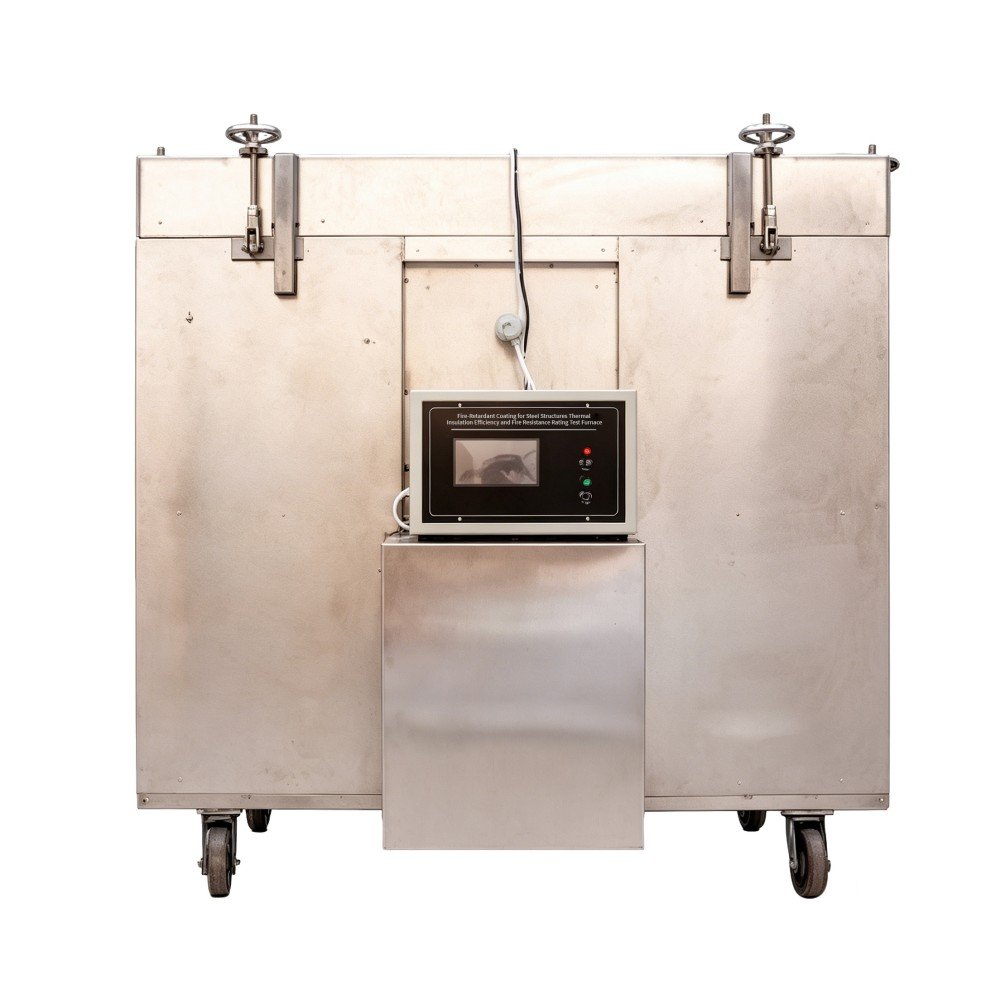
The coating is a system, not a film: the specimen includes substrate preparation, primer, coating at a defined dry film thickness, steel grade and section, and the fixing and joint detail. A datasheet describes the product; a test report describes an assembly.
Two Standards for Fire Resistance Testing for Steel Fireproof Coatings
The word “fireproof coating” hides a distinction that decides which standard applies. A coating either does something to the fire (reactive: it intumesces, chars and insulates) or does something to the steel (passive: it adds mass and board protection that delays heating). EN 13381-4 and EN 13381-8 were written for these two behaviours separately, and a test report under one of them says nothing about the other [1][2].
EN 13381-4: Applied Passive Protection
Part 4 covers protection systems that delay the heating of the steel — boards, cementitious renders, sprayed systems and similar layers. Its title is explicit about the boundary: test methods for determining the contribution to the fire resistance of structural members, applied passive protection to steel members [1]. It was listed in force on 1 May 2013 [1], and older project files often reference pre-2013 national editions, so an audit should start by confirming which edition the assessment report was written against.
EN 13381-8: Applied Reactive Protection
Part 8 covers reactive systems — intumescent and expandable coatings whose protective action is triggered by heat. The scope wording mirrors Part 4 with the protection type changed to applied reactive protection [2], with the same in-force date of 1 May 2013 [2].
| Aspect | EN 13381-4:2013 (passive) | EN 13381-8:2013 (reactive) |
|---|---|---|
| Protection type | Boards, renders, sprayed systems, cementitious layers | Intumescent and expandable coatings |
| What the coating does | Delays heat reaching the steel | Reacts to heat, forms an insulating char |
| Applies to | Steel members used as beams or columns | Steel members used as beams or columns |
| Scope limit | Sections without web openings | Sections without web openings |
| Tension members | Not directly applicable without further evaluation [1] | Not directly applicable without further evaluation [2] |
| Assessment output | Thickness schedule and fire resistance of the assembly | Thickness schedule and fire resistance of the assembly |
Scope Limits That Belong in the Specification
Both parts carry the same structural limitation, and it belongs in a written specification: the method covers sections without openings in the web, and it is not directly applicable to structural tension members without further evaluation [1][2]. A lattice column with web holes, a tension bracing member or a heavily penetrated column therefore sits outside the direct scope of both methods — a report claiming “EN 13381-8 certified” does not by itself cover that member.
From Furnace Data to a Thickness Schedule
The commercial output of a coating fire test is a table, not a certificate of “fire resistance”. The route from furnace data to a usable document runs through four steps, and each step is where a specification can go wrong.
How the Thickness Schedule Is Derived
- Furnace testing of coated sections. A set of sections with different section factors and different coating thicknesses is tested under the ISO 834-1 curve [4].
- Calculation of the unprotected reference. The same section geometry is assessed without protection, giving the baseline heating rate.
- Derivation of the thickness schedule. The protected section is matched to the unprotected section with a safety margin, producing the minimum coating thickness for a given section factor and fire resistance duration.
- Classification and extension. The assembly is classified under EN 13501-2:2023 [6], and the assessment report may extend the tested results to other section factors, spans and thicknesses within defined limits.
Why Section Factor Decides Everything
The section factor is the exposed perimeter divided by the cross-sectional area, and it governs how fast a section heats: a slender hollow section with a large perimeter-to-area ratio heats faster than a compact solid section, so it needs a thicker coating for the same duration. That is the parameter an extended-application assessment manipulates — and the reason a coating that passed on one profile may not be usable on another.
A specification saying “apply X mm of coating for R 60” without naming the section factor, steel grade, span and standard is incomplete in a way no laboratory can fix later, because those are the inputs the thickness was derived from. The thickness is not a catalogue constant either: it is a function of geometry and duration, which is why published tables are indexed by section factor and R-rating rather than a single number.
Intumescent Coatings Add Their Own Variable
A reactive coating does not protect the steel by mass; it protects it by chemistry, so the assessment must capture the reaction, not just the end point. The system is tested as supplied, including any primer, because primer and coating can interact.
Ageing, Primers and Site Application
Environmental ageing matters for the same reason: the assessment states which conditioning the thickness schedule is valid for, and a schedule quoted without its conditioning basis is not a complete document.
| Variable that voids a thickness schedule | What changes | How it is controlled |
|---|---|---|
| Primer compatibility | Primer and coating may interact in the char layer | System tested as supplied, primer named in the report |
| Environmental ageing | Surface chemistry and adhesion change over time | Assessment states the conditioning basis |
| Dry film thickness | Less coating means a thinner insulating char | DFT measurement against the schedule on site |
| Substrate and section | Section factor changes the heating rate | Schedule indexed by section factor and R-rating |
| Joints, fixings, penetrations | Local discontinuities in the protection | Detail matching the tested assembly |
For readers who want the underlying strategy of protecting steel first, the article on fire resistance testing for steel structures sets out the three protection routes and the assessment report in broader context. For the product question — what a coating does versus what a fire-resistant board does — see fire retardant coating vs fire resistant coating.
The North American Route for Steel Fireproof Coatings
Outside Europe the same logic runs through two ASTM methods. ASTM E119 covers fire tests of building construction and materials and remains the reference method for time-temperature exposure and hose-stream testing of building elements 7. For structures exposed to large hydrocarbon pool fires — refinery platforms, petrochemical plant, offshore installations — ASTM E1529 provides the standard test methods for determining the effects of such fires on structural members and assemblies, with its own exposure definition based on the total flux incident on the specimen 8.
Why the Exposure Decides the Coating
The two routes ask different questions of the same product. A cellulosic curve is a slow, sustained exposure; a hydrocarbon pool fire is fast and intense. A coating assessed only against a building curve is not thereby assessed against a hydrocarbon exposure, and an oil-and-gas project that specifies “fire resistant coating” without naming the exposure has not made the testable part of the requirement.
Equipment for Fire Resistance Testing of Steel Fireproof Coatings
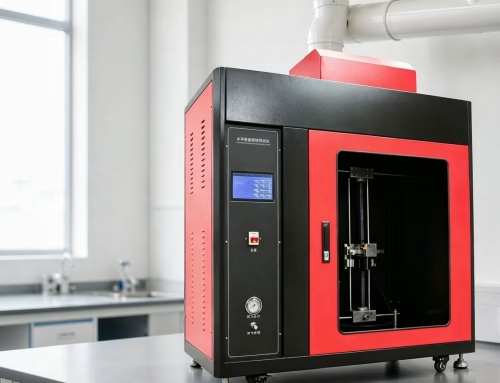
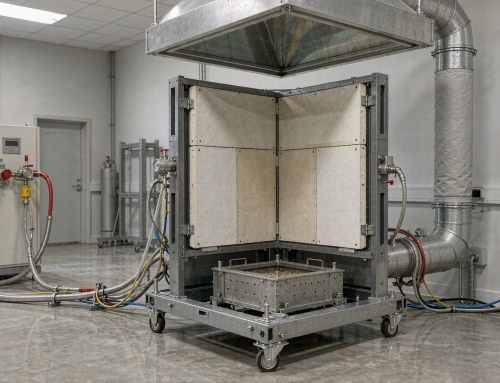
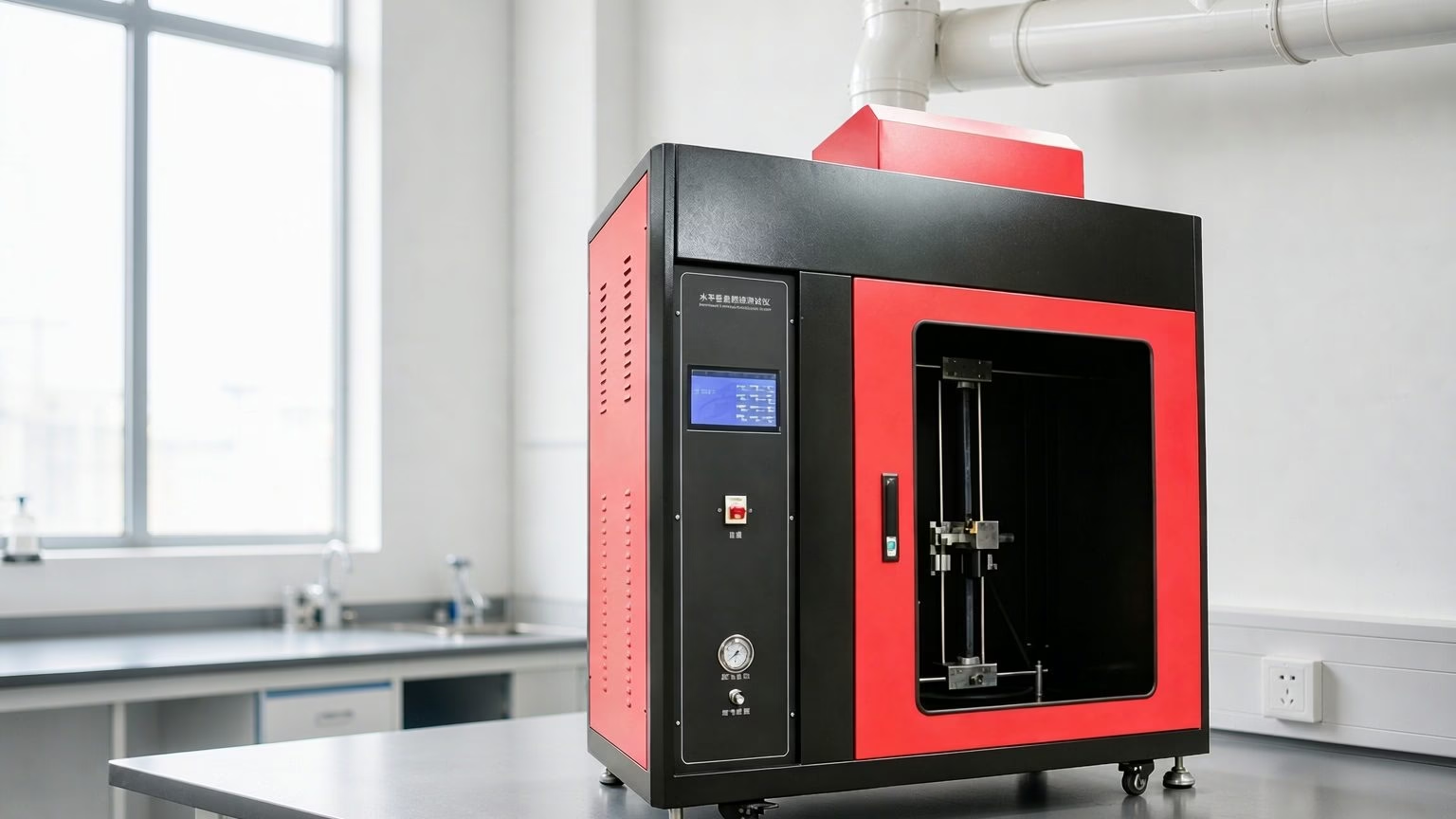
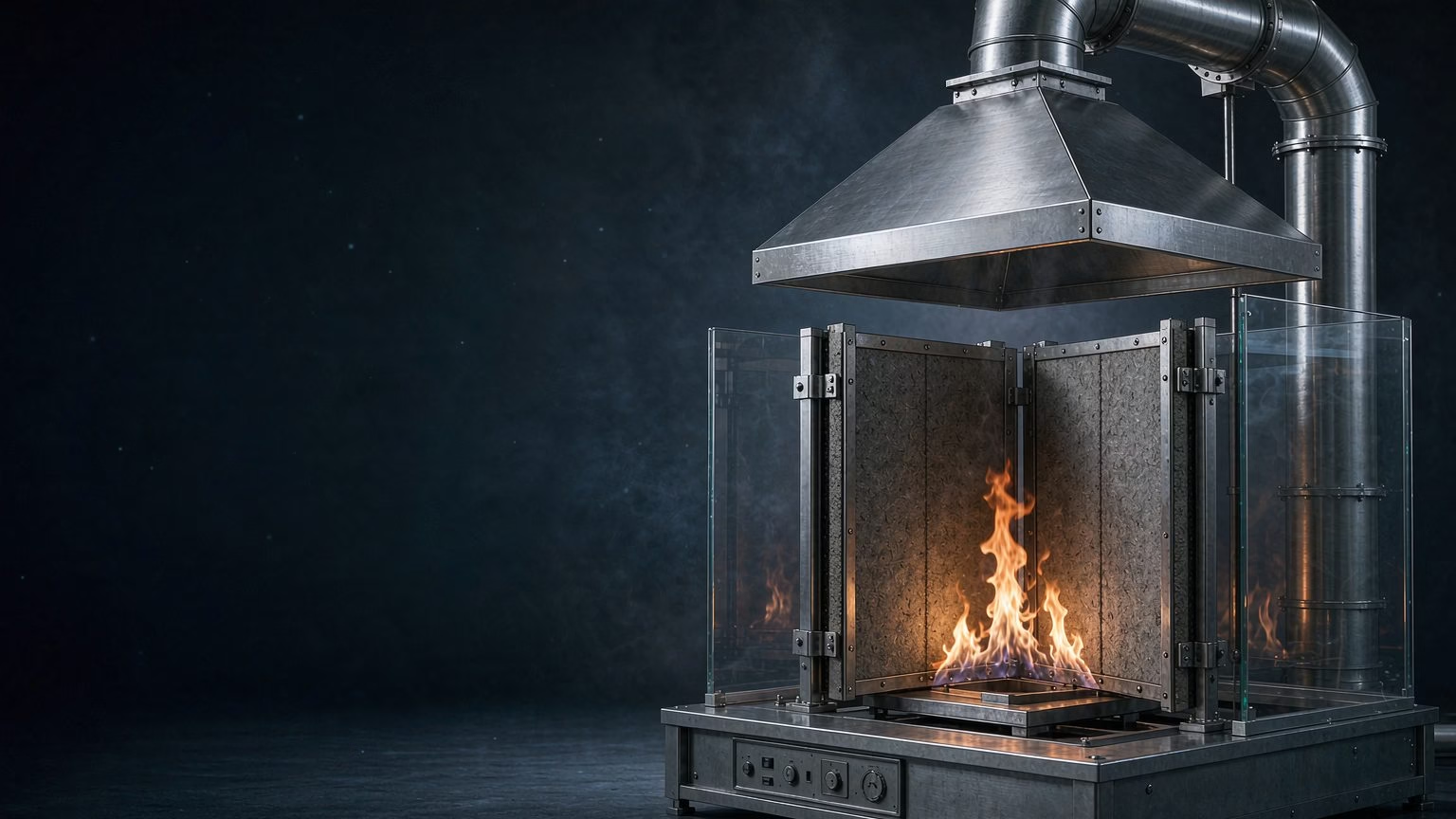
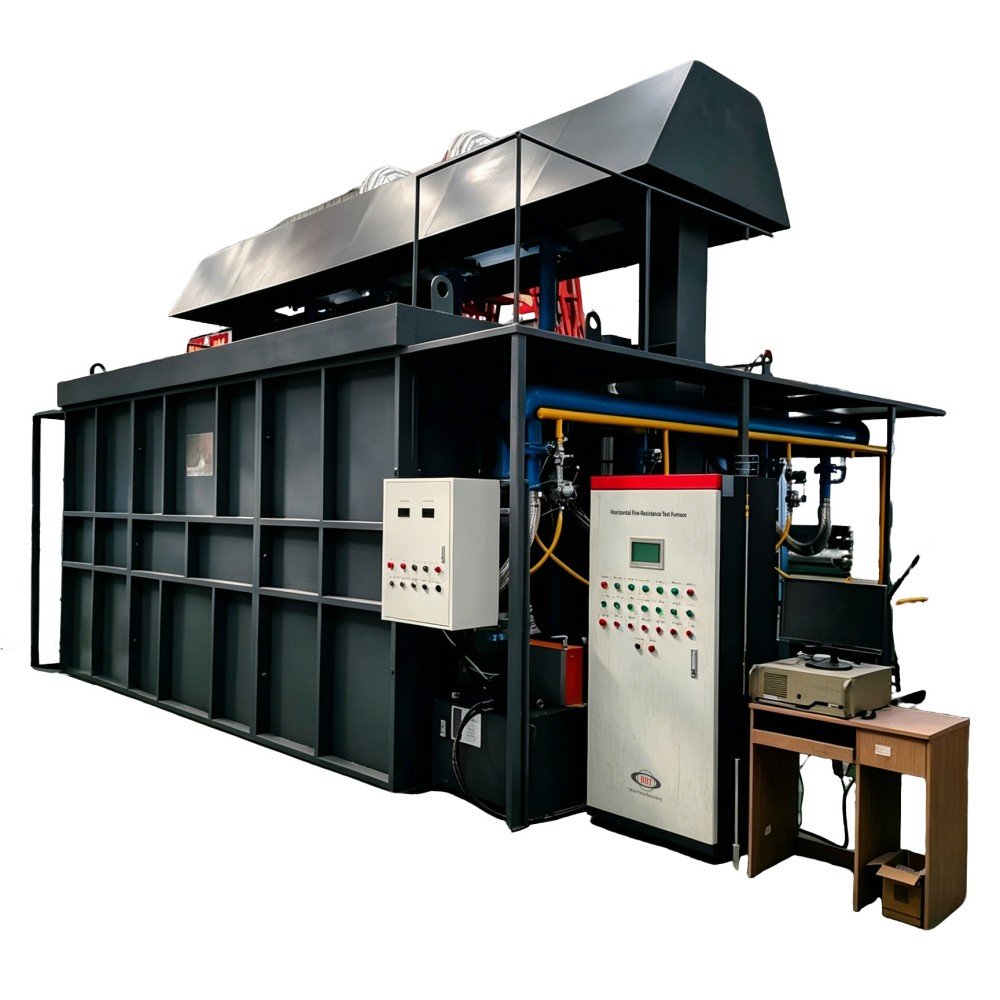
Buying the apparatus is the last step, but the specification drives it: a furnace with enough volume and control for the standard curve, thermocouple instrumentation positioned on the steel, a defined specimen support, and a measurement system that logs against the curve rather than against a stopwatch.
What to Check Before You Buy
A furnace intended for a coating test is also a furnace for coated steel members generally, which is why the equipment question overlaps with the wider fire resistance test furnace discussion.
| Purchase check | Why it matters in a coating test |
|---|---|
| Working volume vs largest member | A beam that does not fit cannot be tested to scale |
| Gas temperature uniformity along the specimen | The curve must be met at every thermocouple position |
| Thermocouple type, count and fixing method | The compliance quantity is the measured steel temperature |
| Logging interval and export format | The assessor needs curve-aligned records, not a stopwatch reading |
| Report output in the assessor’s format | Determines whether the run can be used without rework |
| Furnace atmosphere and draught control | Uncontrolled airflow biases the measured steel temperature |
Ask for the qualification package first: temperature uniformity verification over the working volume, the calibration certificate of the measurement chain, and a sample report from a real coated-section test. Fire resistance testing for steel fireproof coatings is only as good as that qualification chain. The fire retardant coating test furnace page covers the configuration options.
Frequently Asked Questions
Which standard is used to test fireproof coatings on steel?
Two European standards cover applied protection to steel members. EN 13381-4 covers applied passive protection such as boards, renders and sprayed systems, and EN 13381-8 covers applied reactive protection such as intumescent coatings. Both are the 2013 editions, and both are run with the ISO 834-1 temperature-time curve under the general requirements of EN 1363-1.
What does a coating fire resistance test actually measure?
It measures the temperature reached by the protected steel. Thermocouples on the section log how fast the steel heats under the ISO 834-1 curve, and the result is the time needed to reach the critical steel temperature specified for the member. The coating itself is judged by what it does to that steel temperature, not by a separate coating test.
What is the critical steel temperature and where does it come from?
It is the temperature at which the steel section is assumed to have lost its fire resistance. It is not set by the coating test standard; it is derived from the structural fire design of the member under Eurocode 3 Part 1-2, whose current edition is EN 1993-1-2:2024, in force since 20 March 2024. Using a critical temperature from the withdrawn 2005 edition can produce an assessment that no longer matches the code.
Does an EN 13381-8 report cover any steel section?
No. The test method covers steel members used as beams or columns and considers only sections without openings in the web. It is not directly applicable to structural tension members without further evaluation, so a perforated web, a lattice member or a heavily penetrated column needs a specific engineering justification that the coating report does not provide.
How is a coating thickness schedule produced?
A set of sections with different section factors and thicknesses is tested under the standard curve, an unprotected reference is calculated for the same geometry, and the results are matched with a safety margin to give a minimum thickness for each section factor and fire resistance duration. The assessment report then states the conditions under which that schedule may be extended to other geometries.
Can a coating tested to the building curve be used on an oil and gas structure?
Not on that evidence alone. A building curve is a slow, sustained exposure, while a large hydrocarbon pool fire is fast and intense. ASTM E1529 provides the methods for the hydrocarbon case, and a coating assessed under EN 13381 alone has not been assessed against that exposure.
How is a coated steel member verified on site?
By dry film thickness measurements against the approved thickness schedule, plus inspection of surface condition, preparation and continuity. The coating product, primer, substrate steel grade and thickness all form part of the tested assembly, so any substitution on site invalidates the assessment on which the schedule was based.
Conclusion: A Decision Order
- Fix the exposure and the standard first: ISO 834-1 under EN 1363-1 for building elements, ASTM E119 for the North American route, ASTM E1529 for hydrocarbon pool fires.
- Choose the test method by protection type: EN 13381-4 for passive protection, EN 13381-8 for reactive protection [1][2].
- Take the critical steel temperature from the current code, EN 1993-1-2:2024, not from a pre-2024 document [3].
- Ask for the assessment report with the thickness schedule, the section factors covered, the conditioning basis and the extension rules.
- Then buy the apparatus: a furnace with verified uniformity, proper thermocouple instrumentation and a data system that logs to the curve.
Run this order once per project and fire resistance testing for steel fireproof coatings stops being a vague promise of “fire protection” and becomes a document trail: an exposure, a standard, a critical temperature, a thickness schedule with named section factors, and a furnace capable of reproducing it. The two posts worth reading next are fire resistance testing for steel structures for the protection strategy and fire retardant coating vs fire resistant coating for the product classification that decides which method applies. For equipment, see the steel fire retardant coating test furnace and horizontal fire resistance test furnace pages; send BRT your section sizes and R-rating target and we will map the package.
About the Author
BRT Testing (Shenyang Baoruitong Automation Equipment) manufactures steel fire protection and fire resistance test equipment — coating test furnaces, vertical and horizontal resistance furnaces, and the instrumentation that runs the standard curves. The content team writes for fabricators, coating manufacturers and laboratory buyers, with the standard editions cited above verified against the UNI catalogue, the ASTM store and the ISO/IEC webstore in November 2026.
Sources
- UNI — EN 13381-4:2013, Test methods for determining the contribution to the fire resistance of structural members — Part 4: Applied passive protection to steel members (in force 01 May 2013). https://webstore.uni.com/en/en-13381-4-2013
- UNI — EN 13381-8:2013, Test methods for determining the contribution to the fire resistance of structural members — Part 8: Applied reactive protection to steel members (in force 01 May 2013). https://webstore.uni.com/en/en-13381-8-2013
- UNI — EN 1993-1-2:2024, Eurocode 3 — Design of steel structures — Part 1-2: Structural fire design (in force 20 March 2024; the 2005 edition is shown as withdrawn on the same date). https://webstore.uni.com/en/en-1993-1-2-2024
- UNI — ISO 834-1:2025, Fire-resistance tests — Elements of building construction — Part 1: General requirements (in force 30 May 2025). https://webstore.uni.com/en/iso-834-1-2025
- UNI — EN 1363-1:2020, Fire resistance tests — Part 1: General requirements (in force 19 February 2020). https://webstore.uni.com/en/en-1363-1-2020
- UNI — EN 13501-2:2023, Fire classification of construction products and building elements — Part 2: Classification using data from fire resistance and/or smoke control tests (in force 31 May 2023). https://webstore.uni.com/en/en-13501-2-2023
- ASTM — E119, Standard Test Methods for Fire Tests of Building Construction and Materials. https://store.astm.org/e119.html
- ASTM — E1529, Standard Test Methods for Determining Effects of Large Hydrocarbon Pool Fires on Structural Members and Assemblies. https://store.astm.org/e1529.html