Testing the fire performance of building insulation means running the four reaction-to-fire tests that produce a Euroclass — non-combustibility, calorific potential, SBI and small flame — and then adding the tests that the Euroclass does not cover. Which of the four actually decide the result depends entirely on the product: mineral wool is decided by non-combustibility and calorific potential, EPS and XPS are decided by the SBI and the small-flame test, and a foil-faced PIR board is decided by how its facings behave. Facade systems then need an assembly test on top, and pipe insulation is classified on a separate table with its own limits. This guide follows that order.
Start With the Product Type, Not the Test
Every insulation enquiry should begin with the material, because the material determines which criteria are reachable and which are not. A product that is 98 % inorganic cannot fail a calorific potential limit; a product that is 98 % hydrocarbon cannot pass one. Knowing where a product sits tells you which test will be the expensive one.
| Product | Typical Euroclass route | What usually decides the result |
|---|---|---|
| Mineral wool (stone or glass) | A1 or A2-s1,d0 | Binder and organic content drive the calorific potential; the fibre itself is non-combustible 10 |
| EPS and XPS | B-s1,d0 to E | Flame-retardant package and the SBI heat release; small-flame spread sets the floor |
| PUR and PIR foam | B to C, often with s1 or s2 | Foam chemistry and facing; un-faced foam rarely reaches B |
| Phenolic foam | B-s1,d0 to C-s2,d0 | Brittle surface and facing adhesion; SBI behaviour dominates |
| Wood fibre and cellulose | D to E, sometimes C | Calorific content is high by nature; the route is SBI plus small flame |
| Foam glass | A1 or A2-s1,d0 | Inorganic body; facings and adhesives decide A1 versus A2 |
| Foil-faced boards (any core) | Class of the composite | The facing is a substantial component and must be assessed separately 1 |
The Four Reaction-to-Fire Tests Behind a Euroclass
The Euroclass system is a classification, not a test. It is assigned on the basis of results from four methods, and the current criteria for each class are fixed in EU law rather than left to the laboratory [1]2. Understanding which test feeds which class is the difference between a planned test programme and an expensive sequence of retests.
Non-Combustibility and Calorific Potential: The A Route
For A1 and A2, two methods run in parallel. ISO 1182 places a 45 mm diameter, 50 mm high cylinder in a furnace stabilised at 750 °C and records furnace temperature rise, mass loss and duration of sustained flaming — the last of these being a defined term, not an observation 312. EN ISO 1716 burns a milled sample in an oxygen bomb and returns the gross calorific potential in MJ/kg 4. A1 requires all four criteria — temperature rise, mass loss, no sustained flaming and a PCS at or below the limit — while A2 relaxes the furnace criteria and allows a higher calorific value. In practice, insulation manufacturers spend most of their development effort on the second number, because that is where a binder or a facing shows up.
SBI: Where B, C and D Are Decided
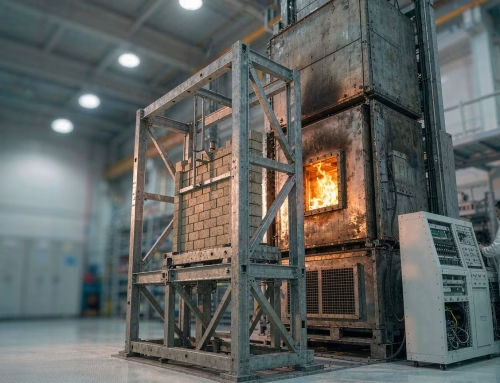
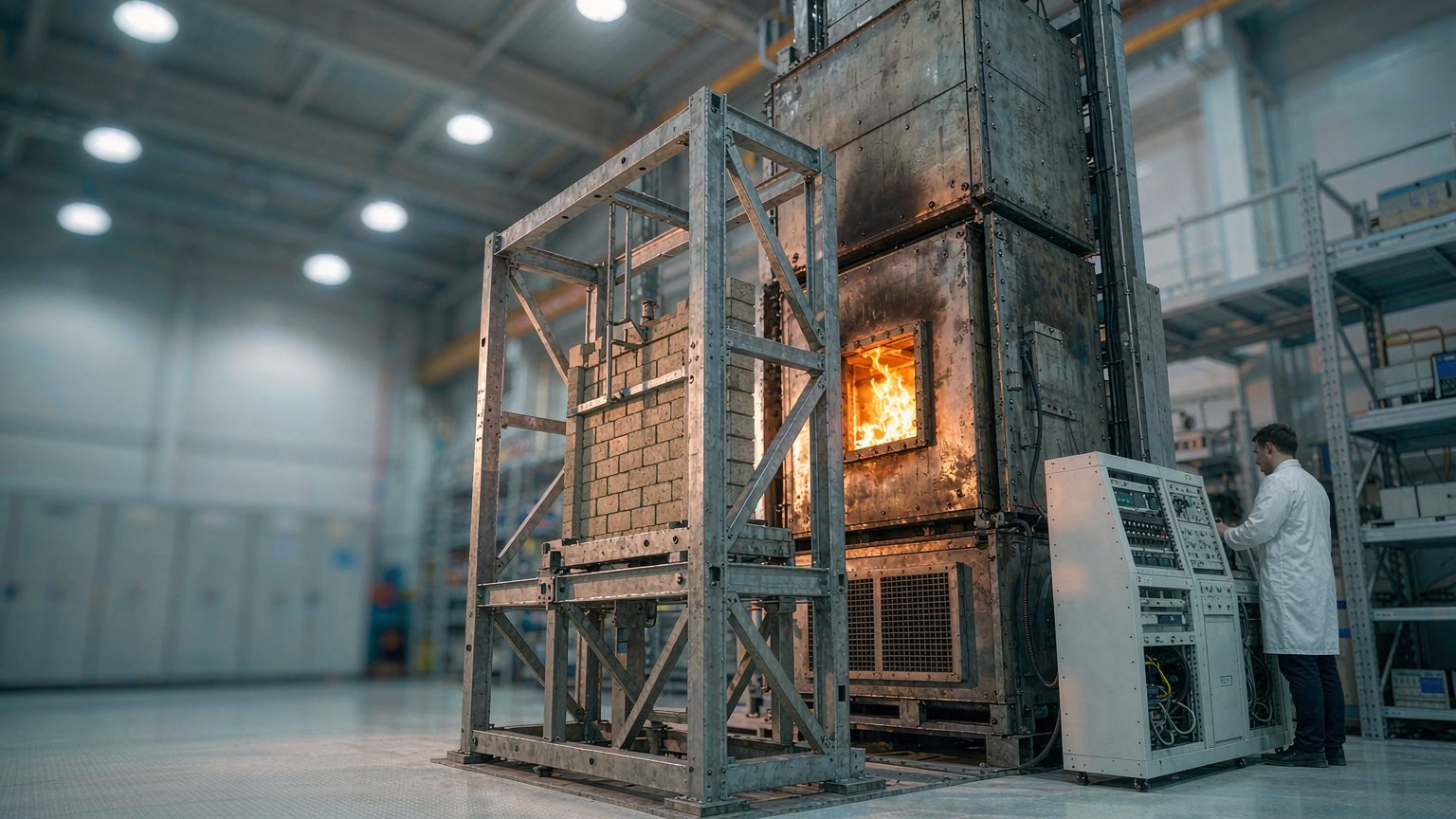
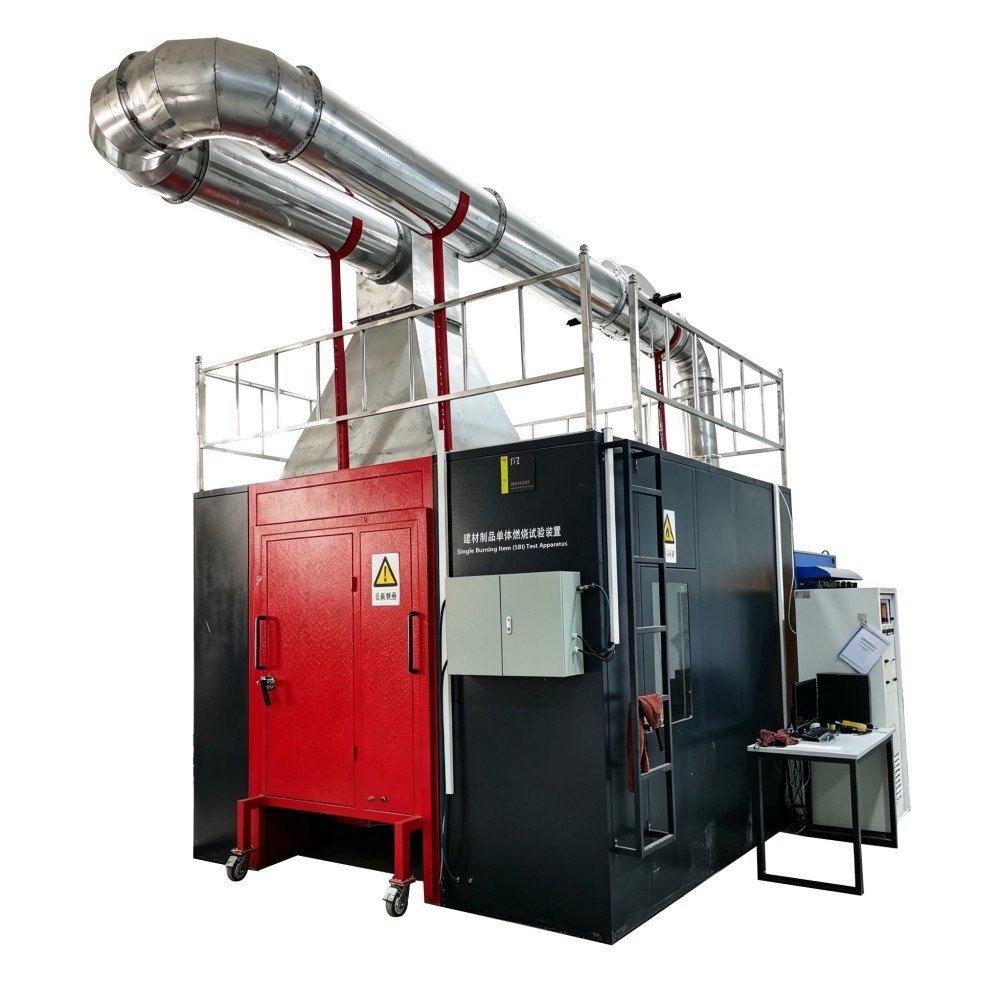
The single burning item test, EN 13823, mounts two boards in a corner configuration, exposes them to a 30 kW propane sand-box burner for 20 minutes and measures heat release, lateral flame spread and smoke 5. It outputs FIGRA (fire growth rate index), THR600s (total heat release in the first ten minutes), LFS (lateral flame spread against the specimen edge), SMOGRA and TSP600s. For most foam insulations this is the test that decides the commercial class, and it is also the test most sensitive to mounting and joint detail — a point covered in our SBI calibration guide.
Small Flame: The E and F Floor
EN ISO 11925-2 applies a small flame to a vertically mounted specimen for 15 or 30 seconds and records whether the flame front reaches 150 mm within 20 or 60 seconds 6. It sets the boundary between E and F and is a mandatory supplementary test for B, C and D. It looks like the simplest test in the set and is the one most often failed on edge treatment: a paper or foil edge that ignites in 15 seconds will strand a product at E regardless of how good its SBI numbers are.
The Criteria That Actually Decide the Class
Read this table row by row and the classification stops being abstract. Note that A2 can be reached through either the furnace route or the calorific route, which is why two manufacturers of similar products sometimes quote the same class from different evidence [1].
| Class | ISO 1182 | EN ISO 1716 | EN 13823 (SBI) | EN ISO 11925-2 |
|---|---|---|---|---|
| A1 | ΔT ≤ 30 °C, Δm ≤ 50 %, no sustained flaming | PCS ≤ 2.0 MJ/kg | Not required | Not required |
| A2 | ΔT ≤ 50 °C, Δm ≤ 50 %, flaming ≤ 20 s | or PCS ≤ 3.0 MJ/kg | FIGRA ≤ 120 W/s, LFS < edge, THR600s ≤ 7.5 MJ | Not required for A2 |
| B | Not required | Not required | FIGRA ≤ 120 W/s, THR600s ≤ 7.5 MJ | Fs ≤ 150 mm within 60 s |
| C | Not required | Not required | FIGRA ≤ 250 W/s, THR600s ≤ 15 MJ | Fs ≤ 150 mm within 60 s |
| D | Not required | Not required | FIGRA ≤ 750 W/s | Fs ≤ 150 mm within 60 s |
| E | Not required | Not required | Not required | Fs ≤ 150 mm within 20 s |
| F | No performance determined | — | — | — |
Smoke and droplet sub-classes ride on the same SBI run: s1 requires SMOGRA ≤ 30 m²/s² and TSP600s ≤ 50 m², and d0 requires no flaming droplets within 600 seconds. A product quoted as “B” without a smoke suffix is an incomplete claim.
Smoke and Droplets: The Sub-Classes That Decide Tenders
Two products can share a B class and still not be interchangeable, because the suffix carries the smoke and droplet result. The s1 and s2 boundary is set by SMOGRA and TSP600s from the SBI run, and d0 requires that no flaming droplets or particles reach the floor of the test rig within ten minutes. In a corridor, a stair enclosure or a tunnel, the suffix is what the authority actually enforces.
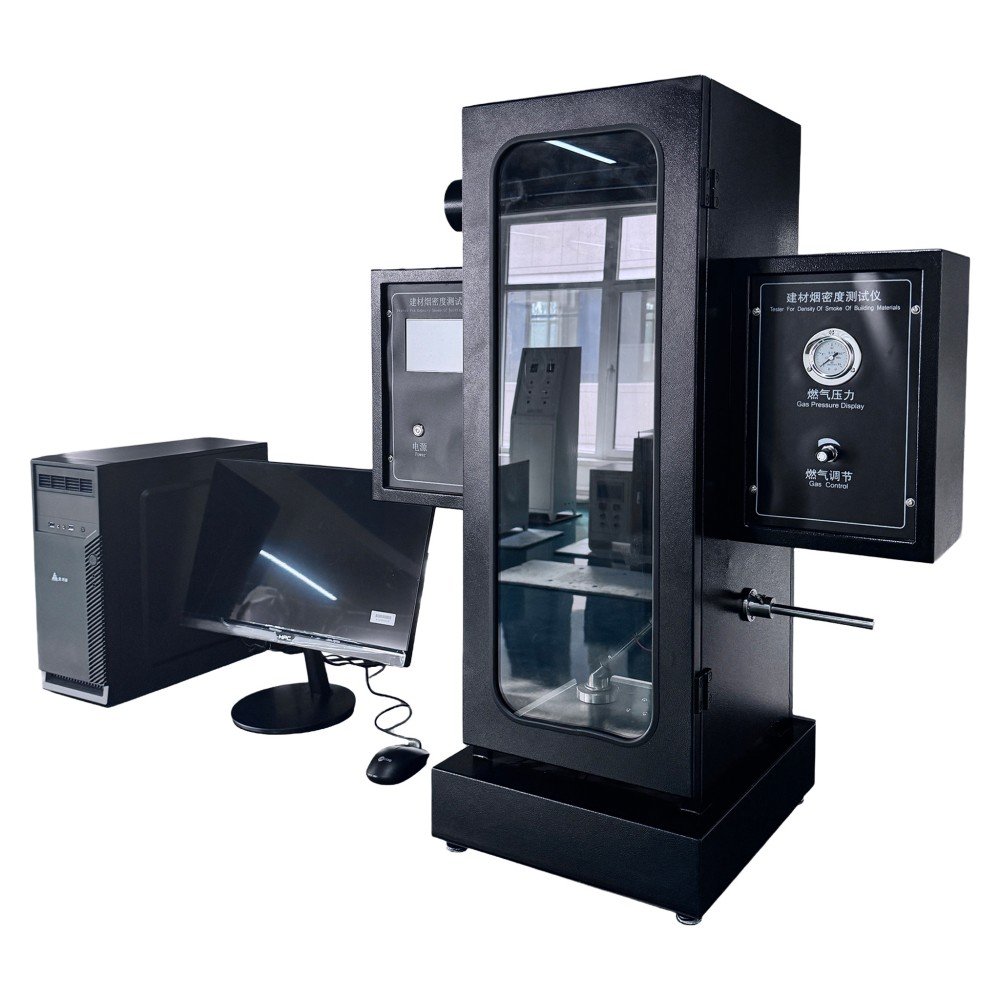
Where a product family is developed for low smoke — mineral wool, foam glass, some phenolic boards — the smoke data usually come from the same SBI campaign. Where smoke is the primary design constraint, laboratories often add a dedicated smoke density bench such as the JYMD building materials smoke density tester so that formulation changes can be screened without booking the SBI rig for every iteration.
Tests That Sit Outside the Euroclass System
Three further tests matter for insulation, and none of them replaces a Euroclass.
Cone Calorimeter: Heat Release for Engineering
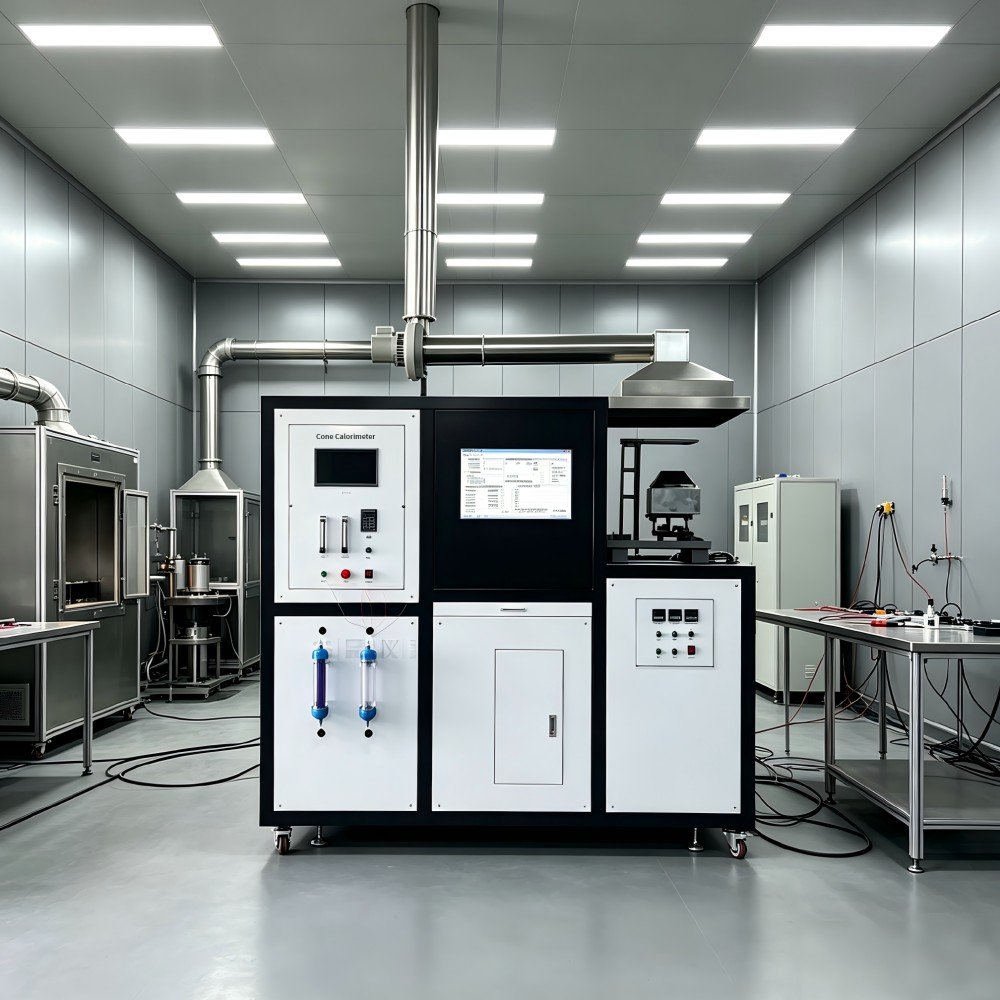
ISO 5660-1 exposes a 100 mm × 100 mm specimen to a controlled irradiance — commonly 35 or 50 kW/m² — and measures heat release rate, ignition time, mass loss and smoke production continuously 7. It is not a classification test, but it is the dataset that fire engineers use to model how a lining will behave, and it is the test that reveals whether a flame retardant is working by chemistry or by dilution. Our cone calorimeter method review covers the calculation chain.
ASTM E84: The North American Surface Burning Route
ASTM E84 runs a 7.6 m horizontal tunnel with a 0.9 m specimen in the ceiling and reports flame spread index and smoke developed index 8. It is the route most North American codes accept for insulation and interior finishes, and it is not convertible to a Euroclass — the two systems measure different things in different geometries. A product sold on both sides of the Atlantic usually needs both datasets.
NFPA 285: The Facade Assembly Test
NFPA 285 is a two-storey assembly test of an exterior wall with a window opening, designed to establish whether fire can propagate through the insulation and air cavity of a cladding system 9. It is the test that decides whether a combustible insulation can be used behind a ventilated facade, and no product-level Euroclass substitutes for it: the same board can pass or fail depending on the cavity depth, the barrier and the cladding.
Insulation Is a System, Not a Board
Facade Cavities and the Fire Barrier Question
A combustible insulation board behind a rainscreen sits in a chimney. The relevant questions are whether the cavity is interrupted by fire barriers at each floor, whether the cladding is combustible, and whether the assembly has been tested as built. Product data cannot answer any of the three. This is why facade specifications increasingly require an NFPA 285 or a national equivalent result, and why a change of cladding material can invalidate an approval that looked product-based.
Pipe Insulation: The L Classes
Linear pipe insulation is classified on a separate table in the same regulation, with its own limits: A1L, A2L, BL, CL, DL, EL and FL [1]. The thresholds are not the same as the flat-product table — the B class limit is FIGRA ≤ 270 W/s here, against 120 W/s for construction products — because the geometry and the mounting differ. Suppliers who quote a flat-product B class for a pipe section are comparing two different tables.
Sample Preparation and Conditioning: The Usual Cause of a Retest
Most failed insulation tests are preparation failures, not formulation failures. Boards are cut with a hot wire and the cut face is left with a melted skin; foil facings are bonded with an adhesive that was not part of the tested build; specimens are conditioned to the wrong moisture content; joints are butted too tightly or left with a gap that changes the airflow.
The standards define conditioning, but they cannot enforce the factory build. The practical rule is to send specimens that represent production, and to state on the test request exactly how the facings were bonded, how the edges were cut and how long the samples were conditioned. A laboratory that receives a hand-made board is testing the hand, not the product. The fire performance of building insulation is decided as much by the factory build as by the formulation, which is why the specimen request form matters more than most buyers expect.
What the Test Report Must State Before You Accept It
A classification report is the deliverable, and the underlying test report is the evidence. ISO/IEC 17025 sets what an accredited laboratory must record and retain, which is why a supplier who can only produce a one-page certificate usually cannot answer the questions below 11.
| Item | Why it matters | Where it goes wrong |
|---|---|---|
| Product identification and density | Class applies to the tested density range | A quote for a lower density than tested |
| Thickness and facing build | Facings are substantial components | Report shows a foil facing, product ships without it |
| Mounting and substrate | Free-standing versus on a substrate changes the result | Standard mounting used for a product always fixed to a wall |
| Conditioning regime | Moisture changes ignition behaviour | Report silent on conditioning |
| Test standard and edition | EN 13823:2020 differs from earlier editions | Report cites an edition no longer current |
| Classification report | The class comes from a classification body, not the test lab | A raw test report presented as a certificate |
| Field-of-application limits | Defines what may change without retesting | Limits page missing from the pack |
Matching Test Scope to Market
| Market | Classification system | Tests a supplier normally needs |
|---|---|---|
| EU / UK (harmonised) | EN 13501-1 Euroclass | ISO 1182, EN ISO 1716, EN 13823, EN ISO 11925-2 as applicable [2] |
| USA | ASTM E84 plus assembly tests | E84 for surface burning; NFPA 285 for facades [8][9] |
| China | GB 8624 | Non-combustibility and calorific value routes aligned with ISO methods |
| Marine | IMO FTP Code | Non-combustibility, surface flammability and smoke tests per part |
| Rail | EN 45545-2 | Heat release and smoke requirements by requirement set |
Five Specification Mistakes
Quoting a class without its smoke and droplet suffix. B-s2,d0 and B-s1,d0 are different products in a tender evaluation, and the suffix is often the reason one supplier is cheaper.
Assuming A2 means the board will not burn in a facade. A2 is a reaction-to-fire class for a product; the facade question is an assembly question.
Testing at a density that will not be produced. Sales samples are frequently denser than production; the classification follows the tested article.
Treating ASTM E84 and Euroclass as convertible. They are not. A flame spread index of 25 does not translate into a Euroclass B, and no table exists that would let it.
Ignoring the pipe-insulation table. The L classes have different limits, and a flat-board report does not cover a pipe section.
Frequently Asked Questions
Which test decides the Euroclass of mineral wool insulation?
Non-combustibility and calorific potential. Mineral wool is inorganic, so it usually passes ISO 1182 comfortably, and the classification then turns on the organic binder content measured as PCS under EN ISO 1716. That is why A1 and A2 mineral wool products often differ in binder chemistry rather than in fibre.
Can EPS insulation reach Euroclass A?
Not as a plain foam. EPS is a hydrocarbon polymer and its calorific potential is far above the A-route limits, so it is classified through the SBI and small-flame route, typically between B and E depending on the flame-retardant package and density. Products marketed as A-rated are composites with a substantial inorganic facing, and the class belongs to that build.
Is EN 13823 needed for a B class insulation?
Yes. For B, C and D the SBI is the primary test because FIGRA and THR600s define those classes, and EN ISO 11925-2 is a mandatory supplement. The SBI result also carries the smoke and droplet sub-classes, so a single run provides the whole classification input.
How long does insulation fire testing take?
The furnace and SBI runs are short, but the programme is not: specimen conditioning, mounting preparation, the number of specimens required and the classification report all add time. Plan the sequence so that the SBI and small-flame work starts only after the specimen build is frozen, otherwise a change of facing forces a repeat of everything.
Does a Euroclass cover use behind a ventilated facade?
No. A Euroclass describes the product’s reaction to fire in a defined test, not the behaviour of a cavity assembly. Facade use is normally governed by an assembly test such as NFPA 285 or a national large-scale equivalent, and the result depends on cavity barriers, cladding and fixing detail as much as on the insulation.
What is the difference between B and BL?
They come from different tables. B applies to construction products under the flat-product table, where the limit is FIGRA ≤ 120 W/s. BL applies to linear pipe insulation, where the limit is FIGRA ≤ 270 W/s and the specimen geometry is a pipe section. A flat-board report cannot be used to claim an L class.
The Decision Order
- Identify the product family and the facings; the family determines which criteria are reachable.
- Decide which market’s classification you need, and therefore which test set applies.
- Freeze the specimen build — density, thickness, facing, bonding — before any specimen is cut.
- Run the A-route tests first if the product is inorganic; run the SBI and small-flame tests first if it is organic.
- Add the engineering and assembly tests the project actually requires: cone calorimeter for modelling, ASTM E84 for North America, NFPA 285 for facades.
- Check the classification report’s field-of-application limits before quoting the class in a tender.
The fire performance of building insulation is a sequence, not a certificate: product class, then assembly, then field of application, and each step has its own evidence. Skipping one of them is how a project ends up with a compliant board and a non-compliant wall.
If you are setting up this test capability in-house, tell us which product families you make and we will map the bench, the calibration consumables and the specimen preparation each route needs — our fire and flame testing equipment range is organised around those routes.
Written by the BRT Testing application engineering team, Shenyang Baoruitong Automation Equipment Co., Ltd. — manufacturers of reaction-to-fire and fire-resistance test equipment for insulation producers and laboratories.