The Short Answer
Smoke production matters because smoke, not heat, is what normally stops people from reaching an exit. A lining can meet every heat criterion in a reaction-to-fire test and still be downgraded on smoke alone. In the European system the difference shows up in the designation itself: the same product that scores B-s1,d0 drops to B-s3,d0 if its smoke growth rate and total smoke production exceed the s2 limits, even though its heat release numbers have not changed 45. Three consequences follow for anyone specifying or buying fire test equipment. You need smoke production testing matched to the market you sell into, because a railway interior, a building lining and a plastics compound are judged on three different smoke quantities. You need to know which of the three measurement families your customer’s specification actually calls for, since they do not produce interchangeable numbers. And you need to check the edition of the standard being cited, because several of the smoke standards most often quoted on datasheets were withdrawn in the last four years 126.
What “Smoke Production” Actually Measures
Two questions the same word hides
“Smoke” is used loosely in fire testing for two different physical questions. The first is obscuration — how much light the smoke stops, which is what decides whether an occupant can see a door. The second is mass or yield — how much smoke the material actually liberated, which is what ventilation models and hazard calculations need. A dense, dark smoke from a thin specimen and a pale smoke from a thick one can produce similar obscuration readings while representing very different amounts of airborne particulate.
That distinction is why the standards disagree on what to report. A smoke chamber reports optical density, which is an obscuration quantity. A cone calorimeter reports a smoke production rate derived from the same optical principle but normalised by the exhaust flow, which is closer to a yield quantity. Both are legitimate, and both are cited in regulations, but a Ds figure from one instrument is not convertible into a smoke production rate from the other.
Three families of measurement
| Family | Representative standards | What is reported | Typical reason it is specified |
|---|---|---|---|
| Closed-chamber obscuration | ISO 5659-2, ASTM E662, ASTM D2843 | Specific optical density Ds, maximum Ds, VOF4 | Transport interiors, cables, plastics compounds; simple pass/fail limits |
| Fire-model / bench-scale rate | ISO 5660-1 (series title covers heat release, smoke production and mass loss rate) | Smoke production rate SPR, total smoke release TSR | Marine, rail and hazard-modelling specifications; research and formulation work |
| Room-scale rate | EN 13823 (SBI) | SMOGRA smoke growth rate, TSP600s total smoke production | CE marking of construction products under EN 13501-1 |
The third family is the one that most often catches exporters out, because the smoke number is not measured by a separate instrument at all — it comes out of the same apparatus that classifies heat release.
What smoke production testing does not tell you
Smoke production testing is not a fire safety verdict on a product. Every method described here measures a material coupon under one specific thermal exposure, and none of them models the geometry, ventilation or ignition scenario of a real room. A result says that under this flux, in this orientation, at this thickness, the material liberated this much light-obscuring aerosol. It does not say the product is safe, and it does not rank two products used in different applications against each other.
The second limit is that smoke production testing is comparative only inside one method. A chamber result and a rate result describe different physical quantities, and a specification that asks for “the smoke figure” without naming the method has not asked an answerable question. Where a customer does that, the useful move is to ask which classification or requirement set the product has to carry, because that document always names the method.
The Three Instruments That Produce Smoke Numbers
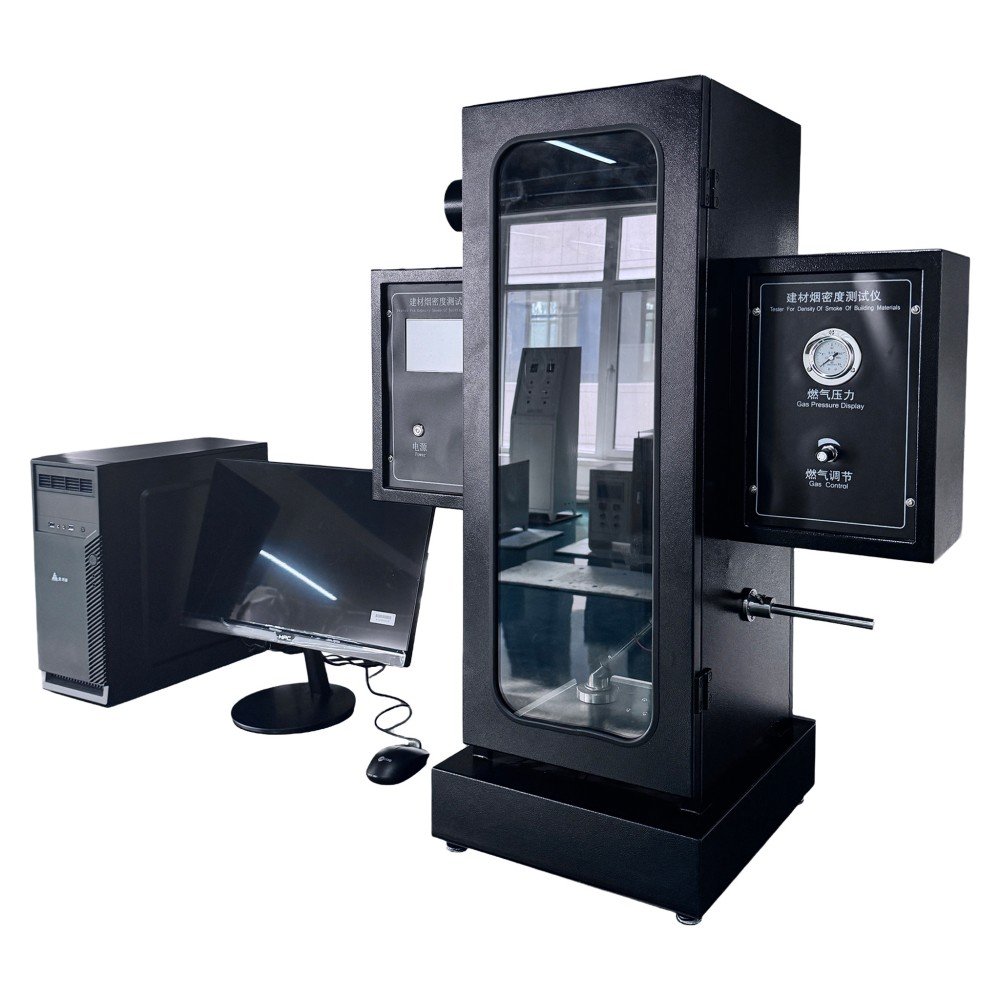
The smoke density chamber: ISO 5659-2 and ASTM E662
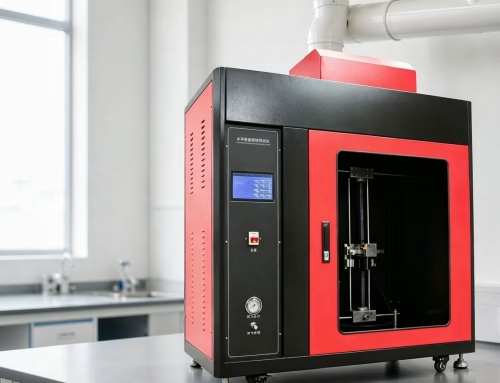
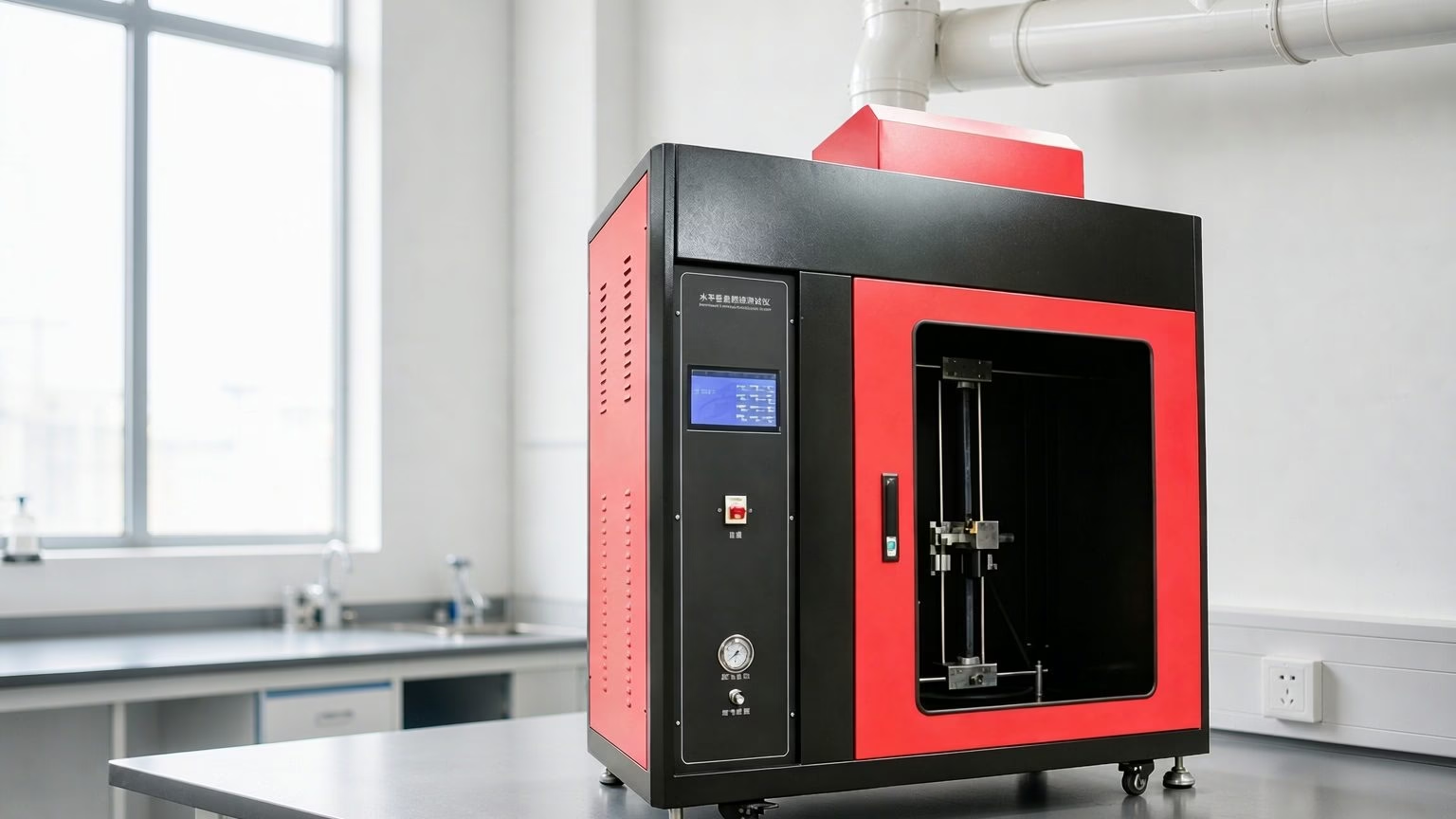
ISO 5659-2 is titled Plastics — Smoke generation — Part 2: Determination of optical density by a single-chamber test [1]. A flat specimen is exposed to a controlled radiant flux inside a closed chamber while a light beam crosses the smoke layer, and the instrument converts the measured transmittance into specific optical density. Both flaming and non-flaming (smouldering) exposure modes are used, which is important: a material that generates little smoke when piloted can generate a great deal when it pyrolyses without a flame, and the two modes answer different regulatory questions.
ASTM E662 is the North American counterpart and is frequently quoted alongside it [2]. ASTM D2843 covers density of smoke from the burning or decomposition of plastics and appears mainly in older plastics specifications 7. The practical trap is that chamber geometry, specimen orientation and exposure mode all differ between these methods, so a Ds value is meaningless without the standard number and mode next to it.
The cone calorimeter: ISO 5660-1
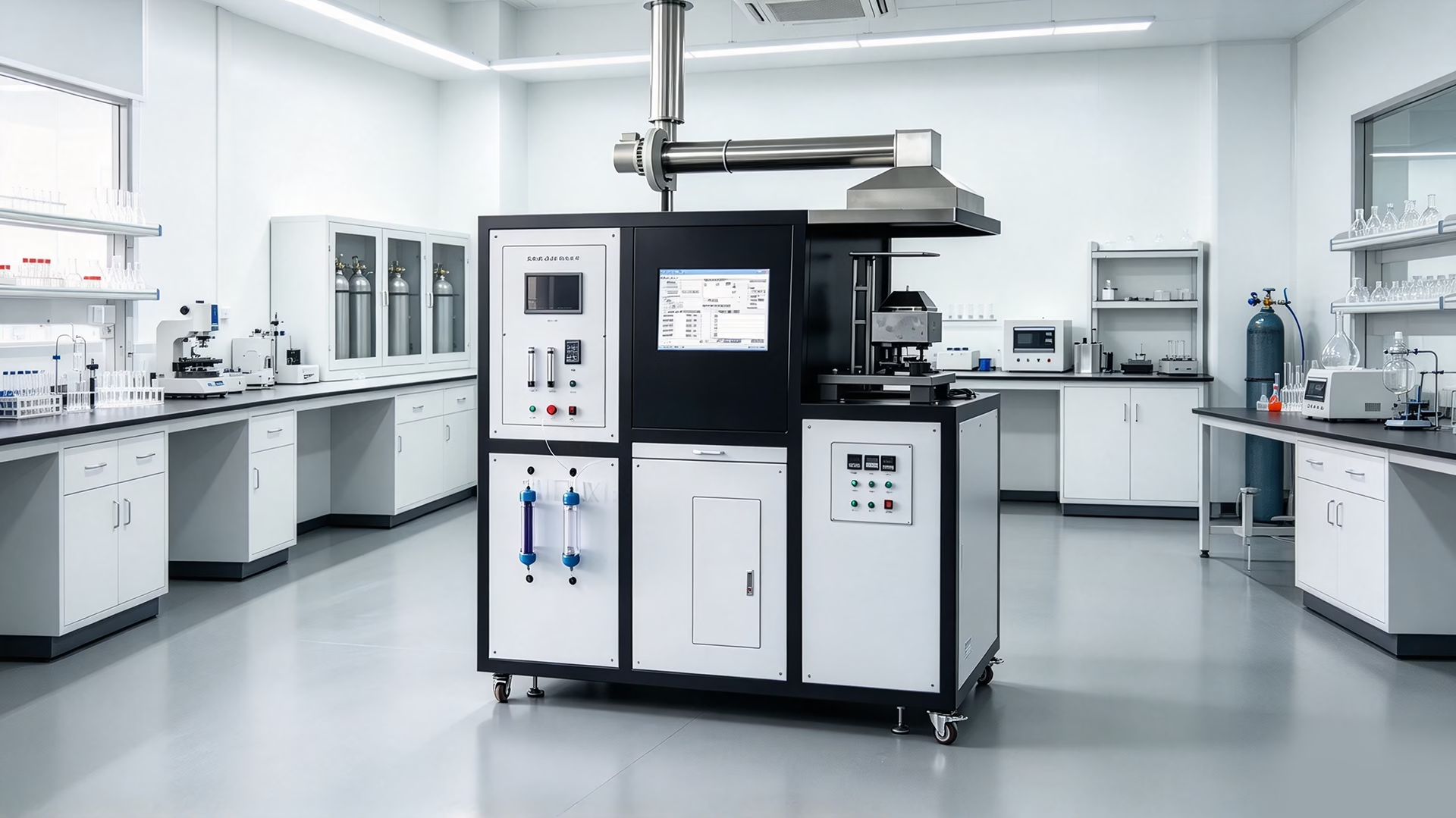
ISO 5660-1 carries smoke production in its own series title: Reaction-to-fire tests — Heat release, smoke production and mass loss rate — Part 1: Heat release rate (cone calorimeter method) 3. The smoke measurement is made in the exhaust duct with a laser photometer on the same run that produces the heat release curve, so heat release rate, smoke production rate and mass loss come out of one 100 mm × 100 mm specimen as a consistent data set. That coherence is why the method is the default for hazard modelling and formulation work, and why a railway or marine specification that quotes MARHE or a smoke production rate is almost always pointing at ISO 5660-1 rather than a chamber.
The single burning item rig: EN 13823
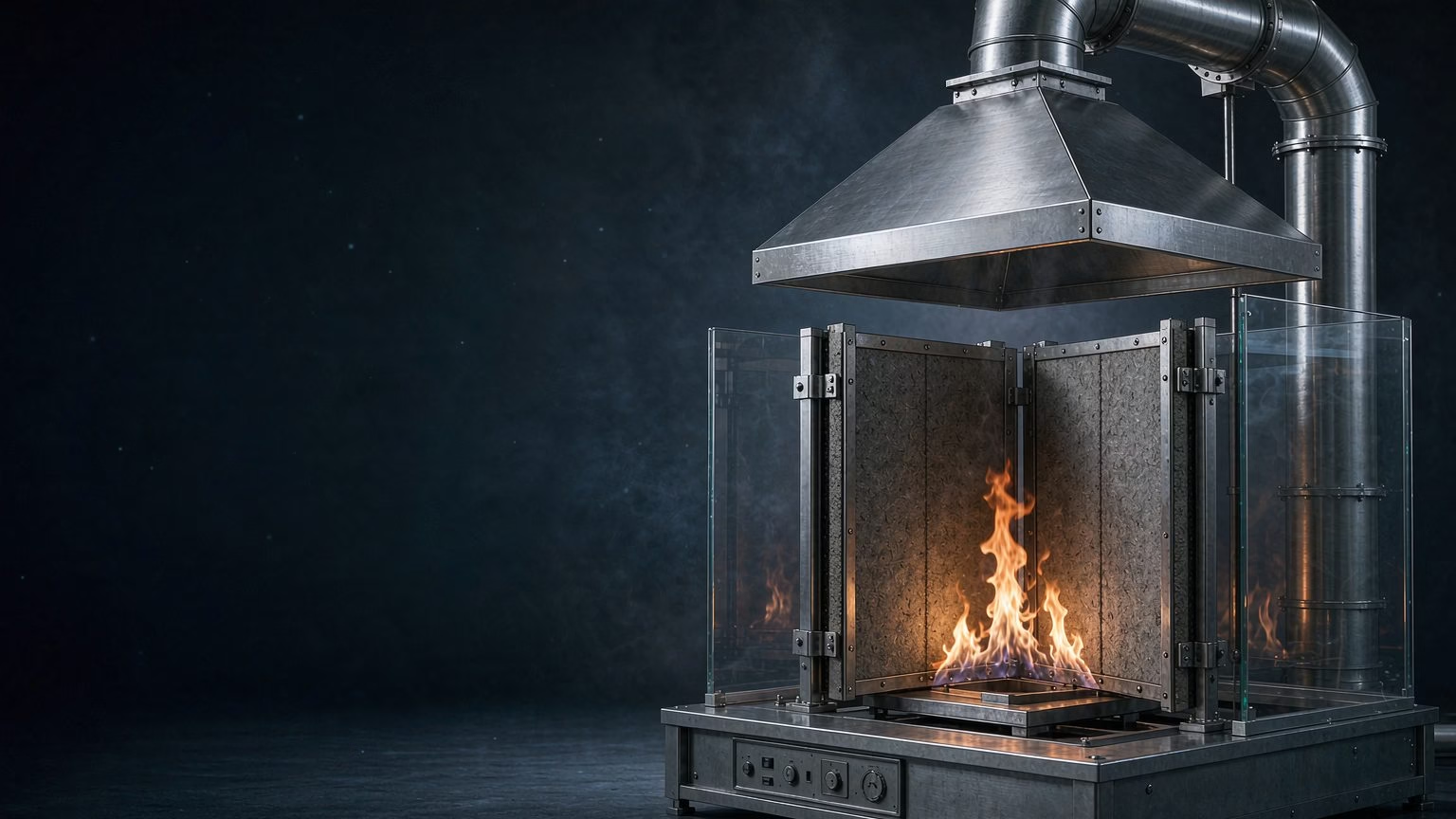
EN 13823 — Reaction to fire tests for building products — Building products excluding floorings exposed to the thermal attack by a single burning item [6] — is the test that generates both the heat and the smoke data behind a European construction product classification. It measures FIGRA and THR600s for heat, and SMOGRA and TSP600s for smoke, from a corner configuration of two specimen wings under an exhaust hood. Our dedicated guide to EN 13823 SBI testing covers the apparatus in detail.
How Smoke Enters a Classification
Under EN 13501-1, Fire classification of construction products and building elements — Part 1: Classification using data from reaction to fire tests [4], smoke is an additional classification appended to the main class for products in classes A2, B, C and D.
| Smoke class | Criterion in EN 13823 (non-flooring) | Interpretation |
|---|---|---|
| s1 | SMOGRA ≤ 30 m²/s² AND TSP600s ≤ 50 m² | Lowest smoke; the class normally required in escape routes and transport interiors |
| s2 | SMOGRA ≤ 180 m²/s² AND TSP600s ≤ 200 m² | Mid-range; up to roughly four times the s1 smoke budget |
| s3 | Neither s1 nor s2 met | No smoke limit achieved |
Two details matter commercially. The smoke class is conjunctive — a product must satisfy both the rate limit and the total limit, so a material with a modest peak but a long smoking tail can lose s1 on the total alone. And the limits are not universal: flooring takes its smoke class from EN ISO 9239-1 instead, and linear pipe insulation uses looser limits than flat products [5]. A supplier quoting “s1” without naming the product family and the test method has not given you a usable figure.
Smoke Toxicity Is a Separate Question
Obscuration and toxicity are regulated separately, and conflating them is the most common specification error in this area. A material can produce a modest amount of visually dense smoke that is comparatively benign, or a thin smoke with a high carbon monoxide or hydrogen chloride yield.
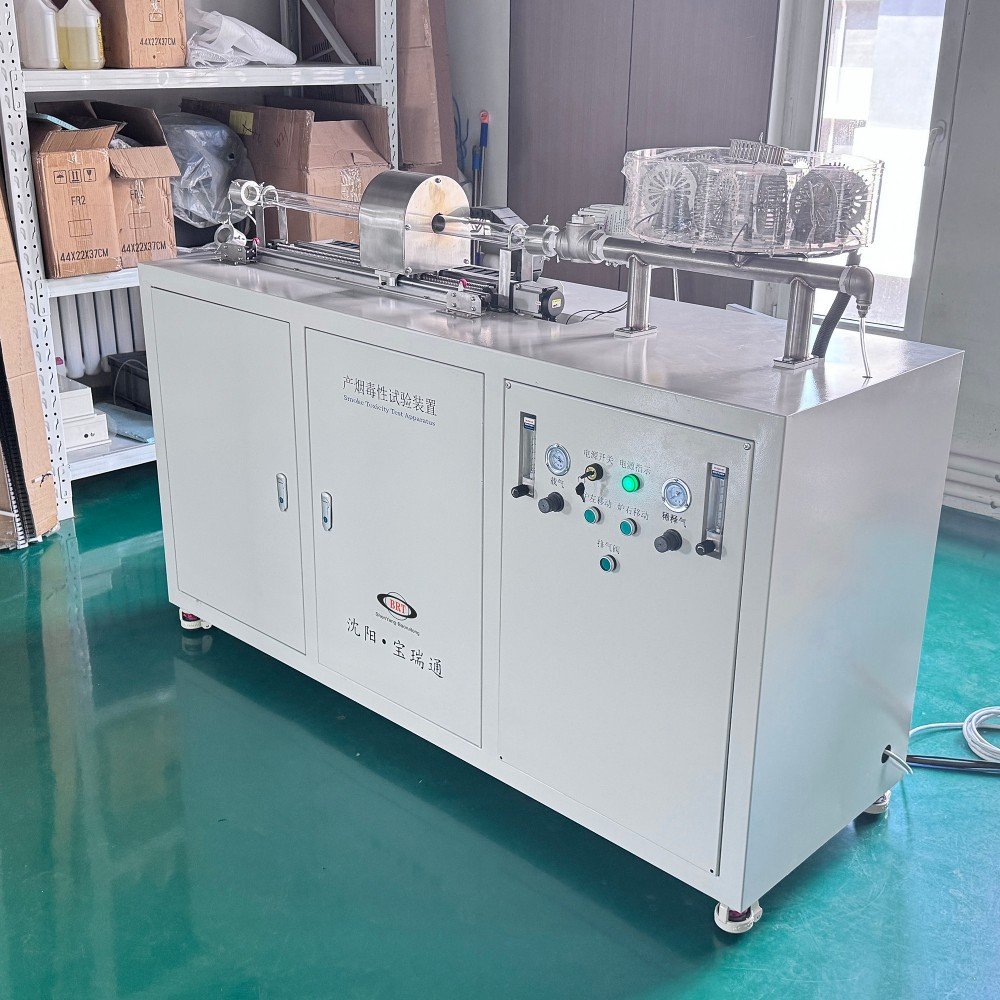
NFPA 269 exists precisely to generate toxic potency data for fire hazard modelling 8; NFPA 130, the standard for fixed guideway transit and passenger rail systems, is the document that then sets out what a transit authority expects of materials and components 9. In Europe, EN 45545-2 — Railway applications — Fire protection on railway vehicles — Part 2: Requirements for fire behaviour of materials and components 10 — assigns requirements by requirement set and hazard level, which is why a railway enquiry almost always asks for smoke density and toxicity together rather than separately.
Why Smoke, Not Heat, Usually Decides Whether People Get Out
Heat release governs how fast a fire grows. Smoke governs how long occupants have to leave. In a compartment fire the two do not fail at the same moment, and the smoke-related limit is usually reached first, which is exactly why classification systems carry a separate smoke subscript rather than folding smoke into the main class.
| Failure route | What governs it | Which test answers it |
|---|---|---|
| Occupant cannot see the exit | Optical density of the smoke layer | ISO 5659-2 / ASTM E662 chamber |
| Occupant is incapacitated by combustion gases | Toxic potency of the smoke | NFPA 269 / EN 45545-2 regime |
| Smoke spreads beyond the room of origin | Rate of smoke generation, not total | ISO 5660-1 SPR, EN 13823 SMOGRA |
| Fire grows to flashover | Heat release rate | ISO 5660-1 HRR, EN 13823 FIGRA |
The third row is the one most often missed in purchasing. A total smoke figure tells you how much smoke eventually appeared; a rate figure tells you how fast it accumulated. Escape time is governed by the rate.
Choosing the Right Smoke Test
Match the method to the market you sell into
| End market | Method normally referenced | Why |
|---|---|---|
| Construction products for the EU | EN 13823, classified under EN 13501-1 | Smoke is part of the CE-marking classification, not a standalone report |
| Rail interiors | EN 45545-2, with ISO 5659-2 for smoke density | Requirements are set by requirement set and hazard level |
| Marine and offshore | IMO FTP Code regime, ISO 5660-1 | Smoke rate is needed for hazard assessment |
| North American plastics and electrical | ASTM E662, ASTM D2843, UL 94 for ignitability | Chamber-based pass/fail limits dominate |
| Formulation and R&D | ISO 5660-1 | One run yields heat, smoke and mass loss together |
If your customer cannot name the standard, ask which classification or requirement set the product has to carry. That answer determines the instrument, and it is a much faster route than comparing datasheets.
Specimen and conditioning traps
Three variables invalidate more smoke data than any instrument fault. Thickness changes the smoke yield per unit area and therefore the reported figure, so the test thickness must match the classified or supplied thickness. Orientation and mounting differ between chamber methods, and a specimen that sags away from the radiant source is no longer at the intended flux. Conditioning matters because absorbed moisture and residual solvent change both the ignition behaviour and the particulate yield. A laboratory that can show a written conditioning record and a calibration certificate for its optical channel is worth more than a marginally better specification.
Equipment and Configuration
| Requirement | BRT apparatus | Product page | Note |
|---|---|---|---|
| Closed-chamber optical density, ISO 5659-2 / ASTM E662 class | Building Materials Smoke Density Tester | /product/building-materials-smoke-density-tester/ | Flaming and non-flaming modes; report the mode with the result |
| Smoke toxicity assessment | Smoke Toxicity Test Equipment | /product/smoke-toxicity-test-equipment/ | Pairs with the density chamber for rail enquiries |
| Heat release, smoke production rate and mass loss on one run | Cone Calorimeter | /product/cone-calorimeter/ | ISO 5660-1; see what a cone calorimeter measures |
| Room-scale classification data for EN 13501-1 | Single Burning Item (SBI) Test Apparatus | /product/single-burning-item-sbi-test-apparatus/ | Generates FIGRA and SMOGRA together |
| Full range of fire and flame apparatus | Fire & Flame Testing Equipment | /fire-flame-testing-equipment/ | Category page |
Common Mistakes in Smoke Testing
| Mistake | Consequence | Fix |
|---|---|---|
| Quoting a Ds figure without the standard, mode and irradiance | The number cannot be compared or audited | Always report method, mode, irradiance and thickness together |
| Assuming a low total smoke figure means a low rate | Product passes a total limit and fails a rate limit such as SMOGRA | Report rate and total as separate line items |
| Treating obscuration as a toxicity result | A benign smoke is rejected, or a toxic one is accepted | Run the toxicity method the requirement set names |
| Citing a withdrawn standard edition | Report rejected at review; retest cost | Check edition status before the test plan is signed off |
| Testing at a thickness that is not the supplied thickness | Classification does not cover the product as sold | Match test thickness to the classified thickness |
Frequently Asked Questions
Is smoke production the same thing as smoke toxicity?
No. Smoke production describes how much light the smoke blocks, or how much smoke the material liberates per unit time. Smoke toxicity describes what that smoke is chemically and what it does to an occupant. The two are measured by different apparatus and regulated by different clauses, and a material can score well on one and poorly on the other.
Why does a product get an s3 instead of an s1?
Because the smoke class is decided by two limits that must both be met. A s1 classification needs a smoke growth rate of 30 m²/s² or less and total smoke production of 50 m² or less in the first 600 seconds of the EN 13823 test. Exceeding either one drops the product to s2, and exceeding the s2 limits of 180 m²/s² and 200 m² leaves it at s3.
Can I convert a specific optical density from ISO 5659-2 into a smoke production rate?
No. The two quantities come from different geometries and different normalisations. Optical density is measured across a fixed light path in a closed chamber; a smoke production rate is derived from the optical density of a flowing exhaust stream of known volumetric rate. There is no valid conversion factor between them.
Which smoke test does a railway interior need?
Railway materials are assessed under EN 45545-2, which assigns requirements by requirement set and hazard level rather than by a single smoke figure. In practice a rail enquiry asks for smoke density by a chamber method and a toxicity assessment together, so the specification has to be read before the test plan is written.
Does a lower heat release rate guarantee a better smoke classification?
No. The two are measured independently from the same run in ISO 5660-1 and EN 13823, and formulations that suppress heat release can increase smoke yield. This is why classification systems carry the smoke subscript separately instead of deriving it from the main class.
Why do chamber results vary so much between laboratories?
Because the result depends on chamber geometry, specimen orientation, exposure mode, irradiance level and conditioning. Two laboratories running the same nominal method but different modes will not agree, and neither result is wrong. The comparison is only valid when the full method string is identical.
Which standards in this area have recently been withdrawn?
ISO 5659-2:2017 was withdrawn with effect from 27 January 2026, EN 13823:2020 was withdrawn on 20 July 2022 and is superseded by EN 13823:2020+A1:2022, and EN 45545-2:2020 was withdrawn on 11 October 2023. Check edition status on the ISO or CEN member catalogue before a test plan is signed off.
Conclusion: How to Decide
Smoke production testing only pays for itself when the method was chosen from the classification the product must carry, so work backwards from the requirement document and not forwards from the instrument you already own.
- Establish which classification or requirement set the finished product must carry — a Euroclass, an EN 45545-2 requirement set, or an ASTM limit — because that document names the method, not you.
- Confirm whether the requirement is on obscuration, on rate, or on toxicity. They are three different instruments.
- Check the edition of every standard in the test plan against the ISO, CEN or ASTM catalogue, and record the withdrawal dates in the report.
- Fix specimen thickness, orientation and conditioning in writing before the run, so the result covers the product as it is actually sold.
- Specify the apparatus to match, then validate the optical channel and the calibration chain at installation.
BRT builds the closed-chamber, toxicity, cone calorimeter and SBI apparatus used for all three smoke families. Send us the classification or requirement set you have to meet and we will map it to a configuration, a test plan and a quotation. Start from the fire and flame testing equipment range or get in touch with the target standard and hazard level.
About the author. This article was prepared by the BRT combustion testing application team at Shenyang Baoruitong Automation Equipment, which manufactures fire testing and laboratory instrumentation for construction product, rail, marine and plastics laboratories. Edition dates and withdrawal dates were checked against ISO, CEN and ASTM catalogue entries on the dates given in the reference list.
Sources
- UNI Ente Italiano di Normazione — ISO 5659-2:2017
- ASTM International — E662-21 Standard Test Method for Specific Optical Density of Smoke Generated by Solid Materials
- UNI Ente Italiano di Normazione — ISO 5660-1:2015
- UNI Ente Italiano di Normazione — EN 13501-1:2018
- Measurlabs — EN 13501-1 fire classification: performance classes and criteria
- UNI Ente Italiano di Normazione — EN 13823:2020
- ASTM International — D2843-22 Standard Test Method for Density of Smoke from the Burning or Decomposition of Plastics
- NFPA — NFPA 269
- NFPA — NFPA 130
- UNI Ente Italiano di Normazione — EN 45545-2:2020