Single Burning Item Test Apparatus: The Short Answer
A single burning item test apparatus is the intermediate-scale reaction-to-fire instrument defined by EN 13823. It mounts two product wings at 90° to form a corner, attacks them with a 30.7 kW propane sandbox burner for 20 minutes, and derives FIGRA, THR600s, SMOGRA and TSP600s from oxygen-consumption calorimetry in a 315 mm exhaust duct. Those four numbers, plus lateral flame spread and flaming droplets, decide whether a construction product reaches Euroclass A2, B, C or D under EN 13501-1.
If you are buying one, the decision is not about burner size or cabinet finish. It is about three things: which edition of EN 13823 the apparatus is built against, how stable the gas analysis train is over a 20-minute run, and whether the data output can be reanalysed. Get those wrong and the instrument will produce numbers that no notified body will accept.
What a Single Burning Item Test Apparatus Measures
The SBI test exists because flat-plate fire tests understate real behaviour. A specimen lying flat radiates heat away from itself. Two panels meeting at a corner trap that heat, so flame and hot gas climb faster. Buildings have corners, and most fires start in one.
Corner Geometry and Specimen Dimensions
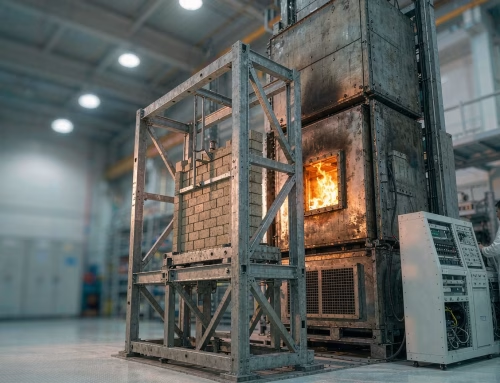
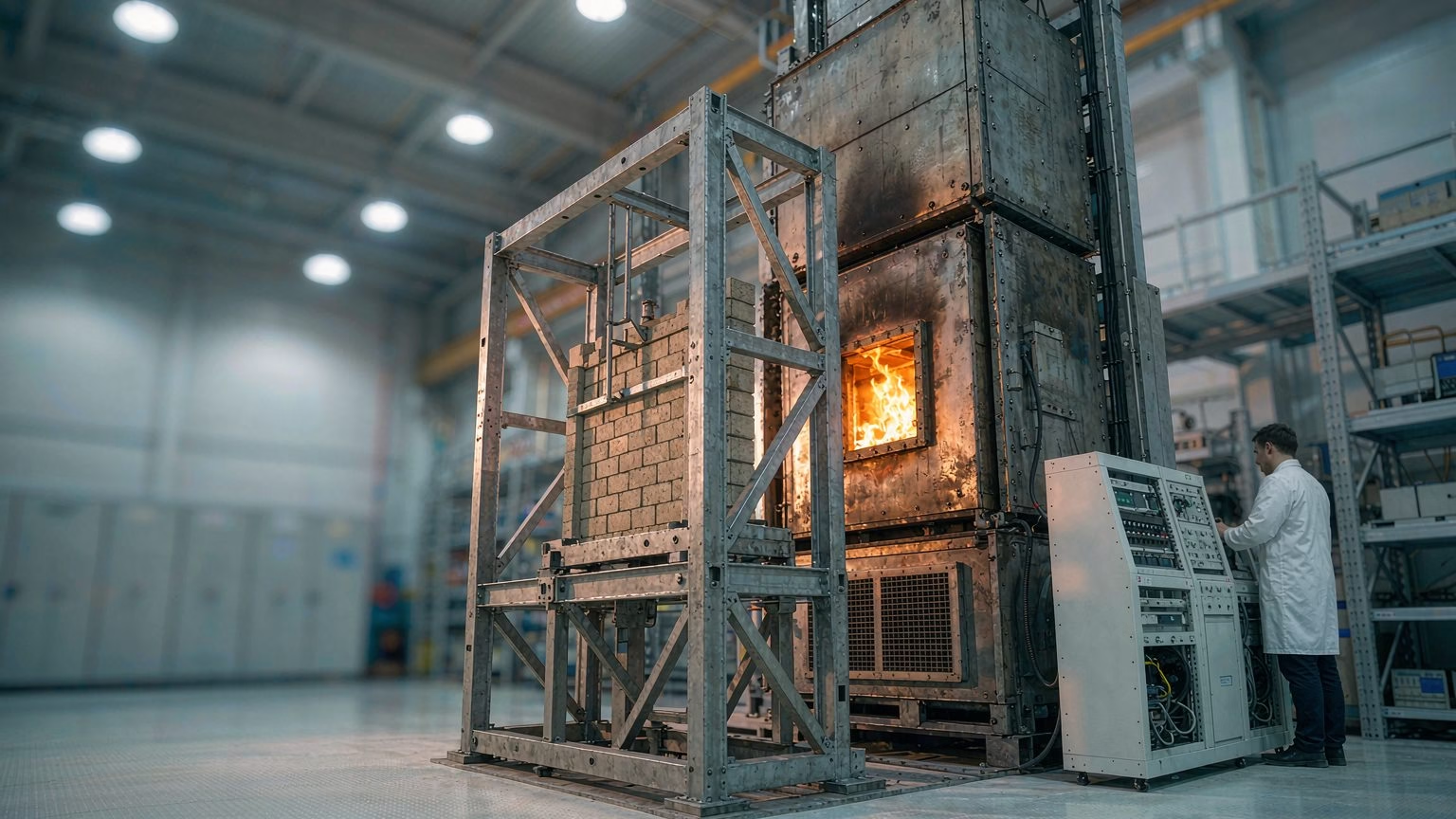
The specimen is built as an L-shaped corner on a mobile trolley. The long wing is 1,000 mm wide by 1,500 mm high; the short wing is 495 mm wide by 1,500 mm high. Both are mounted at 90° to each other, and both are fixed using the method the product will actually use in service — adhesive, mechanical fasteners, or a combination — because the fixing method changes the result.
A sandbox propane burner sits at the foot of the corner. It delivers 30.7 ± 2.0 kW, which represents a single burning wastepaper basket in the corner of a room. A second identical burner runs away from the specimen so the instruments can record a baseline without the product burning.
The 20-Minute Burning Sequence
The record runs 21 minutes, with the main burner ignited at t = 300 s, so the exposure period itself is 20 minutes. Most classification parameters are evaluated over the first 600 seconds after ignition — the phase in which a real fire is still growing and occupants are still evacuating.
Throughout the run the apparatus logs duct volume flow, oxygen concentration, carbon dioxide concentration and smoke obscuration. Data are acquired at roughly 3-second intervals, giving several hundred samples per test. Two observers watch through the window and record lateral flame spread, flaming droplets and particles, and how long any droplet persists.
Inside a Single Burning Item Test Apparatus: The Measurement Chain
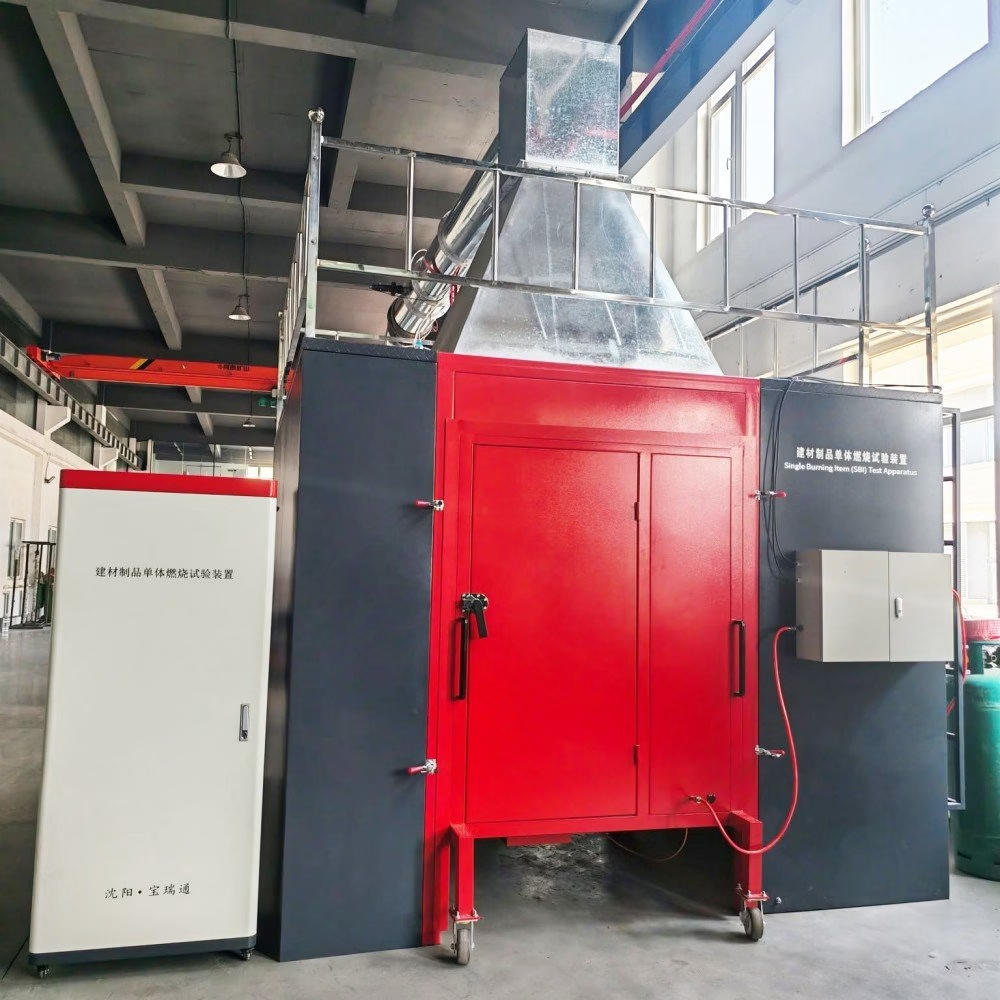
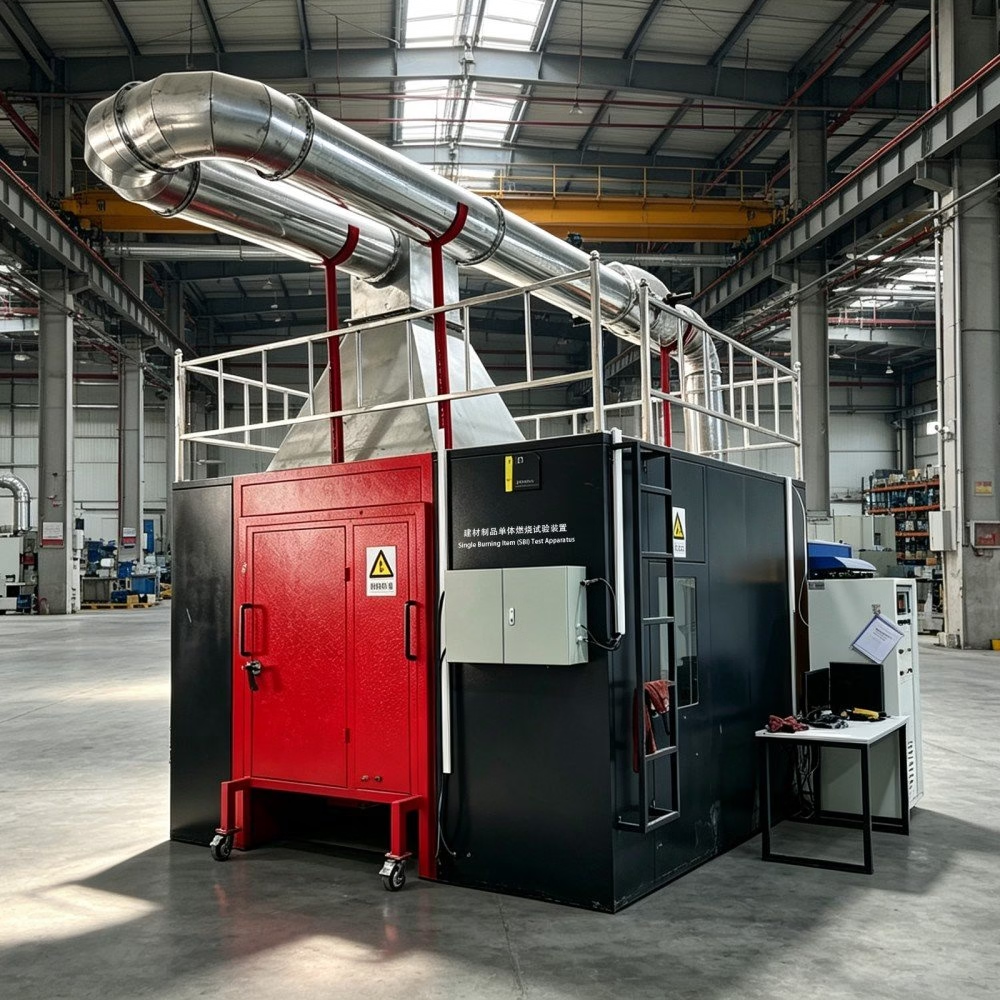
A single burning item test apparatus is not one instrument but four subsystems that must stay in agreement. A weakness in any one of them propagates straight into FIGRA.
Specimen Trolley, Burner Assembly and Frame
The trolley carries the specimen into a fixed frame under a collecting hood. Burner-to-specimen positioning is critical and is set by the frame, not by the operator. The standard supplies design drawings for the burner, the sandbox, the frame and the hood, so a compliant apparatus can be checked dimension by dimension. Burner switching response must fall in the 9–12 s band; the sequence depends on the burner changing state cleanly and reproducibly.
Exhaust Duct and Flow Measurement
Combustion gases pass through a J-shaped duct with an internal diameter of 315 mm, insulated with high-temperature mineral wool. Volume flow must be held at 0.50–0.65 m³/s, normalised to 298 K — this is the single most common setup error in labs that see unstable baselines, because a drifting extraction rate rescales every heat release value.
Three K-type thermocouples of 0.5 mm diameter measure duct temperature. A pressure sensor with a range of at least 0–100 Pa and an accuracy of ±2 Pa reads differential pressure across the flow measurement section; its 90% response time must be no more than 1 second.
The 2020 revision of EN 13823 replaced the older bi-directional probe with a hemispherical probe and changed the Reynolds correction coefficient Kp from 1.08 to 1.24. An apparatus still carrying a bi-directional probe is measuring airflow on a different basis, which is why probe identity belongs at the top of any pre-purchase technical review.
Gas Analysis Train
Oxygen concentration drives the heat release calculation through oxygen-consumption calorimetry; carbon dioxide is measured alongside it. The 2020 edition introduced synchronised CO₂ correction to the heat release calculation, using a general energy value of 17.2 MJ per m³ of oxygen consumed. Requirements on the analysers themselves are strict: response time no more than 12 seconds, delay time no more than 30 seconds, and drift no more than 0.02%.
Long before those analysers see gas, the sample passes through filtration, a refrigerated cold trap and a pump. That conditioning chain is where most field failures begin — contaminated tubing, saturated filters, water carry-over — and it is the subject of a separate deeper treatment in our guide to SBI calibration failures and data drift.
Smoke Measurement
Smoke production is derived from the attenuation of a white-light beam across the duct, measured by a photometer. SMOGRA and TSP600s come from that signal and determine the s1, s2 or s3 sub-class. Note where the baseline is sampled: the 2020 edition moved the smoke production rate baseline window from 390–450 s to 210–270 s, which shifts the reference level every smoke figure is measured against.
EN 13823:2020+A1:2022: What Changed for Apparatus Buyers
The current consolidated edition is EN 13823:2020+A1:2022. The 2020 revision was technical; Amendment A1, issued in July 2022, updated calibration procedures and precision data. The published document runs to 101 pages and is organised as: clauses 1–10 covering scope through test report, then Annex A (normative, calculation procedures), Annex B (informative, precision of the test method), Annexes C and D (calibration procedures, with C normative), Annex E (normative, design drawings), Annex F (informative, data file format) and Annex G (informative, record sheet).
Three changes matter commercially. First, the hemispherical probe and the revised Kp coefficient alter how flow is computed, so data from the 2002 edition is not directly comparable. Second, CO₂ correction changes heat release values in the same way. Third, Annex B now carries 2015–2016 round-robin precision data alongside the 1997 data, which is the evidence base a laboratory needs when it argues about whether two results differ meaningfully.
One practical consequence for exporters: China’s GB/T 20284-2006 is technically equivalent to EN 13823:2002, so a Chinese laboratory running that edition and a European laboratory running the 2020+A1 edition are not operating identical instruments. Product classification parameters — FIGRA, THR600s, SMOGRA, TSP600s, LFS, droplets — are unchanged across editions, but the underlying airflow and heat release computation is not.
| Element | EN 13823:2002 / GB/T 20284-2006 basis | EN 13823:2020+A1:2022 |
|---|---|---|
| Duct flow probe | Bi-directional probe | Hemispherical probe |
| Reynolds correction coefficient Kp | 1.08 | 1.24 |
| Heat release calculation | General energy value E = 17.2 MJ/m³ | CO₂ correction added |
| Smoke production rate baseline window | 390–450 s | 210–270 s |
| Precision data (Annex B) | 1997 round-robin only | 1997 plus 2015–2016 round-robin |
| Classification parameters | FIGRA, THR600s, SMOGRA, TSP600s, LFS, droplets | Unchanged |
Requirements to Verify in a Single Burning Item Test Apparatus
Most single burning item test apparatus datasheets quote the burner output and the specimen size, then stop. The numbers below are the ones that actually determine whether the instrument can hold a baseline across a full run, and they are the ones worth putting into a procurement specification.
| Item | Typical requirement | Why it decides your data quality |
|---|---|---|
| Exhaust volume flow | 0.50–0.65 m³/s at 298 K | Flow errors rescale every heat release value; drift here looks like material variability |
| Duct internal diameter | 315 mm | Sets the measurement section geometry the calculations assume |
| O₂ / CO₂ analyser response | ≤ 12 s | Slow analysers round off the peak that FIGRA is built from |
| Analyser delay time | ≤ 30 s | Shifts the time axis; FIGRA divides by elapsed time, so a lag distorts the index itself |
| Analyser drift | ≤ 0.02% | Drift accumulates across 20 minutes and shows up as a sloping baseline |
| Burner heat output | 30.7 ± 2.0 kW | Defines the fire the product is graded against |
| Burner switching response | 9–12 s | Determines how cleanly the baseline-to-exposure transition is defined |
| Propane mass flow control | Range ≥ 0–2.3 g/s, accuracy ±1% between 0.6 and 2.3 g/s | Manual valves cannot hold a steady mass flow as ambient temperature shifts during a long run |
| Propane purity | Commercial propane, ≥ 95% | Impurities change the energy delivered per unit mass |
| Differential pressure sensor | Range ≥ 0–100 Pa, accuracy ±2 Pa, 90% response ≤ 1 s | Feeds the flow calculation directly |
| Duct thermocouples | 3 × K type, 0.5 mm diameter | Temperature enters the flow and energy equations |
| Step (ladder) calibration | Qgas 30s(t) / HRR30s(t) continuous within 100 ± 5% | The acceptance test for the whole chain, not just the analyser |
| n-Heptane calibration | THR/m = 4,456 ± 222.8 MJ/kg | An end-to-end check against a fuel of known calorific value |
| Data acquisition interval | ≈ 3 s | Coarse sampling misses the shape of the release curve |
Two of these deserve emphasis. The step calibration is the honest test of the instrument, because it forces the burner’s known gas flow and the measured heat release to agree within 5% continuously — not at a single point. And the n-heptane check verifies the entire chain end to end: burner, duct, analyser, calculation. A laboratory that can show both, recently, is telling you more than any datasheet.
Configuration by Laboratory Type
The right configuration depends on what the laboratory is for. The three profiles below cover most purchases.
| Laboratory profile | What the apparatus must deliver | Selection logic |
|---|---|---|
| Notified body / accredited test house | Full traceability, calibrated reference gases, immutable audit records, raw data retention, capacity for back-to-back campaigns | Prioritise the gas analysis train and the data output format over floor-space savings; accreditation auditors read calibration records and raw files |
| Manufacturer in-house QA | Repeatable runs, low consumable cost, fast turnaround, simple operation, output aligned to the notified body that certifies the product | Prioritise the specimen handling and the calibration workflow; an in-house apparatus must agree with the certifying laboratory, not just with itself |
| Research institute | Raw sensor streams, reconfigurable specimens, export in open formats, ability to run non-standard assemblies | Prioritise data access over automation; if you cannot get the unfiltered analogue channels out, you cannot reanalyse a campaign |
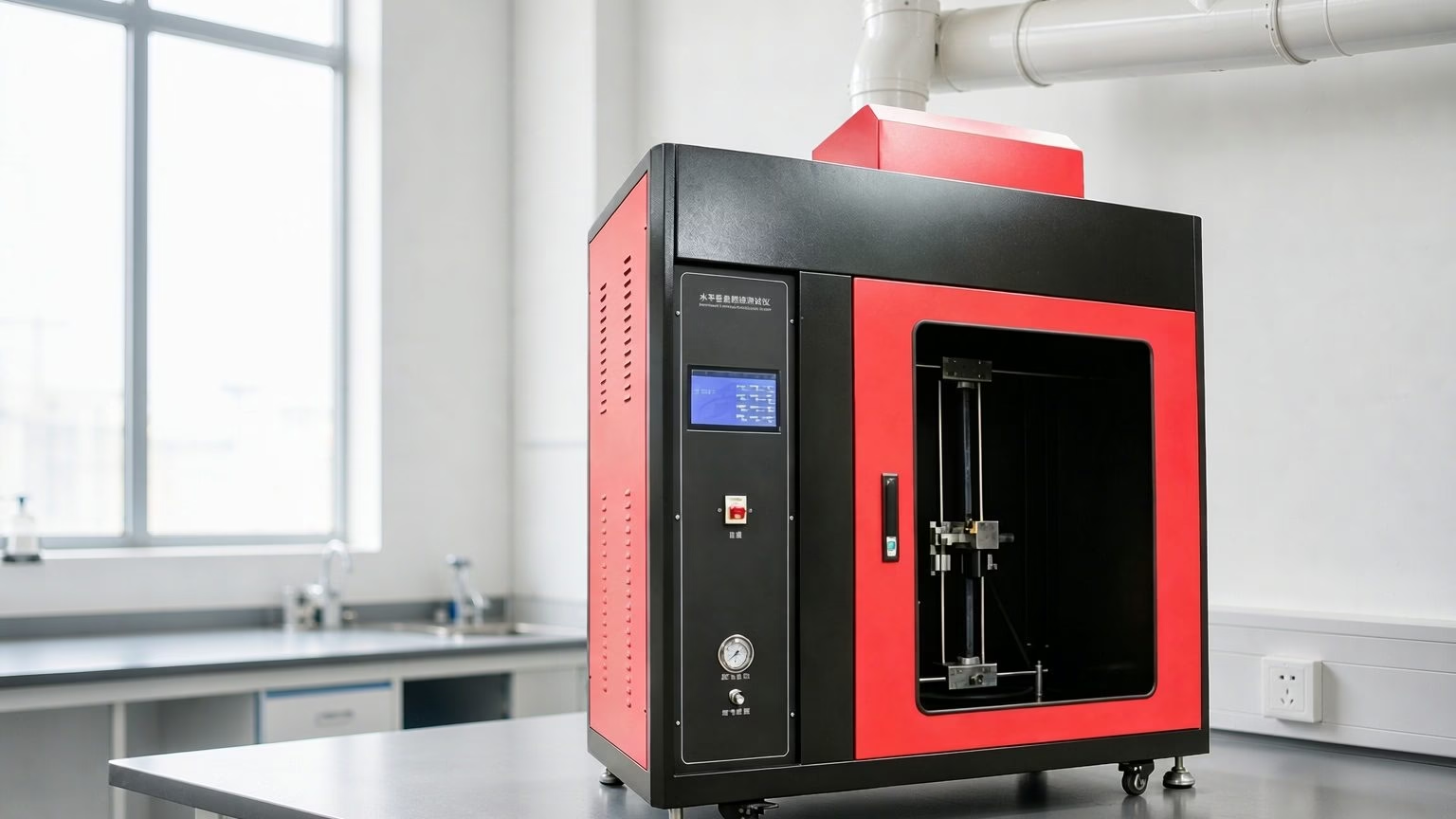
For reference on the instrument itself, see the single burning item SBI test apparatus page, which lists the current configuration and hardware build.
Ancillary Items and Hidden Costs
The single burning item test apparatus is the visible part of the budget. The following items are not, and they recur.
| Item | Why it belongs in the budget from day one |
|---|---|
| Calibration gases and n-heptane | Both the step calibration and the heptane check consume gas on a recurring schedule; grade and certification of the reference gas affect traceability |
| Consumable sampling line parts | Filters, tubing, O-rings, cold trap components and pump diaphragms degrade with soot and moisture exposure; a quoted cost per test that ignores them is incomplete |
| Reference instrument for flow or smoke verification | Verifying the photometer and the flow section needs a traceable reference, not the apparatus checking itself |
| Specimen build time and materials | ETICS and multi-layer assemblies can take hours to build per specimen, plus EN 13238 conditioning of at least 72 h to constant mass — throughput planning must include it |
| Laboratory environment control | The apparatus sits in a room roughly 2.4 × 3.0 × 3.0 m with forced extraction; the building services that support it are part of the project |
| Software and data format | Annex F of the standard defines a data file format; confirm the software exports in a form you can archive and reanalyse years later |
| Operator training | Specimen mounting, calibration and droplet observation are operator-dependent; consistent technique across staff is a documented source of between-campaign variation |
Common Procurement Mistakes
Five recurring errors, in the order they usually appear.
- Buying against the wrong edition. A datasheet that does not state which edition the instrument is built to cannot be evaluated. If the flow probe is bi-directional, the apparatus is on the 2002 basis.
- Comparing price instead of the gas analysis chain. Two apparatus with identical burner specifications can differ by an order of magnitude in baseline stability. The analysers, the cold trap and the sampling line are where that difference lives.
- Ignoring the calibration workflow. Ask to see a recent step calibration record and a heptane result. An apparatus that cannot produce both on request will create friction at every accreditation audit.
- Treating data export as an afterthought. If raw channels cannot come out in an open format, the laboratory cannot reanalyse, cannot answer a client challenge and cannot contribute to interlaboratory work.
- Underestimating specimen throughput. Condition for a minimum of 72 h, build the assembly, run 21 minutes, then cool, clean and repeat. The number of specimens that can realistically be tested per week is far lower than the nominal run time suggests.
Acceptance Checklist for a New Apparatus
| Check | Acceptance criterion | Basis |
|---|---|---|
| Edition and probe type | Documented as EN 13823:2020+A1:2022 with hemispherical probe | EN 13823:2020+A1:2022 |
| Mechanical assembly | Trolley, frame, burner and hood dimensions match the standard’s design drawings | Annex E (normative) |
| Exhaust flow | Holds 0.50–0.65 m³/s at 298 K across a full 21-minute record | Test facility clauses |
| Analyser performance | Response ≤ 12 s, delay ≤ 30 s, drift ≤ 0.02%, demonstrated on site | Instrument requirements |
| Step calibration | Qgas 30s(t) / HRR30s(t) continuous within 100 ± 5% | Annex C (normative) |
| n-Heptane calibration | THR/m = 4,456 ± 222.8 MJ/kg | Annex C (normative) |
| Data output | Exports raw channels in the format described by the standard, plus a human-readable report | Annex F (informative) |
| Documentation set | Calibration certificates for reference gases, sensor calibration records, maintenance schedule and spare-parts list | Accreditation and annexes C–D |
Frequently Asked Questions
What is a single burning item test apparatus used for?
It grades the reaction to fire of essentially flat construction products — wall panels, insulation boards, cladding, ceiling systems — for the European market. Products in classes A2, B, C and D are separated by the FIGRA and THR600s values this apparatus produces, with smoke and droplet sub-classes added on top. It is the reference method for CE marking of those products.
How does a single burning item test apparatus differ from a cone calorimeter?
The cone calorimeter works at bench scale on a 100 mm × 100 mm specimen and is used for material development and screening. An SBI apparatus works at intermediate scale on a 1.5 m corner assembly and carries regulatory weight. They answer different questions, which is why many reaction-to-fire laboratories eventually run both.
Which edition of EN 13823 should a new apparatus be built to?
The current consolidated edition is EN 13823:2020+A1:2022. Buy against that edition unless you have a specific reason to reproduce older data. Edition matters because the probe type, the Reynolds correction coefficient, the CO₂ correction and the smoke baseline window all changed, and results from different editions are not directly interchangeable.
How long does a single burning item test take?
The recorded run is 21 minutes, with the main burner ignited at 300 seconds, so the product is exposed for 20 minutes. Total laboratory time per specimen is far longer: EN 13238 conditioning to constant mass takes at least 72 hours, and building a multi-layer assembly can take hours before the run even starts.
Can an SBI apparatus test floorings?
No. EN 13823 explicitly excludes floorings, which are tested to a different method — the radiant panel test EN ISO 9239-1 — and carry the suffix “fl” in their classification, for example Bfl-s1. The apparatus is for construction products other than floorings and for linear pipe insulation products.
What calibration does an SBI apparatus need?
Two calibrations do the heavy lifting: the step or ladder calibration, which verifies that measured heat release tracks the burner’s known gas output continuously within 100 ± 5%, and the n-heptane calibration, which checks the whole chain against a fuel of known calorific value with a target of 4,456 ± 222.8 MJ/kg. Alongside them, the gas analysers need zero and span checks, and the flow section needs verification against a traceable reference.
Why does FIGRA matter more than total heat release?
FIGRA measures how fast heat release grows rather than how much is eventually released. A product that burns steadily can have a modest FIGRA and a large THR600s, and both limits must be satisfied. FIGRA carries more weight in safety terms because growth rate is what outruns detection and escape time — but the standard sets thresholds for both, and failing either one moves the product down a class.
Choosing a Single Burning Item Test Apparatus: A Decision Sequence
- Confirm the product range you must classify, and therefore which test methods apply.
- Fix the edition: EN 13823:2020+A1:2022 unless there is a documented reason otherwise.
- Write the analytical requirements into the specification — flow range, analyser response, delay, drift, step and heptane criteria.
- Require recent step and heptane calibration records as part of the offer.
- Confirm the data export format and the archive strategy before signature.
- Budget the consumables, reference gases and throughput you will actually need per year.
If the classification route is still open — for example, whether you need the non-combustibility route as well — the companion guides on Euroclass classification under EN 13501-1 and on how EN 13823 data shapes the classification cover that decision. Where the choice is between two instruments, the comparison of SBI against the cone calorimeter sets out the trade-offs. The full set of parameters the apparatus is expected to hold is listed on our fire test parameters page.
For a specification review against your product range, you can reach the technical team through our contact page.
References
- BSI Knowledge — Reaction to fire tests for building products: building products excluding floorings exposed to the thermal attack by a single burning item. knowledge.bsigroup.com
- NEN — NEN-EN 13823:2020+A1:2022 en, current edition, publication date 1 August 2022, 101 pages. nen.nl
- NSAI Standards — I.S. EN 13823:2020, superseded by I.S. EN 13823:2020+A1:2022. shop.standards.ie
- NBS — IS EN 13823:2020 (+A1:2022), Amendment 1 issued July 2022. thenbs.com
- NEN — NEN-EN 13501-1:2019 en, fire classification of construction products and building elements, 55 pages. nen.nl
- ASTM — E1354 Standard Test Method for Heat and Visible Smoke Release Rates Using an Oxygen Consumption Calorimeter. store.astm.org
- European Commission — CE marking for manufacturers under the Construction Products Regulation. ec.europa.eu
- RISE Research Institutes of Sweden — fire safety and reaction-to-fire research. rise.se
- BRE Group — fire testing and certification services. bre.co.uk
About This Guide
This guide was prepared by the technical content team at Shenyang Baoruitong Automation Equipment (BRT), a manufacturer of reaction-to-fire and fire resistance test equipment. The figures quoted for specimen geometry, burner output, duct flow, analyser performance, step calibration and n-heptane calorific value are taken from the requirements of EN 13823 and its annexes; where a value is a laboratory-dependent target rather than a standard limit, it is described as a typical requirement. Classification thresholds referenced in the linked guides come from EN 13501-1.