- The Short Answer
- What the Test Actually Produces
- Who Uses It, and For What Decision
- Why It Is a Late-Stage Test, Not a Development Tool
- Where It Sits in the Classification Ladder
- What It Is Not Used For
- The Comparison People Actually Ask About
- Before You Book a Furnace
- Equipment
- Frequently Asked Questions
- What is the SBI fire test used for in one sentence?
- Which products are tested by SBI?
- Does a product need an SBI test to be class A1?
- Can SBI results be converted into a flame spread index?
- Why does the corner geometry matter so much?
- Is the SBI test a good way to compare formulations during development?
- What does the s1, s2 or s3 subscript tell me?
- Conclusion: Four Questions That Decide Whether You Need It
- Sources
The Short Answer
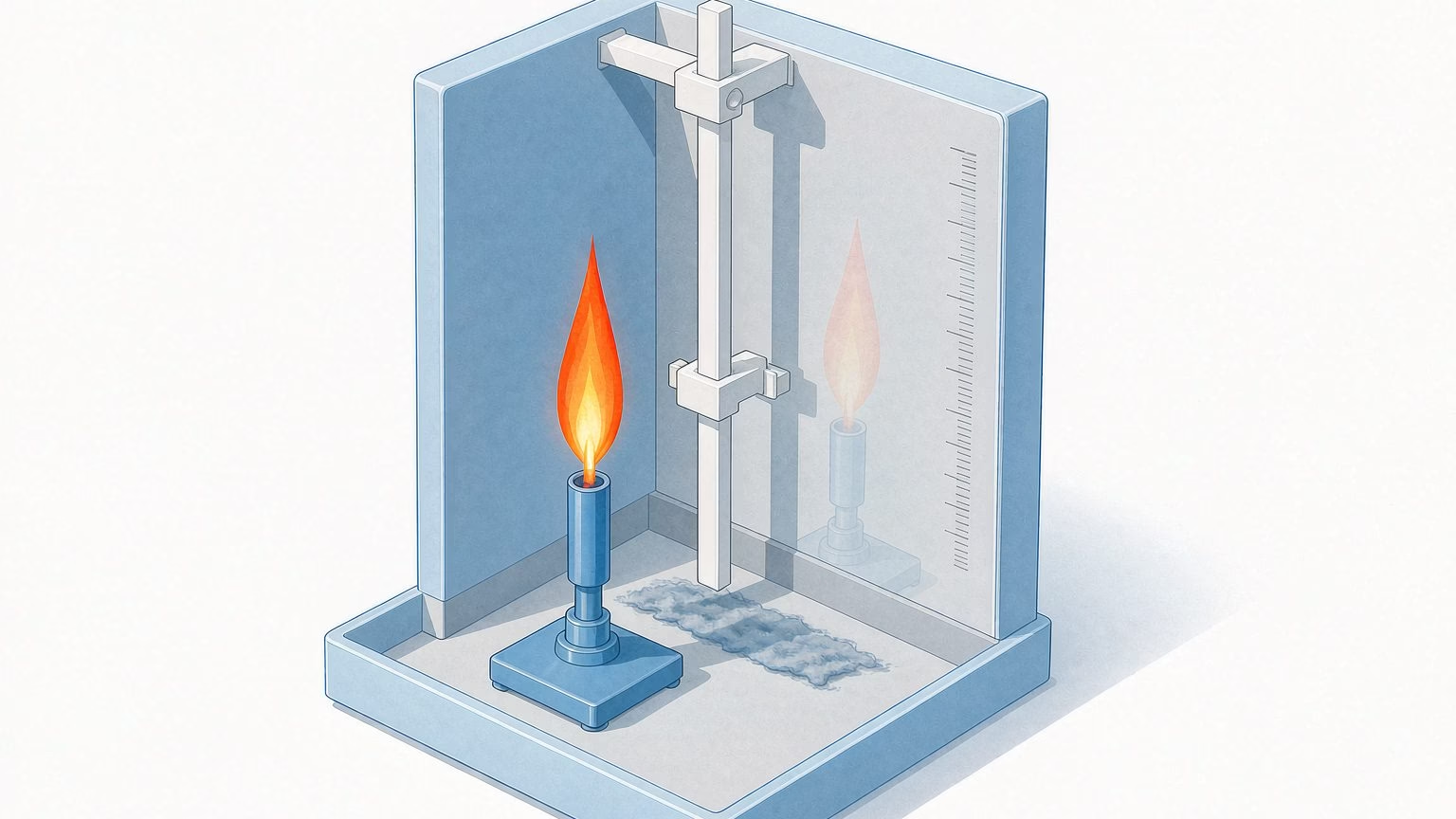
The SBI fire test is used to generate the reaction-to-fire data that a construction product needs in order to be classified — nothing more, and nothing less. It produces five measured quantities from one corner exposure: FIGRA, THR600s, lateral flame spread, SMOGRA and TSP600s, and EN 13501-1 turns those into an A2, B, C or D class plus the smoke and droplet subscripts 12. Its users are manufacturers building a Declaration of Performance, specifiers checking a product against a code requirement, notified bodies writing the classification report, and regulators auditing the result.
The reason the test exists in the form it does is worth knowing before anything else. The older tunnel method, ASTM E84, states in its scope that it does not provide for the effect of aggravated flame spread behaviour of an assembly resulting from the proximity of combustible walls and ceilings 3. The SBI apparatus exists precisely to supply that missing case, by burning a corner rather than a ceiling.
What the Test Actually Produces
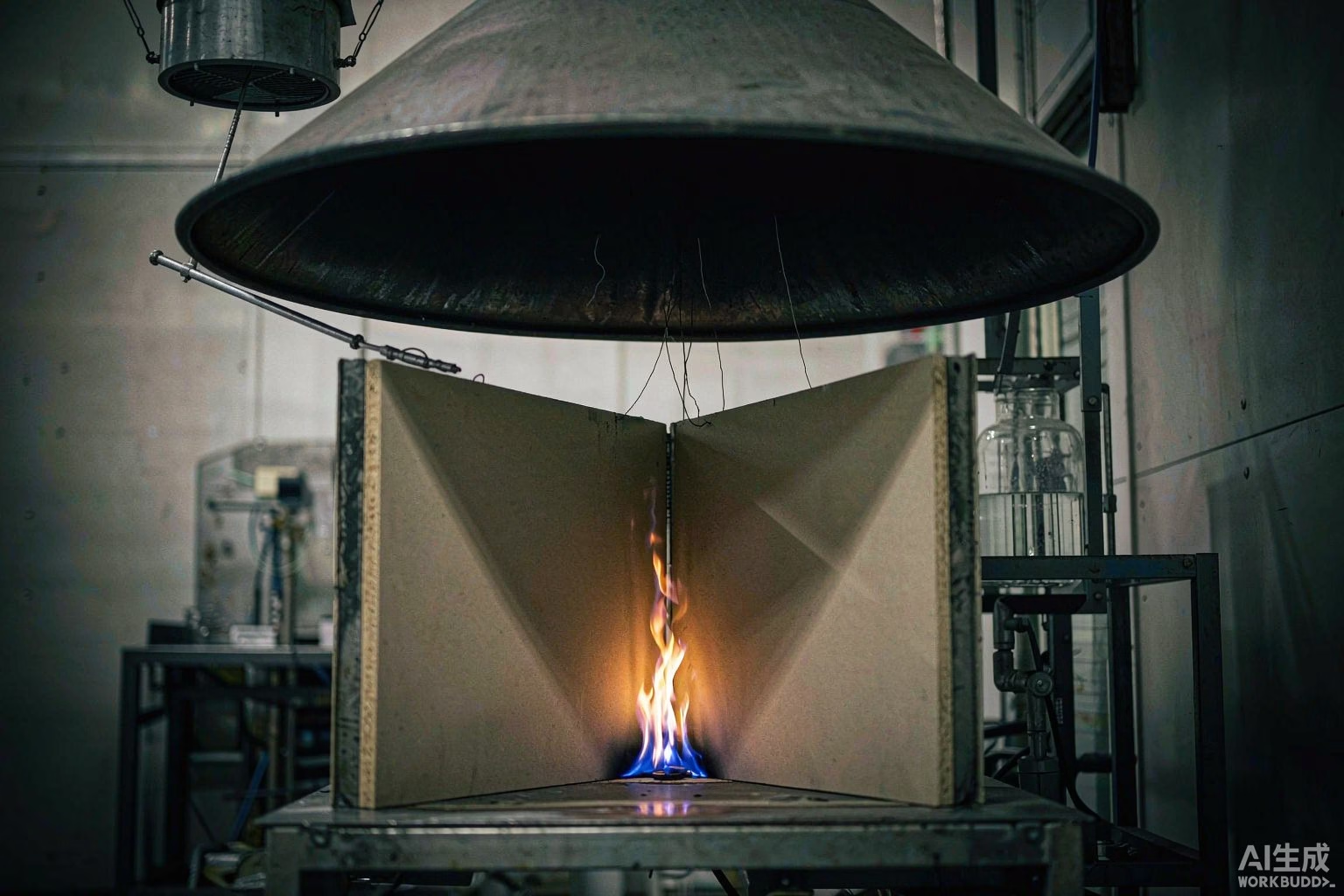
EN 13823:2020+A1:2022 specifies a method of test for determining the reaction to fire performance of construction products excluding floorings, and excluding the products indicated in Delegated Regulation (EU) 2016/364, when exposed to thermal attack by a single burning item [1]. The calculation procedures sit in Annex A, precision data in Annex B, and calibration in Annexes C and D, of which Annex C is normative [1].
The five outputs, and what each one decides
An SBI fire test produces five numbers and one observation, and they are worth listing separately because each one decides a different part of the class.
| Output | What it expresses | Which part of the class it decides |
|---|---|---|
| FIGRA (0.2 MJ and 0.4 MJ thresholds) | How fast heat release grows during the exposure [1] | The main letter, A2 through D |
| THR600s | Total heat released in the first 600 s [1] | The main letter, alongside FIGRA |
| LFS | Whether flame reaches the far edge of the specimen wing [1] | Whether the main letter can be awarded at all |
| SMOGRA | How fast smoke production grows [1] | The s1, s2 or s3 subscript |
| TSP600s | Total smoke produced in the first 600 s [1] | The s1, s2 or s3 subscript |
The droplet subscript comes from observation during the same test rather than from the instrumented channels, which is why a report should state who observed and against what criterion.
Who Uses It, and For What Decision
The honest answer to what the SBI fire test is used for is a list of people rather than a list of measurements. Each of them reads a different part of the same report.
| User | Decision it supports | What they actually read |
|---|---|---|
| Product manufacturer | Whether to declare a class in a Declaration of Performance | The classification report, and the field of application it covers |
| Architect or specifier | Whether the product satisfies the class the building code demands at that location | The class string, including subscripts |
| Notified body or test laboratory | Whether the data support the class being claimed | Raw channels, calibration records, specimen records |
| Regulator or market surveillance | Whether the declared performance is supported | The classification report and the underlying test report |
| Insurer or approval body | Whether a construction detail is acceptable | The class, plus any extended application document |
The string the specifier reads
EN 13501-1 is the document that converts the measurements into that class string. It provides the reaction to fire classification procedure for all construction products except power, control and communication cables, which fall under EN 13501-6, and it treats three categories separately: construction products excluding floorings and linear pipe thermal insulation products, floorings, and linear pipe thermal insulation products [2].
What that means commercially is narrower than it sounds. The reaction to fire class is what appears in the Declaration of Performance, and EN 13501-1 notes that for CE marking under the Construction Products Regulation the NPD option can be used when no reaction to fire performance is to be declared [2]. NPD is a legitimate route, and it is also why a class cannot be inferred from the presence of a CE mark: the mark says a declaration exists, not that the product carries a class.
Why It Is a Late-Stage Test, Not a Development Tool
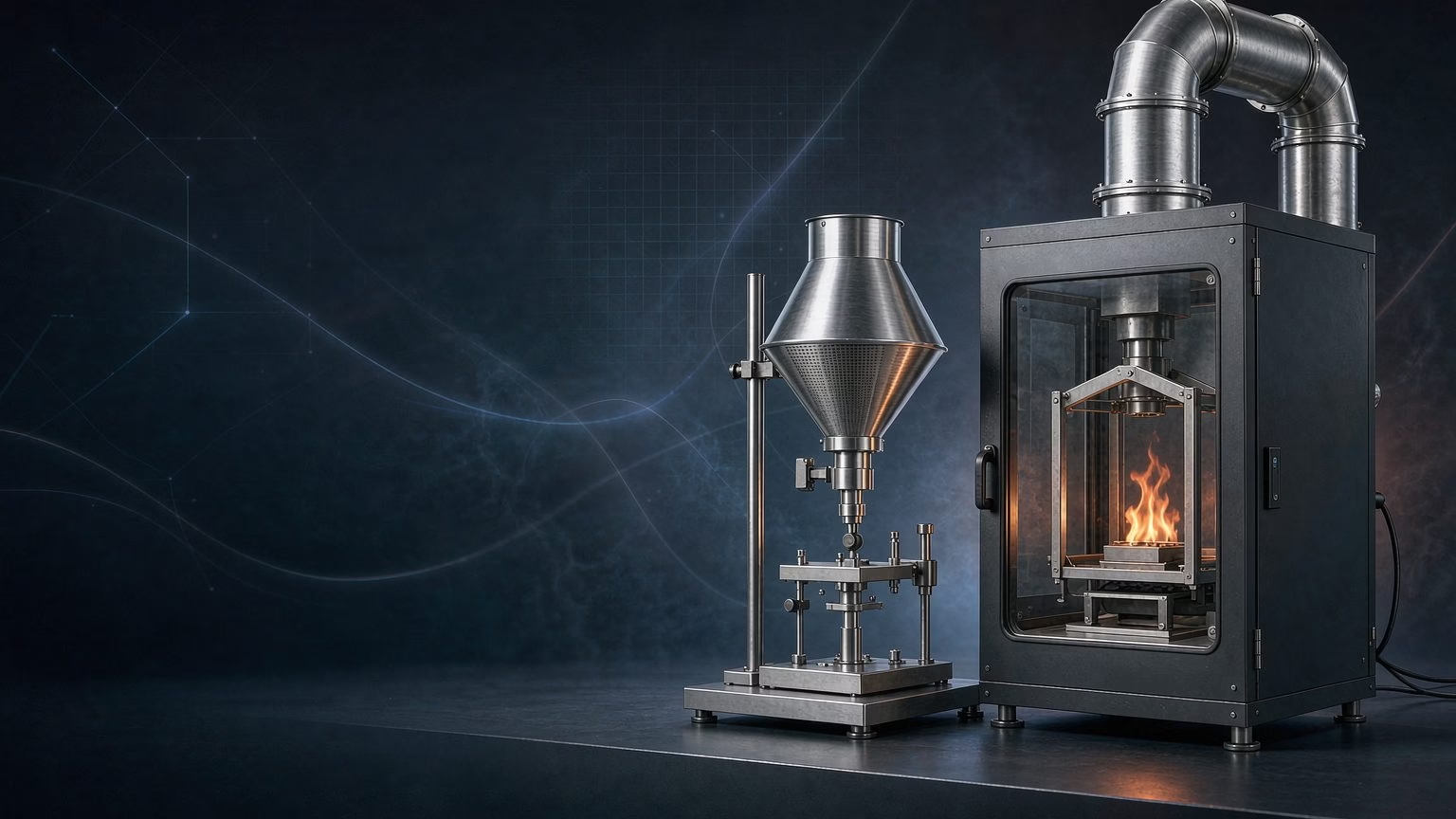
A classification test answers “what class does this product achieve”. A development test answers “why did that change”. The SBI is firmly the first, and treating it as the second is the most common way to waste a testing budget.
Three properties make it a poor development instrument. It runs on a full corner assembly rather than a small coupon, so each iteration costs a specimen build. It is a single exposure that produces indices rather than a continuous property curve, so it tells you the outcome but not the mechanism. And conditioning and substrate selection are prescribed, which means the specimen has to be prepared the way the standard requires rather than the way that would be convenient [1].
Where the screening belongs
The screening work therefore belongs upstream, with the small-flame tests and with bench-scale calorimetry that can be run repeatedly on small specimens. Our comparison of SBI versus the cone calorimeter sets out where the boundary sits, and the practical rule is that a formulation change should be screened before it is ever built into a corner.
The economics are simple. A failed corner run costs a specimen and a booked slot, and it returns one bit of information: this formulation does not reach the target class. A bench-scale programme returns a curve per run and shows which way to move. Laboratories that treat the SBI as a first experiment usually end up running it three times.
Where It Sits in the Classification Ladder
SBI is one route to a class, not the only route. Which tests apply depends on the class being sought, and the ladder is short enough to memorise.
| Target class | Tests involved | Does SBI feature? |
|---|---|---|
| A1 | EN ISO 1182 non-combustibility and EN ISO 1716 calorific potential [2] | No |
| A2 | The A1 pair, plus SBI data for the heat and smoke indices [2] | Yes |
| B, C, D | SBI, together with a small-flame ignitability test [2] | Yes, and it decides the letter |
| E | Small-flame ignitability test only [2] | No |
| F | No performance determined | No |
Two consequences follow. A product claimed as A1 does not need an SBI test at all, which surprises buyers who assume the highest class means the most testing. And a product that fails to reach B because of its FIGRA cannot be rescued by better small-flame results, because the small-flame test is not what is being judged.
A2 deserves its own note, because it is the class where two routes meet. The non-combustibility and calorific potential tests establish that the product contributes very little fuel; the SBI data then establish how the small combustible fraction behaves when it burns in a corner [2]. A supplier holding only the first pair has an incomplete A2 claim, and a supplier holding only the SBI data cannot reach A2 at all.
What It Is Not Used For
The scope of EN 13823 excludes floorings, and it excludes the products listed in Delegated Regulation (EU) 2016/364 [1]. It also notes that the document was developed to determine the reaction to fire performance of essentially flat products, and that some families — linear products such as pipes, ducts and cables — can need special rules [1].
| Question | Where it is actually answered |
|---|---|
| How does a flooring behave? | The flooring route under EN 13501-1, using the radiant panel test [2] |
| How does a cable behave? | EN 13501-6, a separate classification [2] |
| How long does a wall resist a fire? | Fire resistance classification under EN 13501-2, not reaction to fire |
| How toxic is the smoke? | Not classified by this route at all |
| Does the product meet a class in the United States? | A different test and a different classification vocabulary [3] |
The conversion that does not exist
The last row is the one that costs export projects time. SBI data does not convert into a flame spread index, and a flame spread index does not convert into an SBI class, because the two tests are measuring different geometry and different physics.
The Comparison People Actually Ask About
The North American counterpart is the tunnel test. ASTM E84 measures comparative surface burning behaviour of building materials on exposed surfaces such as walls and ceilings, with the specimen in the ceiling position and the surface to be evaluated exposed face down to the ignition source [3]. It is a 10-minute method, and its significance clause describes the result as a comparative measurement of surface flame spread and smoke density against select grade red oak and fibre-cement board, using a specimen a nominal 24 ft long by 20 in. wide [3].
What the tunnel test declines to do
The difference that matters is in what E84 declines to do. It does not measure heat transmission through the tested surface, it does not provide for the effect of aggravated flame spread from the proximity of combustible walls and ceilings, and it does not classify a material as non-combustible by means of a flame spread index alone [3]. The second exclusion is the SBI’s entire justification: a corner puts two surfaces at right angles to each other and lets them preheat one another, which is the situation a corridor, a lift lobby or a facade cavity actually presents.
That also explains why the two results never translate. A product can perform well in a tunnel and poorly in a corner, because the tunnel never gives the second surface a chance to contribute.
Before You Book a Furnace
An SBI fire test is expensive enough that the decision to book one deserves a checklist of its own. The six questions below are the ones that most often turn out to have been answered the wrong way after the specimen has already been built.
| Check | Why it decides whether the test is worth booking |
|---|---|
| Is the product in scope of EN 13823? | Floorings and Delegated Regulation (EU) 2016/364 products are excluded [1] |
| Is it essentially flat? | Linear products such as pipes, ducts and cables can need special rules [1] |
| Which class is being targeted? | A1 and E do not involve SBI at all [2] |
| Is the substrate and conditioning fixed? | They are prescribed, and they change the result [1] |
| Is an extended application needed? | A single test may not cover every thickness and colour in the range |
| Has the formulation already been screened? | Otherwise the corner run is an expensive first experiment |
A note on the current edition
One further point belongs in this checklist even though it is administrative: EN 13823:2020+A1:2022 is currently under review, with a review enquiry recorded as starting in June 2026 and completing in October 2026 [1]. A programme that will report in 2027 should confirm which text is being applied at the time of testing rather than assuming the edition in the quotation is still the reference.
Equipment
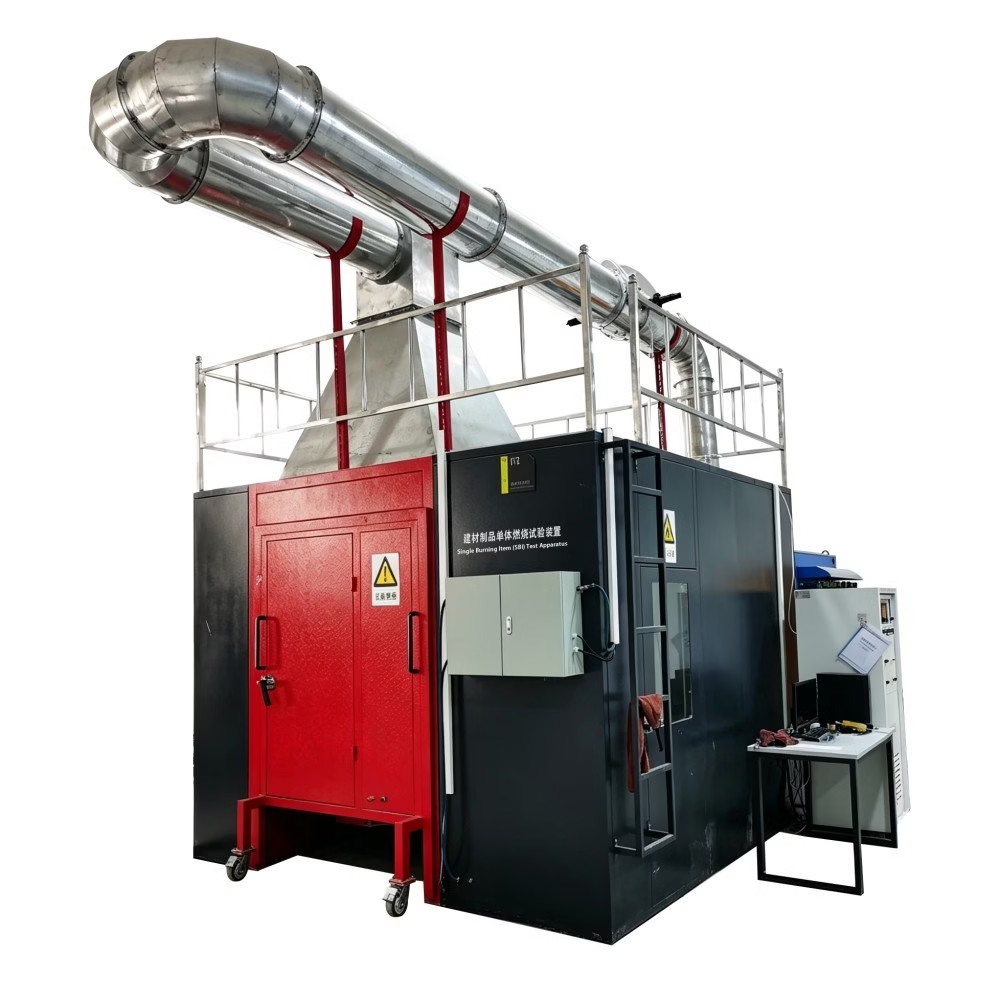
The apparatus is a system rather than a single instrument: the test room, the trolley and specimen frame, the burner, the hood and duct with its measurement section, the gas analysis, the photometer and the data acquisition that computes the indices. BRT’s single burning item test apparatus is configured around that chain, and the acceptance criteria to verify before purchase are set out in our SBI apparatus guide. Calibration is the part buyers underestimate — the normative calibration annex is the reason a cheap apparatus can be more expensive over five years than an expensive one.
Frequently Asked Questions
What is the SBI fire test used for in one sentence?
It is used to produce the reaction-to-fire measurements that EN 13501-1 needs in order to award an A2, B, C or D class, together with the smoke and droplet subscripts, to an essentially flat construction product. It is a classification input, not a research or development test.
Which products are tested by SBI?
Construction products that are essentially flat and that fall within the scope of EN 13823, which excludes floorings and the products listed in Delegated Regulation (EU) 2016/364. The standard notes that linear products such as pipes, ducts and cables can need special rules rather than the standard flat-specimen procedure.
Does a product need an SBI test to be class A1?
No. A1 is established through the non-combustibility and calorific potential tests, and SBI data enter the picture at A2 and below. That is why the highest class is not the most heavily tested one, and why a supplier quoting A1 should be asked which tests the claim actually rests on.
Can SBI results be converted into a flame spread index?
No. ASTM E84 measures comparative surface burning in a ceiling position and reports against red oak and fibre-cement board, and it explicitly does not provide for the effect of aggravated flame spread from the proximity of combustible walls and ceilings. The SBI corner exists to supply that case, so the two results describe different situations and do not translate.
Why does the corner geometry matter so much?
Because two surfaces at right angles preheat each other. A flat specimen in a tunnel never experiences that, so a product can look acceptable in a tunnel and grow quickly in a corner. The corner is what a corridor, a lobby or a facade cavity actually looks like, which is why the classification system is built around it.
Is the SBI test a good way to compare formulations during development?
Usually not. Each run needs a full corner specimen, produces indices rather than a property curve, and requires the prescribed substrate and conditioning, so iteration is slow. Small-flame tests and bench-scale calorimetry are the screening tools, and the SBI is the confirmation at the end.
What does the s1, s2 or s3 subscript tell me?
It reports how much smoke the product produced and how fast, taken from the SMOGRA and TSP600s outputs of the same test. It is a separate axis from the main letter, so a B class can carry a poor smoke subscript, and for escape routes that subscript is often the number that decides the specification.
Conclusion: Four Questions That Decide Whether You Need It
- Is the product in scope? If it is a flooring, a cable or one of the products listed in Delegated Regulation (EU) 2016/364, the answer is no [1].
- Which class are you claiming? A1 and E are reached without SBI; A2, B, C and D are not [2].
- Has it been screened already? If not, run the small-scale work first and save the corner for the formulation you intend to keep.
- Which edition will the report cite? EN 13823:2020+A1:2022 is under review, and the edition in the quotation is not automatically the edition in force at the test date [1].
If you are deciding whether a product belongs on the SBI route or on a different one, send BRT the product description and target class and we will tell you which tests the claim will actually need.
Written by the BRT fire testing applications team, Shenyang Baoruitong Automation Equipment Co., Ltd. Scope, significance and limitation statements are quoted from the EN and ASTM documents cited; no classification thresholds are reproduced because they belong to the classification standard rather than to this article.
Sources
- Itech Standards (CEN catalogue record) — EN 13823:2020+A1:2022 Reaction to fire tests for building products – Building products excluding floorings exposed to the thermal attack by a single burning item — https://standards.iteh.ai/catalog/standards/cen/f56004bc-5670-4b11-9e87-b4b9b6a5dc42/en-13823-2020a1-2022
- Itech Standards (CEN catalogue record) — EN 13501-1:2018 Fire classification of construction products and building elements – Part 1: Classification using data from reaction to fire tests — https://standards.iteh.ai/catalog/standards/cen/4badd874-3b6b-4c82-92b8-63184ae52b81/en-13501-1-2018
- ASTM International — E84 Standard Test Method for Surface Burning Characteristics of Building Materials — https://store.astm.org/e84.html
- National Fire Protection Association — NFPA 255 Standard Method of Test of Surface Burning Characteristics of Building Materials — https://www.nfpa.org/codes-and-standards/nfpa-255-standard-development/255