Building material fire classification answers two different questions, and almost every beginner mistake comes from mixing them. The first question is reaction to fire: how much does this material itself contribute to a fire that is already starting? The second is fire resistance: how long does this wall, floor or door keep performing while a fully developed fire rages on the other side? Every classification system in the world sits on one side or the other of that line, and the class letters you see on a datasheet only make sense once you know which question they answer.
The First Split: Two Families of Fire Performance
Reaction to Fire: What the Material Contributes
Reaction to fire describes a product’s own behaviour when it is exposed to heat or flame: does it ignite, how fast does flame travel across it, how much heat does it release, how much smoke does it make, and does it drip burning droplets? It is a property of the material or product as placed on the market, measured on representative specimens, and it is what the European euronclasses — A1 through F — describe 1.
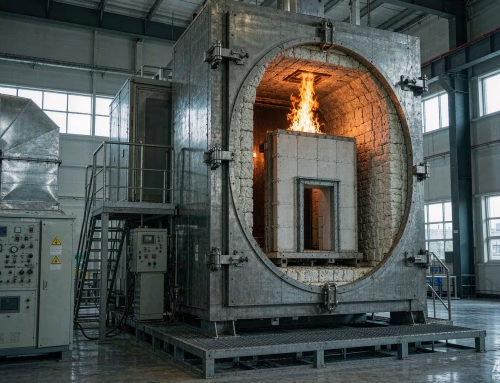
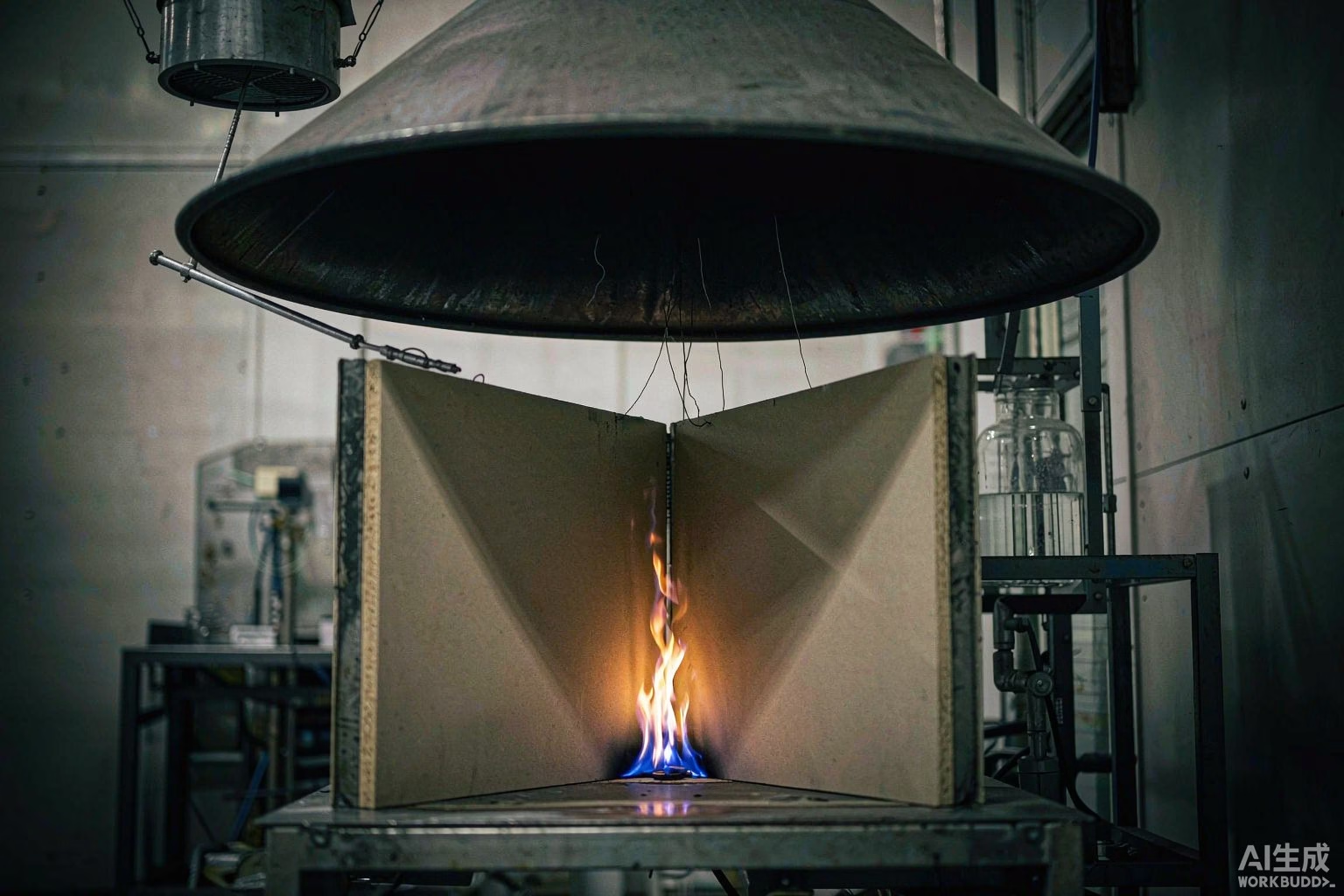
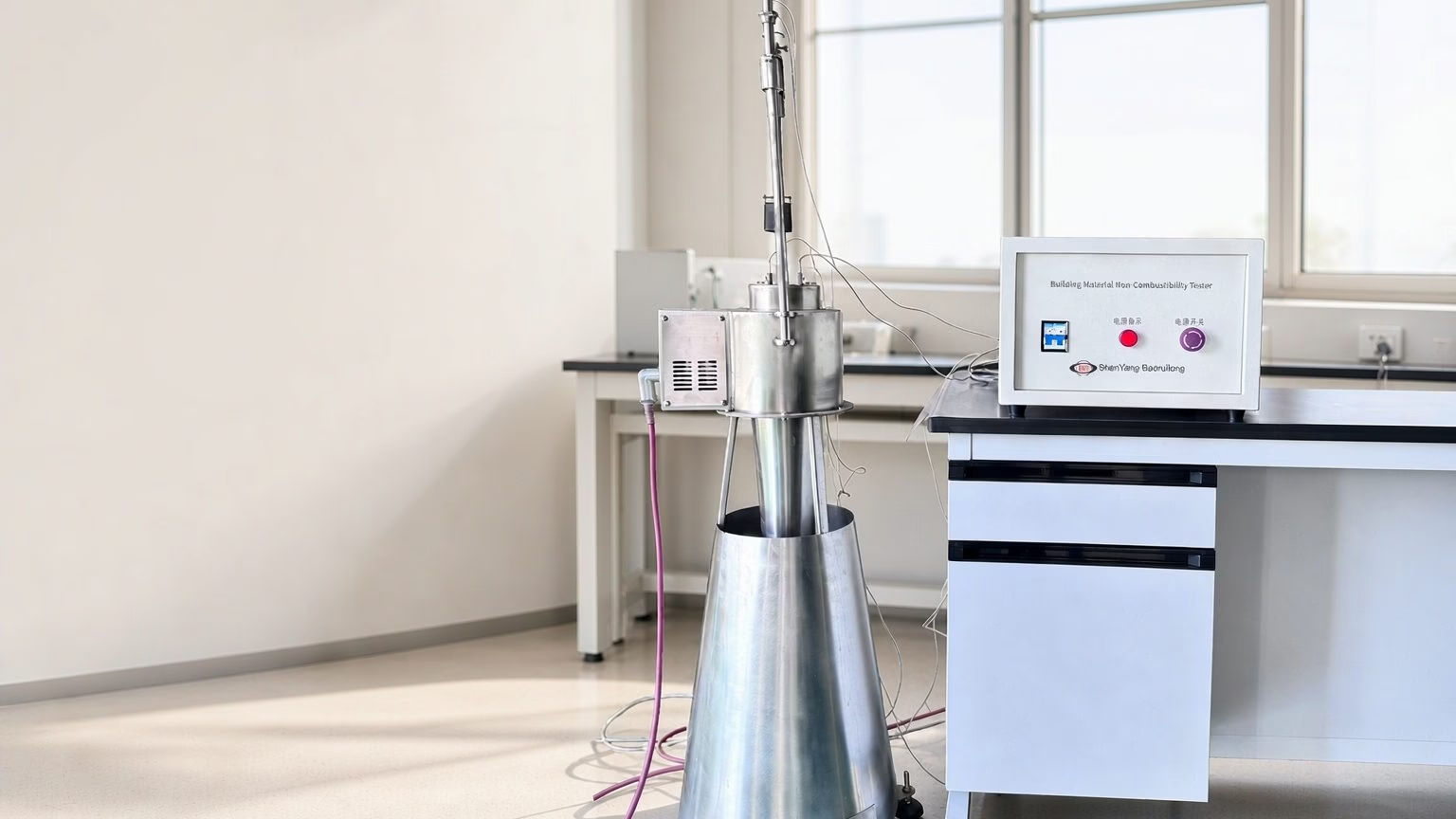
Because the measurement is about contribution rather than survival, reaction to fire testing uses small or medium specimens and controlled ignition sources. Non-combustibility is measured in a furnace at a stabilised temperature 2, heat of combustion in a calorimeter 3, burning behaviour in a corner rig 4, and ignitability from a small direct flame 5. Different products are routed through different combinations of those tests; that is the part our guides go into in depth.
Fire Resistance: What the Assembly Survives
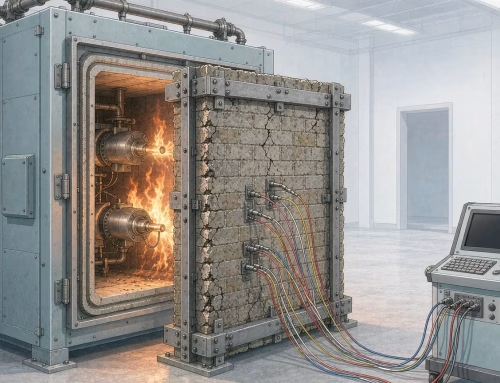
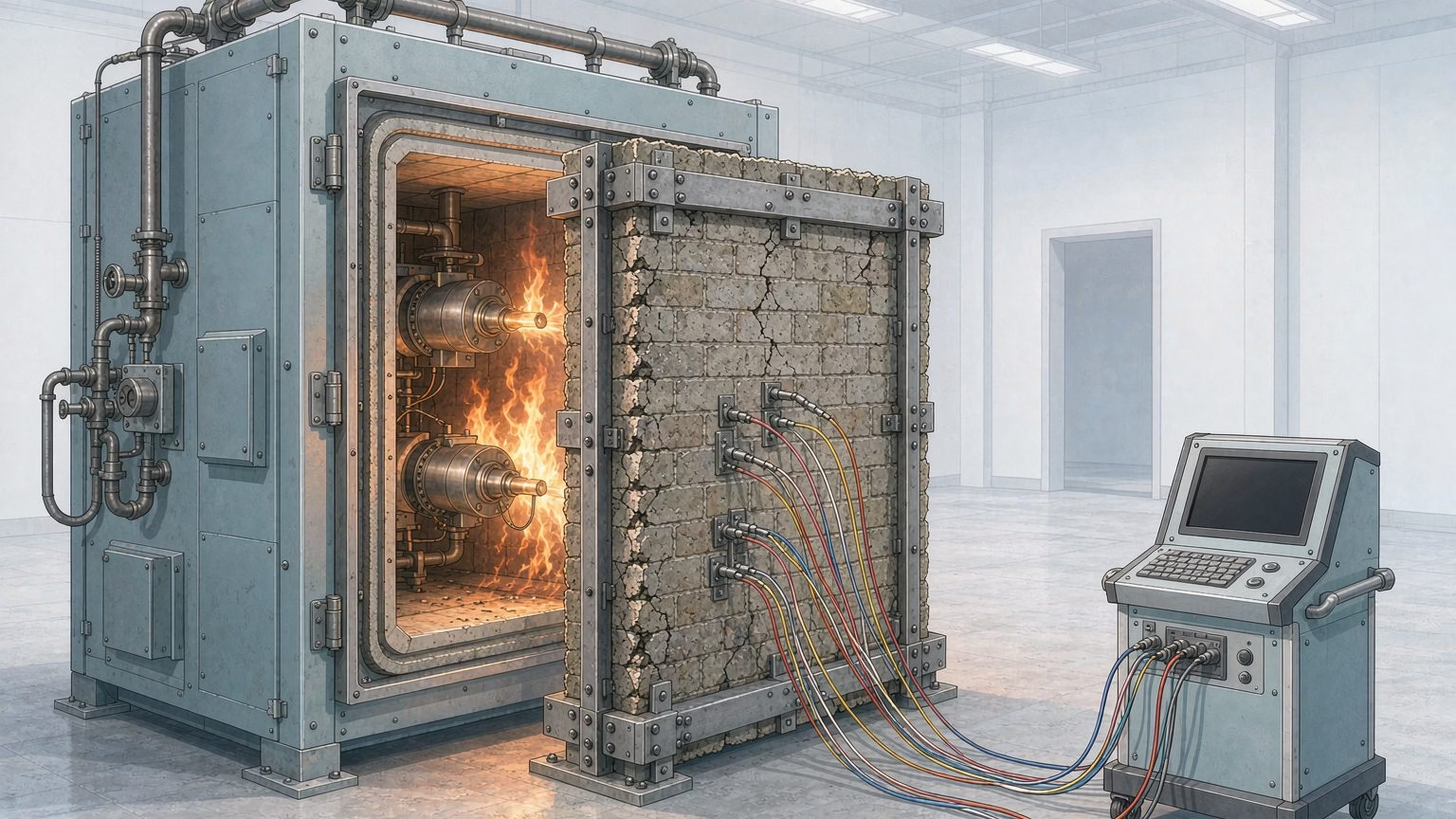
Fire resistance is a different question entirely. Here the specimen is an element or assembly — a wall, a floor, a door, a beam — and the question is how long it continues to do its job while exposed to a standard fire curve. The output is not a letter class but a duration: 30, 60, 90 or 120 minutes, reported against criteria for loadbearing capacity, integrity and insulation 1112.
The distinction matters commercially as well as technically. A manufacturer of insulation boards sells a reaction to fire class. A manufacturer of fire doors sells a fire resistance rating. If you are reading a specification and cannot tell which of the two is being asked for, stop and ask — everything downstream depends on it. Our comparison of fire resistance and flame retardancy treats the same boundary from a materials viewpoint, and what a fire resistance test actually measures explains the three criteria in full.
| Reaction to fire | Fire resistance | |
|---|---|---|
| Question asked | How much does this product feed a starting fire? | How long does this element keep performing in a developed fire? |
| Specimen | Material or product, representative of what is sold | Complete element or assembly, usually full size |
| Governing European framework | EN 13501-1 [1] | EN 13501-2 with furnace methods [11][12] |
| Typical output | Class letter A1–F plus subscripts | Duration in minutes against R, E and I criteria |
| North American counterpart | Surface burning characteristics 7 | Fire endurance of building construction elements [13] |
| Typical apparatus | Furnaces, calorimeters, corner rigs, small-flame benches | Large furnaces with loading frames and extraction |
Reading a Building Material Fire Classification String
The Main Class
A European declaration reads like B-s1, d0. The letter before the hyphen is the main class and it runs from A1 down to F [1].
| Class | Plain-language meaning | How it is established |
|---|---|---|
| A1 | Does not contribute to fire at any stage | Non-combustibility and heat of combustion [2][3] |
| A2 | Negligible contribution | As A1 plus a corner burning test [3][4] |
| B | Very limited contribution | Corner burning behaviour plus small-flame ignitability [4][5] |
| C | Limited contribution | Same test pair, higher thresholds [4][5] |
| D | Acceptable contribution | Same test pair, higher thresholds again [4][5] |
| E | Acceptable reaction to a small flame | Small-flame ignitability alone [5] |
| F | No performance determined | No test required, or fails E |
Two properties of that ladder are worth internalising before you read any supplier literature. First, A1 and A2 are established by different tests from B, C and D — a stone wool board and a phenolic insulation board reach the top of the scale by different routes [2][3][4]. Second, thresholds are set against measured quantities, so a class is a measurement outcome rather than a marketing tier.
The Two Subscripts
The letter after the hyphen is the smoke sub-class, s1 to s3, with s1 the lowest smoke production. The final element is the droplet sub-class, d0 to d2, with d0 meaning no flaming droplets. Some strings carry an additional subscript: fl marks a flooring product, tested by a different method from wall and ceiling products, and L appears in some cable declarations. Read the whole string — a B without its subscripts is only half a declaration [1].
There is also a version question hiding here. The small-flame method behind the E class and the ignitability part of B/C/D moved from the 2020 edition to a 2026 edition [5]6, and reports should cite the edition they were run to.
Cables, Pipes and Linear Products Have Their Own Routes
Not every construction product travels the wall-and-ceiling road. Cables, pipes, ducts and linear sealing products are tested differently, because their geometry and their installed state differ from a flat board: a cable hangs in a bundle, a pipe penetrates a wall, and a linear seal closes a gap between two elements. Their classifications therefore carry their own subscripts, and the applicable methods differ from the board routes described above [1]. The practical takeaway for a beginner is simple: if your product is not flat, do not assume the board route applies, and ask specifically which sub-part of the classification standard covers your product type.
The Three Regimes You Will Meet
| Regime | Main vocabulary | Output looks like | Where it applies |
|---|---|---|---|
| Europe | EN 13501-1 euroclass [1] | A2-s1, d0 |
Products placed on the European market; widely referenced elsewhere |
| North America | Surface burning characteristics [7] and assembly tests 9 | Class A/B/C, or an assembly hourly rating | United States and Canada, under model codes |
| China and other national systems | National grading schemes | Letter-and-number grades defined nationally | Domestic markets; sometimes required alongside EN or ASTM |
Europe: The Euroclass System
The European system is the one most export-oriented manufacturers meet first, because it is referenced well beyond the EU and because its class strings have become a de facto trade shorthand. It is also the system whose structure most cleanly separates the two families: reaction to fire classes under Part 1, and fire resistance classifications under Part 2 [1][11]. It classifies construction products by reaction to fire, with the subscripts described above, and it is issued on the basis of test evidence from a defined set of methods [1]. The detail — which test route reaches which class, what the thresholds are, and where the corner burning test sits — is the subject of our dedicated EN 13501-1 euroclass guide, and the four tests behind the classes are set out in reaction to fire testing.
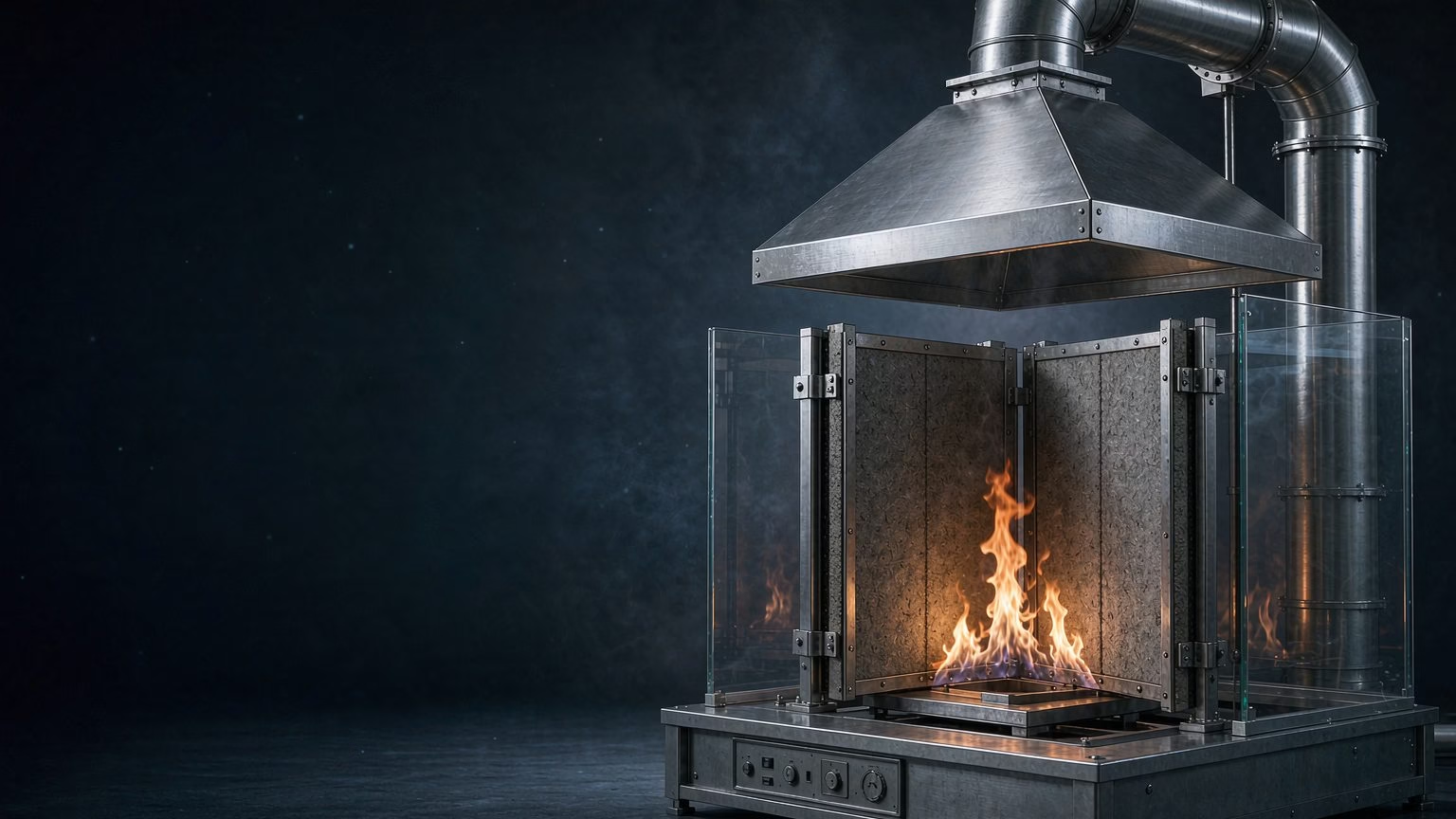
North America: Surface Burning and Assembly Tests
The United States takes two routes that map onto the same split. For materials and surface products, the surface burning characteristics test reports a flame spread index and a smoke developed index, and products are placed into Class A, B or C bands whose thresholds are set by the model codes rather than by the test method alone [7]. For assemblies — exterior wall systems in particular — a multi-storey assembly test is used, and the acceptance criteria are written into the code [9]. Note that the US vocabulary of “Class A” and the European “class A1” are not comparable: one describes surface flame spread, the other describes contribution to fire measured by a completely different set of methods.
Heat release testing also crosses regimes. The cone calorimeter method is not part of the core European construction product route, but it underpins a great deal of product development and appears directly in transport and marine specifications 10; the North American equivalent is published as its own standard [10].
China and Other National Systems
Several major markets run national grading schemes with their own letter-and-number grades, and products sold domestically are classified under those schemes rather than under EN or ASTM. The schemes generally place products on a ladder from non-combustible through limited combustibility to readily combustible, and they commonly require their own test methods even where a broadly similar method exists elsewhere. For a manufacturer, the consequence is that domestic and export classifications are produced in parallel rather than converted from one another, and the cheapest mistake to avoid is assuming a European class can be translated into a national grade by table alone. Where a manufacturer exports, the practical consequence is that one product can legitimately carry two or more classifications, issued under different systems from different test evidence. This is normal and not a contradiction — the classes simply answer each regime’s own question. For a structured view of which regimes apply where, see our global building material fire testing standards guide.
How a Classification Is Actually Issued
“Tested” Is Not the Same as “Classified”
This is the single most useful distinction for anyone new to the subject. A test produces a result — a temperature rise, a heat release figure, a flame spread distance. A classification takes one or more of those results and maps them onto a class defined by the classification standard. The mapping is not done by the test method; it is done by the classification standard [1].
| Step | What happens | Who does it | Output |
|---|---|---|---|
| 1. Determine the route | Identify which family and regime apply to the product | Manufacturer with the certification body | A list of test methods |
| 2. Prepare and condition specimens | Specimens are made and conditioned the way the method requires | Manufacturer or laboratory | Representative specimens |
| 3. Test | Each method is run to its current edition | Testing laboratory, in-house or third party | Individual test results [2][3][4][5] |
| 4. Classify | Results are mapped onto the class thresholds | Manufacturer or notified body, against the classification standard | A class string such as B-s1, d0 [1] |
| 5. Document | The declaration records product, class, methods and editions | Manufacturer | Classification report and declaration |
| 6. Maintain | Changes to formulation, substrate or thickness trigger re-assessment | Manufacturer | Updated or re-issued declaration |
Note steps 2 and 6, where most beginners get caught. The classification applies to the product as tested — its thickness, its substrate, its mounting and fixing method, and often its end-use application. Reformulate, change the facing, or move from wall to ceiling use, and the classification may no longer describe what you are selling.
What a Building Material Fire Classification Does Not Tell You
A classification is narrower than most people assume, and knowing its edges is as useful as knowing its content. It does not describe structural behaviour under load; that is the domain of fire resistance testing and of structural engineering [11]. It does not, in the standard construction product route, give a toxicity figure for fire effluent — where smoke toxicity matters, it is addressed by separate national or sector specifications rather than by the main class [1]. It does not describe performance in a real room fire, because the methods use defined specimens and defined ignition sources rather than a full-scale scenario. And it does not travel with the product name: it travels with the product as tested, including its thickness, substrate and mounting [1]. Read every classification with those four exclusions in mind and you will avoid most of the disputes that arise later in a project.
Six Mistakes Beginners Make
| Mistake | Why it happens | What to do instead |
|---|---|---|
| Mixing reaction to fire with fire resistance | Both are called “fire rating” in casual speech | Ask which of the two the specification requires before anything else |
| Reading the class letter and ignoring the subscripts | The smoke and droplet classes are printed smaller | Always quote the full string, e.g. B-s1, d0 |
| Treating a test result as a classification | A test returns numbers, not letters | Map results through the classification standard [1] |
| Assuming a class transfers between products | It applies to the product as tested | Check thickness, substrate, mounting and end use before reusing a classification |
| Comparing European and North American class letters | Both use “A” | Compare the underlying test methods, not the letters [7] |
| Ignoring standard editions | Editions move quietly | Record the edition each result was run to; EN ISO 11925-2 is one recent example [5][6] |
Where Building Material Fire Classification Goes Deeper
This guide is deliberately the shallow end. Once you know which family and regime you are in, the following go deeper:
- Euroclass classes, thresholds and test routes — the EN 13501-1 euroclass guide is the reference read.
- The four tests behind those classes — reaction to fire testing explains what each one measures and why the current versions matter.
- The small-flame method used for class E and for ignitability — covered in EN ISO 11925-2 single flame source test.
- Non-combustibility in detail — non-combustibility testing to ISO 1182.
- Heat release measurement — ISO 5660 cone calorimeter testing.
- Fire resistance procedure and criteria — how fire resistance is tested for building materials.
- Regional frameworks side by side — the global standards guide.
For the equipment that produces the underlying evidence — non-combustibility apparatus, gross heat of combustion testers, single burning item apparatus and combustibility test apparatus — the full range is listed under fire and flame testing equipment.
Frequently Asked Questions
What does building material fire classification actually mean?
It is a system for describing how a construction product behaves in a fire, expressed as a defined class. Most systems split into two families: reaction to fire, which describes how much the product contributes to a developing fire, and fire resistance, which describes how long a complete element keeps performing under a standard fire.
What is the difference between reaction to fire and fire resistance?
Reaction to fire tests the material or product itself — ignition, flame spread, heat release, smoke and droplets. Fire resistance tests a complete element or assembly against a standard fire curve and reports a duration against criteria for loadbearing capacity, integrity and insulation.
What do the letters and numbers in a Euroclass string mean?
The main letter runs from A1, the highest, down to F. It is followed by a smoke sub-class from s1 to s3 and a droplet sub-class from d0 to d2. A flooring product carries an fl subscript. Read the whole string, because the letter alone is only part of the declaration.
Is Euroclass A1 the same as North American Class A?
No. The two systems use different test methods and answer different questions. A1 describes contribution to fire measured by non-combustibility and heat of combustion, while Class A describes surface flame spread measured by a tunnel method. Comparing the letters directly is a common and expensive error.
Does a test result give me a classification automatically?
No. A test produces measured values. A classification is produced by mapping those values onto thresholds defined in the classification standard, and it applies to the product exactly as it was tested — thickness, substrate and mounting included.
How long does a building material fire classification last?
It lasts as long as the product stays the same. Any change to formulation, facing, thickness, substrate or intended end use can require re-assessment, because the classification describes the product as tested rather than the product family.
Do I need both a European and a North American classification?
Only if you sell into both markets. The two regimes use different methods and neither accepts the other’s evidence directly, so export programmes commonly hold a set of classifications for the same product rather than a single universal grade.
Start With the Question, Not the Letter
Work in this order. First, decide which family applies — reaction to fire or fire resistance — because that choice determines the vocabulary, the methods and the equipment. Second, establish which regime governs your market. Third, learn to read the whole class string, subscripts included, and never quote a bare letter. Fourth, remember that a test result is not yet a classification, and that a classification describes the product exactly as tested. Fifth, record the standard editions behind every result, because they move. Sixth, come back to the deeper guides above once the basics are settled.
BRT Testing manufactures the fire test equipment that produces the underlying evidence — non-combustibility furnaces, calorific value testers, single burning item apparatus, cone calorimeters and small-flame benches. Tell us which market and which class you are targeting, and we will return the test route behind it with the instruments that route requires.
Prepared by the applications engineering team at Shenyang Baoruitong Automation Equipment Co., Ltd. (BRT Testing), a manufacturer and exporter of fire testing equipment and laboratory instruments. Company information is available on our about page, and technical enquiries can be directed through our contact page.
Sources
- iTeh Standards — EN 13501-1:2018
- UNI Ente Italiano di Normazione — ISO 1182:2020
- UNI Ente Italiano di Normazione — ISO 1716:2018
- UNI Ente Italiano di Normazione — EN 13823:2020
- NSAI Standards Store (Ireland) — I.S. EN ISO 11925-2:2020
- glstd.com — EN ISO 11925-2:2026
- ASTM International — E84-23a Standard Test Method for Surface Burning Characteristics of Building Materials
- ASTM International — E119-24 Standard Test Methods for Fire Tests of Building Construction and Materials
- NFPA — NFPA 285
- UNI Ente Italiano di Normazione — ISO 5660-1:2015
- UNI Ente Italiano di Normazione — ISO 834-1:2025
- UNI Ente Italiano di Normazione — EN 1363-1:2020