- The Short Answer
- Why a Rating Is Not a Property
- The Three Questions, and the Tests That Answer Them
- Why the Oxygen Index and the UL 94 Result Disagree
- What Each FR Mechanism Tends to Move
- The Ladder Is Gated, Not Linear
- Designing the Screening Sequence
- What These Tests Do Not Cover
- Recording a Result So It Travels
- Equipment for an FR Programme
- Frequently Asked Questions
- Do I need both the oxygen index and a UL 94 rating?
- Why does my grade pass V-0 at 3 mm but fail at 1 mm?
- Can I go straight to the 500 W test?
- Is ISO 1210 still the right standard for the vertical test?
- Does a V-0 rating mean the part is fire resistant?
- How often do I have to re-test after a formulation change?
- Conclusion: A Six-Step Verification Programme
- Sources
The Short Answer
Testing flame retardant plastics is not one test — it is a qualification argument, and the argument has to survive a change of thickness, a change of colour and a change of supplier. The practical sequence runs from a cheap threshold measurement to a small-flame classification and only then to a 500 W confirmation. ASTM D2863 gives the oxygen threshold 1, ASTM D635 the horizontal 50 W behaviour 2 and ASTM D3801 the vertical one 3, while ASTM D5048 carries the 500 W step 4. The governing product standard for most electrical and electronic applications is ANSI/UL 94, now Edition 7 with a July 2026 revision 5, and its international counterparts are IEC 60695-11-10 for the 50 W work 6 and IEC 60695-11-20 for the 500 W work 7.
The single most useful idea in this whole area is that a rating describes a specimen, not a material. Every one of those standards says so in its own scope, and each one asks you to state the conditions alongside the number.
Why a Rating Is Not a Property
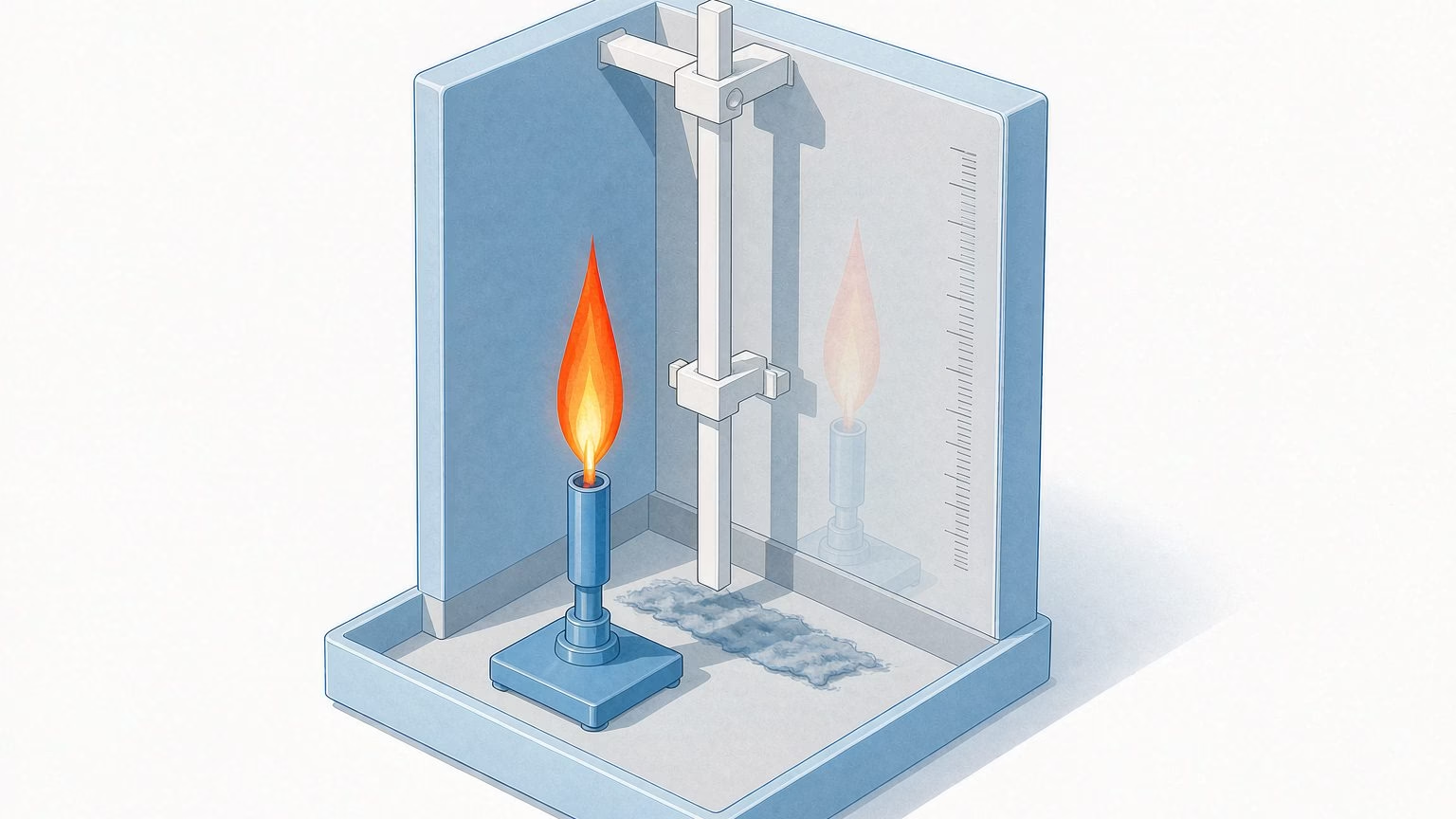
Flame retardant plastics are judged by standards that go out of their way to limit their own claims. UL 94 states in 1.1 that its requirements serve as a preliminary indication of acceptability with respect to flammability for a particular application, and in 1.4 that final acceptance depends on use in complete equipment conforming to the standard applicable to that equipment [5]. ASTM D635 is blunter: the results are a preliminary indication, and correlation with flammability under actual use conditions is not implied [2]. ASTM D2863 uses almost the same sentence about the oxygen index [1].
A flammability number is therefore a measurement of a specimen in a stated geometry under a stated flame, and its authority stops at the edge of those conditions. That is why a flame retardant grade is qualified rather than certified, and why the qualification has to be re-argued whenever the specimen changes.
The standard asks you to declare the formulation ranges
IEC 60695-11-10 devotes subclause 7.3, “Testing materials – ranges in formulations”, to this problem. It separates the general requirement, the effect of density, melt flow and filler or reinforcement, and the effect of colour [6]. A standard would not ask for those three headings if a grade designation were sufficient. It is telling you that a result obtained on one formulation describes that formulation, and that an honest report states the range over which the claim holds.
Thickness is the variable that catches everyone
IEC 60695-11-20 is the clearest document in the family on transferability. Where the method is used for pre-selection, positive results shall be obtained at a test specimen thickness equal to the smallest thickness used in the product application [7]. That sentence explains most of the arguments between a compounder and a converter: a V-0 obtained on a 3.0 mm bar says nothing about the same grade moulded at 0.8 mm.
The same constraint appears in ASTM D5048, which requires comparison only against data for material of the same thickness [4], and in ASTM D635, which lists density, pigments and anisotropy among the influences on a burning result [2].
The Three Questions, and the Tests That Answer Them
A flame retardant additive is asked to do one of three things, and no single test covers all three. Sorting the test list by the question rather than by the standard number is the fastest way to design a programme.
| Question | What the test actually reports | Tests that answer it | What it will never tell you |
|---|---|---|---|
| At what temperature does it ignite without a flame? | A temperature, not a pass or fail | ASTM D1929 hot-air furnace: flash ignition and spontaneous ignition temperature 8 | Whether the part ignites from a small flame |
| Once lit, does it keep burning? | Time, rate and extent of burning after the ignition source is removed | ASTM D635 and IEC 60695-11-10 Method A (horizontal); ASTM D3801 and Method B (vertical) [2][3][6] | How much heat the burning part releases |
| How much heat does it contribute, and will it burn through? | Heat release rate, mass loss, effective heat of combustion, smoke, burn-through | ASTM D2863 oxygen index [1]; ASTM D5048 500 W bar and plaque [4]; ASTM E1354 cone calorimeter 9 | Whether the assembly passes a fire resistance rating |
Does it ignite at all
ASTM D1929 is the outlier in the family because it reports a temperature. It determines the flash ignition temperature and the spontaneous ignition temperature of plastics using a hot-air furnace, and its significance clause describes the values as the lowest ambient air temperature that will cause ignition of the material under the conditions of the test [8]. That makes it the right test when the risk is a part sitting against a hot surface rather than a part near an arc, and the wrong test when the risk is a small open flame.
Does it keep burning once the flame is removed
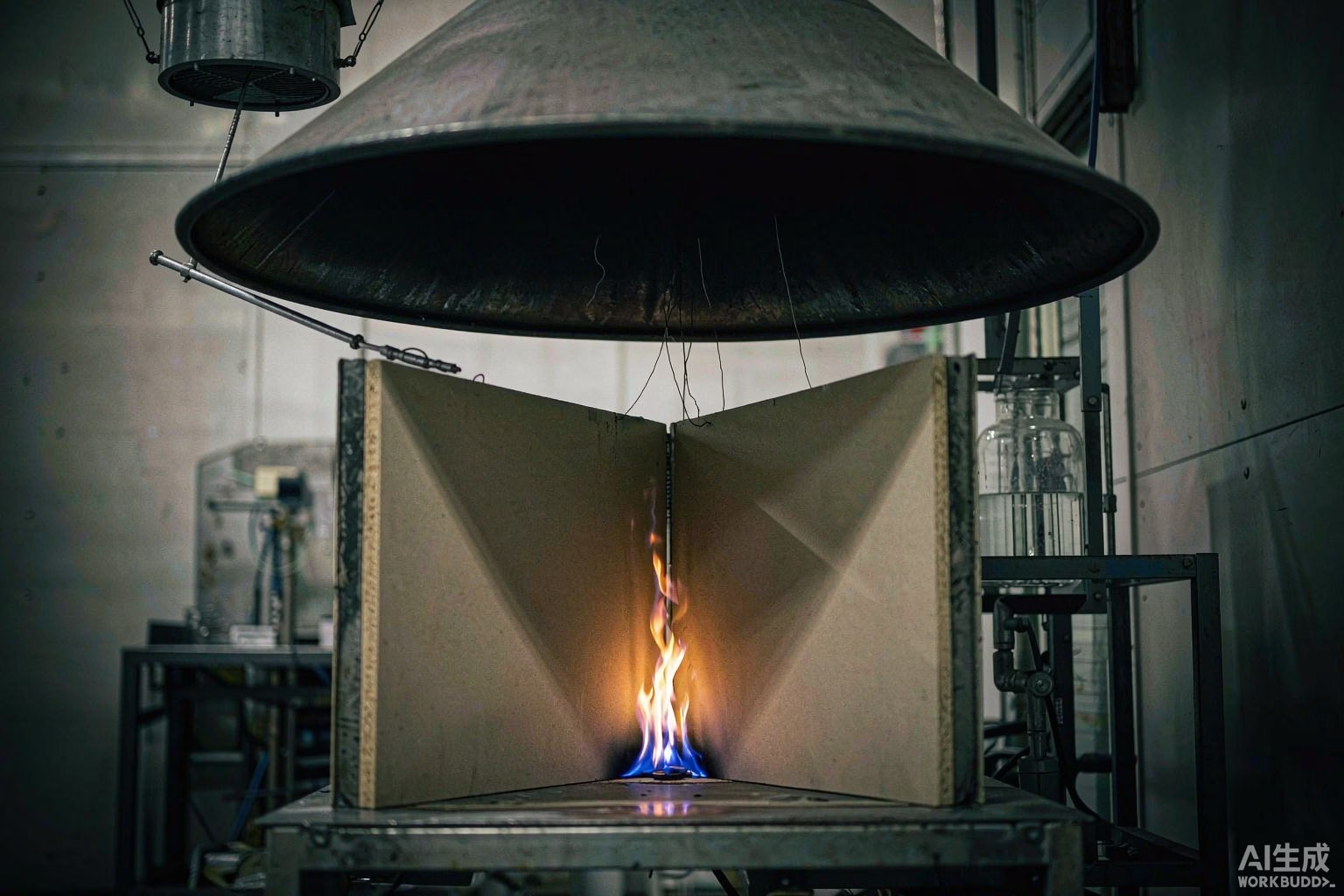
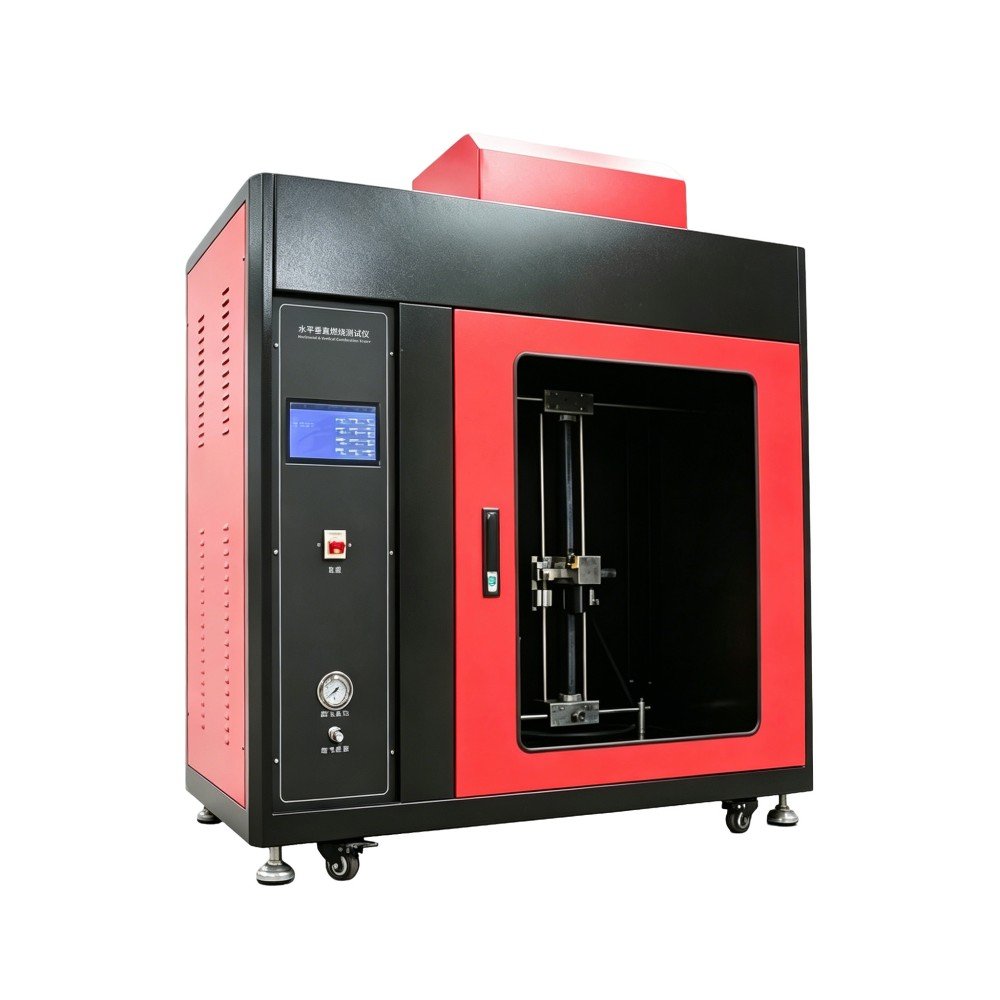
This is where the 50 W tests live. IEC 60695-11-10 describes two methods: Method A is a horizontal burning test intended to determine the linear burning rate, and Method B is a vertical burning test intended to determine whether materials self-extinguish [6]. ASTM D635 is the horizontal counterpart and is technically equivalent to Method A [2]; ASTM D3801 is the vertical counterpart, equivalent both to IEC 60695-11-10 Method B and to the 20 mm (50 W) vertical burning test of ANSI/UL 94 that produces the V-0, V-1 and V-2 designations [3]. The horizontal classification is graded into HB, HB40 and HB75 [6], and the reasoning behind those grades is set out in our guide to UL 94 ratings.
How much heat does it contribute
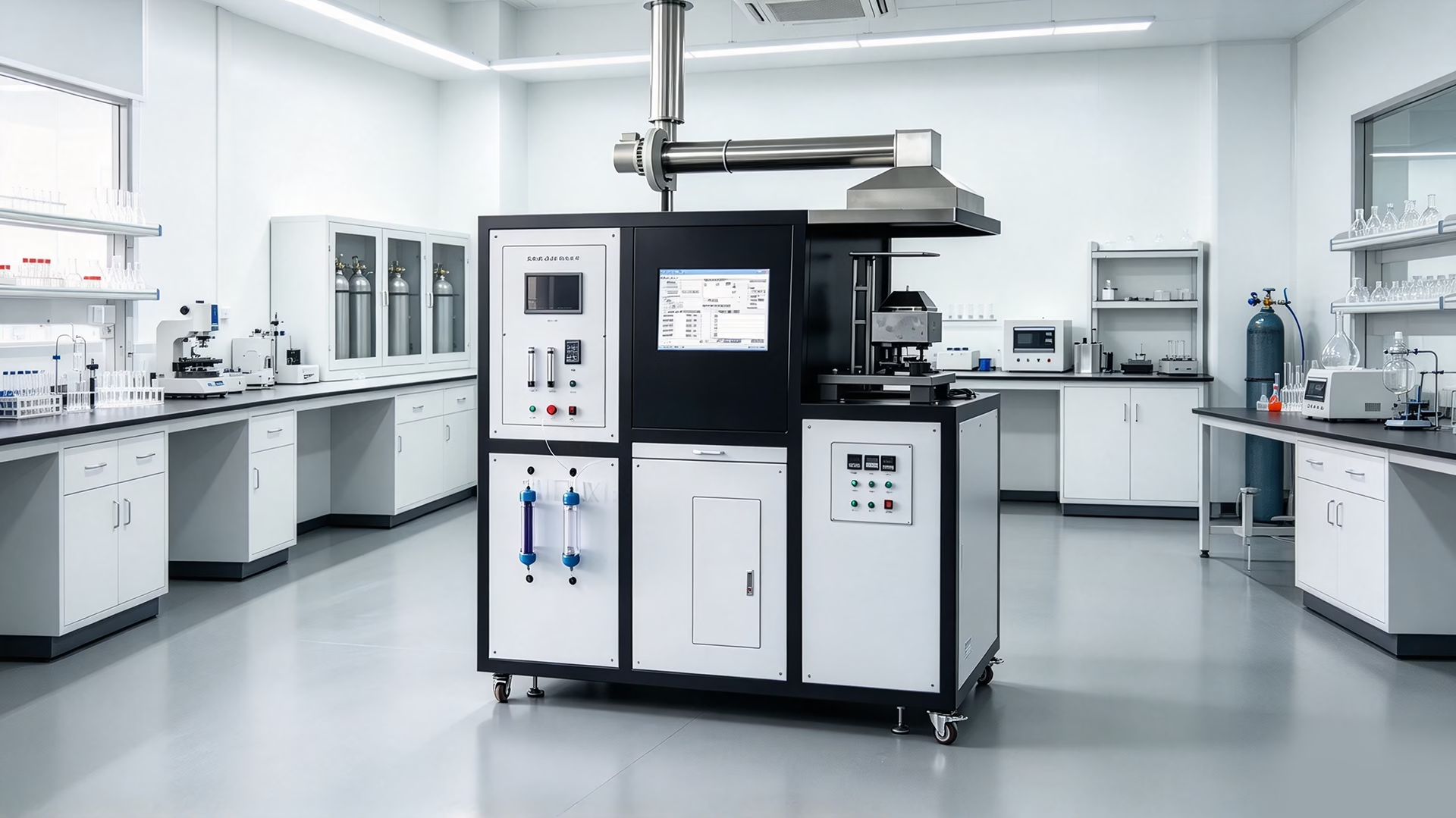
Two tests answer this, and they answer it differently. ASTM D2863 measures the minimum concentration of oxygen, expressed as percent volume, that will just support flaming combustion in a flowing mixture of oxygen and nitrogen — a threshold, offered in three procedures, one of which is a short comparison against a specified minimum value [1]. ASTM E1354 measures the response of materials exposed to controlled radiant heating at initial test heat fluxes from 0 to 100 kW/m², reporting ignitability, heat release rates, mass loss rates, effective heat of combustion and visible smoke development [9].
A threshold and a rate are not interchangeable. The oxygen index tells you how far the atmosphere has to be enriched before the material sustains a flame; the cone calorimeter tells you what the material does to a fire that is already running.
Why the Oxygen Index and the UL 94 Result Disagree
A grade can gain five points of oxygen index and still fail the vertical test, and the reverse happens too, because the two tests create different failure conditions.
The oxygen index is measured with the specimen burning downward in a controlled atmosphere, so the question is whether the flame can sustain itself in that mixture. A vertical small-flame test asks something else: after a defined flame application, does the specimen stop burning within a set time, and do whatever drips off it ignite the cotton pad below. A formulation that works by forming a protective char can raise the oxygen index substantially while still producing a dripping, char-free edge at the top of a vertical bar. A formulation that works by melting and flowing away from the flame can pass the vertical test while barely moving the oxygen index, because it removes itself from the flame rather than resisting it.
Neither number is wrong. ASTM D2863 states plainly that correlation with burning characteristics under actual use conditions is not implied [1]. A datasheet that quotes an oxygen index without a small-flame classification is telling you something about the supplier’s test programme as well as about the polymer.
What Each FR Mechanism Tends to Move
Most flame retardant plastics work by one of five mechanisms, and each one leaves a different fingerprint across the test list. The table below is an expectation map, not a set of measured results: it exists to help you choose which test to run first, and only the test decides what happens in your formulation.
| Mechanism | Primary action | Tests most likely to respond | Tests likely to sit still |
|---|---|---|---|
| Halogenated, gas-phase | Radical scavenging in the flame zone | Vertical small-flame classification, ignition temperature | Oxygen index moves modestly; char-based tests unaffected |
| Phosphorus-based, condensed-phase | Acid-catalysed char formation, less fuel to the flame | Oxygen index, horizontal burn rate, cone heat release | Vertical drip behaviour may not improve |
| Mineral fillers and metal hydrates | Endothermic decomposition, dilution of fuel, heat sink | Cone heat release, ignition temperature, burn-through resistance | Small-flame classification can be loading-limited |
| Intumescent | Swelling char barrier on heating | Horizontal burn rate, cone heat release, burn-through | Oxygen index often flat; vertical dripping unchanged |
| Nano-dispersed clay | Char reinforcement, reduced mass loss rate | Cone heat release, mass loss rate | Small-flame classification often unchanged |
Reading the map honestly
The map is useful for sequencing and dangerous for predicting. A heavily filled system changes the melt viscosity, and viscosity changes dripping, so the vertical result can move for reasons that have nothing to do with flame chemistry. A halogenated system may lift the vertical classification while making the smoke picture worse — a separate measurement, as our note on smoke production in fire testing sets out.
The consequence is simple: test the property you intend to claim, at the thickness you intend to claim it, and never infer one classification from another.
The Ladder Is Gated, Not Linear
It is tempting to treat the 50 W and 500 W tests as two levels of the same ladder, with the second simply more severe. The standards make it a gate instead.
IEC 60695-11-20 states that the test method only applies to materials that have been classified as V-0 or V-1 according to IEC 60695-11-10 [7]. ASTM D5048 is the equivalent method, using a 125 mm (500 W nominal) flame on small bar and plaque specimens, and is equivalent to IEC 60695-11-20 and to UL 94 Section 9 [4]. The plaques exist for a reason: they assess resistance to burn-through, which a bar cannot show [7].
So the sequence cannot be skipped. A material that has not reached V-0 or V-1 gets no 500 W result at all, and a 500 W plaque result answers a question — will the flame pass through the wall of the part — that the vertical bar test never asked.
There is also an exclusion worth knowing: IEC 60695-11-20 does not apply to materials that shrink away from the applied flame without igniting because of their thinness [7]. Thin films and foams need a different route, which is why our overview of horizontal versus vertical flammability testing treats thin and cellular materials as their own case.
Designing the Screening Sequence
A programme that runs every test on every candidate is expensive and slow. A programme that runs one test and hopes is worse. The sequence below is ordered by cost and by how much each result narrows the field.
| Stage | Test | Specimen | What it settles | When to stop |
|---|---|---|---|---|
| 1 | Neat resin baseline | As supplied | Whether the base polymer already meets the target without FR | If it does, the FR package is adding cost for nothing |
| 2 | Oxygen index, short procedure | Bar or sheet up to 10.5 mm [1] | A cheap ranking between candidate formulations | Never on its own — it is a ranking, not a classification |
| 3 | Horizontal 50 W | Bar | Whether the formulation burns slowly enough to be worth the vertical test | If the bar burns to the mark, reformulate before going vertical |
| 4 | Vertical 50 W | Bar | The classification the customer will actually quote | If V-0 or V-1 is reached, proceed; if not, stop and reformulate |
| 5 | 500 W bar and plaque | Bar and square plaque [4] | Burn-through resistance and the 5V-type argument | Only reachable after stage 4 |
| 6 | Cone calorimeter | Planar specimen [9] | Heat release, mass loss, effective heat of combustion, smoke | When the application or the customer asks for heat release data |
| 7 | Ignition temperature | Granules or powder [8] | Behaviour against a hot surface rather than a flame | When the failure mode of concern is a hot part, not an arc |
Two rules make the sequence work. Test at the thickness the product will actually be moulded at, because the standards tie the claim to that thickness [7][4]. And re-run stage 4 whenever the colour, the filler loading or the FR supplier changes, because the standards name those as influences on the result [6][3].
What These Tests Do Not Cover
UL 94 is unusually explicit about its own boundaries, and the list is worth quoting because it prevents most misapplication. The standard is not applicable, with the exception of the Radiant Panel Index Test in Section 10, to parts where the thickness exceeds 13.0 mm or where the surface area exceeds 1 m². It does not cover polymeric materials used for building construction, finishing or contents such as wall and floor coverings, furnishings or decorative objects. Fire resistance in terms of an hourly rating, flame spread, smoke characterisation and heat release rate are not evaluated [5].
Each of those exclusions has a home elsewhere. Hourly fire resistance belongs to the furnace standards behind our guide to fire resistance testing for walls and partitions. Flame spread and heat release for construction products belong to the SBI world of EN 13823 and the Euroclass system. Smoke belongs to ISO 5659 and ASTM E662. A flame retardant plastics programme that is asked for any of those has been asked for a different test, not a better one.
Recording a Result So It Travels
The difference between a result that can be defended a year later and one that cannot is a page of recorded conditions. The standards tell you which conditions matter.
| Record | Why it matters | Where the requirement comes from |
|---|---|---|
| Thickness, measured, with tolerance | The claim applies at that thickness | IEC 60695-11-20 7.5 and Table 1 thickness tolerances [7] |
| Density and filler or reinforcement content | Named as an influence on burning behaviour | IEC 60695-11-10 7.3.2 [6] |
| Colour and any pigment change | Named separately from the base formulation | IEC 60695-11-10 7.3.3 [6]; ASTM D3801 5.2 [3] |
| Conditioning before test | Shrinkage, distortion and conditioning are treated as separate influences | IEC 60695-11-10 5.4 and 5.5 [6] |
| Orientation and flame application | The result is valid only for the exposure conditions described | ASTM D3801 5.4 [3] |
| Cotton pad conditioning | Governs whether a drip counts | IEC 60695-11-20 8.1.4 [7] |
| Which edition of which standard | UL 94 was revised in July 2026; the claimed edition matters | UL 94 Edition 7, last revision 2 July 2026 [5] |
That last row is not pedantry. The July 2026 revision of ANSI/UL 94 added a Flame Stabilization Time requirement to the flame test method in 7.5.4, 9.5.3 and 12.5.4 [5]. A test report that does not name its edition cannot be compared with one that does.
Equipment for an FR Programme
The hardware maps almost one-to-one onto the sequence above, which means a laboratory can start with two instruments and grow. The horizontal and vertical combustion tester covers stages 3 and 4 in a single frame, with the burner, the clamp and the cotton-pad fixture that UL 94 and IEC 60695-11-10 both require. The plastic LOI limiting oxygen index tester and the intelligent automatic touch screen oxygen index tester cover stage 2, and the cone calorimeter covers stage 6.
For foam and thin-film work, which is excluded from the 500 W method, the plastic foam vertical and horizontal burning tester is the correct starting point. Where the programme also has to answer smoke questions, the smoke toxicity test equipment sits alongside. The rest of the equipment picture belongs to the test families themselves, which our overview of how to test the flammability of plastic materials covers.
Frequently Asked Questions
Do I need both the oxygen index and a UL 94 rating?
They answer different questions and neither replaces the other. The oxygen index is a threshold measurement — the minimum oxygen concentration that will just support flaming combustion — and ASTM D2863 states that correlation with burning characteristics under actual use conditions is not implied. A UL 94 or IEC 60695-11-10 classification reports what happens to a bar under a defined 50 W flame. Use the oxygen index for ranking and the small-flame test for the claim.
Why does my grade pass V-0 at 3 mm but fail at 1 mm?
Because the rating is tied to the specimen, and thickness is one of the influences the standards name explicitly. IEC 60695-11-20 requires that pre-selection results be obtained at a thickness equal to the smallest thickness used in the product, and ASTM D5048 states that data shall be compared only with data for material of the same thickness. Thinner sections heat through faster and hold less material to absorb heat.
Can I go straight to the 500 W test?
No. IEC 60695-11-20 only applies to materials classified as V-0 or V-1 according to IEC 60695-11-10, so the 500 W step is gated behind the 50 W vertical result. The 500 W method exists to add two things the bar test cannot give: burn-through resistance on a plaque specimen, and behaviour under a substantially larger ignition source.
Is ISO 1210 still the right standard for the vertical test?
No. ASTM D3801 records that IEC 60695-11-10 has replaced ISO 1210. Specifications still quoting ISO 1210 are pointing at a document that is no longer the current route to the same result, and the current equivalent pair is IEC 60695-11-10 Method B and ASTM D3801.
Does a V-0 rating mean the part is fire resistant?
No. UL 94 states that the performance level determined by its methods shall not be assumed to correlate with performance in end-use application, and that fire resistance in terms of an hourly rating, flame spread, smoke characterisation and heat release rate are not evaluated. Fire resistance is a different discipline with different apparatus, measured in minutes of retained integrity and insulation.
How often do I have to re-test after a formulation change?
Whenever the change falls inside the variables the standards name: thickness, colour or pigment, filler or reinforcement content, density, or a change of FR supplier. Those are precisely the headings under which IEC 60695-11-10 asks for formulation ranges to be declared, and ASTM D3801 names colour additives and loss of volatile components as measurable influences.
Conclusion: A Six-Step Verification Programme
- Establish the neat resin baseline before adding anything, so the FR package is justified by a measured difference.
- Rank candidates on the oxygen index, knowing it is a threshold and not a classification [1].
- Run the horizontal 50 W test to eliminate formulations that will not survive the vertical one [2].
- Run the vertical 50 W test at the thinnest wall section the product will be moulded at, and record thickness with it [3][6].
- Proceed to the 500 W bar and plaque only once V-0 or V-1 is achieved, and read the plaque result as the burn-through answer [4][7].
- Add the cone calorimeter and the ignition temperature test when the application asks for heat release or hot-surface behaviour, and record the edition of every standard cited [8][9].
If you are building this sequence around a specific formulation and a specific wall thickness, send BRT your specimen list and we will map each stage to an apparatus and a specimen geometry.
Written by the BRT fire testing applications team, Shenyang Baoruitong Automation Equipment Co., Ltd. Scope and significance statements are quoted from the UL, IEC and ASTM documents cited; the mechanism map is an expectation guide, not measured data.
Sources
- ASTM International — D2863 Standard Test Method for Measuring the Minimum Oxygen Concentration to Support Candle-Like Burning of Plastics (Oxygen Index) — https://store.astm.org/d2863.html
- ASTM International — D635 Standard Test Method for Rate of Burning and/or Extent and Time of Burning of Plastics in a Horizontal Position — https://store.astm.org/d635.html
- ASTM International — D3801 Standard Test Method for Measuring the Comparative Burning Characteristics of Solid Plastics in a Vertical Position — https://store.astm.org/d3801.html
- ASTM International — D5048 Standard Test Method for Measuring the Comparative Burning Characteristics and Resistance to Burn-Through of Solid Plastics Using a 125-mm Flame — https://store.astm.org/d5048.html
- UL Standards & Engagement — UL 94 Tests for Flammability of Plastic Materials for Parts in Devices and Appliances, Edition 7 — https://www.shopulstandards.com/ProductDetail.aspx?productId=UL94
- International Electrotechnical Commission — IEC 60695-11-10:2013 Fire hazard testing – Part 11-10: Test flames – 50 W horizontal and vertical flame test methods — https://webstore.iec.ch/en/publication/2938
- International Electrotechnical Commission — IEC 60695-11-20:2015 Fire hazard testing – Part 11-20: Test flames – 500 W flame test method — https://webstore.iec.ch/en/publication/22282
- ASTM International — D1929 Standard Test Method for Determining Ignition Temperature of Plastics — https://store.astm.org/d1929.html
- ASTM International — E1354 Standard Test Method for Heat and Visible Smoke Release Rates for Materials and Products Using an Oxygen Consumption Calorimeter — https://store.astm.org/e1354.html