The Short Answer
Flame spread testing measures how far and how fast a flame travels across the surface of a material once it has been ignited, under a defined ignition source and a defined mounting. There is no single universal test. Five methods cover almost every regulatory requirement: the tunnel test (ASTM E84 1, also published as NFPA 255 2), the Single Burning Item test (EN 13823:2020+A1:2022 3) for the Euroclass route, lateral flame spread in the vertical configuration (ISO 5658-2 7), the radiant panel method for surfaces and floorings (ASTM E162 9 and EN ISO 9239-1:2025 6), and small-flame ignitability (EN ISO 11925-2:2026 5) as a screening supplement.
Which one applies is decided by your target market, not by your material. North American codes typically ask for a tunnel test result; the European route to a Euroclass runs through the SBI test. If you need to work out which classification system you are aiming at first, start with our overview of building material fire classification.
What Flame Spread Testing Actually Measures
Flame spread versus ignitability versus heat release
These three are routinely confused, and the confusion costs money because each requires a different apparatus.
- Ignitability asks whether the material lights at all under a small, defined flame, and whether it self-extinguishes.
- Flame spread assumes ignition has happened and measures how the flame front moves away from the ignition zone.
- Heat release measures how much energy the burning material feeds back into the fire.
A material can be hard to ignite but spread quickly once lit; another can light easily and then self-extinguish with no spread at all. Only a flame spread test distinguishes the two.
The three quantities a flame spread test can report
| 报告形式 | 含义 | 典型出处 |
|---|---|---|
| 指数(index) | 相对于基准材料的相对数值,无量纲 | 隧道试验的火焰传播指数(FSI) |
| 距离 / 时间 | 火焰前沿到达某标记的距离或所需时间 | SBI 的横向火焰传播(LFS)、BS 476-7 的分级 |
| 通量阈值 | 维持火焰传播所需的最小辐射热通量 | 铺地材料的临界辐射通量(CRF) |
Knowing which of the three your regulation asks for is the first step, because it determines the apparatus you buy or the laboratory you commission.
The Five Test Methods That Cover Most Requirements
The tunnel test (ASTM E84 / NFPA 255)
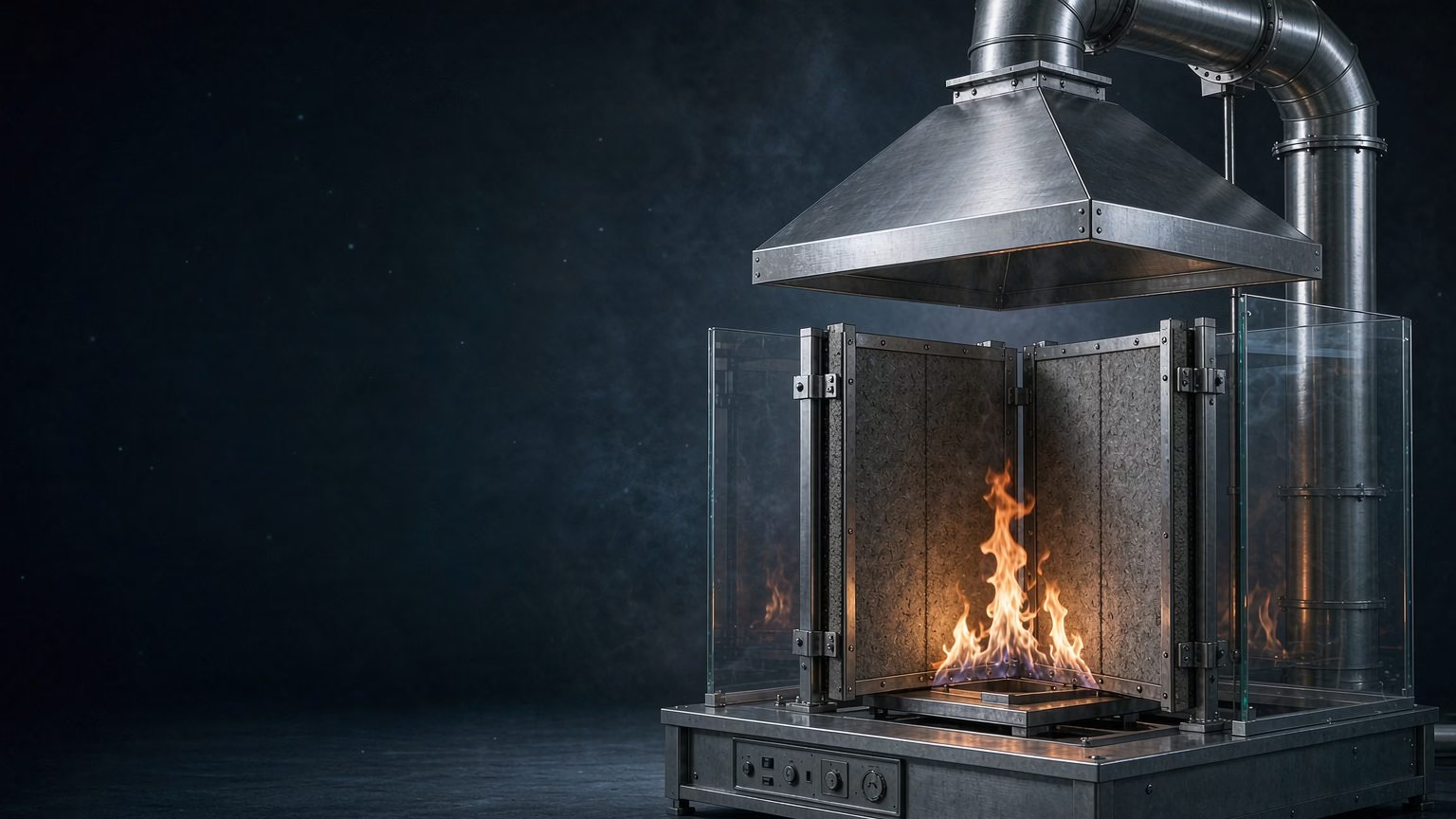
The specimen is mounted in the ceiling position with the surface to be evaluated facing down towards the ignition source, and the test runs for 10 minutes [1]. The result is reported as a surface burning characteristic, conventionally as a flame spread index and a smoke developed index relative to the calibration baselines of the method. NFPA 255 [2] is the same method published under the NFPA numbering, which is why a single test run can satisfy both citations.
This is the method North American model codes reference for interior wall and ceiling finishes, and it is the reason a material destined for that market is almost always tested here first.
The Single Burning Item test (EN 13823)
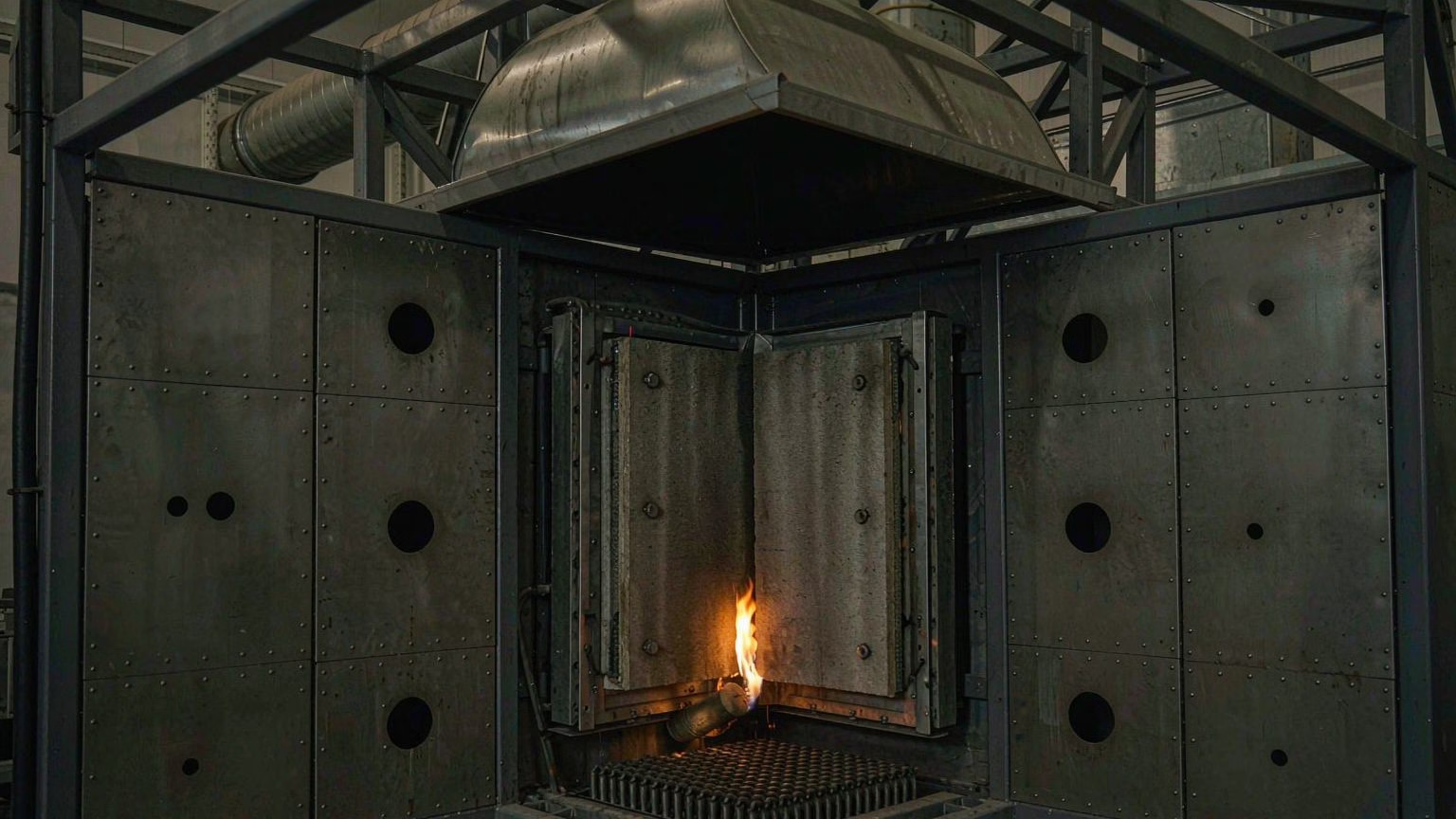
EN 13823 exposes a corner specimen — two wings joined at right angles, excluding floorings — to a propane burner placed at the base of the corner, and records heat release, smoke production, lateral flame spread (LFS) and flaming droplets over the test duration [3]. LFS is assessed against the edge of the specimen: whether the flame front reaches the far edge of the long wing is itself a criterion.
There is a version trap worth knowing. Many datasheets and test reports still cite EN 13823:2020. The UNI store record shows that edition withdrawn on 20 July 2022, with EN 13823:2020+A1:2022 as the current consolidated edition 4. A report that names only the 2020 edition is not wrong about the method but is out of date about the document, and an assessor may ask for it to be re-issued.
Lateral flame spread in the vertical configuration (ISO 5658-2)
ISO 5658-2 measures lateral spread of flame along a vertically oriented specimen exposed to radiant heat in the presence of a pilot flame, and is written for essentially flat products used as exposed surfaces of walls in buildings and in transport vehicles such as ships and trains [7]. This is the method to look at when the requirement comes from a transport or marine framework rather than a building code, and it is explicitly stated as not suitable on its own for describing fire hazard under real conditions.
The radiant panel methods (ASTM E162 and EN ISO 9239-1)
ASTM E162 measures surface flammability using a radiant heat energy source [9]. Its own scope carries an important limitation: it is not intended for use as a basis of ratings for building code purposes. It remains widely used in transport, marine and materials development work, but it should not be offered as a code substitute for a tunnel test.
For floorings, EN ISO 9239-1:2025 assesses the wind-opposed burning behaviour and spread of flame of horizontally mounted floorings exposed to a heat flux gradient, ignited with pilot flames, with smoke development covered in an annex [6]. The result is normally expressed as a critical radiant flux — the flux level at which the flame stops propagating — and that number is what feeds the flooring classes of EN 13501-1 8.
Small-flame ignitability (EN ISO 11925-2)
EN ISO 11925-2:2026 determines ignitability by direct small-flame impingement under zero impressed irradiance, using vertically oriented specimens [5]. It does not measure spread across a large surface, but it is a mandatory supplement in the Euroclass route and a cheap screening tool: a product that fails here will not reach a high class regardless of its SBI numbers.
Beyond the Bench: Room Corner Tests
Bench-scale flame spread methods are screening tools, and every one of them carries a scope statement saying so. When the question is how a finished assembly behaves — a wall lining on its real framing, with joints, cavities and fixings — the requirement moves to a room-scale method. NFPA 286 is the room corner test used for that purpose in North America, evaluating the contribution of wall and ceiling interior finish to room fire growth 10.
The reason to know about this tier is commercial as much as technical. A product that performs well in the tunnel test can still be restricted on the basis of a room corner result, and the other way round. If your customer’s specification mentions room fire growth, a bench-scale flame spread index alone will not answer it, and you should budget for the larger test from the start rather than after a failed submission.
Specimen Preparation: Where Results Are Won or Lost
Conditioning and moisture
Hygroscopic materials — wood, board products, textiles, some insulation — change their ignition and spread behaviour with moisture content, and the change is large enough to move a result across a class boundary. Standard conditioning to a defined temperature and humidity before testing is not a formality; it is the single largest source of irreproducibility when it is skipped. Laboratories that run a mixed workload keep a dedicated conditioning room rather than relying on ambient storage, precisely because of this.
Representative sampling and faces
Flame spread is directional. A product with a facing, a laminate, a coating or a grain will spread differently depending on which face is exposed and which way the specimen is oriented relative to the flame front. Cutting all replicates from one sheet, or from one edge of a roll, produces a tight-looking dataset that does not represent the production spread. Take specimens across the production range and test the face that will actually be exposed in service, mounted the way it will be mounted in service.
Choosing the Right Flame Spread Test
| 目标市场 / 框架 | 主要方法 | 报告的量 | 补充试验 |
|---|---|---|---|
| 北美(内墙与吊顶) | ASTM E84 隧道试验 [1] | 火焰传播指数 | 视法规加测产烟 |
| 欧盟 / 英国(CPR 路线) | EN 13823 SBI [3] | LFS、FIGRA、THR600s | EN ISO 11925-2 [5] |
| 铺地材料 | EN ISO 9239-1 [6] | 临界辐射通量 | EN ISO 11925-2 [5] |
| 船舶 / 轨道交通 | ISO 5658-2 [7] | 横向火焰传播距离 | 视框架加测产烟毒性 |
| 英国遗留规范 | BS 476-7 11 | 分级(1–4 级) | 视规范 |
| 中国 | GB 8624 分级体系 12 | 分级(A / B1 / B2 / B3) | 按分级要求配套 |
Running a Flame Spread Test: What the Laboratory Controls
| 变量 | 为什么决定成败 | 实务要点 |
|---|---|---|
| 试样尺寸与数量 | 火焰前沿距离与试样尺度直接相关 | 按标准裁切,留足重复样 |
| 状态调节 | 含水率改变点燃与传播行为 | 按标准温湿度调节至恒重 |
| 基材与粘结方式 | 结果属于「含基材的系统」而非裸材料 | 按最终使用状态安装 |
| 安装方位 | 水平、垂直、吊顶位结果不可互换 | 严格按方法规定的方位 |
| 边缘与接缝处理 | 边缘常成为优先传播路径 | 按方法封边或按实际构造保留 |
| 通风与排气流量 | 影响火焰前沿与产烟测量 | 按方法校准流量 |
Two of these variables deserve more attention than they usually get. Orientation is not a detail but a different experiment: a horizontal specimen, a vertical specimen and a ceiling-mounted specimen are exposed to different buoyancy-driven flame shapes, and no method permits results to be transferred between them. Exhaust flow is the other one, because on modern rigs the same duct that removes the smoke also carries the gas sampling used for heat release and smoke production, so a flow error corrupts more than one reported quantity at once.
That first row of the table drives a point buyers miss: a flame spread result belongs to the system as mounted, not to the raw material. Changing the adhesive, the substrate or the fixing can move a product between classes, which is why test houses insist on the end-use construction being declared up front.
Reading the Result
| 结果形式 | 怎么读 | 常见误读 |
|---|---|---|
| 指数(无量纲) | 相对基准材料,数值越低传播越慢 | 当成绝对值或当成百分比 |
| 距边缘传播(LFS) | 火焰是否到达试样远边缘,是与否 | 当成距离数值去比较不同试样 |
| 临界辐射通量 kW/m² | 数值越高越难维持传播 | 忽略试样基材对结果的影响 |
| 分级字母 | 分级体系的结论,不是测试原始输出 | 把「测试」当「分级」 |
Common Errors in Flame Spread Testing
| 错误 | 后果 |
|---|---|
| 用过版标准号下单 | 报告被评估机构退回 |
| 只测裸材料,不测最终构造 | 结果与实际应用不符 |
| 拿一种方法的指数套另一种方法的限值 | 判定无效 |
| 忽略状态调节 | 结果不可复现 |
| 把可燃性(ignitability)结果当成分级结论 | 分级不成立 |
| 未确认方法适用的产品类别 | 例如用排除铺地材料的方法测地板 |
From a Test Result to a Classification
A test report and a classification are two different documents, and conflating them is the most expensive mistake in this whole workflow. The laboratory produces measured values — a flame spread index, a lateral spread observation, a critical radiant flux, a heat release curve. The classification is a formal conclusion drawn from those values against the thresholds of a classification standard, issued by whoever has the authority to issue it under the regulation in question.
This matters for planning. Buying the apparatus gives you the first document, not the second. Manufacturers who sell into Europe normally run the tests in-house for development control and then commission the formal classification through a notified body; the internal data is what lets them predict the outcome and avoid a failed submission. If you are setting up a laboratory, decide early which of the two you are buying capability for, because it changes both the equipment list and the accreditation path.
Equipment for a Flame Spread Testing Programme
| 设备 | 对应方法 | 适用 |
|---|---|---|
| SBI 试验装置 | EN 13823 | 欧盟/英国墙体与吊顶制品 |
| 建筑材料可燃性试验装置 | EN ISO 11925-2 | 小火焰点燃性筛选 |
| 辐射热通量试验仪 | 辐射面板类方法 | 表面可燃性与热通量标定 |
| 建材烟密度试验机 | 产烟量测量 | 与传播结果配套 |
| 锥形量热仪 | ISO 5660-1 | 热释放与点燃特性研究 |
If your laboratory is being set up from scratch, the honest sequence is to buy for the market you actually sell into, then add capability. Our reaction to fire testing guide maps which apparatus produces which part of a Euroclass, and the fire testing equipment range lists the full catalogue.
Frequently Asked Questions
What is flame spread testing?
Flame spread testing measures how far and how fast a flame travels across a material’s surface after ignition, under a defined ignition source and mounting. It is distinct from ignitability, which asks whether the material lights, and from heat release, which measures the energy the fire gives back.
Which flame spread test do I need for Europe?
For wall and ceiling products under the Construction Products Regulation, the route runs through EN 13823, the Single Burning Item test, supplemented by EN ISO 11925-2. The results feed the Euroclass in EN 13501-1. Floorings use EN ISO 9239-1 instead of EN 13823.
Which flame spread test applies in North America?
Interior wall and ceiling finishes are normally evaluated with the tunnel test, ASTM E84, which is also published as NFPA 255. The specimen is mounted in the ceiling position with the tested surface facing down towards the ignition source, and the test runs for ten minutes.
What is a flame spread index?
It is a relative number, not a physical quantity. The tunnel test reports the behaviour of the specimen against the method’s calibration baselines, so a lower index means slower flame spread. It should never be read as a percentage or compared with results from a different method.
Can one flame spread result be used in every market?
No. The methods differ in ignition source, specimen size, orientation and the quantity reported, and the classification systems built on them are not interchangeable. A material sold into both Europe and North America normally needs both test programmes.
Why does my test report cite a withdrawn standard edition?
Standard editions are revised. The UNI record, for example, shows EN 13823:2020 withdrawn in July 2022 in favour of EN 13823:2020+A1:2022. The test method is unchanged, but reports should cite the current edition to avoid questions from assessors.
Does the substrate affect the result?
Yes, and often decisively. A flame spread result belongs to the product as mounted, including adhesive, substrate and fixing, so the end-use construction has to be declared and reproduced on the rig.
Conclusion: A Sequence for Getting This Right
- Fix the target market first — that decides the method, not the material.
- Confirm the current edition of the standard before you commission anything.
- Declare the end-use construction, including substrate and fixing, in writing.
- Ask the laboratory which quantity will be reported: index, distance, or flux threshold.
- Treat a test result as evidence, and a classification as a separate formal step.
- Budget for repeat specimens and for the supplementary tests the classification route requires.
BRT Testing supplies the apparatus behind every method in this guide — SBI rigs, small-flame ignitability apparatus, radiant heat flux instruments, smoke density testers and cone calorimeters — with commissioning and calibration documentation. Send us your target market and product construction, and we will map it to a test programme and the equipment list that supports it.
Shenyang Baoruitong Automation Equipment Co., Ltd.
BRT Testing designs and manufactures fire testing and spectroscopic instruments in Shenyang, China, including Single Burning Item apparatus, non-combustibility furnaces, cone calorimeters and smoke density testers. Our technical team supports method selection, installation, calibration and operator training for laboratories working to EN, ISO, ASTM and GB frameworks.
Sources
- ASTM International — E84-24 Standard Test Method for Surface Burning Characteristics of Building Materials
- NFPA — NFPA 255
- Genorma — EN 13823:2020+A1:2022
- UNI Ente Italiano di Normazione — EN 13823:2020
- Genorma — EN ISO 11925-2:2026
- UNI Ente Italiano di Normazione — EN ISO 9239-1:2025
- UNI Ente Italiano di Normazione — ISO 5658-2:2006
- UNI Ente Italiano di Normazione — EN 13501-1:2018
- ASTM International — E162-22 Standard Test Method for Surface Flammability of Materials Using a Radiant Heat Energy Source
- NFPA — NFPA 286
- NSAI Standards Store (Ireland) — BS 476-7:1997
- SAMR (China) — National standards full-text platform, GB 8624 search