a double beam spectrophotometer exists to cancel one specific error — the change in source intensity that happens between the moment you blank the instrument and the moment you read the sample. If your measurement is a single reading taken within seconds of blanking, a single-beam instrument is not measurably worse. If your measurement involves a scan, a batch of 30 samples, or a reading that runs for 20 minutes, the gap becomes the dominant source of error in your result. Everything else in this comparison — cost, warm-up, maintenance — follows from that one mechanism.
This article works through the mechanism quantitatively, then gives you the acceptance tests to run before you accept delivery. It is deliberately not a model catalogue; for a full range overview, see the UV/Vis spectrophotometer buying guide.
What Actually Differs: One Ratio or Two
A single-beam instrument stores one number and later divides by it. During blank correction it records the sample-beam intensity with the reference in place (S_blank); then it replaces the reference with your sample and records S_meas. Transmittance is %T = (S_meas / S_blank) × 100 [1].
The vulnerability is temporal. S_blank and S_meas are captured at different times, and nothing in the calculation knows the source may have moved in between. A double beam spectrophotometer removes the time gap by construction: the monochromatic light is split into a sample beam and a reference beam that reach detectors simultaneously (or are alternated fast enough that drift cannot resolve between them). The instrument then works with a ratio of ratios — (S_meas/R_meas) ÷ (S_blank/R_blank). A source fluctuation that reduces both beams equally appears in numerator and denominator and cancels [1][2].
That is the whole mechanism. The rest of this comparison is arithmetic about how large the residual error can get.
Worked Example: What a 10% Lamp Drop Costs You
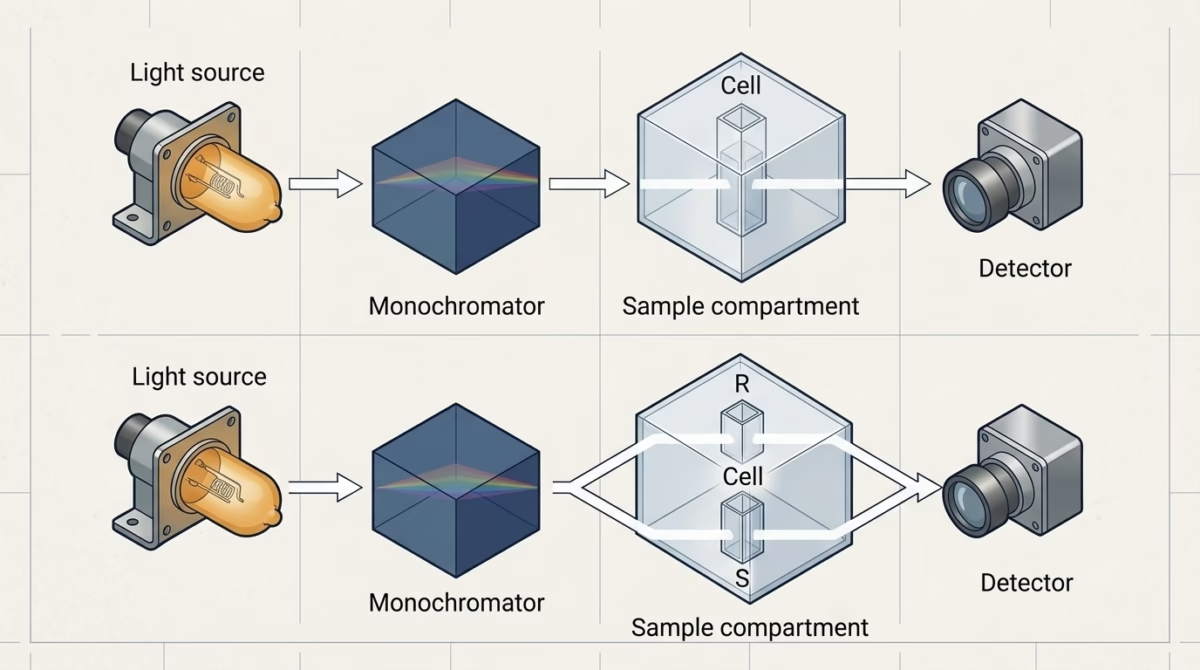
Double Beam vs Single Beam Spectrophotometer Working Principle
Put real numbers on it. Take a sample with a true transmittance of 40% (absorbance 0.398), and suppose the source intensity during the sample reading has fallen to 90% of its value during blanking. On a single-beam instrument, S_meas is therefore 0.90 × S_blank before the light even reaches the sample, so:
%T = [0.40 × (0.90 × S_blank)] / S_blank × 100 = 36.0%
The instrument reports 36.0% when the truth is 40.0%. In absorbance that is 0.444 against a true 0.398 — an error of +0.046 Abs, or 11.5% relative, and 4.6 times the ±0.010 A tolerance USP <857> sets below 1 A [3]. A single-beam instrument that drifts 10% across a measurement window cannot pass the pharmacopoeial check, and the failure is invisible in the reading itself [1]. On a double-beam instrument the same drop applies to R_meas as well as S_meas, so the 0.90 factor divides out and the reported value stays at 40.0% to within the noise floor.
Why this matters more than the number suggests: on a single-beam instrument you cannot tell drift from signal after the fact — a reading of 36.0% is a perfectly plausible concentration result. The double beam converts an error you cannot detect into a ratio that self-corrects. That, not a better detector or a finer grating, is what the extra optics buy you [2].
The Practical Consequence: Warm-Up and Blank Frequency
Because the single-beam calculation holds across the entire interval between blanking and reading, that interval has to stay short. Shimadzu’s application note puts the practical rule plainly: single-beam systems should be allowed roughly one to two hours after power-on to stabilise before measurement begins, precisely because source intensity variation across the blank-to-sample window maps directly into the result [1].
A double beam instrument shortens this requirement for a different reason. Its reference channel measures the source continuously, so stabilisation is tracked rather than assumed; the same note observes that this reduces warm-up burden and extends usable lamp life, because throughput is not lost waiting for thermal equilibrium [1].
| Operating factor | Single beam spectrophotometer | Double beam spectrophotometer |
| Time gap between blank and read | Cannot be eliminated | Cancelled by ratio |
| Practical warm-up before measuring | ~1–2 h (source stabilisation) [1] | Short — reference tracks source [1] |
| Re-blanking through a 30-sample batch | Repeated, at operator discretion | Typically once per run |
| Drift effect on a 20-minute kinetic scan | Accumulates across the run | Compensated continuously |
| Failure mode | Silent — drift looks like signal | Ratio flags instability as noise |
| Optical complexity / cost | Lower | Higher |
Split beam vs double beam spectrophotometer: a naming trap
Buyers frequently see “split beam” and “double beam” used as if they were the same thing. They are not, and the distinction decides whether the drift cancellation above actually applies.
- True double beam: two separate beams exist simultaneously — one through sample, one through reference — and the ratio is formed continuously from real reference measurements.
- Split beam: the beam is alternated between sample and reference positions, often by a rotating mirror, so the two readings are separated by a short but non-zero time interval. Fast enough to cancel slow thermal drift, slower than a genuinely simultaneous design for fast transients [2].
Both are legitimately better than single beam at cancelling slow drift. If you are buying for fast kinetics, ask which architecture you are being sold and how the time offset compares with the timescale of your reaction.
The Specification That Decides High-Absorbance Work
Drift is the difference single and double beam is typically judged on, but it is not the specification that limits the most measurements. That distinction belongs to stray light — radiation reaching the detector from outside the nominal spectral bandwidth selected by the monochromator.
Stray light causes measured absorbance to fall below the true value, and the error is worst exactly where quantitative work is hardest: at high absorbance, where the transmitted signal is small and the stray contribution is a comparatively large fraction of it. This is why stray light, not detector sensitivity, sets the upper end of linear absorbance range [2][4].
The practical consequence is easy to miss, because stray light rejection is governed by monochromator design, not by whether the beams are split. A single monochromator instrument typically achieves stray light around 0.01–0.05%T, with linearity out to roughly 3–4 Abs. A double monochromator design, where light is dispersed twice in series, pushes stray light down by orders of magnitude — one published specification gives 0.00008%T with linearity to 6 Abs [5].
So “double beam” does not automatically mean “low stray light.” A double-beam instrument with a single monochromator cancels drift but still hits a stray-light ceiling; a single-beam instrument with a double monochromator suppresses stray light but still suffers temporal drift. These are two independent design axes. If your method requires readings above 3 Abs — concentrated dyes, optical filter characterisation, high-OD coatings — specify stray light and linear range directly rather than inferring them from the beam configuration [5]. Below about 1.5 Abs stray light is rarely the binding constraint, and the question returns to drift and throughput.
Choosing Between Them on Mechanism, Not Category
Ask what your measurement does during the time a single-beam instrument would need to hold stable.
Choose single beam when the blank-to-read interval is short and controlled. Fixed-wavelength quantitation where the blank is remeasured adjacent to each sample, teaching laboratories, and high-throughput screening where each cuvette gets its own blank are cases where the temporal error term is small by design. The simpler optical train also passes more light to the detector at a given bandwidth, which helps when signal is scarce [6].
Choose double beam when the measurement itself spans time. Full-spectrum scans, kinetic runs, multi-sample batches, temperature-ramped work, and any method where a blank cannot practically be re-read alongside every sample put drift directly into the result. The economics are usually decided by throughput and rework rather than unit price: an instrument that requires re-blanking 30 times a batch and re-running failed assays can cost more in a year than the price gap at purchase [2].
Verify, don’t assume, when the claim is architectural. “Double beam” is a term covering genuinely simultaneous reference measurement, fast alternation, and in some listings a single-beam instrument with a second cuvette position. The tests below distinguish them on evidence rather than vocabulary.
Acceptance Testing: OQ/PQ Checks That Expose the Difference
This is the part most comparison articles omit, and the part that actually protects the purchase. The checks follow the operational-qualification structure of USP <857>, which separates OQ — does the instrument meet specified performance — from PQ, does it keep meeting the requirements of your specific method [3][4]. Run them before signing off, on your samples, not the supplier’s.
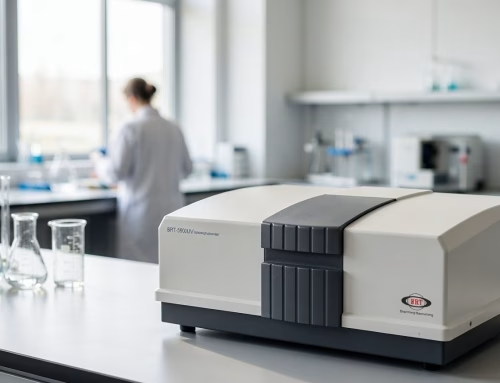
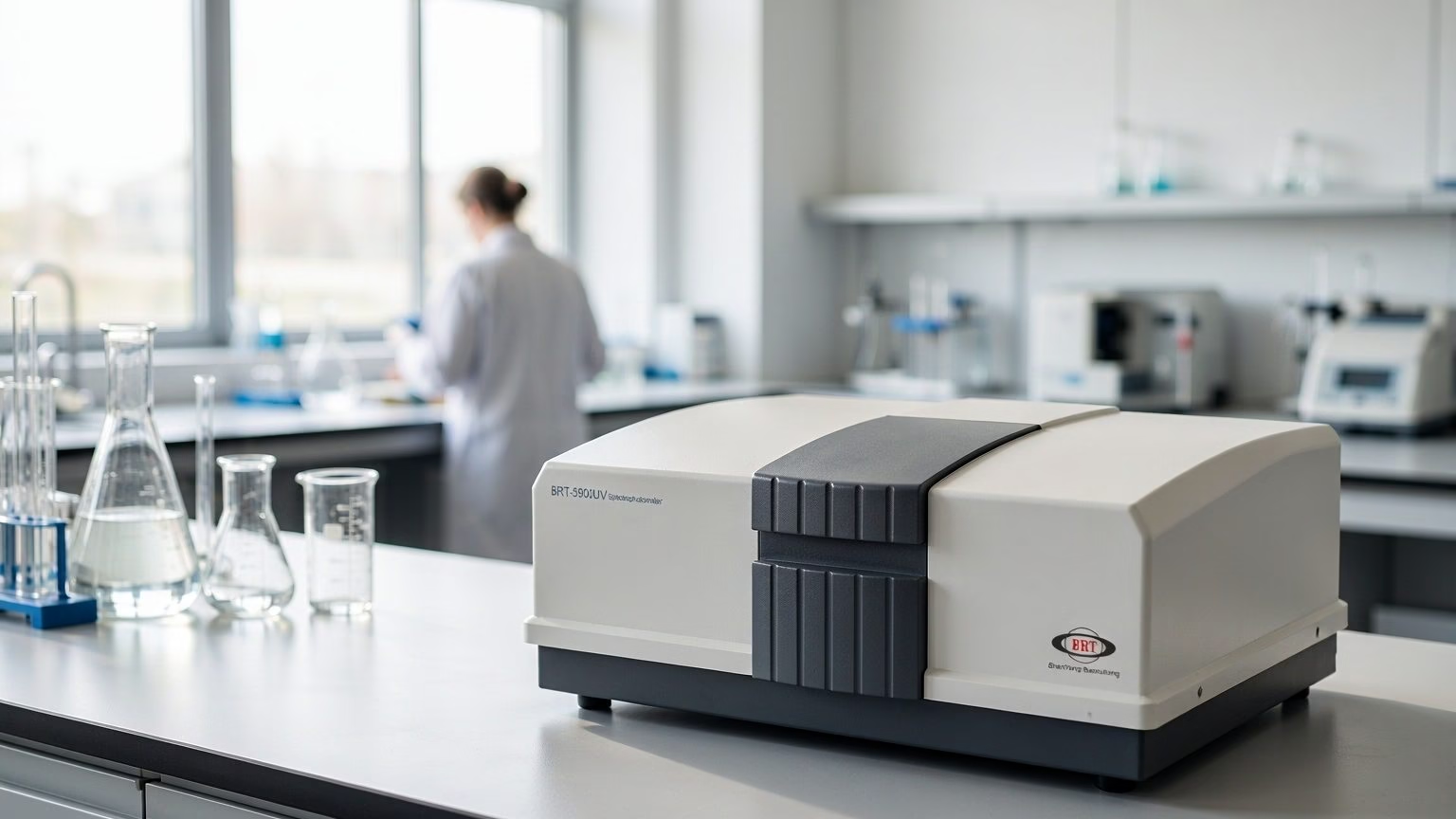
Start with baseline drift. With both cuvettes filled from the same reference blank, run a 30-minute baseline at a fixed wavelength in your working region, then repeat over the full scan range. Record the maximum absorbance excursion in Abs/30 min and the peak-to-peak noise on the 100%T line. The BRT-5600UV is specified at ≤0.001 Abs/30 min and the flagship BRT-5900UV at ≤±0.001 Abs baseline flatness [7][8] — treat 0.001 Abs/30 min as a good modern double-beam figure, and an order of magnitude worse as a sign of either a single-beam design or a drift problem. This is the exact error term the double-beam ratio is supposed to cancel: if a unit labelled double beam shows single-beam drift, something in the architecture or alignment is not as advertised.
Then confirm the three parameters that set your working envelope — wavelength accuracy, photometric accuracy and stray light — against the criteria in the table below.
One revision to be aware of: USP <857> removed photometric linearity as a separate OQ requirement in December 2022, but accuracy checks remain mandatory and linearity must still be demonstrated during method validation or system suitability. A supplier still quoting the pre-2022 checklist is working from an outdated document [3].
| Parameter | Reference material | Acceptance criterion | Source |
| Baseline drift / stability | Same blank both positions | Record Abs/30 min excursion; ~0.001 Abs/30 min is a good modern double-beam figure | [3][7][8] |
| Wavelength accuracy | Holmium oxide (240–650 nm), didymium (longer λ), cerium (short λ) | ±1 nm (200–400 nm); ±2 nm (400–900 nm); ≥6 replicates | [3][4][9] |
| Wavelength precision | Same | SD ≤0.5 nm across operational range | [4] |
| Photometric accuracy | K₂Cr₂O₇ in HClO₄ at 235/257/313/350 nm; NIST-traceable ND filters (440–635 nm) | <1 A: ±0.010 A, precision ≤±0.005 A; >1 A: ±1%, precision ≤±0.5% | [3][4] |
| Stray light | KCl ~198 nm; NaI/KI 220–250 nm; acetone ~300 nm; NaNO₂ 340–370 nm | Against method linear-range requirement | [3] |
| Resolution / SBW | Toluene in hexane | 2 nm SBW for most quantitative work | [3] |
Six questions to put in writing to any supplier
Answers to these discriminate between designs faster than any brochure, and give you a written record if the delivered unit does not match.
- Is the reference measured simultaneously with the sample, or alternated? If alternated, what is the time offset between readings?
- What is the specified baseline drift in Abs per 30 minutes, measured with the same blank in both positions?
- What is the specified stray light value, with the filter and wavelength at which it was determined?
- Which certified reference materials are supplied, and are they traceable to NIST or an equivalent national institute?
- Does the data software support audit trails, user access levels and electronic signatures?
- What is the stated warm-up time to measurement readiness, in writing?
For regulated work the fifth question is not optional: pharmacopoeial compliance depends on documented instrument performance, and a UV/Vis system without compliant data handling will fail an audit regardless of its optical quality [4].
Frequently Asked Questions
Is a double beam spectrophotometer always more accurate than a single beam?
No — it is more stable across time, which is a different claim. A double beam cancels source drift by forming a ratio of sample and reference readings; it does not improve wavelength accuracy, stray light, or resolution, all of which are set by the monochromator and the detector. A well-built single beam with a double monochromator can beat a double beam with a single monochromator on high-absorbance accuracy. Compare specifications on the parameter your method depends on rather than on the beam label.
How much measurement error does source drift actually cause on a single beam?
It scales directly with the intensity change. If the source falls to 90% between blanking and reading, a sample with true transmittance of 40% is reported at 36% — an absorbance error of +0.046 A, roughly four times the ±0.010 A tolerance USP <857> applies below 1 A. A 5% drift halves that error but still breaches the tolerance. Because the reading looks plausible, the error is undetectable without an independent check.
Does single beam vs double beam matter for a single reading taken immediately after blanking?
Almost not at all. The drift term grows with the time interval between blank and read, so a reading taken within seconds of blanking on a stabilised instrument leaves little time for the source to move. This is why single-beam instruments remain perfectly suitable for fixed-wavelength routine quantitation. The configuration begins to matter as the interval extends — through a scan, a batch, or a kinetic run.
What is the difference between split beam and double beam?
A true double beam creates two beams simultaneously — one through the sample, one through the reference — and forms the ratio continuously from live reference measurements. A split beam alternates a single beam between the sample and reference positions, often with a rotating mirror, so the two measurements are separated by a short but real time offset. Both cancel slow thermal drift; simultaneous measurement is more robust for fast transient events like rapid reaction kinetics.
Can a single beam spectrophotometer run kinetic measurements?
It can, with limits. Because a single beam has no live reference, any drift in source intensity during the run appears as an apparent change in absorbance, and the longer the run the larger the accumulated error. Kinetic work with a single beam therefore needs a longer warm-up, tighter temperature control, and frequent re-blanking — often impractical mid-reaction. For runs beyond a few minutes, or where the absorbance change per unit time is small, a double beam is the more defensible choice.
Do I need a double monochromator, or is double beam enough?
They address different errors, and you may need one, the other, or both. Double beam targets temporal drift. A double monochromator targets stray light, which limits the maximum absorbance you can measure accurately — a single monochromator typically reaches about 3–4 A, while double-monochromator designs push linearity toward 6 A. If your method stays below 1.5 A, stray light is rarely the constraint and double beam alone may be sufficient for drift.
What should I test before accepting a new spectrophotometer?
Run four checks on your own samples before signing off. Baseline drift over 30 minutes with the same blank in both positions, recorded in Abs/30 min. Wavelength accuracy against holmium oxide over at least six replicates. Photometric accuracy against potassium dichromate at 235, 257, 313 and 350 nm. And stray light with the cut-off filter appropriate to your working wavelengths. Compare results against the written specification, and require the drift figure in writing before purchase.
How long does a spectrophotometer need to warm up?
Single-beam instruments are commonly allowed one to two hours after power-on, because source intensity must stabilise before the blank-to-sample interval can be trusted. Double-beam instruments shorten this requirement because their reference channel tracks the source continuously rather than assuming it is constant, which also avoids burning lamp life while waiting. Sulphur and xenon flash sources eliminate the wait almost entirely.
Conclusion: Decide in the Order That Reflects the Mechanism
Work through these steps before comparing prices, because the optical question has to be answered first.
- Establish whether your measurement spans time. A scan, a batch, or a kinetic run puts drift into your result; a fixed-wavelength reading adjacent to its own blank largely does not.
- Set your maximum working absorbance. Above roughly 3 A you are choosing on stray light and monochromator design; below 1.5 A stray light is rarely the constraint.
- State your acceptance criteria from the applicable pharmacopoeia — ±0.010 A, ±1 nm, ≤0.5 nm SD — before you look at any instrument.
- Demand the drift and stray-light figures in writing, with filter, wavelength and method specified. A number without a stated method is not a specification.
- Run the four OQ checks on your own samples before accepting delivery, and hold the balance of payment against the drift result.
- Cost the workflow, not the box. Analyst hours lost to re-blanking and repeat runs usually exceed the purchase-price gap over a service life.
If you would like the four-check acceptance protocol as a fillable table, or a beam configuration matched to your specific method, send us your method parameters.
About the author