The Short Answer
A non-combustibility test puts a small specimen into a furnace held at 750 °C and measures three things: how much the temperature rises, how much mass is lost, and how long the specimen sustains a flame. It does not measure whether a product survives a fire — that is fire resistance, a different family of tests entirely. The European version is EN ISO 1182, published by ISO with the 2020 edition currently listed by national standards bodies 1. The North American version is ASTM E136, whose title states the apparatus directly: a vertical tube furnace at 750 °C 5. The three criteria that fall out of both are strikingly similar: a temperature rise of no more than 30 °C, a mass loss of no more than 50 per cent, and no sustained flaming [5]6. What turns those three numbers into a classification is a separate document. Under EN 13501-1, Euroclass A1 requires a temperature rise of at most 30 °C, a mass loss of at most 50 per cent and no sustained flaming at all, together with a gross heat of combustion of at most 2.0 MJ/kg; Euroclass A2 relaxes the temperature rise to 50 °C and the flaming time to 20 s, and raises the calorific value limit to 3.0 MJ/kg 3.
What a Non-Combustibility Test Actually Measures
The test is deliberately narrow, and understanding what it leaves out is more useful than memorising the procedure.
| Quantity | Symbol | What it is actually telling you |
|---|---|---|
| Temperature rise | ΔT | Whether the specimen released heat of its own while sitting in the furnace |
| Mass loss | Δm | How much of the specimen volatilised or burned away |
| Duration of sustained flaming | tf | Whether the specimen supported a flame, and for how long |
Read together, the three answer one question: does this material contribute energy to a fire it did not start? A material that neither heats the furnace, nor loses much mass, nor sustains a flame is not going to feed a growing fire, which is the property a regulator is actually buying when it specifies A1. What the test does not answer is how the material behaves as part of an assembly, how much smoke it would produce in a real fire, or how long a wall built from it would last. Those are different tests.
It is worth separating the two families at the outset, because the vocabulary is used loosely. Non-combustibility sits in the reaction to fire family — it asks how much a material feeds a fire. Fire resistance asks how long a complete element keeps performing. Our guide to building material fire classification places both in the wider system.
How the EN ISO 1182 Furnace Test Works
The specimen
The specimen is a small cylinder — commonly around 45 mm in diameter and 50 mm in height — and the exact dimensions, tolerances and any stacking rules for thin products are given in the current standard text rather than in any summary [1]. Where a product is not homogeneous, the normal approach is to test the substantial components separately, because a classification is only as good as its weakest component. Specimens are conditioned before testing, and a set is run rather than a single piece, because the result is an average rather than a single observation.
The furnace and the thermocouples
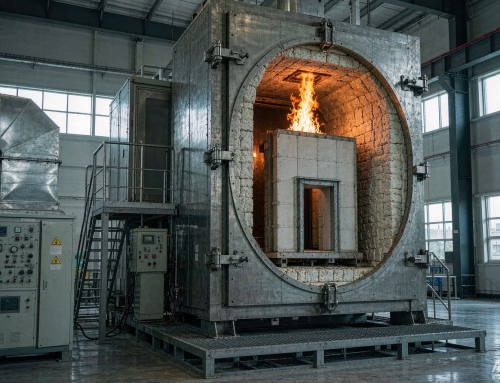
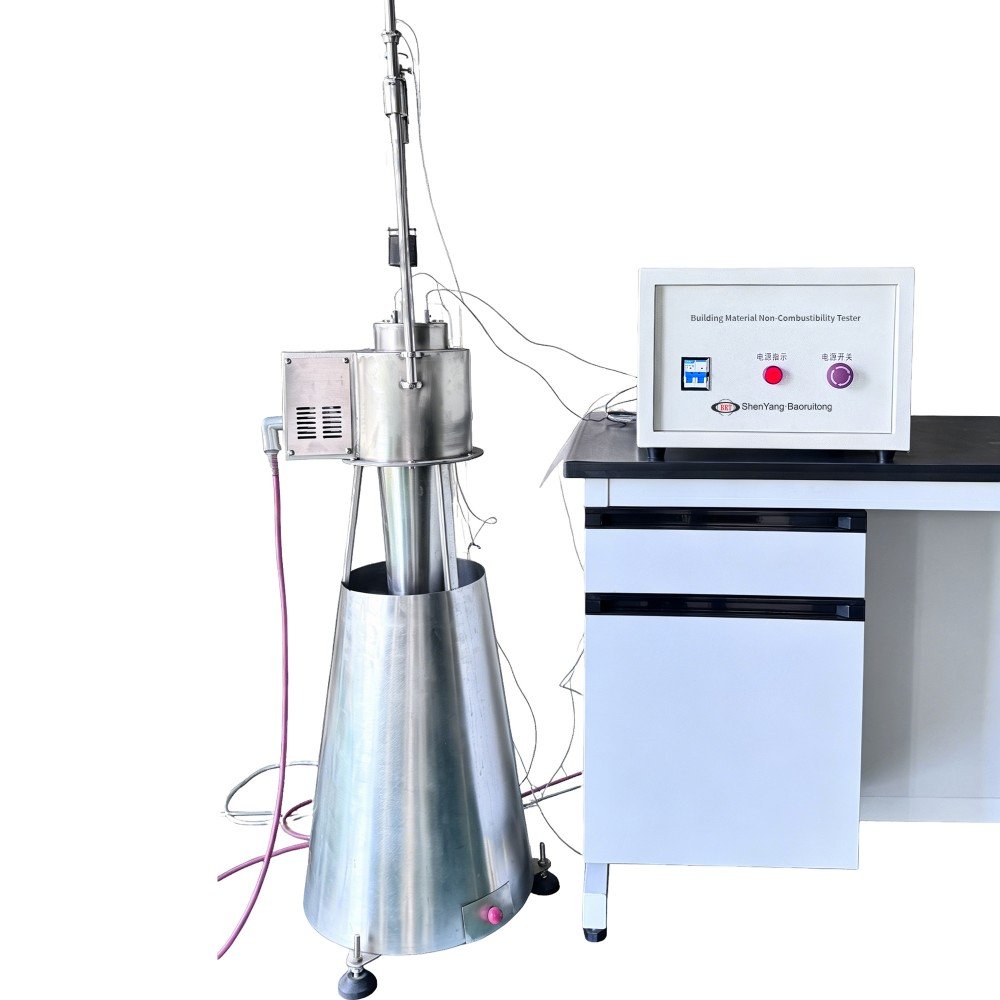
The furnace is a vertical tube furnace stabilised at 750 °C. The figure that matters is not the setpoint but the stability: the furnace has to reach thermal equilibrium before a specimen goes in, and the instrumentation has to resolve a temperature rise of a few degrees against a background of 750 °C. Three temperatures are tracked during the run — the furnace temperature, the specimen surface temperature and the specimen centre temperature [1]. It is worth pausing on why the specimen is instrumented at all. A material can be non-combustible and still show a temperature rise, because it is being heated; the rise being measured is the excess over what the furnace alone would produce, and that excess is the heat the specimen is contributing.
Duration and end point
The specimen is inserted quickly and the run continues until the temperatures have stabilised, with provision to extend when equilibrium has not been reached. Afterwards the specimen is cooled and reweighed, and the three quantities are calculated from the records. The result is not a pass or fail on its own — it is three numbers, read against whatever classification system applies.
Reading the Three Quantities
Temperature rise, ΔT
ΔT is the excess temperature produced by the specimen over the stabilised furnace condition. A specimen that releases heat of its own raises the temperature of everything around it, and that is exactly what the measurement is designed to catch. This is the criterion that excludes most organic binders: even a small fraction of combustible binder in an otherwise inorganic board can push ΔT past the limit.
Mass loss, Δm
Δm is the fraction of the specimen’s mass that is gone at the end of the run, reported as a percentage, with a limit of 50 per cent for both A1 and A2 [3]. Mass loss alone is not decisive — a material can lose mass without contributing fuel — so it is always read alongside ΔT.
Duration of sustained flaming, tf
tf is the total time the specimen sustained a flame during the run. Momentary flashes are not the same thing as sustained flaming, and the distinction is defined in the standard rather than left to the operator. For Euroclass A1 the requirement is that there is no sustained flaming at all; for A2, up to 20 s is permitted [3]. That single difference — zero versus 20 seconds — is the clearest expression of how much stricter A1 is.
Where the Pass Lines Come From
The furnace test produces numbers; the classification system supplies the thresholds. In Europe that is EN 13501-1, and the thresholds are laid down in European Commission Decision 2000/147/EC [3].
| Class | Test | Classification criteria |
|---|---|---|
| A1 | EN ISO 1182 and EN ISO 1716 | ΔT ≤ 30 °C; Δm ≤ 50 %; tf = 0 (no sustained flaming); PCS ≤ 2.0 MJ/kg for homogeneous products and substantial components; PCS ≤ 1.4 MJ/m² for any internal non-substantial component |
| A2 | EN ISO 1182 or EN ISO 1716, and EN 13823, and EN ISO 11925-2 | ΔT ≤ 50 °C; Δm ≤ 50 %; tf ≤ 20 s; PCS ≤ 3.0 MJ/kg; FIGRA ≤ 120 W/s and lateral flame spread not to the specimen edge; Fs ≤ 150 mm within 60 s in the small flame test |
Two structural points decide how a submission is planned. First, A1 requires both the furnace test and the calorific value test, while A2 allows either one but then adds two further tests — the single burning item test and the small flame test [3]. A2 is therefore not a cheaper A1; it is a different and in some ways larger package. Second, the calorific value limits are written per component, not per product, so a non-homogeneous product has to satisfy several limits at once.
The Second Route: Gross Heat of Combustion
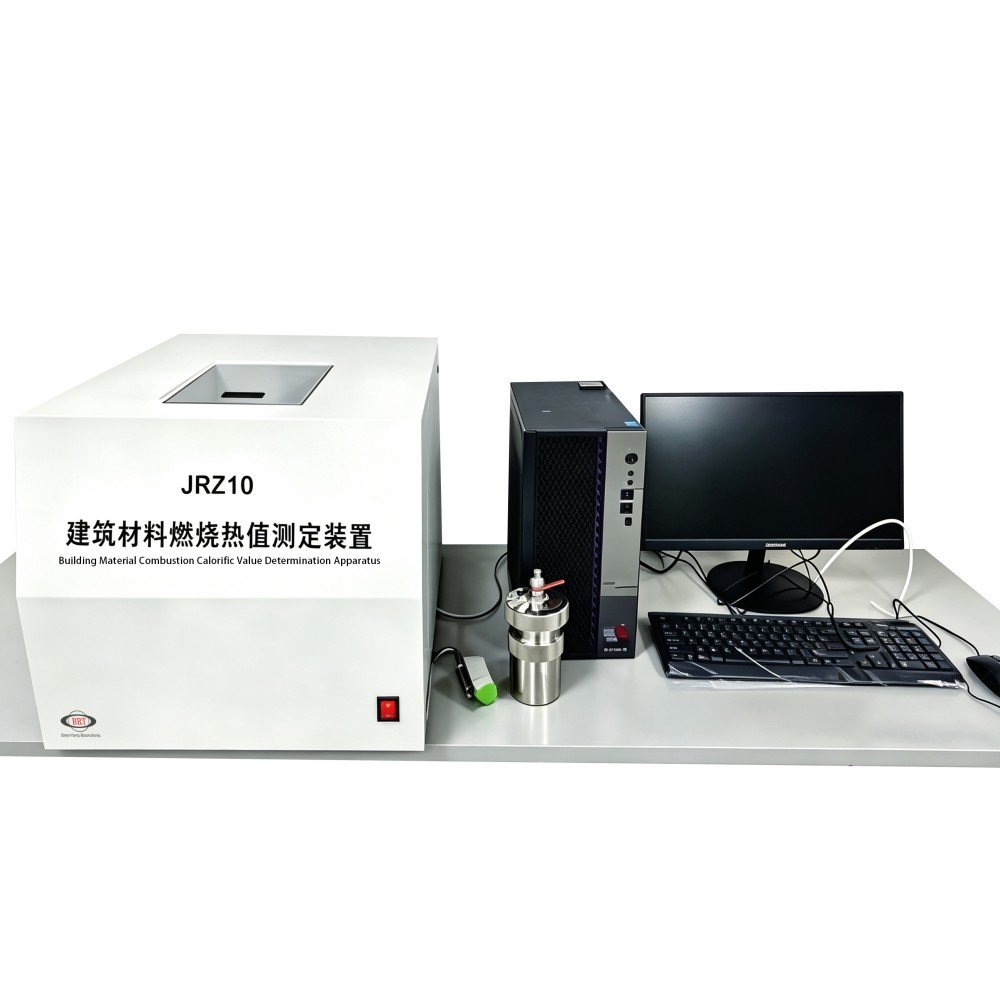
EN ISO 1716 measures the gross heat of combustion, or calorific value, of a product using a bomb calorimeter 2. The principle is direct: burn a known mass completely in oxygen and measure the heat released. The result, PCS, is expressed in MJ/kg for homogeneous products and substantial components, and in MJ/m² for non-substantial components [3].
The two routes are not redundant, and choosing between them is a real decision. The furnace method is empirical — it exposes the product to one specific condition and observes. The calorimetric method is intrinsic — it measures a property of the material that does not depend on a furnace geometry. A product with an awkward shape, or one that cannot be formed into the specified specimen, may be far easier to submit through ISO 1716.
Non-Combustibility Testing in North America
ASTM E136 is the North American counterpart, and its scope is stated in its own title: assessing combustibility of materials using a vertical tube furnace at 750 °C [5]. A dry specimen is heated in the furnace and observed for temperature rise, flaming and mass loss. The criteria applied across the ASTM, ISO and United States Coast Guard methods are described consistently in manufacturer technical literature: any visible flame must disappear within 30 seconds, the specimen’s surface and centre temperatures must not rise by more than 30 °C, and the material must not lose more than 50 per cent of its mass [6].
One limitation is worth stating plainly, because it affects how the result should be reported. ASTM E136 is a pass or fail test. It does not produce a quantitative measure of how much heat a material would release, so two materials that both pass are not equally non-combustible, and two that both fail are not equally combustible [6]. Where a number is needed rather than a class, the calorimetric route is the one that supplies it.
What a Non-Combustibility Test Does Not Tell You
This is the section that prevents the most specification errors.
It does not tell you how much smoke a material produces. A product can pass a non-combustibility test and still be part of a system where smoke is the dominating hazard, which is why smoke measurement is a separate discipline — see why smoke production matters in fire testing.
It does not tell you how a wall or floor assembly performs. Fire resistance is measured on complete elements in a furnace against a time-temperature curve and reported in minutes. We cover that side in what a fire resistance test is and why it matters.
It does not rank materials within a class. Because the result is a set of thresholds rather than a scale, a non-combustibility test cannot tell you which of two A1 products is better. It tells you both clear the line.
Where a product has to be classified beyond A1 and A2, the single burning item method and the small flame test take over, and our overview of fire testing standards for interior building materials sets out how they fit together.
Building a Non-Combustibility Capability
A laboratory supporting A1 and A2 submissions needs two instruments minimum, and usually three.
A non-combustibility apparatus is the first purchase — a vertical tube furnace with insertion gear and the thermocouple set needed to hold 750 °C stably and resolve a few degrees of rise. Our separate article on the ISO 1182 non-combustibility test goes through that instrument in more detail.
A gross heat of combustion tester is the second, and it is required rather than optional for A1 [2][3]. The JRZ10 calorific value tester covers the oxygen bomb method used for building products.
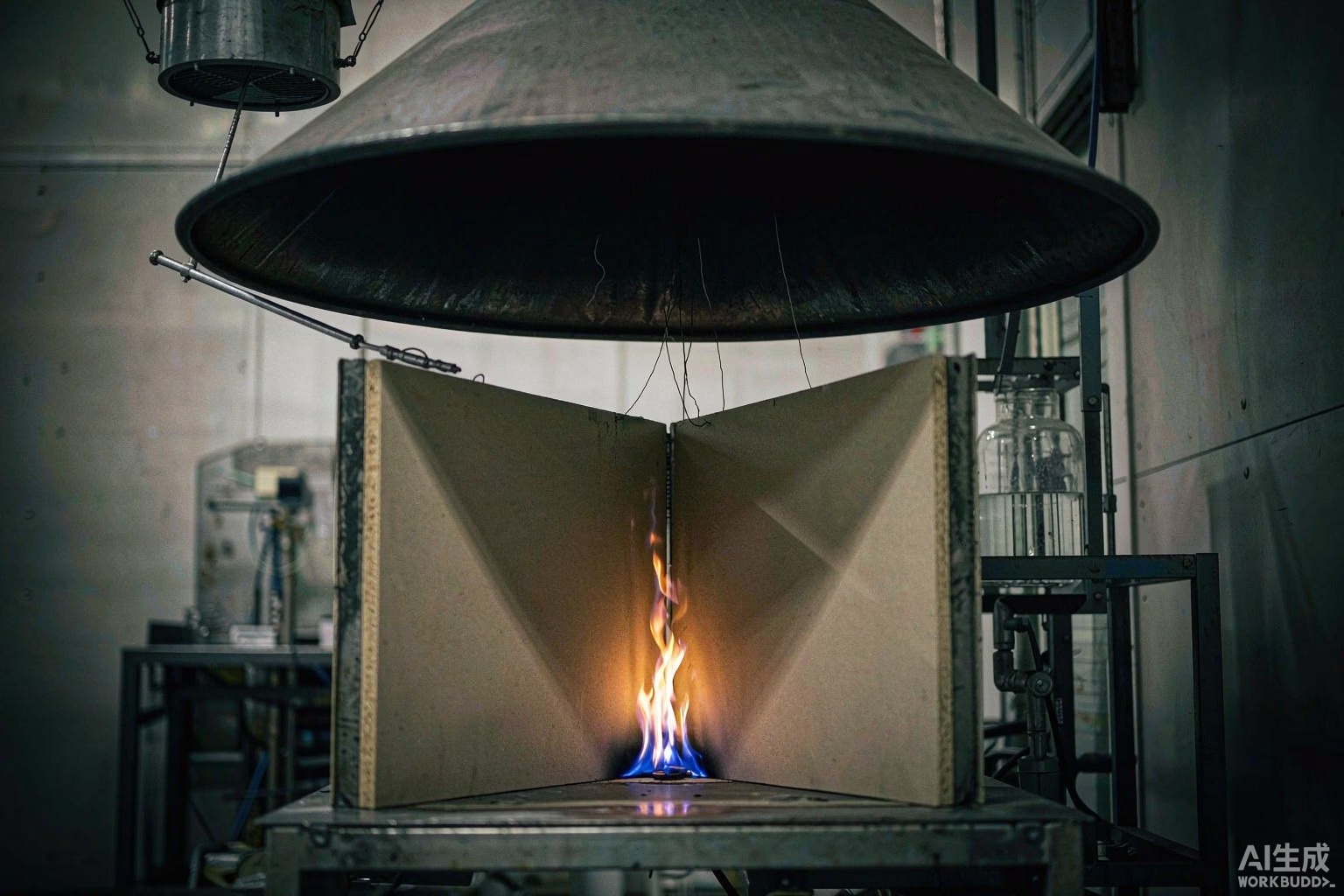
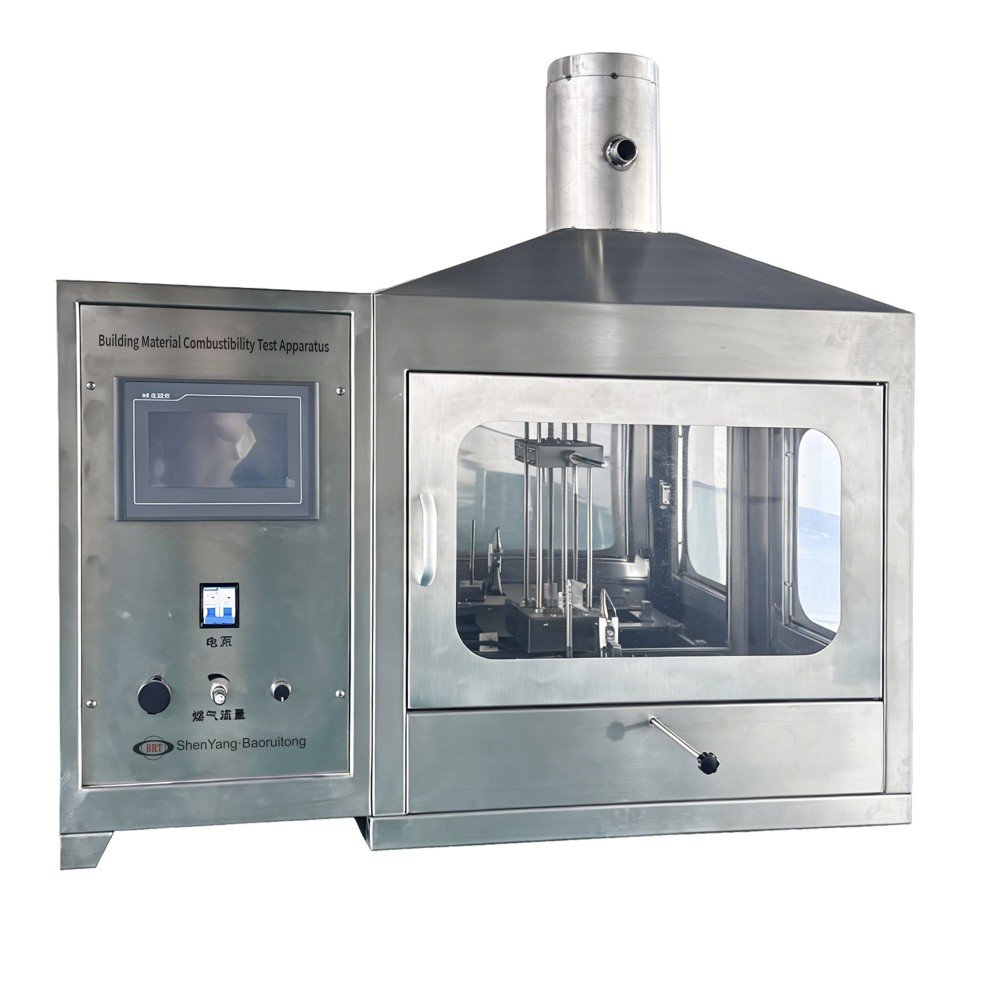
A small flame apparatus is the third, because an A2 submission also calls up EN ISO 11925-2 [3]. The building material combustibility test apparatus covers that method, and the hard combustibility tester extends coverage to denser products. Where smoke is also in scope, a building materials smoke density tester and a cone calorimeter complete the picture.
Mistakes in Non-Combustibility Submissions
| Mistake | Why it fails | What to do instead |
|---|---|---|
| Treating A2 as a cheaper A1 | A2 adds the single burning item and small flame tests [3] | Compare full test packages, not single tests |
| Submitting a composite product as one specimen | Calorific value limits are written per component [3] | Test substantial and non-substantial components separately |
| Reporting “non-combustible” without the classification system | The pass lines come from EN 13501-1, not from the furnace test [3] | Always state the class and the standard |
| Using the result to rank two materials | The test returns thresholds, not a scale [6] | Use calorific value or heat release when a number is needed |
| Assuming it covers smoke | Smoke is not measured in this test | Add smoke density or cone calorimetry |
Frequently Asked Questions
What temperature is a non-combustibility test run at?
750 °C. Both EN ISO 1182 and ASTM E136 specify that temperature, and the North American method is named for it — ASTM E136 is the test method for behaviour of materials in a vertical tube furnace at 750 °C. What matters as much as the setpoint is stability: the furnace has to reach thermal equilibrium before the specimen goes in, because the measurement is a rise of only a few degrees against a 750 °C background.
Is a non-combustibility test the same as a fire resistance test?
No. A non-combustibility test asks whether a material feeds a fire that has already started, and returns three numbers: temperature rise, mass loss and sustained flaming time. A fire resistance test asks how long a complete building element keeps performing under a standard fire, and returns a period in minutes. They are used for different decisions and their results are not interchangeable.
What is the difference between Euroclass A1 and A2?
A1 requires no sustained flaming at all, a temperature rise of at most 30 °C, a mass loss of at most 50 per cent, and both the furnace test and the calorific value test. A2 allows up to 20 seconds of sustained flaming and a temperature rise of up to 50 °C, allows either the furnace test or the calorific value test, but then adds the single burning item test and the small flame test.
Why does A1 need two tests when A2 only needs one?
Because A1 is the stricter claim. EN 13501-1 requires both the furnace method and the calorific value method for A1, so that the empirical observation and the intrinsic measurement agree. For A2 either one is accepted, but the classification then also depends on the single burning item and small flame results.
Can I use the calorific value test instead of the furnace test?
For Euroclass A2, yes — EN 13501-1 accepts EN ISO 1182 or EN ISO 1716. For A1 both are required. In practice the choice is often made on specimen geometry: a product that cannot be formed into the specified cylindrical specimen may be far easier to submit calorimetrically.
Does a non-combustibility result say anything about smoke?
No. Smoke production is not measured in this test, and a material that passes can still be part of a system where smoke is the dominant hazard. Smoke is assessed separately, by smoke density measurement or by cone calorimetry.
Is ASTM E136 equivalent to EN ISO 1182?
They are close relatives built on the same principle — a small specimen in a 750 °C furnace, assessed on temperature rise, flaming and mass loss — but they are different publications with different specimens and different reporting. A result should always be reported against the method it was run to.
The Decision Sequence
- Establish which class the specification calls up. A1 and A2 are different test packages, not adjacent grades.
- Decide the route: furnace, calorific value, or both. A1 requires both; A2 accepts either.
- Break a non-homogeneous product into its components before testing. Calorific value limits are written per component.
- Add the single burning item and small flame tests if the target is A2. They are part of the package, not optional extras.
- State the class, the method and the edition in every report. A number without those is not a result.
- Do not use the result for anything it does not measure — smoke, assemblies or ranking.
If you are specifying equipment rather than a single test, contact the BRT application team with the classes and markets you need to support, and we will map them to an instrument configuration. Our guide to choosing a fire testing laboratory equipment supplier lists the questions worth putting to any vendor.
About the Author
This article was prepared by the BRT combustion testing application team at Shenyang Baoruitong Automation Equipment Co., Ltd., which supplies non-combustibility apparatus, gross heat of combustion testers and small flame apparatus to building product laboratories. Classification thresholds are quoted from the European Commission decision published by the UK legislation service, and standard titles and editions are taken from national standards body catalogue entries and ASTM International.
Sources
- UNI Ente Italiano di Normazione — EN ISO 1182:2020, non-combustibility test
- UNI Ente Italiano di Normazione — EN ISO 1716:2018, gross heat of combustion
- European Commission Decision 2000/147/EC — EN 13501-1 classification criteria (UK legislation service)
- UK Government RADAR 2 project report — EN 13501-1 classes and criteria
- ASTM International — E136-22, assessing combustibility of materials using a vertical tube furnace at 750 °C
- Johns Manville — Non-Combustible Thermal Insulation technical bulletin (ASTM E136, ISO 1182, USCG 164.109)
- UNI Ente Italiano di Normazione — EN ISO 11925-2:2020, small flame ignitability test