The Short Answer
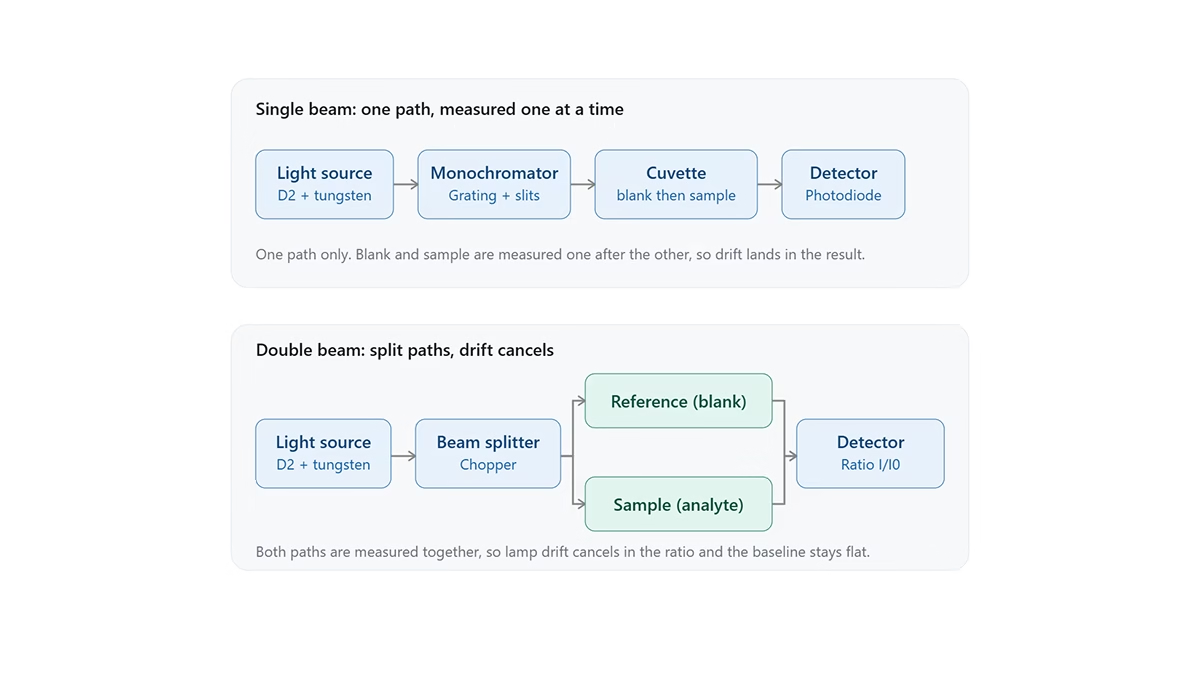
A double beam UV-Vis spectrophotometer is an absorption spectrometer that splits the light from one lamp into two paths — a sample path and a reference path — and measures the ratio between them continuously. A single beam instrument measures the blank first, stores it, and measures the sample afterwards; a double beam instrument measures both, at effectively the same moment, on every data point.
That single architectural change is what the term describes. It does not mean two lamps, and it does not automatically mean a more accurate wavelength axis or less stray light. What it buys you is immunity to source drift and lamp warm-up: because the reference is read at the same instant as the sample, a lamp that fades during a scan cancels itself out. If your work is scanning, kinetics, or anything that runs longer than a minute, that is the reason to specify double beam optics. If you want the full purchase-side comparison, including what a drifting lamp actually costs you in absorbance units, see our dedicated guide on single beam vs double beam spectrophotometers.
What “Double Beam” Means in Optical Terms
One source, two paths, one ratio
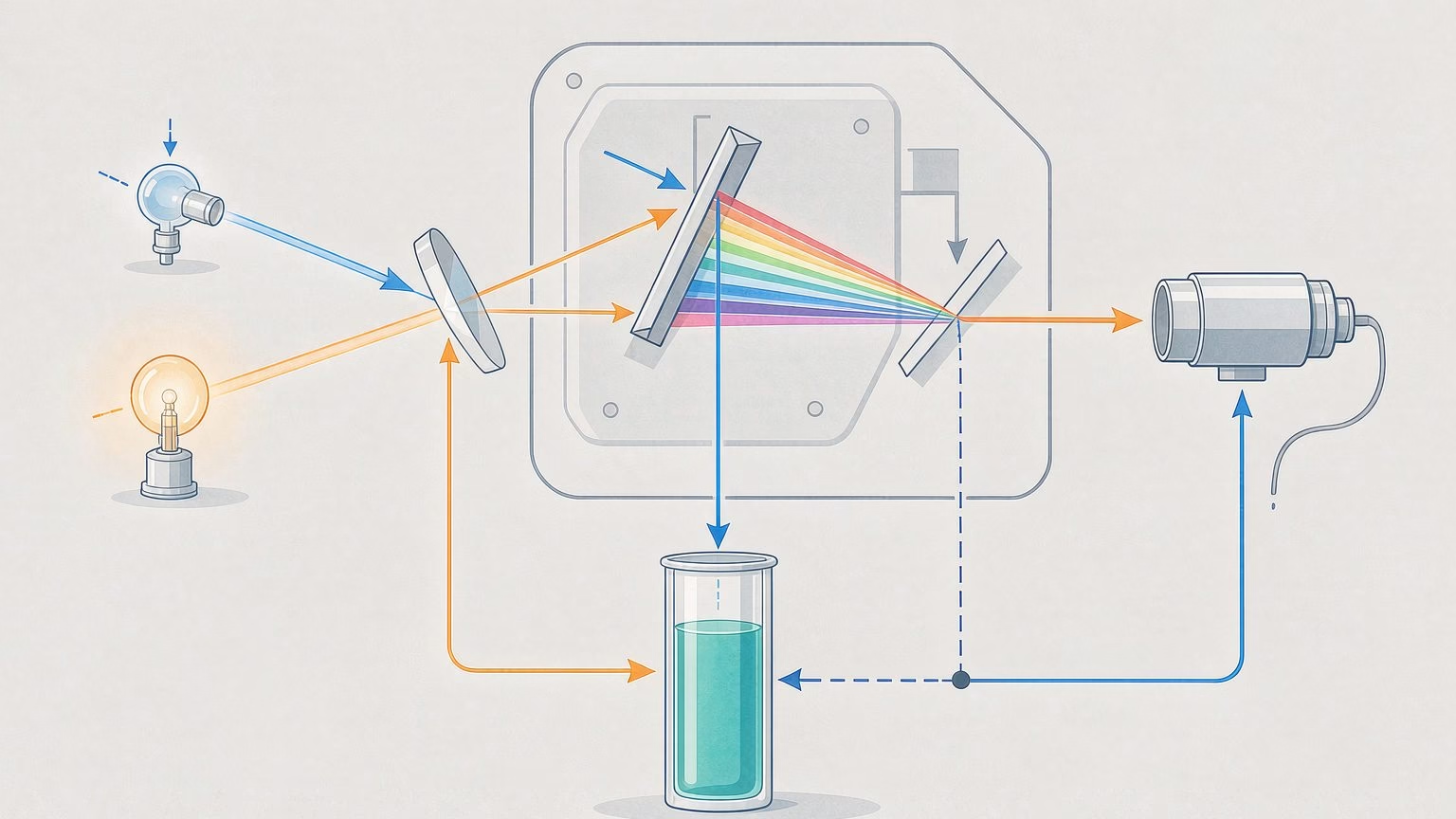
Every UV-Vis spectrophotometer reports absorbance as a ratio: the light that reached the detector through the sample, divided against the light that would have reached it without the sample. A single beam instrument obtains the denominator by running a blank and remembering it. A double beam instrument obtains it by measuring a second physical beam at the same time.
The practical consequence is that the denominator stops being a stored number and becomes a live one. Anything that changes the light source between the blank and the sample — warm-up, mains fluctuation, lamp ageing, a deuterium lamp nearing end of life — is present in both beams and divides out. This is why the double beam layout is the default in pharmaceutical QC, where the method may run for hours and the acceptance criterion is tight.
Where the split happens: before or after the monochromator
The split point is the detail most datasheets never state, yet it defines what the instrument can do.
| 分光位置 | 结构含义 | 典型后果 |
|---|---|---|
| 单色器之前分束 | 两束光各自经过完整单色器(双单色器结构) | 杂散光极低,光通量也低,成本高,多见于研究级 |
| 单色器之后分束 | 一束单色光被切成样品束与参考束 | 最常见布局,光通量与杂散光之间取平衡 |
| 样品室之后合束(ratio-recording 检测器侧) | 两个检测器分别读样品与参考 | 电子学更简单,对检测器配对一致性要求高 |
Most routine and mid-precision laboratory instruments split after the monochromator: one beam passes through the sample cuvette, the other through a reference cuvette or through air, and the two are recombined — optically by a chopper, or electronically by two matched detectors.
Inside a Double Beam UV-Vis Spectrophotometer: Component by Component
The source compartment and why lamp changeover matters
UV work below roughly 340 nm needs a deuterium lamp; visible work needs a tungsten halogen lamp. A double beam instrument therefore carries two lamps and switches between them at a defined crossover wavelength. Because both beams see the same lamp at the same time, the crossover region — where lamp output is weakest — is far less disruptive than on a single beam instrument. On several BRT models the changeover point is user-settable between 294 nm and 365 nm, which lets a laboratory push the switch away from an analytically important wavelength.
The monochromator and the beam-forming optics
Downstream of the source, a holographic grating — typically 1,200 lines/mm on routine instruments, 1,600 lines/mm on high-precision models — selects the wavelength. The spectral bandwidth that results (1.8 nm is the common figure in the mid-precision class, 1.0 nm in the research class) determines how well two adjacent absorption peaks can be separated. Note carefully: this is a property of the monochromator and the slit, not of the number of beams.
The sample and reference compartment
This is the part that surprises buyers. In a true double beam instrument, the reference position is a real cuvette position, and in normal use it holds a cuvette filled with the blank solution. Putting nothing in the reference holder is physically possible but throws away part of the benefit: the reference beam then sees air while the sample beam sees solvent and cuvette wall, and the solvent’s own absorption is no longer cancelled.
Detectors: one or two
A double beam instrument may use one detector with a rotating chopper mirror that alternately sends the sample and reference beams into it, or two matched detectors reading both beams continuously. Either is legitimate. What matters is that the two channels are stable relative to each other over the length of a scan, which is a specification you should ask for in writing.
What the Second Beam Actually Removes
| 误差来源 | 单光束表现 | 双光束表现 |
|---|---|---|
| 光源强度漂移 | 空白与样品不同时刻读数,漂移直接进结果 | 两束同时读,漂移被比值抵消 |
| 开机预热未完成 | 读数随灯温上升持续漂移 | 漂移同样进入参考束,显著削弱 |
| 长扫描 / 动力学 | 单次扫描内的漂移造成基线倾斜 | 基线在整个扫描期间保持平直 |
| 灯切换瞬变 | 换灯点附近出现台阶 | 两束同步受影响,台阶被抵消 |
| 电网波动 | 直接体现在吸光度上 | 共模抑制 |
Five Things a Double Beam Design Does Not Fix
- Stray light. Stray light is generated in the monochromator and the optics; a second beam does not reduce it. It remains the binding limit at high absorbance, and it is verified with cut-off filters or a certified reference material, not by the beam geometry.
- Wavelength accuracy. The grating position drives this. It is verified against a holmium oxide solution or a holmium oxide glass filter, such as NIST SRM 2034 4.
- Spectral bandwidth. A wider bandwidth flattens peak heights and shifts apparent peak positions on sharp bands. It is a slit/grating property.
- Photometric (absorbance) accuracy at high absorbance. Verified with neutral density glass filters; NIST SRM 930e is the widely used reference for this 3.
- Chemistry errors. Wrong blank, wrong cuvette material, dirty optics, or a method outside the linear range will produce wrong numbers on any instrument.
A useful way to hold this: double beam fixes time-dependent errors; it does not fix wavelength-, bandpass- or detector-dependent errors. Standards bodies treat these as separate checks — ASTM E275 is written specifically to describe and measure the performance of a UV-Vis spectrophotometer across those independent axes 1, and ASTM E169 covers the general techniques of quantitative analysis that sit on top of them 2.
Why the Label on the Datasheet Misleads Buyers
Two beams does not mean two monochromators
The most common misreading is to assume that a double beam UV-Vis spectrophotometer contains two wavelength selectors. It does not. There is one monochromator, and the monochromatic light leaving it is what gets divided. Instruments that genuinely use two monochromators in series exist, and they are built for a different reason — to suppress stray light by filtering the light twice — but they are described as double monochromator instruments, and they are a separate, considerably more expensive category. Conflating the two leads buyers to expect a stray light performance that the beam geometry alone will never deliver.
Double beam is not a compliance grade
Buying a double beam UV-Vis spectrophotometer does not by itself satisfy a pharmacopoeial or a regulated-method requirement. What those documents require is a set of demonstrated performance characteristics: wavelength accuracy within a stated tolerance, photometric accuracy verified with traceable filters, stray light below a stated limit, and control of the resolution used for the measurement. A well-maintained single beam instrument can pass all of them; a neglected double beam instrument can fail any of them. The beam geometry makes passing easier over long runs, not automatic.
Where the term matters least
For methods that are read within seconds of blanking, at a single wavelength, at a stable room temperature, the distinction is close to irrelevant. Most routine water analysis and simple concentration checks fall into this group, which is why single beam instruments remain the rational choice for them. The label earns its cost only when the measurement takes long enough for the lamp to change while you are reading it.
Specifications to Read on a Double Beam Datasheet
| 指标 | 在双光束机型上要看什么 | 为什么重要 |
|---|---|---|
| 光谱带宽 | 1.0–2.0 nm,取决于峰形 | 决定相邻峰能否分开 |
| 波长准确度 / 重复性 | ±0.3 nm 与 ≤0.2 nm 是常见档位 | 决定峰位是否可比对 |
| 杂散光 | 明示为 %T(如 ≤0.015 %T) | 决定高吸光度段的线性 |
| 基线平直度 / 漂移 | 明示为 Abs 或 Abs/30 min | 这是双光束真正的价值指标 |
| 光度范围 | −0.301 至 3.000 Abs 或更宽 | 决定是否需要稀释 |
| 检测器类型 | 硅光电池 / 光电倍增管(PMT) | PMT 灵敏度更高,噪声更低 |
| 光源与更换方式 | 插座式免调整 vs 需光路校准 | 影响停机时间与维护成本 |
Pharmacopoeial users have an extra layer here: the European Pharmacopoeia general chapter 2.2.25 sets out the apparatus and performance requirements applied to ultraviolet and visible absorption spectrophotometry 6, and instruments used in regulated work are normally qualified against it under an ISO/IEC 17025 quality system 10.
Where Double Beam Instruments Fit in a Laboratory
Choosing the beam geometry is a question about your measurement clock, not about your budget tier. Ask how long the instrument is reading before the next blank is taken. Under roughly a minute, source drift contributes very little and the simpler optical layout costs you nothing in data quality. Beyond several minutes — a full spectral scan, a kinetic trace, a dissolution sequence, a thermostatted multi-cell run — drift becomes the dominant controllable error, and the second beam is the cheapest way to remove it. The table below maps that judgement onto common laboratory work.
| 应用场景 | 为什么需要双光束 | 建议档位 |
|---|---|---|
| 药典含量测定与溶出度 | 长时间序列、严格验收限 | 高精度双光束 + PMT |
| 酶动力学与反应跟踪 | 单次运行跨越数十分钟 | 低漂移双光束 + 恒温池架 |
| 全光谱扫描与纯度比值 | 扫描期间基线必须平直 | 1.8 nm 双光束 |
| 水质与常规浓度测定 | 方法成熟、重复性好即可 | 单光束通常已足够 |
| 教学与演示 | 预算优先 | 入门单光束 |
If your menu is dominated by the last two rows, a double beam instrument will not buy you measurably better data; if it is dominated by the first three, the beam geometry is the cheapest way to remove a whole class of error.
The BRT Testing Double Beam Range
| 型号 | 光学结构 | 波长范围 / 带宽 | 关键差异 | 适用 |
|---|---|---|---|---|
| BRT-3200UV | Double Beam Optics,1,200 lines/mm | 190–1100 nm / 1.8 nm | 波长准确度 ±0.3 nm,重复性 ≤0.1 nm | 常规双光束入门 |
| BRT-5400UV | Split Double Beam Optics,C-T 单色器 | 190–1100 nm / 1.8 nm | 自动 8 联池架,高通量筛选 | 多样品日常检测 |
| BRT-5600UV | Split Double Beam,C-T 单色器 | 190–1100 nm / 1.8 nm | 杂散光 ≤0.05 %T,基线漂移 ≤0.001 Abs/30 min | 低漂移要求 |
| BRT-5800UV | Double Beam Optics,C-T 单色器 | 190–1100 nm / 1.8 nm | 光度范围至 4.000 Abs,硅光电池 | 宽浓度范围 |
| BRT-5900UV | Double Beam,1,600 lines/mm | 190–900 nm / 1.0 nm | PMT 检测器,杂散光 ≤0.015 %T,基线平直度 ≤±0.001 Abs | 高精度与药典级 |
| BRT-6100UV | Double Beam Optical System | 190–1100 nm | 插座式氘灯/钨灯,免光路调整更换 | 维护便利性优先 |
Two naming points are worth flagging, because they cause real specification errors. First, “split double beam” is not the same phrase as “double beam” — check the optical system line on the datasheet rather than the model family name. Second, research-grade instruments move to a 1,600 lines/mm grating and a photomultiplier detector (BRT-5900UV), which is what delivers the 1.0 nm bandwidth and the ≤0.015 %T stray light figure; that improvement comes from the grating and detector, not from having two beams. The full model-by-model breakdown sits in our UV/Vis spectrophotometer buying guide.
Running Costs and Consumables
The purchase price is the smaller half of the ownership cost of a double beam UV-Vis spectrophotometer, because the design adds a reference channel that has to be kept in the same condition as the sample channel. Two lamps age on their own schedules, two cuvette positions have to be matched, and the verification programme has to cover both. The items below are the ones that routinely surprise first-time buyers.
| 项目 | 影响 | 备注 |
|---|---|---|
| 氘灯 | UV 段能量随时间下降 | 插座式可免光路校准更换(如 BRT-6100UV) |
| 钨灯 | 可见段光源 | 20 W 级为常见规格 |
| 比色皿 | 石英用于 UV,玻璃/塑料仅可见段 | 材质决定 190 nm 可用性 |
| 标准物质 | 波长与光度核查 | NIST SRM 2034 / SRM 930e 一类 [3][4] |
| 软件与合规包 | 审计追踪、权限、电子签名 | 受监管实验室必问 |
| 年度校准 | 波长、光度、杂散光 | 与 ISO/IEC 17025 体系挂钩 [10] |
Instrument vendors publish configuration guidance covering exactly these items, and it is worth reading the manufacturer’s own optical and detector documentation before committing to a service contract 11.
Verifying a Double Beam Instrument After Installation
| 检查项 | 参考物质 / 方法 | 判据来源 |
|---|---|---|
| 波长准确度 | 氧化钬溶液,NIST SRM 2034 | 证书值 [4] |
| 光度准确度 | 中性密度玻璃滤光片,NIST SRM 930e | 证书值 [3] |
| 杂散光 | 截止滤光片或标准规定的杂散光测试 | ASTM E275 [1] |
| 分辨率 / 带宽 | 特征峰半高宽或标准溶液 | ASTM E275 [1] |
| 基线平直度与漂移 | 空气对空气扫描 | 厂家规格 + 方法需求 |
| 药典适用性 | 2.2.25 项下各项 | Ph. Eur. 2.2.25 [6] |
Traceability is the point of all six rows: NIST maintains the reference materials and the measurement chain that make a photometric or wavelength figure comparable between laboratories 5, and instrument makers publish their own optical layout and performance data for the same reason 789.
Frequently Asked Questions
What is a double beam UV-Vis spectrophotometer in simple terms?
It is a spectrophotometer that sends light from one lamp down two paths at the same time — one through your sample, one through a reference — and reports the ratio of the two. Measuring both at once means any change in lamp brightness cancels out, so the instrument stays stable over long scans and kinetic runs.
Does a double beam spectrophotometer have two lamps?
No, it has one lamp pair for the two wavelength regions: a deuterium lamp for the ultraviolet and a tungsten halogen lamp for the visible. “Double beam” refers to the two light paths after the monochromator, not to two lamps or two separate light sources.
Is a double beam instrument always more accurate than a single beam one?
Not in every respect. It is markedly more stable against source drift, warm-up and long-run baseline tilt. It is not automatically better on wavelength accuracy, spectral bandwidth or stray light, because those depend on the grating, the slit and the detector instead.
What goes in the reference beam?
In normal use, a cuvette filled with the same blank solution used to zero the method — solvent, buffer or reagent blank. Leaving the reference position empty is possible, but it stops the solvent and cuvette wall contributions from being cancelled in the ratio.
What is the difference between split beam and double beam?
“Split beam” usually describes an optical layout in which the monochromatic light is divided by a static beam splitter, while “double beam” is the broader term for any design that measures sample and reference simultaneously. Manufacturers are not consistent, so read the optical system line on the datasheet rather than the label.
How do I verify a double beam spectrophotometer after installation?
Check wavelength accuracy against a holmium oxide reference material, photometric accuracy against neutral density glass filters, and stray light with a cut-off filter. ASTM E275 sets out how these performance parameters are described and measured, and pharmacopoeial users add the checks in Ph. Eur. 2.2.25.
When is a single beam instrument enough?
When your methods are short, run at room temperature, and are re-blanked frequently — routine concentration checks, water quality parameters and teaching labs. The stability advantage of double beam optics shows up mainly in scanning, kinetics and long unattended sequences.
Conclusion: A Sequence for Deciding
- List the methods you actually run and how long each one takes.
- If most runs exceed a few minutes, specify double beam optics — the drift immunity is the cheapest error reduction available.
- Set the bandwidth from your sharpest absorption peak, not from the instrument class.
- Ask for stray light, baseline flatness and drift as numbers with units; these are the figures that separate one double beam instrument from another.
- Budget for the reference materials and the annual verification before you buy, not after.
- Confirm the lamp changeover wavelength can be moved away from your analytical wavelength.
BRT Testing builds both single beam and double beam UV-Vis spectrophotometers, from 1.8 nm routine instruments to 1.0 nm PMT-based research models. Browse the UV-Vis spectrophotometer range, or send us your method list and we will map it to a configuration with the acceptance figures written down.
Shenyang Baoruitong Automation Equipment Co., Ltd.
BRT Testing manufactures UV-Vis spectrophotometers, FTIR spectrometers and fire testing equipment in Shenyang, China. Our application team supports wavelength, photometric and stray-light verification with certified reference materials, and supplies the documentation needed for ISO/IEC 17025 and pharmacopoeial qualification. Contact us for a configuration proposal and a written acceptance test plan.
Sources
- ASTM International — E275-08 (reapproved 2022) Standard Practice for Describing and Measuring Performance of Ultraviolet and Visible Spectrophotometers
- ASTM International — E169-16 Standard Practices for General Techniques of Ultraviolet-Visible Quantitative Analysis
- NIST — SRM 930e, neutral density filters (certificate)
- NIST — SRM 2034, holmium oxide solution wavelength standard (certificate)
- NIST — Traceability in Molecular Spectrophotometry
- European Pharmacopoeia — 2.2.25 Absorption spectrophotometry, ultraviolet and visible (public text)
- Edinburgh Instruments — DS5 double-beam UV-Vis spectrophotometer data sheet
- Edinburgh Instruments — UV-Vis Spectroscopy
- Shimadzu — UV-Vis-NIR Spectroscopy
- UNI Ente Italiano di Normazione — ISO/IEC 17025:2017
- Thermo Fisher Scientific — Molecular spectroscopy