- The Short Answer
- What a Burning Rate Number Actually Contains
- The Instrument Settings That Change the Answer
- Method 1 — Horizontal Rate Under a 50 W Flame
- Method 2 — The 102 mm/min Rule for Vehicle Interiors
- Method 3 — Horizontal Rate for Rigid Plastics (ASTM D635)
- Method 4 — Foams and Thin Films
- Method 5 — Vertical Tests That Do Not Report a Rate
- The Five Methods Side by Side
- What Moves the Number Within a Single Method
- Reading a Burning Rate Report: Six Checks
- When Burning Rate Is the Wrong Specification
- Equipment for Measuring Burning Rate
- Frequently Asked Questions
- What is the formula for burning rate?
- Is the FMVSS 302 limit 100 mm/min or 102 mm/min?
- Why does a burning rate need a thickness?
- What happens if the specimen stops burning before the end mark?
- Can a horizontal rate be compared with a vertical result?
- Which standard applies to vehicle interior materials in Europe?
- Does a low burning rate mean the material is fire safe?
- Conclusion: A Decision Order
- About the Author
- Sources
The Short Answer
Burning rate is the distance a flame front travels along a specimen divided by the time it takes, expressed in millimetres per minute. The arithmetic is the same everywhere — B = 60 × (D / T), with D in millimetres and T in seconds, the formula written into 49 CFR 571.302 for vehicle interior materials 1. What changes is everything around it: specimen orientation, ignition flame power, where timing starts and stops, and what the operator does when the flame goes out. A horizontal bar timed between two 38 mm marks and a vertical bar timed to self-extinguishment both yield mm/min, and those figures cannot be compared. Fix the method first, then read the rate.
What a Burning Rate Number Actually Contains
A rate is a ratio, and a ratio is only useful when both terms are defined. The distance term is never the full specimen length, because every method excludes the zone under the ignition flame and the zone at the far end where the front becomes unstable. The time term is never the total test duration, because it starts at one reference mark and ends at a second mark or when flaming ceases.
The formula, and the two numbers it hides
B = 60 × (D / T) converts millimetres per second into millimetres per minute. D is the distance travelled between the start and stop references, not the specimen length; T is the elapsed time between those two events. Two laboratories can test the same material and report 32 and 41 mm/min without arithmetic error, because they timed different spans.
Why the timed span matters more than the specimen length
On a full-length 356 mm specimen, 49 CFR 571.302 starts timing 38 mm from the open end and stops 38 mm from the clamped end, so the span entering the formula is roughly 280 mm [1]. On a short part the same references sit closer together, the rate is still reported in mm/min, and it is still read as if it described the material. It describes the material in that geometry only.
The Instrument Settings That Change the Answer
Four settings move the result before any material property is involved, and a report that omits them cannot be reproduced.
| Setting | What the standards fix | Why it changes the number |
|---|---|---|
| Ignition flame | 38 mm flame from a 10 mm bore burner in 49 CFR 571.302 [1]; 50 W nominal in IEC 60695-11-10 3 | A hotter or longer flame preheats further ahead of the front and raises the apparent rate |
| Flame application time | 15 s in 49 CFR 571.302 [1]; 30 s in the 50 W horizontal method [3] | Longer contact deepens the pyrolysis zone and shortens the delay before sustained spread |
| Specimen thickness | Capped at 13 mm in 49 CFR 571.302 [1] and in ISO 3795 2 | Thin specimens heat through faster; the rate is thickness dependent, not a material constant |
| Draught control | Enclosed cabinet, 381 × 203 × 356 mm in 49 CFR 571.302 [1] | A bench draught can double a horizontal rate; the cabinet exists to remove that variable |
Conditioning before the clock starts
49 CFR 571.302 requires 24 hours at 21 °C and 50 % relative humidity, with the test run under the same conditions [1]. A specimen pulled from a humid store and tested immediately burns more slowly at first and then erratically, because the water absorbs heat before pyrolysis begins. When two datasets disagree by 20 % and nothing else explains it, ask how the specimens were conditioned.
Method 1 — Horizontal Rate Under a 50 W Flame
IEC 60695-11-10 is the electrotechnical route and the one behind the familiar UL 94 horizontal classes. It specifies small-scale laboratory procedures that compare the burning behaviour of bar specimens, oriented horizontally or vertically, exposed to a small flame with a nominal thermal power of 50 W, and the methods determine either the linear burning rate or the self-extinguishing properties of the material [3].
What the standard fixes, and what it leaves open
The methods apply to solid and cellular materials with an apparent density above 250 kg/m³, determined in accordance with ISO 845 [3]. That density floor is not a formality: below it, cellular materials wick and collapse in ways the bar geometry cannot represent, which is why foams have their own standard.
Method A is horizontal and reports a linear burning rate over a defined span between marks. Method B is vertical and reports afterflame and afterglow times plus whether burning drips ignite the cotton below — a different currency entirely.
Where the 40 and 75 mm/min figures come from
The two horizontal classes in UL 94 are named after their limits: HB40 for specimens from 3 mm to 13 mm thick and HB75 below 3 mm. The class names encode the numbers, which is why a rate reported without a thickness band is ambiguous. Our UL 94 HB, V-0, V-1 and V-2 guide walks through how horizontal and vertical classes are assigned from the same cabinet.
Method 2 — The 102 mm/min Rule for Vehicle Interiors
This is the most widely quoted burning rate limit in the world and the most widely misquoted number in the category. 49 CFR 571.302, Federal Motor Vehicle Safety Standard 302, requires that the listed occupant-compartment materials shall not burn, nor transmit a flame front across their surface, at a rate of more than 102 mm per minute [1]. Not 100. The error is common, and a report written against 100 mm/min is not written against the regulation.
Specimen geometry: 102 mm by 356 mm, cut to 13 mm
The specimen is a rectangle 102 mm wide by 356 mm long wherever possible, with the thickness of the material as used in the vehicle, cut down to 13 mm measured from the surface nearest the occupant compartment where it is thicker [1]. The surface closest to the occupant air space faces downward on the test frame — the side a passenger would touch is the side that burns.
ISO 3795 specifies the same horizontal small-flame concept for occupant-compartment materials, permits testing of materials and parts individually or in combination, and is limited to a thickness of 13 mm [2]. The current edition is ISO 3795:1989, in force since 19 October 1989, which cancelled the 1976 first edition [2].
The procedure in six steps
The sequence below is the one in 49 CFR 571.302, and the marks are what make the number reproducible [1].
| Step | Action | Parameter fixed by the regulation |
|---|---|---|
| 1 | Mount the specimen | U-shaped frame, interior 51 mm wide by 330 mm long; sides and one end held |
| 2 | Place the burner | Tip centre 19 mm below the centre of the bottom edge of the open end |
| 3 | Apply the flame | 15 seconds, then withdraw |
| 4 | Start timing | When the flame front reaches 38 mm from the open end |
| 5 | Stop timing | At 38 mm from the clamped end, or where flaming stops if it stops earlier |
| 6 | Calculate | B = 60 × (D / T) in mm/min |
The escape clause most reports omit
Paragraph S4.3(b) provides that a material which stops burning before it has burned for 60 seconds from the start of timing, and has not burned more than 51 mm from that point, is considered to meet the burn-rate requirement [1]. This matters for materials that char and self-extinguish: they may never produce a rate at all, and a report that records only a rate shows a blank where a pass belongs. Ask for the time and distance record, not just the quotient.
Method 3 — Horizontal Rate for Rigid Plastics (ASTM D635)
ASTM D635 is the North American counterpart for rigid plastics and is titled for the rate of burning and/or extent and time of burning of plastics in a horizontal position 4. The “and/or” is the useful part: the method returns a rate, an extent, a time, or a combination, depending on whether the front reaches the far reference before it stops.
When the front reaches the far mark, the quotient is a rate. When it stops short, the extent becomes the result and the rate is undefined — which is why a D635 report showing no rate is not a failed test but a test that ended in self-extinguishment, usually the more interesting outcome. For non-rigid materials the companion method is ASTM D4804, which determines flammability characteristics of nonrigid solid plastics 5.
Method 4 — Foams and Thin Films
Two product families break the horizontal bar model, and each has its own standard.
Foams: ISO 9772
ISO 9772 determines the horizontal burning characteristics of small specimens of cellular plastics subjected to a small flame 6. The specimen is small because a foam does not burn like a solid: it melts back, collapses and can burn at the edge while the centre is untouched. ISO 9772:2020 is current, in force since 24 November 2020 [6].
Thin films: ISO 9773
ISO 9773 covers the burning behaviour of thin flexible vertical specimens in contact with a small-flame ignition source 7. A film thin enough to curl cannot be clamped in a horizontal bar without changing what is measured, so the geometry goes vertical and the reported quantities become afterflame time and drip behaviour. ISO 9773:2024 is current, in force since 13 September 2024 [7].
Method 5 — Vertical Tests That Do Not Report a Rate
Not every flame test produces a burning rate, and the ones that do not are routinely misread as if they did. IEC 60332-1-2 tests resistance to vertical flame propagation for a single vertical insulated conductor or cable under a 1 kW pre-mixed flame 8. The outcome is recorded as the extent of char relative to the reference mark near the top clamp, together with whether flaming material fell. There is no mm/min figure here, and quoting one would be invention. The same applies to the vertical 50 W method, where afterflame, afterglow and drip behaviour are the currency [3].
The Five Methods Side by Side
| Method | Orientation | Ignition | Reported quantity | Governing document |
|---|---|---|---|---|
| 50 W bar, Method A | Horizontal | 50 W nominal flame, 30 s | Linear burning rate between marks | IEC 60695-11-10:2013 [3] |
| Vehicle interior | Horizontal | 38 mm gas flame, 15 s | Rate in mm/min against a 102 mm/min limit | 49 CFR 571.302 [1] |
| Vehicle interior, ISO route | Horizontal | Small flame | Horizontal burning rate, ≤ 13 mm thick | ISO 3795:1989 [2] |
| Rigid plastics | Horizontal | Small flame at one end | Rate, extent and/or time | ASTM D635 [4] |
| Cellular plastics | Horizontal | Small flame | Horizontal burning characteristics | ISO 9772:2020 [6] |
| Thin flexible film | Vertical | Small flame | Afterflame, drip behaviour | ISO 9773:2024 [7] |
| Single cable | Vertical | 1 kW pre-mixed flame | Extent of char, falling particles | IEC 60332-1-2:2025 [8] |
The table is the shortest answer to the most common procurement question: which number should a specification quote. The rate column only has entries where the method actually defines one.
What Moves the Number Within a Single Method
Four factors account for most of the spread between laboratories running the same method on the same material. None of them is an error, and all of them must be recorded for a result to be reproducible.
| Factor | What happens | How to control it |
|---|---|---|
| Thickness | Heat crosses a thin section faster, so thin specimens usually burn faster than thick ones of the same formulation | Test in the thickness band the class limit is written for, and record measured thickness at the burn path |
| Direction of cut | Extruded and rolled products are anisotropic; 49 CFR 571.302 requires the most adverse direction [1] | State the cut direction relative to machine direction on the report |
| Edge condition | A sawn edge exposes filler; a moulded edge does not | Compare like with like; note the edge preparation |
| Flame-front definition | The front is where visible flame ends, and operators disagree at the margins on charring materials | Video with a time stamp on any run that decides a shipment |
A rate that decides a shipment should arrive with the raw time and distance record, because the quotient alone cannot be audited.
Reading a Burning Rate Report: Six Checks
| Check | What good looks like | Why it matters |
|---|---|---|
| Method and edition | Full designation with year, e.g. IEC 60695-11-10:2013 | Editions change flame application times and geometries |
| Orientation stated | Horizontal or vertical, explicitly | A vertical result cannot be compared with a horizontal limit |
| Timed span given | Start and stop references in mm | Without it the rate cannot be recalculated |
| Thickness recorded | Measured, not nominal, at the tested point | Class limits are thickness banded |
| Conditioning recorded | Temperature, humidity, duration | Unconditioned specimens give non-reproducible rates |
| Time and distance, not only rate | Raw T and D alongside B | Lets a reviewer apply the self-extinguishment clause |
When Burning Rate Is the Wrong Specification
A burning rate answers a narrow question: how fast a flame front moves along a bar in a defined geometry. It says nothing about how much heat the material releases, how much smoke it makes, or whether an assembly resists fire. Specifying a rate where the fire scenario is a compartment fire is a category error, and the fix is a different instrument — a cone calorimeter for heat release rate under a defined irradiance, or the single burning item apparatus for a corner assembly.
The rate is also a poor discriminator between two good materials: two formulations that both pass at 30 mm/min may behave very differently at 50 kW/m². Our guide to how to test the flammability of plastic materials sets out how the methods fit together.
Equipment for Measuring Burning Rate
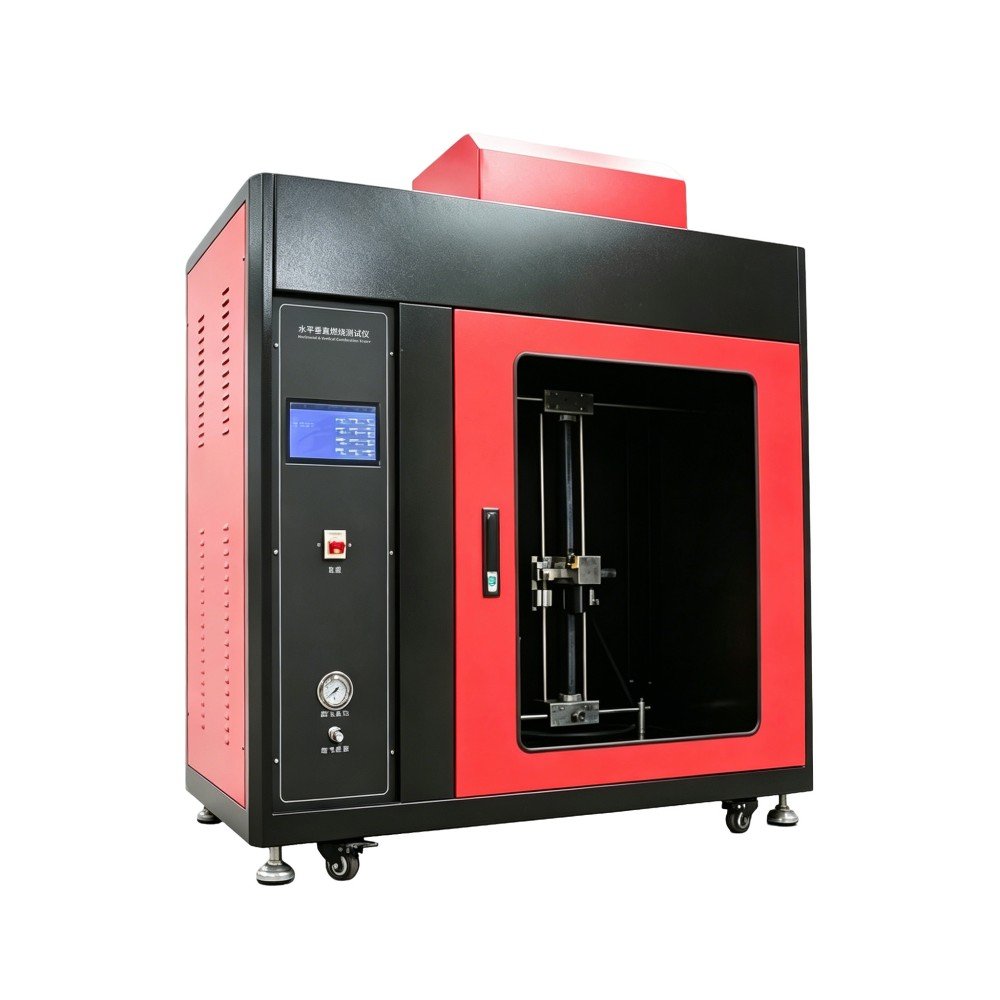
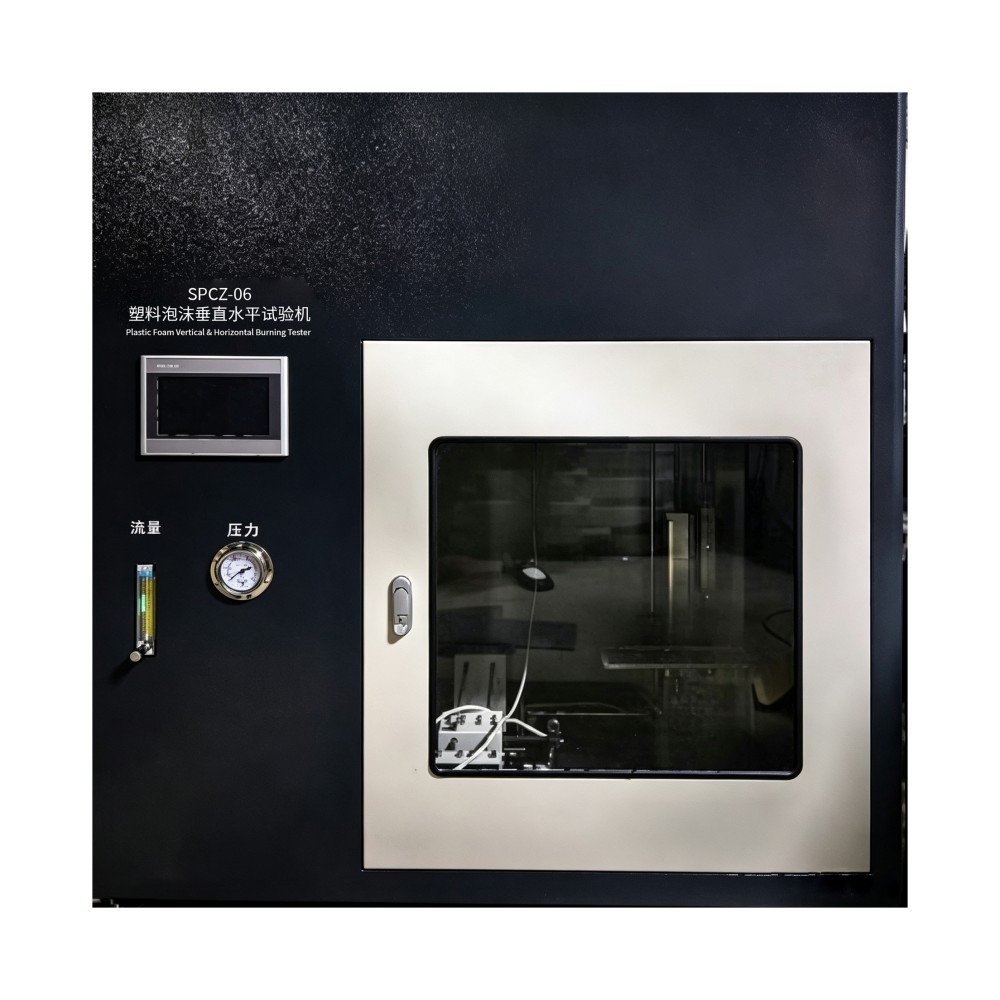
The horizontal bar methods need a draught-free enclosure, a calibrated burner on a positioning jig, a specimen frame that holds the bar flat, and marks at fixed distances from the ignition end. The SPCZ-05 horizontal and vertical combustion tester covers the 50 W bar geometry with the burner on an adjustable carriage, and the SPCZ-06 foam burning tester covers the ISO 9772 cellular-plastics geometry.
For single-flame-source assessment the building material combustibility test apparatus runs EN ISO 11925-2, and the oxygen index tester gives the minimum oxygen concentration that supports candle-like burning, the quantity defined by ASTM D2863 9 — a different and often more discriminating measure than a rate. The fire and flame testing equipment category lists the full range.
Frequently Asked Questions
What is the formula for burning rate?
Burning rate is B = 60 × (D / T), where D is the distance the flame front travels in millimetres and T is the time in seconds, which gives a result in millimetres per minute. The 60 converts seconds to minutes. D and T must be measured between the same two reference marks the method specifies, otherwise the quotient is not comparable.
Is the FMVSS 302 limit 100 mm/min or 102 mm/min?
It is 102 mm per minute. 49 CFR 571.302 paragraph S4.3(a) requires that the material shall not burn or transmit a flame front across its surface at a rate of more than 102 mm per minute. Many summaries round it to 100, but a test report written against 100 mm/min is not written against the regulation.
Why does a burning rate need a thickness?
Because the rate is not a material constant. A thin section heats through faster and usually burns faster than a thick one of the same formulation, so class limits are written in thickness bands. UL 94’s horizontal classes, for example, allow 40 mm/min from 3 mm to 13 mm and 75 mm/min below 3 mm.
What happens if the specimen stops burning before the end mark?
The test returns an extent rather than a rate, and that is a valid result. In 49 CFR 571.302 a material that stops burning within 60 seconds of the start of timing and has not burned more than 51 mm is treated as meeting the burn-rate requirement. Ask for the raw time and distance record, not just the calculated figure.
Can a horizontal rate be compared with a vertical result?
No. The orientations measure different things: a horizontal rate describes how fast a front travels along an upper surface, while vertical tests report afterflame time, afterglow and dripping. Converting one into the other is not defined by any of the standards involved, so a specification that mixes them is unenforceable.
Which standard applies to vehicle interior materials in Europe?
ISO 3795:1989 is the ISO method for the horizontal burning rate of occupant-compartment materials, limited to 13 mm thickness and applicable to materials and parts individually or in combination. It is the current edition, in force since 19 October 1989, and it cancelled the 1976 first edition.
Does a low burning rate mean the material is fire safe?
No. A rate describes flame travel along a small bar in a fixed geometry. It says nothing about heat release rate, smoke production, or how an assembly performs in a compartment fire. Those questions need a cone calorimeter, a smoke density test or a full-scale fire resistance test, and a good specification asks for the one that matches the fire scenario.
Conclusion: A Decision Order
- Decide what the rate is for. A regulatory limit, a material comparison and an incoming inspection need three different levels of rigour.
- Name the method and the edition before naming a target number. A rate without a method is not a specification.
- Fix the geometry in writing: orientation, thickness band, specimen size and cut direction.
- Require the timed span and the raw time and distance alongside the calculated rate.
- Record conditioning, because an unconditioned specimen produces a number nobody can reproduce.
Talk to BRT Testing about the horizontal and vertical combustion tester for 50 W bar methods, or get in touch with the material, the thickness band and the limit you have to meet.
About the Author
Written by the BRT Testing application engineering team in Shenyang, China. BRT Testing builds horizontal and vertical flame test equipment for plastics, foams, cables and construction products, and supports manufacturers preparing FMVSS 302, IEC 60695-11-10 and ISO 3795 submissions. Regulatory text, standard editions and status were checked against the eCFR mirror of 49 CFR 571.302, the UNI store and the IEC webstore on 3 November 2026.
Sources
- U.S. Code of Federal Regulations — 49 CFR 571.302, Federal Motor Vehicle Safety Standard No. 302, Flammability of interior materials — https://www.law.cornell.edu/cfr/text/49/571.302
- UNI — ISO 3795:1989, Road vehicles and tractors — Determination of burning behaviour of interior materials (current, in force 19 October 1989) — https://webstore.uni.com/en/iso-3795-1989
- IEC — IEC 60695-11-10:2013, Test flames — 50 W horizontal and vertical flame test methods — https://webstore.iec.ch/en/publication/2938
- ASTM — D635, Rate of Burning and/or Extent and Time of Burning of Plastics in a Horizontal Position — https://store.astm.org/d0635-22.html
- ASTM — D4804, Flammability Characteristics of Nonrigid Solid Plastics — https://store.astm.org/d4804.html
- UNI — ISO 9772:2020, Cellular plastics — Horizontal burning characteristics of small specimens (current, 24 November 2020) — https://webstore.uni.com/en/iso-9772-2020
- UNI — ISO 9773:2024, Thin flexible vertical specimens in contact with a small-flame ignition source (current, 13 September 2024) — https://webstore.uni.com/en/iso-9773-2024
- IEC — IEC 60332-1-2:2025, Test for vertical flame propagation for a single insulated wire or cable — https://webstore.iec.ch/en/publication/80873
- ASTM — D2863, Minimum Oxygen Concentration to Support Candle-Like Combustion of Plastics (Oxygen Index) — https://store.astm.org/d2863.html