- How UV/Vis Spectrophotometry Measures Water Quality
- Why COD Is the Parameter That Sets Your Specification
- Matching Instrument Specifications to Water Methods
- Single Beam or Double Beam for Water Analysis?
- Application-to-Configuration Matching
- The BRT Testing UV/Vis Range for Water Laboratories
- Accessories and the Costs Buyers Forget
- Six Purchasing Mistakes in Water Laboratories
- Acceptance and OQ/PQ Checks for a Water Laboratory
- Frequently Asked Questions
- Can a UV/Vis spectrophotometer measure COD directly without digestion?
- What wavelength is used for spectrophotometer COD measurement?
- Can UV absorbance at 254 nm replace COD testing?
- Do I really need a double-beam instrument for water quality testing?
- What bandwidth does a water analysis spectrophotometer need?
- Can I use glass cuvettes for all water tests?
- How often should a water laboratory verify the spectrophotometer?
- Is a visible-only spectrophotometer enough for a wastewater laboratory?
- Conclusion: Specifying From the Method List Outward
When a water laboratory writes a specification, the instrument has to satisfy a method, not a brochure. UV/Vis spectrophotometry for water quality testing is unusual in that the same optical bench serves two different jobs: regulated colorimetric determinations such as COD, and fast screening parameters such as nitrate, phosphate and SAC254. The short answer for most municipal and industrial water labs is a single-beam instrument with a 2 nm bandwidth and a spectral range reaching 190 nm — that covers the 190–1100 nm working window, keeps 254 nm UV measurements open, and stays affordable. Step up to double beam only when high-absorbance digested samples or drift between blanks is eating your throughput.
How UV/Vis Spectrophotometry Measures Water Quality
Every parameter a spectrophotometer reports is ultimately one number: how much light the sample absorbed at a chosen wavelength. The instrument splits a broadband source through a monochromator, passes a narrow band of wavelengths through the sample, and compares transmitted intensity against a reference. The Beer-Lambert relationship, A = εbc, converts that ratio into concentration once a calibration curve has fixed the relationship between absorbance and a known standard.
The Five Components That Decide Performance
Five optical components determine how well the instrument performs that task. The light source provides deuterium emission across the UV region and tungsten emission across the visible region. The monochromator isolates the wavelength band you selected. The cuvette sets the path length — normally 10 mm for water work, but longer for low-concentration samples. The detector converts transmitted photons into a signal. The readout electronics apply the calibration and report the result.
What a Water Laboratory Actually Measures
A water laboratory’s wavelength needs are broader than a clinical or pharmaceutical laboratory’s. The table below maps the measurements commonly requested on water and wastewater samples to the wavelengths and optical requirements behind them.
| Parameter | Typical wavelength | Notes on optics |
| COD, low range (3–150 mg/L) | 420 nm | Dichromate (Cr⁶⁺) remaining is measured; needs stable visible-region photometry |
| COD, mid range (20–1500 mg/L) | 620 nm | Cr³⁺ produced is measured; the workhorse range for municipal wastewater |
| COD, ultra-low (0.7–40 mg/L) | 350 nm | Needs UV-capable optics and low stray light |
| Nitrate (UV screening method) | 220 nm and 275 nm | Dual-wavelength correction; requires quartz cuvettes and genuine UV output |
| Phosphate, ammonia, phenolics | 400–880 nm | Visible region only; colorimetric reagent chemistry governs accuracy |
| Phenolics (4-AAP method) | 505 or 520 nm | Distillation then colour development; range 2–500 µg/L as phenol 8 |
| Colour (true colour) | 350–780 nm spectrum | Filtered sample, spectrum scan, reported in colour units or Pt/Co 5 |
| SAC254 (dissolved organics) | 254 nm | Spectral absorption coefficient; a screening indicator, not a regulated COD substitute 4 |
Table note: COD wavelength ranges follow the reactor digestion framework described in the US EPA Reactor Digestion Method 1 and ISO 15705:2002 7. Municipal reporting in the United States generally cites EPA Method 410.4 or Standard Methods 5220D 2, both of which appear in the EPA’s approved methods list for Clean Water Act reporting 11; chloride-bearing samples require the titrimetric route instead. Colour determination follows ISO 7887, whose spectrometric section covers raw and potable water and industrial water of low colour [5], with the current catalogue entry recorded by the standards body 6.
Why COD Is the Parameter That Sets Your Specification
COD is where spectrophotometer cod measurement stops being a convenience and becomes a compliance requirement. The chemistry is a redox reaction. A sealed vial containing potassium dichromate, sulfuric acid and a silver sulfate catalyst is heated with the sample, typically at 148 °C for two hours in commercial test kits 3. Oxidisable organic matter reduces the yellow dichromate ion to green chromic ion, and the extent of that colour change is what the instrument reads [2].
That colour change can be read at two different points, and the choice has real consequences. Measuring the remaining dichromate at 420 nm suits low-range work up to roughly 150 mg/L, because the absorbable species is still abundant and the change is easy to resolve. Measuring the chromic ion produced at 620 nm suits higher concentrations up to about 1500 mg/L, where dichromate depletion is nearly total and the green species carries the information instead [1].
Two interferences dominate real water samples. Chloride is oxidised by dichromate and produces a falsely high result, which is why most reagent vials contain mercury sulfate to complex chloride — and why mercury-free vials are only appropriate where chloride is known to be low [3]. Turbidity raises the baseline and drives results falsely low, so turbid surface water usually needs filtration or dilution before measurement. Both are sample-preparation problems, not instrument problems, but a laboratory that ignores them will blame the spectrophotometer for data that were never valid.
What the Method Documents Actually Fix
The determinative technique is specified, not left to preference. The approved method catalogues set out which analytical route applies to which sample type and range — for example, the phenolics methods approved for NPDES reporting cover a stated range from 2 to 500 µg/L as phenol and read the developed colour at 505 or 520 nm 9, while the broader catalogue of methods for chemical analysis of water sets out colorimetric, platinum-cobalt and spectrophotometric routes for colour determination 10. A laboratory’s instrument list has to accommodate the wavelength and range requirements of every method it intends to report under.
Reading COD Results Without Fooling Yourself
Method compliance and instrument plausibility are two separate checks, and laboratories frequently perform only the first. A calibrated instrument can still return a number that no reviewer should accept.
The practical safeguards are consistent across method versions. Absorbance values for a COD determination should fall in a usable mid-range rather than sitting near the top of the scale, because photometric uncertainty grows sharply as absorbance rises; diluting a sample and multiplying the result is almost always more defensible than reading a saturated solution. Every batch should carry a reagent blank and at least one certified standard [2]. If the calibration curve is only verified at the endpoints, errors in the middle of the range go undetected — and the middle is where most wastewater samples land.
Matching Instrument Specifications to Water Methods
Not every number on a spec sheet matters equally to a water laboratory. Five parameters decide whether an instrument can carry a method reliably.
| Specification | What it controls | Why a water laboratory cares |
| Bandwidth | Peak definition and resolution of overlapping spectra | 4 nm suits broad-band reagent colorimetry (COD, phosphate, ammonia); 2 nm matters for direct UV nitrate and scan-based colour; 1.0–1.8 nm is research work |
| Wavelength range | Which methods are physically possible | Anything below 200 nm unlocks 254 nm SAC254 and 350 nm ultra-low COD; visible-only instruments starting at 320–325 nm cannot do either, and no calibration fixes it [4] |
| Wavelength accuracy | Whether readings land on the intended wavelength | ±0.3 to ±0.5 nm is typical for routine work; ±0.1 nm or better with sub-0.2 nm repeatability for narrow-band UV and steep spectral regions |
| Photometric accuracy and stray light | How close a reading is to truth, and the absorbance ceiling | Low stray light is what lets high-absorbance digested samples be read without dilution; check the figure specified at 220 or 340 nm |
| Baseline stability and drift | How long a blank holds across a batch | A throughput and repeatability issue, not an accuracy one — single beam needs disciplined re-blanking, double beam references continuously |
The same five parameters, read against three laboratory profiles, produce a short list of target values:
| Specification | Routine water laboratory | High-throughput / high-absorbance | Research or method development |
| Bandwidth | 4 nm acceptable; 2 nm preferred | 2 nm | 1.0–1.8 nm |
| Wavelength range | Must reach ≤200 nm | 190–1100 nm | 190–1100 nm, extended UV welcome |
| Wavelength accuracy | ±0.5 nm workable | ±0.3 nm | ±0.1 nm or better |
| Stray light | Adequate for mid-range COD | Specified at 220/340 nm, low | Lowest available |
| Beam configuration | Single beam | Double beam | Double beam |
| Cuvette handling | Manual, 10 mm quartz + glass | Automated multi-cell changer | Automated changer plus scan software |
Single Beam or Double Beam for Water Analysis?
This is the question buyers ask most often, and the answer depends on workload rather than on prestige.
What Changes Between the Two Configurations
A single-beam instrument measures one optical path. You blank the instrument, then read the sample. Instrument and electronics drift between the blank and the reading is not compensated, so operators re-blank frequently and allow the instrument to warm up fully before a batch. For a laboratory running a modest daily sample count with reagent-based COD methods, this is adequate and the cost saving is real.
A double-beam instrument splits the source into a sample path and a reference path and compares them continuously. Drift from lamp ageing and ambient temperature changes largely cancels out, which means blanks hold longer and longer batches stay stable. This matters in two situations: laboratories running continuous high-volume digestion batches, and laboratories reading high-absorbance samples where drift is a larger fraction of the signal.
| Consideration | Single beam | Double beam |
| Drift control | Requires periodic re-blanking | Continuously referenced |
| Warm-up discipline | Strict — full warm-up essential | More forgiving |
| High-absorbance samples | Reads fine, drift matters more | Preferred |
| Throughput | Suits batch-by-batch work | Suits continuous runs |
| Multi-cell automation | Less common | Common, often 8-position |
| Cost | Lower | Higher |
The honest recommendation for a municipal or industrial wastewater laboratory is to start from the sample count and the absorbance range. If your digested samples read in the middle of the scale and you process a batch at a time, a well-specified single-beam instrument will produce compliant data indefinitely. Choose double beam when throughput or high-absorbance work makes drift a recurring nuisance — not because it sounds like the safer purchase. For the drift mathematics behind that trade-off, see Double Beam vs Single Beam Spectrophotometer.
Application-to-Configuration Matching
The fastest way to specify a water analysis spectrophotometer is to work backwards from the methods you must report. The parameter lists below follow the determinative wavelengths set out in the EPA reactor digestion framework [1] and the ISO 15705 sealed-tube method [7]; colour determinations follow ISO 7887 [5].
| Application | Non-negotiable optics | Recommended configuration |
| Municipal wastewater COD, EPA 410.4 / SM 5220D | 420 nm and 620 nm photometry, mid-range absorbance | Single beam, 2 nm, 190–1100 nm |
| Industrial effluent COD, high chloride | Titrimetric route plus photometric screening | Single beam with scan capability, plus titration glassware |
| Nitrate by UV screening | Genuine UV output to 220 nm, quartz cuvettes | Single or double beam, 2 nm or better, 190–1100 nm |
| SAC254 / dissolved organic screening | 254 nm capability, low stray light | Single beam, 2 nm, 190–1100 nm |
| Colour determination | Spectral scan 350–780 nm | Double beam with scan software |
| High-volume compliance laboratory | Drift control, automated cuvette handling | Double beam, 1.8 nm, 8-cell changer |
| Research and method development | Narrow bandwidth, full scan, kinetics | Double beam, 1.0 nm, research-grade optics |
The BRT Testing UV/Vis Range for Water Laboratories
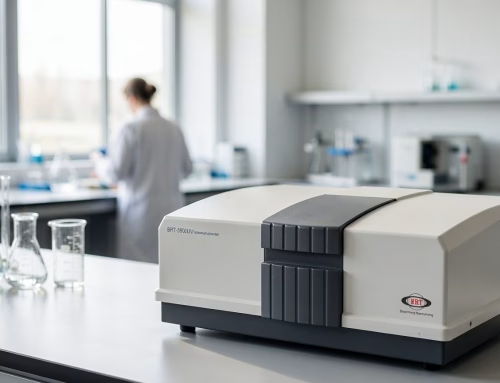
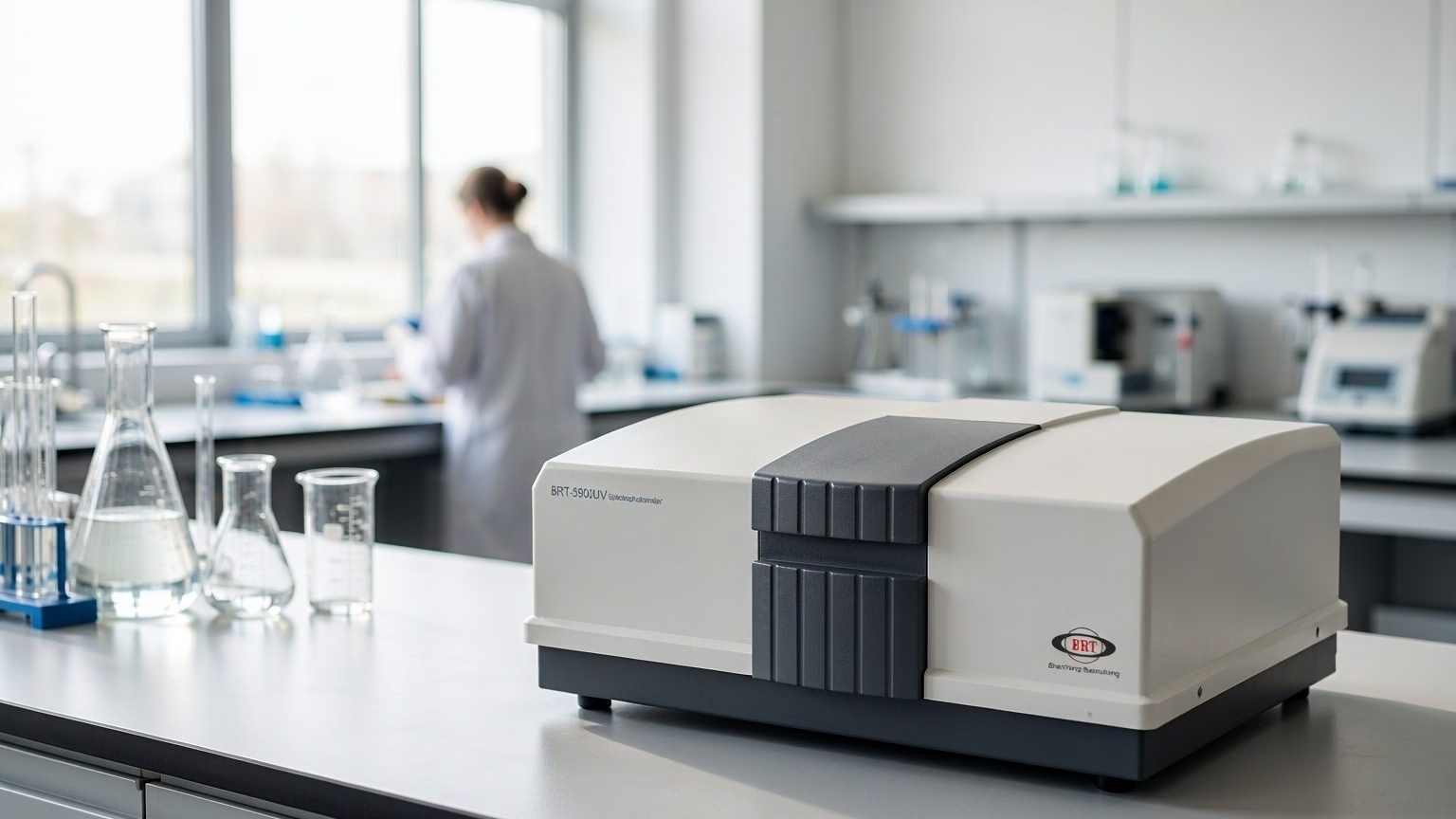
BRT Testing builds UV/Vis spectrophotometers across four tiers plus visible-only instruments for laboratories whose work is confined to the visible region. Every model below covers water-laboratory photometry; the differences are bandwidth, beam configuration and automation.
| Tier | Representative models | Bandwidth | Range | Beam | Best suited to |
| Tier 1 — Entry UV/Vis | BRT-1100UV, BRT-1200UV | 4 nm | 200–1000 nm | Single | Small labs beginning regulated COD and nitrate work |
| Tier 2 — Refined single beam | BRT-1800UV, BRT-5200UV, BRT-5000UV | 2–4 nm | 190–1100 nm | Single | Routine multi-parameter water testing with UV screening |
| Tier 3 — Double beam workhorses | BRT-5400UV, BRT-5600UV, BRT-5800UV, BRT-6100UV | 1.8 nm | 190–1100 nm | Double | High-throughput compliance labs and high-absorbance samples |
| Tier 4 — Research grade | BRT-3200UV, BRT-5900UV | 1.0–1.8 nm | 190–1100 nm | Double | Method development, scan-based colour work, trace analysis |
| Visible-only | BRT-1150V, BRT-5200V, BRT-1800V, BRT-1200V | 2–4 nm | 320–1100 nm | Single | Reagent-based colorimetry only, where no UV parameter is required |
Selection logic by tier. Tier 1 exists for laboratories moving from visual comparison or a filter photometer into regulated photometry; the 4 nm bandwidth fits broad-band reagent chemistry. Tier 2 is the pivot point — the 190–1100 nm range and 2 nm bandwidth open 254 nm screening and 350 nm ultra-low COD without the cost of double-beam optics. Tier 3 is where drift control and automated 8-cell handling change daily workflow. Tier 4 exists for laboratories developing or validating their own methods. The visible-only instruments are not a downgrade — they are the correct purchase for a laboratory whose methods never leave the visible region.
The category page for the full range is UV/Vis Spectrophotometer. To compare the optical geometries in more depth before choosing a tier, the UV/Vis Spectrophotometer Buying Guide works through the same specifications from a beam-geometry angle.
Accessories and the Costs Buyers Forget
The instrument is rarely the whole invoice. Four recurring costs deserve a line in the budget.
Cuvettes and Reference Materials
Water methods routinely need both quartz and glass. UV measurements at 220, 254 and 350 nm require quartz, because ordinary glass absorbs strongly in that region [4]. Visible-region colorimetry can use glass or plastic. Photometric accuracy claims are only meaningful when checked against traceable standards — potassium dichromate or potassium permanganate solutions in perchloric acid, or certified absorbance standards traceable to a national metrology institute 12. These are consumables, consumed in the calibration process itself.
Lamps, Reagents and Digestion Equipment
Deuterium lamps are the shortest-lived component in a UV/Vis instrument and the most expensive single part, so budget replacement on a schedule rather than after a signal-to-noise failure appears mid-batch. COD analysis cannot be separated from a heating block or thermoreactor, sealed reagent vials, and a documented temperature profile [1]. Mercury-bearing vials also generate hazardous waste that must be disposed of under local regulation [2].
Six Purchasing Mistakes in Water Laboratories
| Mistake | Why it costs you |
| Buying a visible-only instrument, then adding a UV method | The 190–254 nm range cannot be retrofitted; this is a full replacement, not an upgrade |
| Specifying on bandwidth alone | A 1 nm instrument with poor stray light performs worse on high-absorbance COD than a well-built 2 nm instrument |
| Ignoring stray light figures entirely | Sets the absorbance ceiling; skip it and high-range samples force dilutions that add error |
| Omitting cuvette material from the purchase | Quartz cuvettes for UV work are frequently a separate line item discovered after installation |
| Assuming a spectrophotometer replaces titration | High-chloride samples and atypical colour or turbidity still require the titrimetric route |
| Skipping acceptance testing | A certificate is not evidence the instrument met specification on the day it arrived |
Acceptance and OQ/PQ Checks for a Water Laboratory
Before accepting delivery, require evidence against five parameters. Each has a defensible reference and a pass criterion.
The Five Parameters to Verify
| Parameter | Reference material or method | Criterion |
| Wavelength accuracy | Holmium oxide or didymium filter; or deuterium lamp emission lines | Within the manufacturer’s stated tolerance at 2–3 points across the working range |
| Photometric accuracy | Certified neutral-density or potassium dichromate standards [12] | Within stated tolerance at low, mid and high absorbance |
| Stray light | Sodium iodide or potassium chloride solution per method convention | Meets the specified limit at 220 nm and/or 340 nm |
| Baseline stability | Blank reading over a defined interval after full warm-up | Drift within the manufacturer’s specification over the stated period |
| Photometric repeatability | Repeated readings of a stable standard | Standard deviation within the stated repeatability figure |
Questions to Put to the Supplier in Writing
Ask these before the purchase order is placed. A supplier who cannot answer them is selling a box rather than an instrument.
| Question | What a competent answer looks like |
| What is the measured stray light value at 220 nm? | A specific figure, not “very low” |
| What is the photometric accuracy, against which reference standard? | A tolerance plus the standard and wavelength used |
| What is the wavelength accuracy tolerance and how is it verified? | A tolerance plus the verification method |
| What is the expected deuterium lamp life in hours? | A stated range, not a vague assurance |
If your laboratory reports against a regulated method or an accredited quality system, the acceptance record should also identify the reference materials used, their certificates, and the date of verification, so the evidence survives an audit. The stray light and wavelength tests behind these criteria are worked through step by step in UV/Vis Wavelength Accuracy & Stray Light Verification.
Frequently Asked Questions
Can a UV/Vis spectrophotometer measure COD directly without digestion?
No. COD is defined by a chemical oxidation, and the spectrophotometer only reads the colour that oxidation produces. Every recognised method — EPA 410.4, ISO 15705, Standard Methods 5220D — requires the sample to be heated with dichromate and sulfuric acid first, typically at 148 °C for two hours in sealed vials [7]. Without that step, the instrument has nothing meaningful to measure.
What wavelength is used for spectrophotometer COD measurement?
It depends on the range. Low-range methods up to about 150 mg/L measure residual dichromate at 420 nm. Mid-range methods up to roughly 1500 mg/L measure the chromic ion produced at 620 nm. Ultra-low-range methods down to 0.7 mg/L use 350 nm, which requires genuine UV optics [1]. Your reagent kit documentation defines which wavelength your method expects.
Can UV absorbance at 254 nm replace COD testing?
Not for compliance. SAC254 measures dissolved organic matter absorbable in the UV region, and its correlation with COD varies with the composition of each water body [4]. It is an excellent fast screening indicator for stable sources such as a specific industrial effluent or a surface water monitoring station, but it is not a regulated COD determination and must be re-correlated whenever the source changes.
Do I really need a double-beam instrument for water quality testing?
Only if drift or throughput makes single-beam work impractical. A conscientious single-beam operator re-blanks between batches and produces fully compliant results. Double beam earns its cost in laboratories running continuous high-volume digestion batches, or reading high-absorbance samples where drift is a large fraction of the signal. Match the beam configuration to the workload, not to the price bracket.
What bandwidth does a water analysis spectrophotometer need?
A 4 nm bandwidth suits reagent-based colorimetric methods that read broad absorption bands, which covers most COD, phosphate and ammonia chemistries. A 2 nm bandwidth adds value when you measure nitrate directly by UV absorbance or resolve overlapping spectra. Bandwidths of 1.0–1.8 nm are for research and method development rather than routine water analysis.
Can I use glass cuvettes for all water tests?
No. UV measurements at 220, 254 and 350 nm require quartz cuvettes, because ordinary glass absorbs strongly in that region and would mask the sample signal. Visible-region colorimetry — COD at 420 or 620 nm, phosphate, ammonia — can use glass or plastic. A water laboratory performing both UV screening and visible colorimetry needs both types on hand.
How often should a water laboratory verify the spectrophotometer?
Verification frequency follows the quality system, but the common baseline is wavelength and photometric accuracy checks at commissioning, after any lamp change or major service, and then on a scheduled interval — quarterly or semi-annual for routine laboratories. Laboratories reporting against regulated methods should additionally run a certified standard with each batch and keep the records for audit.
Is a visible-only spectrophotometer enough for a wastewater laboratory?
It depends entirely on your method list. If every method you report reads in the visible region — mid-range COD at 620 nm, phosphate, ammonia, phenolics — a visible-only instrument is the correct and cheaper purchase. The moment you add an SAC254 screening or an ultra-low-range COD read at 350 nm, you need a UV-capable instrument, and that cannot be retrofitted.
Conclusion: Specifying From the Method List Outward
Work through these steps in order, and the instrument choice falls out almost automatically.
- List every parameter you must report, and mark which ones are regulated versus screening.
- Identify the shortest wavelength on that list. If anything sits at or below 254 nm, your instrument must reach below 200 nm — that single fact eliminates visible-only models.
- Set the bandwidth from the chemistry. Broad-band reagent colorimetry accepts 4 nm; direct UV absorbance and scan work want 2 nm or better.
- Set the beam configuration from the workload. Batch-by-batch work suits single beam; continuous high-volume work justifies double beam.
- Budget for cuvettes, reference standards and lamps, not just the instrument.
- Write the acceptance criteria into the purchase order before you sign it.
If you would like help mapping your method list onto a specific configuration, get in touch with the parameters you report and the ranges you work in. Our applications team will recommend the right water analysis spectrophotometer for your methods and confirm which optics they actually require.
This article was prepared by the applications team at Shenyang Baoruitong Automation Equipment Co., Ltd., a manufacturer and exporter of UV/Vis and FTIR spectrophotometers and fire-testing equipment. Our UV/Vis range spans single-beam entry instruments through 1.0 nm research-grade double-beam systems, so we have no stake in recommending one configuration over another — the acceptance criteria above are the same ones we expect our own instruments to pass. Company information is available on our about page.